


Introduction: Why LAI ANDAs Demand More Than a CRO or CDMO Alone
The generic pathway for Long-Acting Injectables (LAIs), including depot microsphere formulations, in situ forming implants, and suspension-based intramuscular products, differs significantly from conventional solid oral dosage ANDA filings. A CRO CDMO ANDA Partnership is not simply a convenience in this context; it often determines whether a sponsor achieves first-to-file status or becomes stuck in repeated cycles of complete response letters (CRLs). The scientific, manufacturing, and regulatory components of LAI programs are tightly connected, and fragmented development frequently creates avoidable inconsistencies. Sponsors pursuing LAI generics should therefore consider integration early to avoid costly redevelopment and regulatory delays. In practice, coordinated decision-making across formulation, analytics, and clinical design is essential to maintain alignment throughout development.
Streamline your path to market: Learn how an integrated CDMO can accelerate generic drug development in the US and Canada.
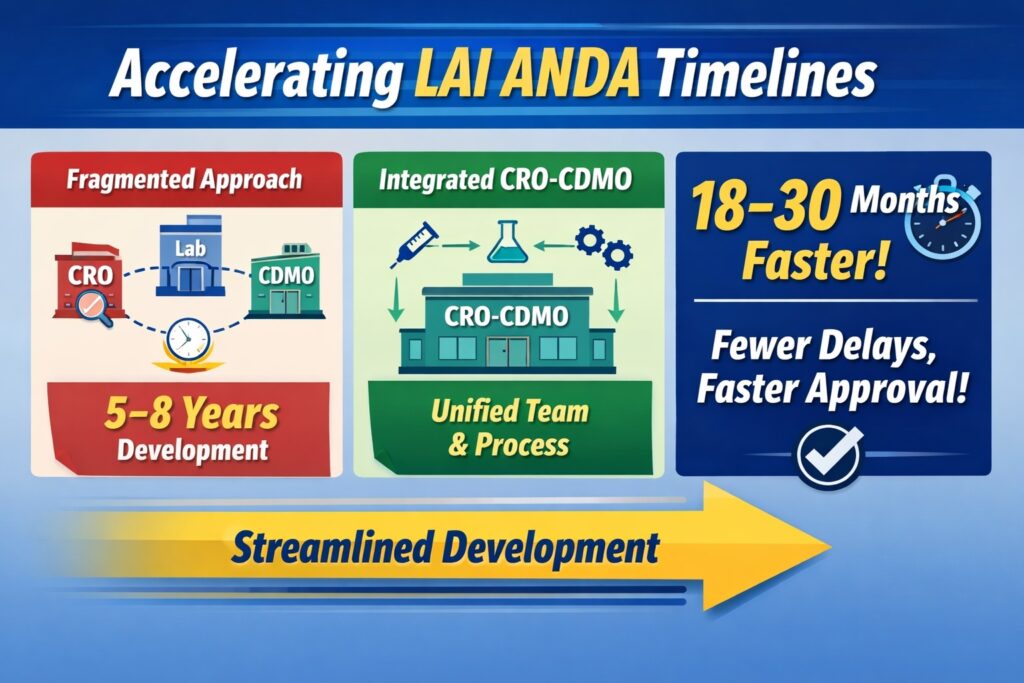
Standard ANDA timelines for LAIs often extend to 5–8 years when development is divided among a clinical CRO, an analytical laboratory, and a sterile CDMO without structured integration. Integrated CRO-CDMO operating models have demonstrated timeline reductions of 18–30 months in comparable programs, not by bypassing requirements, but by removing re-work and communication delays at each transition point. These efficiencies come from concurrent development planning, shared datasets, and aligned quality systems. The cumulative impact is shorter development cycles, fewer regulatory queries, and improved submission readiness. This article explores where those efficiencies occur and outlines what FDA expects within a complete LAI ANDA submission package.
Evaluate your outsourcing strategy: Compare the benefits of CRO vs. In-House ANDA development.
Share via:
▶ Quick Summary
- LAI ANDAs are among the most complex generic drug filings — requiring integrated BE strategy, specialized CMC documentation, and sterile manufacturing capability simultaneously.
- A CRO CDMO ANDA Partnership eliminates the data handoff delays that occur when sponsors coordinate separate BE, formulation, and manufacturing vendors.
- Integrated teams compress timelines by running formulation development, pivotal BE studies, and CMC scale-up in parallel, not sequentially.
- FDA’s product-specific guidances (PSGs) for LAIs demand NCA-based pharmacokinetic evidence, Q1/Q2 sameness justification, and sterility bridging — all requiring tight cross-functional coordination.
- The most common ANDA deficiency letters for LAIs stem from incomplete in vitro–in vivo correlation (IVIVC) data, inadequate particle size characterization, and CMC inconsistencies — gaps a unified CRO-CDMO team is specifically positioned to prevent.
- ResolveMass Laboratories Inc. operates as an end-to-end CRO-CDMO partner with deep LAI expertise — covering preclinical through ANDA submission and post-approval support.
The Specific Regulatory Burden That Makes LAI ANDAs Different
LAI ANDAs present greater complexity than standard ANDAs because FDA’s Office of Generic Drugs (OGD) requires demonstration of bioequivalence across an extended release profile, sometimes lasting days or weeks, rather than a single pharmacokinetic window. This requirement introduces layered data expectations that must align across formulation, analytical testing, and clinical evaluation. Each dataset must support the others, making isolated development approaches difficult to reconcile later. The extended-release nature of LAIs also increases variability, which requires more robust statistical planning and carefully validated analytical methods. As a result, regulatory success depends heavily on coordination across disciplines.
These layered requirements cannot be fulfilled effectively by a single organizational function. Bioanalytical methods must align with release kinetics, while manufacturing parameters must support consistent pharmacokinetics. Any deviation in one area may affect overall bioequivalence outcomes. Therefore, development strategies for LAIs must consider regulatory expectations holistically rather than sequentially. Integrated execution helps ensure that changes in formulation, process, or analytics are reflected consistently throughout the program.
Master the submission process: Review the essential requirements for ANDA submission for generic drugs.
What FDA’s Product-Specific Guidances Actually Require for LAIs
FDA Product-Specific Guidances (PSGs) for depot LAIs, such as those for leuprolide acetate, naltrexone extended-release, or risperidone microspheres, specify several interconnected requirements. These expectations extend beyond standard bioequivalence and require a combination of in vivo, in vitro, and CMC data. Sponsors must demonstrate that the test product behaves similarly to the reference listed drug (RLD) across the entire release interval. The depth of characterization required often necessitates multiple development iterations. Careful planning ensures that each dataset supports the overall equivalence argument.
In vivo bioequivalence is typically based on non-compartmental analysis (NCA) of AUC and Cmax across the full release interval, often including multiple sampling points beyond Day 28. Q1 (qualitative) and Q2 (quantitative) sameness relative to the RLD is generally expected, or a scientifically justified rationale must demonstrate that deviations do not impact release kinetics or tissue tolerability. In vitro drug release testing (IVRT) must use a validated, discriminating method that reflects in vivo performance and anchors the CMC section. These requirements collectively support a comprehensive bioequivalence argument. Failure to align these datasets often leads to regulatory deficiencies.
Deep dive into Leuprolide development: Explore our comprehensive guide on how to develop generic Leuprolide Depot.
Particle size distribution (PSD) characterization must demonstrate comparability between the test product and RLD, including DV10, DV50, DV90, and span under identical analytical conditions. Sterility assurance must align with a qualified sterile manufacturing process, typically involving aseptic fill-finish operations and validated environmental monitoring. These elements collectively establish product quality, safety, and performance. Consistency across analytical and manufacturing controls is critical for regulatory acceptance. Integrated development simplifies alignment across these parameters.
A key insight is that each requirement directly influences the others. A change in particle size distribution can alter the IVRT profile, while modification of the polymer-to-drug ratio may disrupt Q2 sameness. Similarly, an insufficiently validated IVRT method weakens the BE bridging argument. When different vendors control separate datasets, reconciliation challenges become likely. Integrated CRO-CDMO execution reduces these risks by aligning development decisions from the outset.
Technical Insight: Understand the specific challenges of Lupron Depot particle characterization.
Where CRO-CDMO Integration Eliminates ANDA Deficiency Risk
The primary benefit of a CRO CDMO ANDA Partnership is the removal of the translation gap, where data produced by a CRO must later be interpreted by a CDMO during scale-up. This transition frequently introduces inconsistencies that trigger FDA Information Requests (IRs) or CRLs. Integration ensures that development assumptions remain consistent across formulation, analytics, and manufacturing. This continuity strengthens the scientific rationale presented in the ANDA. It also reduces the need for retrospective justification during review.
When teams operate within a unified framework, knowledge transfer becomes continuous rather than episodic. Development batches, analytical methods, and process parameters are defined collaboratively. This reduces ambiguity and prevents misalignment between clinical and commercial manufacturing strategies. Regulatory documentation also becomes more cohesive, supporting a clearer narrative for reviewers. Ultimately, integration lowers the probability of deficiency cycles.
Optimize your partnership: Discover the advantages of hiring a specialized generic drug development CRO for ANDA.
1. Formulation Development to BE Study Design: No Handoff Required
When formulation scientists and clinical pharmacology teams operate within a single organization, the pivotal BE study is designed around the actual manufactured batch rather than a theoretical formulation. This alignment improves the reliability of clinical outcomes. It also reduces uncertainty related to process variability. As a result, bioequivalence studies better reflect commercial manufacturing conditions. This consistency strengthens the ANDA submission.
The analytical method used for PSD characterization during development is typically the same method used for CMC specification data and comparative in vitro datasets submitted in the ANDA. The pilot-scale batch used in the BE study is manufactured under parameters that will be scaled for commercial production. Consequently, pharmacokinetic variability reflects biological variability rather than process drift. Dissolution or IVRT method development is conducted alongside formulation optimization instead of retrospectively. This concurrent approach ensures that analytical tools are fit-for-purpose during pivotal studies.
2. Parallel Rather Than Sequential CMC and Clinical Tracks in a CRO CDMO ANDA Partnership
Sequential development, where formulation is finalized before analytical methods are developed and BE studies are conducted, can add 18–24 months to an LAI program. An integrated CRO CDMO ANDA Partnership compresses timelines by executing analytical validation, process development, and clinical preparation simultaneously. Parallel execution reduces idle time between development phases. It also enables rapid response to emerging data. This model supports faster progression toward submission.
Running CMC and clinical activities in parallel also improves cross-functional decision-making. Analytical data can inform process adjustments in real time. Clinical study design can be refined based on manufacturing outcomes. This dynamic approach reduces the risk of repeating studies. The result is a more efficient and predictable development timeline.
| Development Activity | Fragmented Model (Sequential) | Integrated CRO-CDMO (Parallel) |
|---|---|---|
| Formulation finalization | Month 1–18 | Month 1–12 |
| Analytical method development & validation | Month 19–28 | Month 8–18 (concurrent) |
| Pivotal BE study execution | Month 29–42 | Month 19–30 |
| CMC scale-up & process validation | Month 43–56 | Month 22–36 (overlapping) |
| ANDA compilation & submission | Month 57–66 | Month 37–48 |
| Total estimated timeline | ~66 months | ~48 months |
Note: Timelines are illustrative estimates based on depot microsphere LAI programs. Actual timelines vary by product complexity and regulatory interactions. Parallel execution benefits depend on early planning and organizational coordination. Integrated teams are better positioned to implement this approach effectively.
CMC Documentation: The Silent Risk in LAI ANDA Filings
The CMC section of an LAI ANDA is often the source of most deficiency letters rather than the clinical BE data. Documentation gaps, inconsistent process descriptions, and insufficient justification frequently trigger regulatory queries. A strong CRO CDMO ANDA Partnership addresses CMC integrity throughout development. This includes aligned documentation practices and standardized data capture. Consistent quality systems further strengthen submission readiness.
Strong CMC documentation also demonstrates process understanding. Reviewers expect traceability from development batches to commercial production. Integrated development ensures continuity across documentation stages. This reduces the need for post-hoc explanations. As a result, submissions are more defensible.
Secure your strategy: Learn more about our specialized Leuprolide Depot CMC strategy.
Process Validation and Scale-Up Coherence
LAI manufacturing processes such as microencapsulation, cryoprotected lyophilization, or suspension homogenization involve critical process parameters (CPPs) that are highly sensitive to scale. When a CDMO inherits a process from an external CRO, re-validation at each scale becomes necessary. This increases cost, extends timelines, and invites regulatory scrutiny. Differences between clinical and commercial batches must then be justified. These justifications often complicate review.
Within an integrated CRO-CDMO, bench-scale development is documented using the same quality system governing GMP manufacturing. Reviewers can trace a direct line from development batch to registration batch. This continuity supports process understanding under the Process Analytical Technology (PAT) and Quality by Design (QbD) framework. It also reduces uncertainty during scale-up. Ultimately, consistent documentation improves regulatory confidence.
Specification Setting for Particle Size and Drug Release
FDA expects specification ranges to be justified statistically, using RLD characterization data and applicant manufacturing data. This requires multiple development batches to establish particle size distribution. Correlation between in vitro release and in vivo PK must also be demonstrated, even qualitatively. Process capability data must confirm that specifications are achievable under GMP conditions. These requirements demand coordinated data generation.
Each dataset originates from different functional teams. Integrated teams enable concurrent, iterative specification setting. This approach improves reliability compared to retrospective justification. Alignment between development and manufacturing simplifies regulatory defense. The resulting specifications are more scientifically robust.
Bioequivalence Strategy for LAIs: Where Clinical and Analytical Expertise Must Converge
BE studies for LAIs are among the most analytically demanding in the generic industry. They require ultra-sensitive bioanalytical methods, extended sampling schedules, and careful statistical planning. The prolonged PK profile increases variability and analytical complexity. Close coordination between formulation and bioanalysis is essential. Integrated teams are better equipped to manage these challenges.
These studies must also account for delayed release phases. Sampling schedules often extend for weeks or months. Analytical sensitivity must remain consistent throughout the study. Data integrity is critical for demonstrating bioequivalence. Integration helps ensure method suitability.
Navigate the complexity: Understand the regulatory pathway for complex peptide injectables.
Bioanalytical Method Validation Under 21 CFR Part 320 and FDA 2018 BMV Guidance
LAI BE studies often involve plasma concentrations near quantification limits, especially during late-release phases where levels may fall below 1 ng/mL. LC-MS/MS methods must demonstrate selectivity across the plasma matrix, including metabolite interference. Incurred sample reanalysis (ISR) must show at least 67% of re-assayed samples within 20% of original results. Stability must be demonstrated across long-term storage. These requirements ensure reliable PK assessment.
A CRO CDMO ANDA Partnership informed by formulation release kinetics produces fit-for-purpose bioanalytical methods. Early alignment reduces repeat validations. It also minimizes delays during study execution. Analytical robustness strengthens the BE dataset. This improves submission quality.
Statistical Power and Sampling Schedule Design
Inter-subject variability in LAI pharmacokinetics is higher than in immediate-release oral products. BE studies for LAIs commonly enroll 36–72 subjects per arm to achieve 90% power at the 80–125% boundary. This is particularly important for Cmax, which reflects the initial burst release phase. Accurate variability estimates are essential for study success. Underpowered studies risk failure.
Inadequate sample size is a frequent error when BE planning is outsourced without formulation-specific knowledge. Failed BE studies often require re-manufacturing and re-testing. Integrated teams can assess variability using pilot PK studies. This improves study design accuracy. Consequently, the likelihood of success increases.
Technology Transfer and Site Authorization: The Final CRO-CDMO Advantage
Many LAI ANDA programs encounter challenges during manufacturing site authorization. This occurs when the nominated site does not align with clinical manufacturing records. The issue is common when pilot batches are produced at a CRO facility and commercial production is outsourced. Documentation discrepancies then require reconciliation. This may delay approval.
An integrated CRO-CDMO eliminates this risk. The same manufacturing site produces pivotal BE batches and commercial batches. Equipment, parameters, and environmental conditions remain consistent. The Site Master File directly supports clinical records. This simplifies regulatory review.
ResolveMass Advantage
ResolveMass Laboratories Inc. operates as a unified CRO-CDMO continuum, supporting development from early preclinical formulation through GMP manufacturing, pivotal BE execution, ANDA compilation, and post-approval change management. The organization provides expertise across microsphere, suspension, and implant LAI formats. In-house sterile fill-finish capability supports parenteral manufacturing. Integrated teams maintain continuity across development stages. This structure reduces risk and accelerates timelines.
The ResolveMass approach emphasizes aligned analytics, manufacturing, and regulatory strategy. Early-stage development is designed with ANDA requirements in mind. Documentation is structured for direct inclusion in submission modules. This reduces reformatting and interpretation challenges. The result is improved submission readiness.
Avoiding the Top 5 ANDA Deficiency Triggers Specific to LAIs
The most common deficiency categories in FDA Complete Response Letters for LAI ANDAs relate to IVRT methodology, PSD specifications, BE study design, CMC consistency, and sterility assurance. Fragmented development models often generate gaps in these areas. Integrated CRO-CDMO partnerships address them proactively. Alignment across datasets reduces regulatory risk. Early planning improves defensibility.
| Deficiency Type | Root Cause in Fragmented Models | How Integration Prevents It |
|---|---|---|
| 1 | Incomplete IVIVC / IVRT methodology | Dissolution method developed post-BE without formulation context |
| 2 | PSD specification unjustified | CDMO sets specs based on manufacturing capability, not clinical data |
| 3 | BE study failed / underpowered | Sample size estimated without formulation variability data |
| 4 | CMC inconsistency between clinical and commercial batches | Clinical batches at CRO pilot plant; commercial at separate CDMO |
| 5 | Sterility assurance gaps | Non-GMP CRO conditions for pilot batches not transferable |
Selecting the Right CRO CDMO ANDA Partnership for Your LAI Program
Not all integrated CRO-CDMO organizations have equivalent LAI expertise. Sponsors should evaluate partners based on demonstrated LAI ANDA submission history, not only aqueous injectable experience. In-house sterile manufacturing with validated environmental monitoring is essential. Integrated bioanalytical capabilities must support sub-ng/mL quantification. Regulatory expertise in OGD communications is also critical.
QbD-aligned CMC documentation should be generated during development. This ensures direct translation into ANDA Module 3. Organizations with aligned quality systems reduce rework. Sponsors should also assess scalability and manufacturing readiness. These criteria help identify suitable partners.
Conclusion: The Strategic Case for Integrated Development in LAI ANDAs
For Long-Acting Injectable ANDAs, the critical decision is not whether to engage a CRO and a CDMO, but whether those functions operate as an integrated structure. LAI development requires tightly interconnected datasets and coordinated regulatory strategy. Fragmented approaches introduce inconsistencies and delays. Integration improves data continuity and submission quality. This leads to more efficient development.
A purpose-built CRO CDMO ANDA Partnership that manages formulation, GMP manufacturing, pivotal BE, and CMC documentation produces stronger ANDA packages. Such programs typically experience fewer deficiency cycles and shorter time-to-market. Sponsors targeting first-to-file exclusivity benefit from reduced development risk. Integrated execution also supports portfolio expansion. For complex generics, this approach becomes strategically important.
Partner with experts: Explore ResolveMass’s Leuprolide Depot generic drug development services.
ResolveMass Laboratories Inc. provides integrated CRO-CDMO capability with technical depth in LAI formulation science, sterile manufacturing, and ANDA regulatory strategy. The team supports development across suspension-based depots, polymeric microsphere systems, and implant technologies. End-to-end coordination enhances submission readiness. This integrated model supports accelerated LAI ANDA development.
Frequently Asked Questions: CRO CDMO ANDA Partnership for LAIs
Using separate vendors for clinical and manufacturing work can create gaps between the bioequivalence data and the CMC section. FDA expects the batches used in BE studies to represent the final commercial manufacturing process. If pilot batches are made under different conditions and later scaled elsewhere, even small differences may raise questions. A CRO CDMO ANDA Partnership helps maintain consistency from development through submission.
For LAIs, FDA expects sponsors to clearly show how critical quality attributes such as particle size, encapsulation efficiency, and residual solvents are controlled. This requires linking each attribute to defined critical process parameters supported by development data. The ANDA should include documentation showing how process changes affect product performance. This level of clarity is easier when formulation and manufacturing are managed within an integrated program.
In LAIs, particle size directly influences drug release and pharmacokinetics, making it a primary quality attribute. FDA expects PSD limits to be supported by reference product characterization, development batch data, and clinical performance where possible. Specifications must ensure consistent in vivo behavior while remaining achievable in routine GMP production. Integrated development allows alignment between clinical data and manufacturing capability.
Depot microsphere LAI BE studies usually follow a single-dose, parallel-group design because crossover studies require long washout periods. Blood sampling is performed across the full release period, which may extend several weeks or months depending on the product. Bioequivalence is evaluated using AUC and Cmax derived from non-compartmental analysis. Larger sample sizes are typically required due to higher variability.
Under GDUFA II, FDA targets a 10-month review for standard ANDAs and about 12 months for complex submissions such as LAIs. These timelines apply only to the first review cycle after filing. If deficiencies are identified, additional review cycles can extend timelines significantly. Avoiding these cycles through strong initial submissions is critical for faster approvals.
IVIVC is not required for every LAI, but FDA often expects a discriminating in vitro release method that reflects in vivo performance. A strong correlation helps justify specifications and supports post-approval flexibility. When IVIVC cannot be established, sponsors must provide scientific justification for the release method. This requires coordination between formulation, analytics, and clinical teams throughout development.
Sterile LAI manufacturing involves aseptic processing, environmental monitoring, media fills, and container closure integrity testing. These elements must be validated and documented in the ANDA. Specialized equipment such as lyophilization systems or suspension filling lines may also be required. Choosing a partner with proven sterile injectable experience helps reduce regulatory risk and delays.
Reference:
- Kurata, H., Ishino, T., Ohshima, Y., & Yohda, M. (2022). CDMOs play a critical role in the biopharmaceutical ecosystem. Frontiers in Bioengineering and Biotechnology, 10, 841420. https://doi.org/10.3389/fbioe.2022.841420
- Joseph A. DiMasi, Abigail Dirks, Kenneth A. Getz. The Net Financial Benefits of Single Vendor Integrated CDMO and CRO Drug Development Services.https://www.researchsquare.com/article/rs-6531199/v1
- Yashaswini Singh Megha Reddy Neil Mehta Hayden Rooke-Ley Olivier J. Wouters Erin C. Fuse Brown. Unpacking Private Equity Investments In Drug Industry Third-Party Entities.https://www.healthaffairs.org/content/forefront/unpacking-private-equity-investments-drug-industry-third-party-entities
- Generics and CDMO API segment drags earnings.https://images.assettype.com/bloombergquint/2022-08/b026f158-1c24-4239-826a-56b92ca87e6a/Motilal_Oswal_Jubilant_Pharmova_Q1FY23_Result_Update.pdf
Get In Touch With Us
About The Author


