


Introduction:
Choosing the right CRO for Injectable Drug Development is one of the most important strategic decisions pharmaceutical and biotechnology companies make during product development. Injectable drug products are significantly more complex than oral dosage forms because they demand exceptional analytical precision, stringent sterility requirements, comprehensive regulatory compliance, and extensive characterization throughout development.
Whether developing generic injectables, biosimilars, long-acting injectables (LAIs), peptide therapeutics, biologics, liposomal formulations, or nanoparticle-based drug products, selecting a scientifically capable CRO can significantly reduce development risks while accelerating regulatory approval. A single misstep in impurity control, stability design, or container-closure evaluation can add months — or years — to a submission timeline, which is why sponsors increasingly treat CRO selection as a scientific partnership decision rather than a procurement exercise.
This guide explains the essential criteria organizations should evaluate when selecting a CRO and why analytical expertise plays a critical role in successful injectable drug development.
Summary:
- Selecting the right CRO for Injectable Drug Development directly impacts regulatory success, development timelines, product quality, and commercialization.
- Injectable drug products require specialized analytical capabilities, regulatory expertise, and extensive experience with sterile formulations, biologics, peptides, and complex injectables.
- An ideal CRO should provide end-to-end analytical support from early formulation through NDA, ANDA, BLA, or IND submissions.
- Regulatory compliance, advanced instrumentation, data integrity, and scientific expertise should all be evaluated before selecting a CRO.
- A long-term partnership with an experienced CRO reduces project risk, accelerates development, and improves submission readiness.
- ResolveMass Laboratories supports pharmaceutical and biotechnology companies with comprehensive analytical solutions tailored for injectable drug development, including deep, product-specific experience such as its ongoing dexamethasone injectable CRO work.
1: Why Injectable Drug Development Requires Specialized CRO Expertise
Injectable products present unique scientific and regulatory challenges that require highly specialized analytical support, because they bypass the body’s natural barriers and demand a much higher standard of purity, sterility, and characterization than oral dosage forms.
Unlike conventional dosage forms, injectable products require detailed characterization of:
- Sterility assurance
- Particulate matter
- Extractables and leachables
- Container closure compatibility
- Stability
- Impurity profiling
- Elemental impurities
- Nitrosamines
- Degradation pathways
- Protein aggregation (for biologics)
- Peptide characterization
- Device compatibility
- Formulation stability
Each of these analytical areas directly influences product quality, patient safety, and regulatory acceptance. An experienced CRO understands how these analytical requirements evolve throughout product development — from early feasibility work through commercial lot release — and builds testing strategies that anticipate agency questions rather than simply reacting to them.
A well-documented example of this complexity in practice is corticosteroid injectable development. Programs built around dexamethasone injection generic development routinely surface the same categories of challenge seen across the broader injectable landscape: impurity control, formulation equivalence, and stability under real-world storage conditions.
2: What Should You Look for in a CRO for Injectable Drug Development?
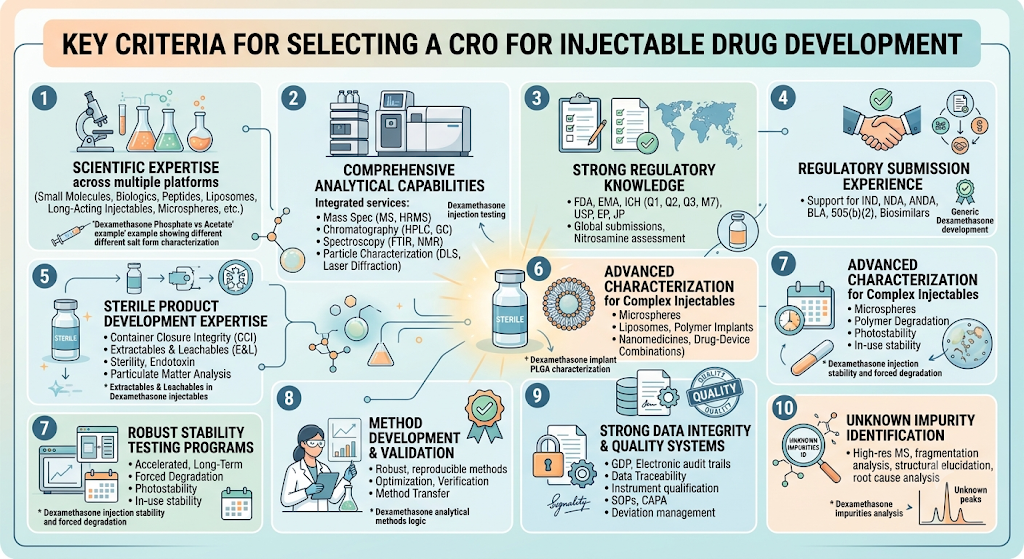
The best CRO for Injectable Drug Development combines scientific expertise, regulatory knowledge, advanced instrumentation, and a collaborative project management approach. The following factors should be carefully evaluated before selecting a CRO.
1. Scientific Expertise Across Multiple Injectable Platforms
A CRO should possess hands-on experience with diverse injectable dosage forms rather than a narrow specialty in one product class.
| Injectable Product Type | Typical Analytical Requirements |
|---|---|
| Small Molecule Injectables | Impurity profiling, assay, stability |
| Biologics | Protein characterization, glycosylation, aggregation |
| Biosimilars | Comparative analytical characterization |
| Peptides | Sequence confirmation, impurity analysis |
| Liposomal Formulations | Encapsulation efficiency, particle sizing |
| Nanoparticles | Surface characterization, particle distribution |
| Long-Acting Injectables | Polymer characterization, release kinetics |
| Microspheres | PLGA characterization, degradation studies |
| Prefilled Syringes | Extractables & leachables, compatibility |
| Auto-injectors | Device compatibility, container closure studies |
Experience across multiple product categories enables a CRO to anticipate development challenges before they become regulatory issues. For example, corticosteroid injectables like dexamethasone are formulated in more than one salt form, and understanding the analytical distinctions is essential — a point illustrated well by comparative work on dexamethasone phosphate vs acetate formulations, where solubility, release rate, and impurity profiles differ meaningfully between the two forms.
2. Comprehensive Analytical Capabilities
The ideal CRO should offer integrated analytical services under one roof rather than subcontracting critical testing to third parties.
Key analytical capabilities include:
Mass Spectrometry
- LC-MS/MS
- LC-HRMS
- GC-MS/MS
- GC-HRMS
- Orbitrap HRMS
- QTOF-MS
Chromatography
- HPLC
- UHPLC
- GC
- SEC
- GPC
Spectroscopy
- FTIR
- UV
- Fluorescence
- Circular Dichroism
- Raman
Structural Characterization
- NMR
- DSC
- TGA
- XRD
Particle Characterization
- Dynamic Light Scattering (DLS)
- Laser Diffraction
- SEM
- TEM
- Micro-CT
Having these capabilities available within one CRO improves project efficiency while reducing outsourcing complexity. This breadth is exactly what supports rigorous, submission-ready testing such as the dexamethasone injection analytical methods used to confirm identity, strength, and purity across a corticosteroid injectable’s shelf life.
3. Strong Regulatory Knowledge
A qualified CRO should understand global regulatory expectations from the earliest development stages, not just at the point of submission.
This includes experience with:
- FDA Guidance
- EMA Guidelines
- ICH Q1
- ICH Q2(R2)
- ICH Q3
- ICH M7
- USP Chapters
- EP Requirements
- JP Requirements
Regulatory knowledge helps ensure analytical methods and reports are submission-ready, minimizing the likelihood of agency questions or deficiencies. Nowhere is this more visible than in nitrosamine risk assessment under ICH M7, and in impurity characterization work such as dexamethasone impurities analysis, where regulatory-aligned methods are essential to defending an impurity control strategy during review.
4. Experience Supporting IND, NDA, ANDA, and BLA Programs
Not every CRO has direct experience supporting regulatory submissions. Ask whether the CRO has successfully supported:
- IND submissions
- NDA applications
- ANDA filings
- BLA submissions
- Biosimilar development
- 505(b)(2) programs
- Global regulatory submissions
Experience with regulatory documentation is often as important as analytical testing itself. A CRO that has previously supported an ANDA filing for a generic corticosteroid injectable — the kind of work reflected in dexamethasone injection generic development — brings pattern recognition for the specific deficiencies reviewers tend to raise on injectable generics.
5. Sterile Product Development Expertise
Sterile injectable products require specialized analytical support throughout development. Critical studies include:
- Container Closure Integrity (CCI)
- Extractables and Leachables (E&L)
- Particulate Matter Analysis
- Sterility Testing
- Endotoxin Testing
- Filter Compatibility
- Packaging Compatibility
- Silicone Oil Evaluation
- Glass Delamination Assessment
These studies ensure the product maintains safety and quality throughout its shelf life. Container-closure and packaging risk is a particularly common source of late-stage findings, and dedicated studies such as extractables and leachables in dexamethasone injectables illustrate how packaging-derived compounds must be actively ruled out rather than assumed to be negligible.
6. Advanced Characterization for Complex Injectables
Modern injectable products often involve sophisticated delivery technologies. Examples include:
- PLGA microspheres
- Liposomes
- Polymer implants
- Depot injections
- Nanomedicines
- Drug-device combination products
Characterization may include polymer molecular weight, particle morphology, surface chemistry, drug loading, encapsulation efficiency, burst release, controlled release profiling, and degradation kinetics.
Advanced analytical expertise is essential for understanding formulation behavior and optimizing performance. A representative example is long-acting depot development, where a detailed dexamethasone implant PLGA characterization case study shows how polymer degradation and drug release kinetics must be tightly linked to support a defensible in vitro release specification.
7. Robust Stability Testing Programs
A reliable CRO should design scientifically sound stability programs that support regulatory expectations. These studies commonly include:
- Accelerated stability
- Long-term stability
- Forced degradation
- Photostability
- Freeze-thaw stability
- In-use stability
- Stress testing
Well-designed stability studies help establish product shelf life and identify degradation pathways early in development. Corticosteroid injectables are a useful illustration: work on dexamethasone injection stability and complementary forced degradation of dexamethasone studies together map out both real-time shelf-life behavior and the stress conditions most likely to generate regulatory-relevant degradation products.
8. Expertise in Method Development and Validation
Analytical methods should be robust, reproducible, and regulatory compliant. A CRO should provide method development, method optimization, method validation, method verification, method transfer, and cleaning validation support. Validated methods generate reliable data that can withstand regulatory scrutiny, which is precisely why sponsors should expect a CRO to be able to walk through the validation logic behind methods like those used for dexamethasone injection analytical methods, rather than presenting only a final certificate of analysis.
9. Strong Data Integrity and Quality Systems
Regulatory agencies increasingly focus on data integrity. An experienced CRO should operate under rigorous quality systems with:
- Good Documentation Practices (GDP)
- Electronic audit trails
- Data traceability
- Instrument qualification
- SOP-driven workflows
- Change control procedures
- Deviation management
- CAPA systems
- Controlled documentation
Strong quality systems build confidence in analytical results and support successful inspections.
10. Ability to Identify Unknown Impurities
Unknown impurities frequently delay injectable development programs. Advanced impurity identification requires high-resolution mass spectrometry, accurate mass measurements, fragmentation analysis, structural elucidation, and orthogonal analytical techniques.
Rapid identification helps developers understand root causes and implement effective control strategies — a capability directly demonstrated in projects like dexamethasone impurities analysis, where unknown degradation-related peaks must be identified, confirmed, and tied back to a specific formulation or process root cause.
Questions to Ask Before Selecting a CRO
Before finalizing your partnership, consider asking the following:
| Question | Why It Matters |
|---|---|
| Does the CRO have injectable-specific experience? | Demonstrates relevant expertise. |
| What regulatory submissions has the CRO supported? | Indicates familiarity with agency expectations. |
| Which analytical platforms are available in-house? | Reduces reliance on subcontracting. |
| Can the CRO perform method development and validation? | Supports seamless project progression. |
| How is data integrity maintained? | Ensures reliable, inspection-ready data. |
| Are project managers assigned to clients? | Improves communication and coordination. |
| Can analytical services scale with project needs? | Supports long-term collaboration. |
3: Case Example: What CRO Selection Looks Like in Practice
Corticosteroid injectables offer a useful lens for understanding what “the right CRO” actually does across a full development program, because they touch nearly every capability area described above.
A sponsor developing a generic or reformulated corticosteroid injectable typically needs support across formulation science — for instance, evaluating a dexamethasone sodium phosphate formulation against solubility and stability targets — alongside impurity control, stability design, and packaging risk assessment. Programs of this kind commonly encounter the same categories of friction discussed in dexamethasone development challenges, from degradation-related impurity spikes to container-closure interactions that only appear under long-term storage.
The sponsors who move through these programs fastest are the ones working with a CRO experienced enough to see these issues coming — which is the core argument for selecting a partner with demonstrated, product-specific experience rather than general capability claims alone.
4: Benefits of Partnering with an Experienced CRO
Selecting the right CRO offers measurable advantages throughout the product lifecycle, including:
- Faster analytical development
- Reduced regulatory risk
- Earlier identification of formulation challenges
- Improved submission readiness
- High-quality scientific documentation
- Greater confidence during agency reviews
- Reduced overall development costs
- Accelerated project timelines
- Access to specialized analytical expertise
- Improved cross-functional collaboration
Rather than functioning solely as a testing laboratory, an experienced CRO becomes a scientific partner that contributes directly to product success.
5: Why Analytical Expertise Matters Throughout Injectable Development
Analytical characterization supports nearly every stage of injectable drug development. From early formulation screening to commercial manufacturing, analytical data informs critical decisions regarding formulation optimization, manufacturing processes, quality control, and regulatory submissions.
A CRO with deep expertise in analytical sciences can identify issues before they affect timelines, helping sponsors maintain development momentum while meeting global quality standards.
6: Why ResolveMass Laboratories Is a Trusted CRO Partner
ResolveMass Laboratories provides comprehensive analytical solutions for pharmaceutical and biotechnology companies developing injectable drug products. Our scientific teams support projects involving complex generic injectables, biosimilars, peptides, biologics, long-acting injectables (LAIs), polymer-based drug delivery systems, liposomal formulations, nanoparticle therapeutics, and drug-device combination products.
Our capabilities include:
- Advanced LC-MS/MS and HRMS analysis
- Method development and validation
- Forced degradation and stability studies
- Extractables and leachables testing
- Nitrosamine risk assessment and testing
- Peptide and protein characterization
- Polymer characterization
- Impurity identification
- Reverse engineering studies
- Regulatory-ready analytical reporting
This breadth is reflected across our body of corticosteroid injectable work — spanning formulation comparison, stability, impurity identification, and packaging risk — which sponsors can review as a working example of what a full-service CRO for Injectable Drug Development delivers in practice, starting with our dedicated dexamethasone injectable CRO program overview.
By combining advanced instrumentation, experienced scientists, and a commitment to quality, ResolveMass Laboratories helps sponsors generate reliable analytical data that supports confident regulatory submissions and efficient product development.
Conclusion:
Selecting the right CRO for Injectable Drug Development is about more than outsourcing laboratory testing — it is about choosing a scientific partner capable of supporting every phase of development with technical excellence, regulatory insight, and dependable data. A CRO with proven expertise in injectable formulations, advanced analytical technologies, quality systems, and global regulatory requirements can significantly improve development efficiency while reducing risk.
For pharmaceutical and biotechnology companies developing sterile injectables, biologics, peptides, long-acting formulations, or complex drug-device combinations, partnering with an experienced organization like ResolveMass Laboratories ensures access to the analytical capabilities needed to move programs forward with confidence. Investing time in evaluating a CRO today can lead to faster approvals, stronger regulatory submissions, and ultimately, safer and more effective injectable therapies for patients.
Frequently Asked Questions:
Choosing the right CRO is critical because injectable drug products have stringent quality, sterility, and regulatory requirements. An experienced CRO helps ensure accurate analytical testing, robust method development, regulatory compliance, and timely project execution. The right partner can identify formulation challenges early, reduce development risks, and accelerate IND, NDA, ANDA, or BLA submissions. Ultimately, a capable CRO contributes to product quality, patient safety, and faster commercialization.
A qualified CRO should offer comprehensive analytical services, including method development and validation, stability studies, impurity profiling, extractables and leachables (E&L) testing, elemental impurity analysis, nitrosamine testing, peptide and protein characterization, polymer analysis, and regulatory documentation support. Ideally, the CRO should also have expertise in sterile products, container closure systems, and drug-device compatibility studies to support every stage of injectable product development.
When evaluating a CRO, consider its scientific expertise, regulatory experience, advanced analytical instrumentation, quality management system, and experience with injectable dosage forms. Look for proven capabilities in handling biologics, biosimilars, peptides, long-acting injectables, and complex formulations. Strong project management, transparent communication, and a history of supporting successful regulatory submissions are also important indicators of a reliable CRO partner.
An experienced CRO develops analytical methods and studies that align with FDA, EMA, ICH, USP, and other international regulatory guidelines. It generates scientifically sound, submission-ready data that supports INDs, NDAs, ANDAs, and BLAs. By following validated procedures, maintaining data integrity, and preparing comprehensive analytical reports, the CRO helps minimize regulatory questions and facilitates smoother review processes.
Yes. Many experienced CROs support a wide range of injectable products, including small molecules, biologics, biosimilars, peptides, monoclonal antibodies, liposomal formulations, nanoparticles, and long-acting injectables. Their multidisciplinary expertise allows them to customize analytical strategies based on the unique characteristics of each product while ensuring compliance with applicable regulatory expectations.
Reference
- Petrie G. Antibody Drug Conjugate Development: Keys to Rapid IND Submission and Approval.https://www.eag.com/wp-content/uploads/2018/01/M-028517-Keys-to-Rapid-IND-Submission.pdf
- Steinmetz KL, Spack EG. The basics of preclinical drug development for neurodegenerative disease indications. BMC neurology. 2009 Jun 12;9(Suppl 1):S2.https://link.springer.com/article/10.1186/1471-2377-9-S1-S2
- Kendrick JS, Webber C. One small step in time, one giant leap for DMPK kind–a CRO perspective of the evolving core discipline of drug development. Xenobiotica. 2022 Aug 3;52(8):797-810.https://www.tandfonline.com/doi/abs/10.1080/00498254.2022.2124389
- Daas ID, Iersel TV, Wemer J. The Role of Contract Research Organizations (CROs) in Imaging for the Drug Development Process. InTrends on the role of PET in drug development 2012 (pp. 615-628).https://www.worldscientific.com/doi/abs/10.1142/9789814317740_0022
About the Author


