


Introduction:
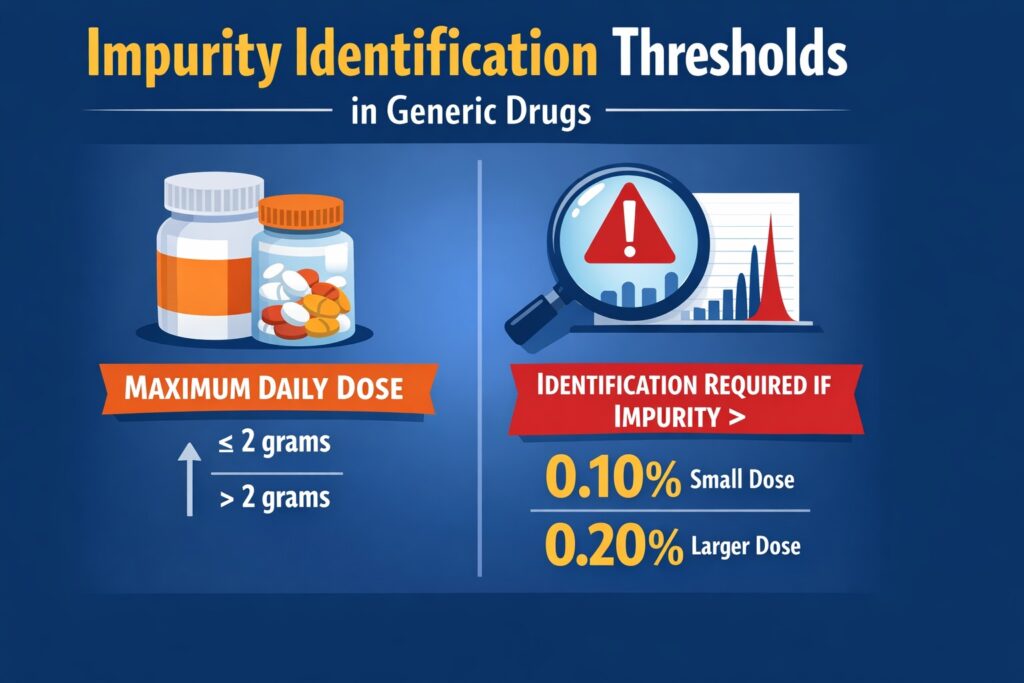
The detection and characterization of unknown impurities in generic drug products is a critical requirement for regulatory approval and patient safety. Even very small amounts of unexpected substances must be carefully isolated and studied using advanced analytical tools. A trusted CRO for Unknown Impurity Identification plays a vital role in helping manufacturers meet these expectations with scientific confidence. Regulatory guidance such as ICH Q3B(R2) requires that any degradation product above qualification thresholds—typically 0.10% or 0.20% depending on the maximum daily dose—must be structurally identified. This ensures that unexpected degradants do not affect product safety, strength, or long-term stability.
In practical situations, manufacturers must investigate even small chromatographic peaks that appear during stability studies. These peaks may represent degradation products, process-related impurities, or interactions between the API and excipients or packaging. Careful analytical evaluation is essential to determine their exact origin and structure. Working with an experienced CRO gives pharmaceutical companies access to high-resolution mass spectrometry (HRMS) and advanced nuclear magnetic resonance (NMR) expertise. This collaboration helps convert complex analytical data into clear regulatory documentation and reduces the risk of review delays.
Explore our comprehensive solutions: Mass Spectrometry-Based Analytical Services
Quick Summary
- Impurities above ICH limits (0.10–0.20%) must be structurally identified to meet regulatory requirements and ensure patient safety.
- HRMS and 2D NMR are key techniques used to accurately determine impurity structures and confirm their identity.
- Early identification helps avoid regulatory delays, including ANDA rejection or additional agency queries.
- Structural elucidation helps find the root cause, allowing manufacturers to correct process or stability issues.
- Genotoxic risk assessment under ICH M7 is essential to evaluate potential safety concerns.
- Working with an experienced CRO ensures faster, compliant, and regulatory-ready impurity identification.
Regulatory Mandates for Impurity Identification in Generic Pharmaceuticals
Structural identification becomes mandatory when an impurity peak crosses the limits defined by the International Council for Harmonisation (ICH). ICH Q3A(R2) applies to drug substances, while ICH Q3B(R2) applies to finished drug products. These guidelines use a risk-based approach, linking identification thresholds to the maximum daily dose (MDD). For many small-molecule generics, a new impurity above 0.10% during stability testing must be structurally characterized. Regulatory agencies such as the FDA and EMA treat unidentified impurities as potential safety concerns.
Understanding the difference between drug substance and drug product impurities is very important when planning an investigation. Drug substance impurities usually come from the synthetic process and may include starting materials, reagents, or catalysts. Drug product impurities are often formed during storage and may result from degradation, excipient interaction, packaging leachables, or exposure to heat and light. In generic development, differences in formulation and process compared to the innovator product can increase the risk of new impurities not listed in USP monographs or compendial references.
| Impurity Type | Regulatory Guideline | Typical Identification Threshold | Primary Analytical Focus |
| Drug Substance (API) | ICH Q3A(R2) | 0.10% (for MDD \leq 2g) | Process-related by-products, reagents, catalysts |
| Drug Product | ICH Q3B(R2) | 0.10% – 0.20% (Dose dependent) | Degradants, excipient interactions, leachables |
| Mutagenic Impurities | ICH M7(R1) | 1.5 \mug/day (TTC) | DNA-reactive structural alerts, QSAR modeling |
Failure to identify impurities properly can result in a Refuse-to-Receive (RTR) notice or a Complete Response Letter (CRL) during ANDA review. Early collaboration with a CRO for Unknown Impurity Identification helps demonstrate that the impurity profile of the generic product is well understood and comparable to the Reference Listed Drug (RLD). Proactive identification reduces regulatory uncertainty and strengthens the submission package. This approach also supports faster review timelines and fewer post-submission questions.
Ensure your submission meets all standards: Analytical Method Development and Validation Service
The Role of a CRO for Unknown Impurity Identification in Structural Elucidation
A specialized CRO for Unknown Impurity Identification provides advanced instruments and expert scientists who focus on trace-level structural analysis. The main objective is to convert an unknown chromatographic peak into a clearly defined chemical structure supported by solid analytical data. This process usually combines high-resolution mass spectrometry and multi-dimensional NMR techniques. In certain cases, even impurities below 0.10% must be identified if there is a potential toxicological concern. Therefore, scientific accuracy and detailed documentation are essential.
The investigation often starts by adapting an existing HPLC-UV method so it can be used with LC-HRMS. Quality control methods frequently use non-volatile buffers like phosphate, which are not suitable for mass spectrometry. A bridging strategy is developed to maintain peak shape and retention time while enabling accurate mass detection. Once successfully transferred, advanced instruments such as Orbitrap or TOF systems provide very high mass accuracy. This allows confident assignment of molecular formulas like CxHyNzOa.
Learn more about our chromatographic capabilities: HPLC Analysis Services
Beyond structural analysis, the CRO connects the findings to regulatory risk assessment. After identifying the structure, in-silico QSAR modeling under ICH M7 guidelines is performed to evaluate possible mutagenic risk. This integrated workflow—from isolation to toxicological review—ensures a complete and defensible regulatory response. As a result, manufacturers can address impurity concerns early and avoid last-minute submission issues.
Technical Workflow for Characterizing an Unknown Impurity at 0.18%
When an impurity appears at 0.18%, a clear analytical pathway is followed. The process begins with determining the molecular formula using HRMS and continues with structural mapping using advanced NMR experiments. Orthogonal techniques are combined to ensure that conclusions are reliable and scientifically sound. Structural decisions are never based on a single dataset but on multiple supporting results. This systematic method ensures strong regulatory acceptance.
All steps must be carefully documented for submission purposes. Chromatographic isolation, accurate mass measurement, and spectroscopic confirmation are combined to provide a high level of confidence. Detailed reporting ensures traceability and transparency during regulatory review. This disciplined approach supports both scientific accuracy and compliance.
Phase 1: Isolation and Mass Determination
At 0.18% w/w, the impurity exists in very small amounts within a complex mixture of API and excipients. Semi-preparative HPLC is used to isolate the impurity fraction from the bulk material. Multiple injections are often required to collect enough material, usually between 1–5 mg, for further analysis. After solvent removal, a purified fraction with more than 95% purity is obtained. This purified sample is essential for accurate structural studies.
Identify and mitigate risks early: Nitrosamine Analysis and Testing
The isolated compound is then analyzed using HRMS, such as a Q Exactive Orbitrap system. Unlike low-resolution systems, HRMS provides exact mass measurements to several decimal places. This precision significantly reduces the number of possible molecular formulas. Sub-2 ppm accuracy allows confident elemental composition assignment and supports reliable identification.
| Analytical Step | Technique Used | Purpose | Key Outcome |
|---|---|---|---|
| Isolation | Semi-Prep HPLC | Separate impurity from API/excipients | Purified fraction (>95% purity) |
| Formula Prediction | HRMS (Orbitrap) | Measure exact m/z ratio | Sub-2 ppm mass accuracy; molecular formula |
| Substructure Mapping | MS/MS Fragmentation | Generate daughter ions | Identification of modified functional groups |
| Connectivity | 600 MHz NMR (1D/2D) | Map H-C correlations | Definitive structural framework |
| Confirmation | Synthetic Spiking | Co-injection with standard | Unambiguous identity match |
Phase 2: NMR Structural Elucidation and Root Cause Analysis
After determining the molecular formula, NMR spectroscopy provides detailed connectivity information. Using a 600 MHz instrument, both 1D (^1H, ^{13}C) and 2D experiments such as HSQC and HMBC are performed. These experiments reveal short-range and long-range proton–carbon correlations. By combining this information, chemists construct the complete molecular framework. This level of detail ensures strong scientific confidence.
In one investigation, the impurity was identified as a hydroxylated derivative of the API. The NMR spectrum showed a new methylene signal in the aromatic region and the disappearance of a methyl signal. These changes indicated an oxidative transformation. The data clearly pointed to oxidation occurring during the final drying stage. Based on this insight, manufacturing controls were adjusted.
After modifying drying temperature and adding antioxidants, impurity levels dropped below 0.10%. The stability batch met regulatory expectations, and no further action was required. This example demonstrates how structural elucidation directly supports manufacturing improvements. A skilled CRO for Unknown Impurity Identification not only determines the structure but also helps identify the root cause.
Access high-resolution structural data: NMR Services for Small Molecules
Case Study: Forced Degradation and Novel Impurity Identification in Alectinib Hydrochloride
Forced degradation studies help predict how a drug behaves under stress conditions. By exposing the product to heat, light, acid, base, and oxidative environments, scientists can identify possible degradation pathways. In this case, Alectinib Hydrochloride showed stability under thermal and hydrolytic stress but sensitivity under oxidative conditions. This information is valuable for long-term stability planning. Early detection reduces regulatory risk.
Exposure to H_2O_2 produced four previously unreported degradation products (DP-1 to DP-4). Prep-HPLC was used for isolation, and LC-MS/MS provided molecular weight information. The parent compound showed m/z 483.32, while degradants displayed mass changes linked to oxygen addition or structural transformation. Early structural clarification allowed preventive control strategies. This proactive approach strengthens regulatory confidence.
Strengthen your drug development pipeline: Drug Discovery Services
Characterization of Novel Degradants (DP-1 to DP-4)
Comprehensive characterization required combining MS, FTIR, and NMR data. For example, DP-4 involved conversion of a nitrile (CN) group into an amide (CONH_2). MS showed an 18 Da increase, but FTIR confirmed loss of the CN stretch. Additionally, ^1H NMR revealed a new NH_2 signal. Using multiple techniques eliminated uncertainty in structural assignment.
| Degradant ID | Molecular Ion (m/z) | Identified Structure | Key Spectroscopic Evidence |
|---|---|---|---|
| DP-1 | 499.15 | N-oxide | NMR shift in the morpholine ring region |
| DP-2 | 499.26 | Epoxide | Merged singlet peaks in aromatic methyl regions |
| DP-3 | 499.19 | N-hydroxy | MS/MS fragment at 395.24 (loss of OH) |
| DP-4 | 501.60 | Amide | Loss of CN peak in FTIR; new amide NH₂ signal |
The final impurity profile supported a strong regulatory submission. Identifying degradants early reduced uncertainty during review. It also improved the manufacturer’s oxidative control strategy. Such systematic evaluation is central to regulatory success.
High-Resolution Mass Spectrometry (HRMS) vs. Triple Quadrupole (QQQ) for Impurity Profiling
HRMS systems provide major advantages when identifying unknown impurities. Triple Quadrupole instruments are excellent for quantifying known compounds using MRM mode. However, they require predefined targets and are less suitable for unknown analysis. HRMS supports non-target screening and accurate elemental composition assignment. This makes it ideal for discovery-based impurity investigations.
The difference lies mainly in mass accuracy and resolution. HRMS can separate compounds with identical nominal mass but slightly different exact masses. Even small millidalton differences can have regulatory importance. This precision is critical when distinguishing oxidative degradants from nitrogen-containing impurities. Therefore, HRMS is often preferred for structural elucidation projects.
| Feature | Triple Quadrupole (QQQ) | High-Resolution MS (HRMS/Orbitrap) |
|---|---|---|
| Mass Accuracy | 100 – 500 ppm (Unit mass) | < 2 ppm (Sub-ppm possible) |
| Resolution | ~500 | 70,000 – 500,000 |
| Identification | Requires reference standard | Capable of de novo identification |
| Sensitivity | Excellent for target compounds | Comparable in most SIM/HR-MS modes |
| Linear Range | 4 – 5 orders of magnitude | 5 – 6 orders of magnitude (Extended dynamic range) |
Structural Elucidation Using 2D NMR in a CRO for Unknown Impurity Identification
2D NMR spectroscopy is essential for confirming molecular connectivity and positional isomers. While MS defines molecular formula, it cannot reliably determine substitution positions. NMR provides detailed information about each proton and carbon environment. Techniques such as HSQC and HMBC reveal direct and long-range correlations. Together, they create a complete structural map.
Because NMR requires milligram quantities, careful isolation is necessary. When combined with LC-MS, it provides strong orthogonal confirmation. This integrated approach shortens timelines and avoids unnecessary synthesis of multiple candidates. For a CRO for Unknown Impurity Identification, 2D NMR is a key tool in delivering regulatory-ready results.
Evaluate long-term product safety: Stability Studies for Pharmaceuticals
Genotoxic Impurity Assessment under ICH M7 Guidelines
After structural identification, safety assessment under ICH M7 is required. Even impurities below 0.10% must be reviewed if structural alerts are present. In-silico (Q)SAR modeling predicts potential mutagenic risk. Both rule-based and statistical models are used to improve reliability. Clear documentation supports regulatory transparency.
If no alerts are detected, the impurity is managed as non-mutagenic. If alerts are present, control strategies such as TTC limits or Ames testing may be required. Proper classification ensures patient safety and regulatory compliance. This step completes the scientific justification process.
| ICH M7 Classification | Description | Control Strategy |
|---|---|---|
| Class 1 | Known mutagenic carcinogen | Control at compound-specific acceptable intake |
| Class 2 | Known mutagen (no carcinogenicity data) | Control at or below TTC (1.5 µg/day) |
| Class 3 | Alerting structure with unknown mutagenicity | Ames test or control at TTC |
| Class 4 | Alerting structure with negative Ames test | Control as non-mutagenic impurity |
| Class 5 | No structural alerts or negative predictions | Control as non-mutagenic impurity |
Technical Challenges: Method Transfer and Mobile Phase Compatibility
Transferring an HPLC method to LC-MS can be challenging. Many QC methods use non-volatile buffers that interfere with MS detection. These salts reduce ionization efficiency and contaminate the source. Therefore, method modification is often required. Careful adjustment ensures reliable results.
Volatile buffers such as ammonium formate or formic acid are commonly used instead. Maintaining peak resolution and retention time is very important during this transition. Proper optimization prevents co-elution and ensures the correct peak is analyzed. Attention to these details protects data quality.
Strategies for Mitigating Matrix Effects and Ion Suppression
Matrix components can suppress ionization and affect accuracy. Several strategies help reduce this problem. Divert valves can send API-rich fractions to waste before impurity peaks reach the detector. Dilution techniques lower excipient concentration and improve signal clarity. These practical steps improve analytical reliability.
Advanced approaches such as 2D-LC or UPLC optimization further enhance separation and sensitivity. Sub-2 μm columns improve peak resolution and signal-to-noise ratio. Careful method design ensures accurate mass detection. These measures support confident impurity identification.
Optimizing Impurity Profiling for Regulatory Submission Success
A well-defined impurity profile is essential for regulatory approval. Manufacturers must clearly document impurity identity, origin, and control strategy. Comparisons between development and commercial batches are required under ICH Q3B(R2). Any new impurity must be fully justified. Early planning reduces submission risk.
If a new impurity appears at 0.18%, structural identification is only the first step. Determining its root cause is equally important. Addressing raw material variability or process conditions prevents recurrence. A strong impurity control strategy supports faster regulatory review and commercial success.
Conclusion
The structural identification of unknown impurities is a critical step in generic drug development. Any impurity exceeding regulatory thresholds must be characterized to ensure safety and compliance. Advanced tools such as Orbitrap HRMS and 600 MHz NMR provide the precision needed for accurate results. Scientific rigor and detailed documentation are essential for approval success.
Partnering with a specialized CRO for Unknown Impurity Identification ensures that manufacturers receive expert support from detection to toxicological assessment. This integrated approach reduces regulatory risk and strengthens submission quality. Ultimately, systematic impurity profiling protects patients and supports long-term commercial success.
Contact ResolveMass Laboratories Inc. for Expert Support
If you are facing an unknown impurity above regulatory thresholds or require a comprehensive forced degradation study, our technical team is ready to assist.
Contact Us
Frequently Asked Questions (FAQs)
Regulatory authorities expect structural identification when an impurity crosses the reporting limits defined in ICH guidelines. For many generic products, this typically occurs at levels around 0.10% to 0.20%, depending on the daily dose. At this point, simply detecting the impurity is not sufficient; its chemical structure must be clearly established. A specialized CRO helps generate the scientific evidence needed for regulatory acceptance.
Conventional LC-MS instruments such as triple quadrupole systems usually measure mass with limited precision. This level of accuracy is enough for quantification but not for determining an exact molecular composition. High-resolution systems provide precise mass values that allow scientists to calculate possible elemental formulas. This precision is essential when trying to identify an unknown compound with confidence.
Process impurities originate during the synthesis of the active pharmaceutical ingredient and may include residual reagents or reaction by-products. In contrast, degradation products develop later due to environmental factors such as heat, light, oxygen, or interaction with excipients. These changes can occur during manufacturing or storage. Understanding the source helps in correcting the root cause and controlling future formation.
Mass spectrometry can work with extremely small quantities, but NMR analysis generally needs a larger amount of purified material. In most cases, a few milligrams of the isolated impurity are required to obtain clear spectral data. This quantity is usually collected through preparative chromatography. Adequate sample purity and quantity are critical for reliable structural interpretation.
An unusually potent impurity refers to a substance that can produce toxic or biological effects at very low concentrations. Even trace levels may pose safety concerns if the compound has strong pharmacological or genotoxic properties. Because of this risk, regulators may request identification at levels below typical reporting thresholds. Proper evaluation ensures patient safety and regulatory compliance.
Phosphate salts are not suitable for mass spectrometry because they do not evaporate easily and can accumulate inside the instrument. This buildup may reduce sensitivity and affect long-term performance. To avoid these issues, analysts use volatile alternatives that are compatible with MS detection. This adjustment helps maintain signal quality and reliable results.
Reference:
- European Medicines Agency. (2006). ICH Q3B(R2): Impurities in new drug products (Step 5). https://www.ema.europa.eu/en/documents/scientific-guideline/ich-q-3-b-r2-impurities-new-drug-products-step-5_en.pdf
- Boiteau, R. M., Hoyt, D. W., Nicora, C. D., Kinmonth-Schultz, H. A., Ward, J. K., & Bingol, K. (2018). Structure elucidation of unknown metabolites in metabolomics by combined NMR and MS/MS prediction. Metabolites, 8(1), 8. https://doi.org/10.3390/metabo8010008
- Feith, A., Teleki, A., Graf, M., Favilli, L., & Takors, R. (2019). HILIC-enabled 13C metabolomics strategies: Comparing quantitative precision and spectral accuracy of QTOF high- and QQQ low-resolution mass spectrometry. Metabolites, 9(4), 63. https://doi.org/10.3390/metabo9040063
- Gathungu, R. M., Bird, S. S., & Vouros, P. (2018). The integration of LC-MS and NMR for the analysis of low molecular weight trace analytes in complex matrices. Mass Spectrometry Reviews, 39(1–2), 35–54. https://doi.org/10.1002/mas.21575
- European Medicines Agency. (2023). ICH M7(R2): Assessment and control of DNA reactive (mutagenic) impurities in pharmaceuticals to limit potential carcinogenic risk – Scientific guideline. https://www.ema.europa.eu/en/ich-m7-assessment-control-dna-reactive-mutagenic-impurities-pharmaceuticals-limit-potential-carcinogenic-risk-scientific-guideline
Get In Touch With Us
About The Author


