


Introduction
A peptide purity testing report should be assessed as a comprehensive analytical record that establishes molecular identity, relative chromatographic purity, net peptide content, and significant process-related impurities. Within a CRO vs CDMO Generic Injectable Program, careful interpretation of these parameters is essential to confirm that synthetic peptide active pharmaceutical ingredients (APIs) meet applicable regulatory expectations and the specifications associated with the Reference Listed Drug.
Peptides occupy a distinctive analytical position between conventional small organic molecules and larger, structurally complex biologics. As synthetic peptides progress from discovery and development into commercial generic injectable programs, detailed characterization reports, typically supplied as Certificates of Analysis (COAs) or technical datasheets, serve as essential tools for quality assurance, risk control, and regulatory compliance. Proper evaluation of these documents requires a thorough understanding of analytical chemistry because a high reported purity value alone does not establish the correct molecular structure, complete mass accountability, or the absence of potentially significant degradation products. A comprehensive assessment therefore requires the review of complementary orthogonal analytical techniques, raw chromatographic data, and complete regulatory impurity profiles. ResolveMass Laboratories Inc. emphasizes that treating analytical datasheets as integrated, multidimensional datasets can help prevent expensive downstream issues during parenteral formulation and drug development.
Learn more about selecting an appropriate peptide development and manufacturing partner in the U.S. with our guide on How to Choose a Peptide CDMO in the US.
Share via:
Quick Summary:
- Peptide purity reports require a multidimensional review—HPLC purity alone is not enough to establish identity, quality, or regulatory suitability.
- Chromatographic purity and Net Peptide Content (NPC) are different: HPLC purity measures UV peak area, while NPC measures the actual peptide mass after excluding salts, water, and residual solvents.
- Molecular identity should be confirmed by mass spectrometry: ESI-MS, MALDI-TOF, and LC-MS/MS help verify theoretical mass, charge states, sequence, and modifications such as oxidation or deamidation.
- Impurity profiling is essential: Key impurities include deletion/truncated peptides, incomplete deprotection products, racemization products, oxidation, deamidation, isoaspartate, and aggregates.
- Non-peptide contaminants must also be assessed: Residual solvents, counterions such as TFA, moisture, bacterial endotoxins, and sterility/microbial quality are important for injectable peptide APIs.
- Regulatory compliance requires appropriate impurity assessment: FDA/ICH expectations, applicable ANDA requirements, and comparison with the Reference Listed Drug (RLD) should be considered when evaluating generic peptide injectables.
- A structured datasheet audit strengthens quality decisions: Review traceability, chromatographic baseline and integration, peak resolution, mass accuracy, NPC, moisture/counterions, residual solvents, endotoxins, and analytical method performance to support quality, safety, and regulatory readiness.
Evaluating Analytical Metrics in a CRO vs CDMO Generic Injectable Program
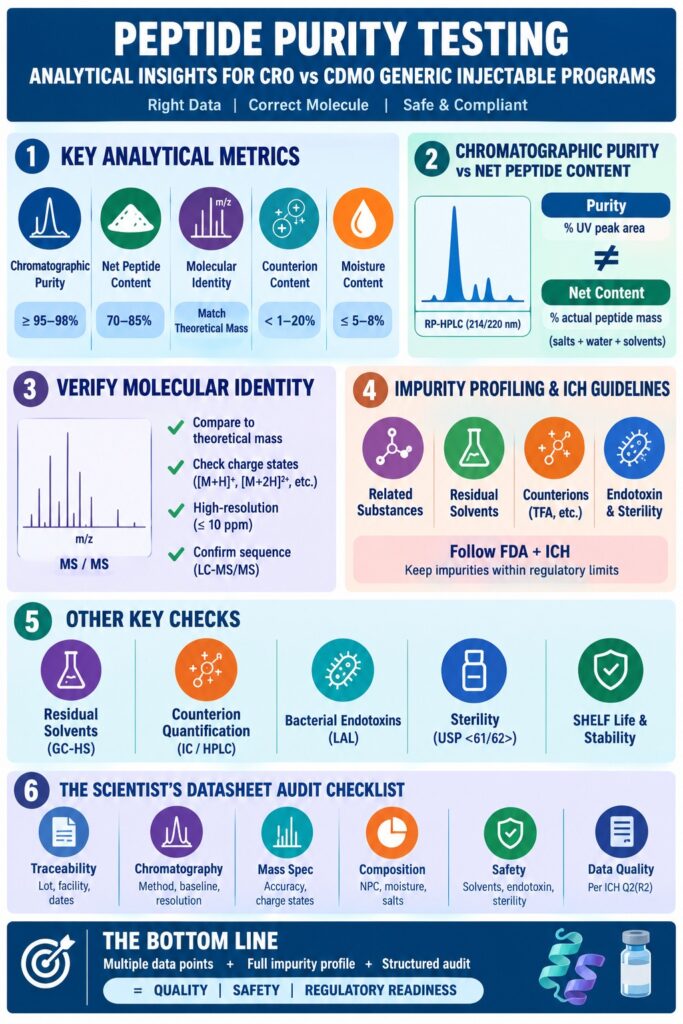
Assessment of analytical metrics in a peptide purity report requires a clear distinction between relative chromatographic area percentages and absolute net peptide content, together with confirmation of sequence identity using high-resolution mass spectrometry. Maintaining this distinction helps prevent dosing inaccuracies and verifies that the intended peptide molecule has been synthesized without significant structural modifications.
Compare the roles and capabilities of CDMOs and CMOs in peptide development with our guide on Peptide CDMO vs CMO.
Differentiating Chromatographic Purity from Net Peptide Content
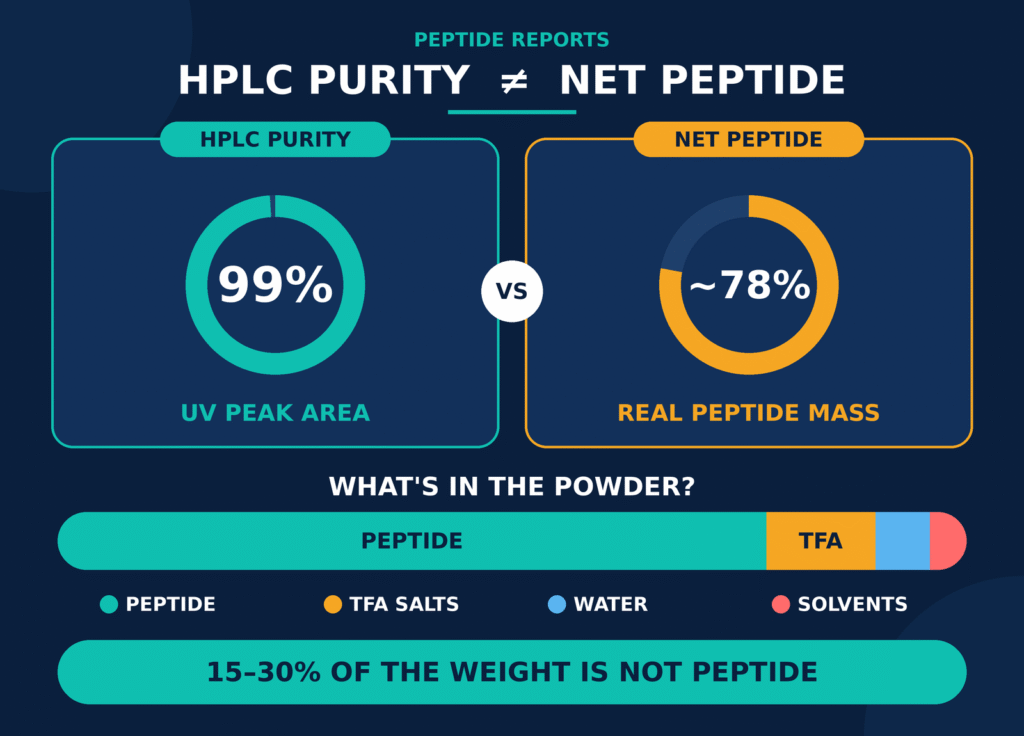
Chromatographic purity represents the percentage of UV detector response attributable to the target peptide peak compared with the total integrated peak area, whereas net peptide content represents the actual mass percentage of peptide present in the powder after excluding counterions, moisture, and residual solvents. Therefore, a vial with a reported HPLC purity of 99% may contain only 70% to 85% net peptide by weight because the remaining mass can consist of bound salts, residual water, and other non-peptide components.
One of the most important sources of misinterpretation in peptide datasheets is the assumption that chromatographic purity and net peptide content are equivalent. Chromatographic purity is generally determined using Reversed-Phase High-Performance Liquid Chromatography (RP-HPLC) with Ultraviolet (UV) detection, commonly at 214 nm or 220 nm. At 214 nm, the detector primarily measures UV absorption associated with peptide bonds. The reported purity value is calculated from the integrated area of the target peptide peak relative to the combined integrated area of all detected chromatographic signals. However, this measurement is limited to UV-absorbing substances that are separated under the specific chromatographic conditions used. It does not account for non-UV-absorbing contaminants, counterion salts, residual solvents, or moisture.
Net Peptide Content (NPC), in contrast, represents the actual mass fraction of the lyophilisate attributable to the target peptide sequence. Synthetic peptides manufactured through Solid-Phase Peptide Synthesis (SPPS) are frequently cleaved and purified using trifluoroacetic acid (TFA). As a result, basic amino acid residues, including Lysine, Arginine, and Histidine, as well as the N-terminus, may retain bound TFA counterions. Trapped water molecules and residual organic solvents can also remain within the material. Collectively, these non-peptide components may represent approximately 15% to 30% of the total powder weight. Consequently, a peptide showing 99% chromatographic purity may contain only approximately 75% to 80% net peptide by weight.
For additional context on the analytical and structural differences between peptide therapeutics and conventional small molecules, explore Difference Between a Peptide and a Small Molecule Drug.
| Analytical Parameter | Underlying Definition | Primary Testing Method | Typical Specification Range | Critical Analytical Significance |
|---|---|---|---|---|
| Chromatographic Purity | Proportion of target peptide UV signal relative to total detected peak area. | RP-HPLC / UPLC with UV detection at 214/220 nm. | ≥ 95.0% to ≥ 98.0%. | Identifies sequence-related impurities, deletion sequences, and degradation products. |
| Net Peptide Content (NPC) | Actual mass percentage of target peptide within the dried powder. | Elemental Nitrogen Analysis (Dumas) or Quantitative Amino Acid Analysis (AAA). | 70.0% to 85.0% (for TFA salts). | Essential for precise molar concentration calculations during bioassays and dosing. |
| Molecular Identity | Confirmation of exact molecular weight and amino acid composition. | ESI-MS, MALDI-TOF MS, or LC-MS/MS tandem sequencing. | Matches theoretical monoisotopic/average mass. | Guarantees the target construct was synthesized rather than an incorrect or isobaric sequence. |
| Counterion Content | Quantitative determination of bound acid salts (TFA, acetate, hydrochloride). | Ion Chromatography (IC) or RP-HPLC with conductive/UV detection. | < 1.0% (for acetate/HCl conversion) or 10% to 20% (for native TFA). | Determines salt form suitability for cellular toxicity and parenteral drug formulation. |
| Moisture Content | Proportion of residual water trapped in the lyophilized matrix. | Karl Fischer Titration or Loss on Drying (LOD). | ≤ 5.0% to ≤ 8.0% w/w. | Influences long-term hydrolytic degradation and storage stability. |
Verifying Molecular Identity via Mass Spectrometry
Molecular identity in a peptide testing report is established by comparing the measured mass-to-charge ratios (m/z) and deconvoluted neutral mass obtained through Electrospray Ionization (ESI-MS) or MALDI-TOF mass spectrometry with the calculated theoretical mass of the peptide sequence. High-resolution LC-MS can further confirm the molecular composition while identifying mass shifts associated with modifications such as oxidation, deamidation, or incomplete removal of protecting groups.
Although HPLC determines the relative distribution of chromatographically detected components, Mass Spectrometry (MS) provides molecular identity information by measuring the mass-to-charge ratio (m/z) of ionized molecular species. Liquid Chromatography-Mass Spectrometry (LC-MS), using Electrospray Ionization (ESI) or Matrix-Assisted Laser Desorption/Ionization Time-of-Flight (MALDI-TOF), converts peptide molecules into gas-phase ions for mass analysis.
A detailed audit of an MS report should compare the experimentally observed molecular mass with the calculated theoretical mass based on the primary amino acid sequence. For larger peptides, ESI-MS commonly produces multiple charge states, including [M+H]+, [M+2H]2+, and [M+3H]3+. The analytical report should provide a clearly deconvoluted neutral mass spectrum demonstrating agreement with the theoretical monoisotopic or average molecular weight. High-resolution analytical platforms, including Orbitrap or Time-of-Flight systems, can provide mass accuracy within parts-per-million (ppm) tolerances and help differentiate the intended peptide from modifications such as oxidation (+16 Da) or deamidation (+1 Da). For definitive sequence confirmation, tandem mass spectrometry (LC-MS/MS) or Edman degradation fragmentation profiles should also be evaluated to exclude amino acid transpositions or sequence scrambling.
If your program requires analytical testing alongside broader development activities, explore our One-Stop CDMO Analytical Services for ANDA capabilities.
Impurity Profiling and ICH Guidelines for a CRO vs CDMO Generic Injectable Program
Peptide impurity profiling requires the identification and quantification of related synthetic substances, organic solvents, counterions, and endotoxins in accordance with applicable FDA and ICH guidelines. Comprehensive characterization helps demonstrate that process-related impurities remain within appropriate regulatory limits and minimizes the possibility of unexpected safety or immunogenicity concerns.
Regulatory Thresholds and ANDA Requirements
Regulatory assessment of generic peptide injectables requires careful evaluation of peptide-related impurities, including demonstrating that relevant new specified impurities remain within applicable regulatory expectations and that impurities exceeding established reporting thresholds are appropriately identified and characterized under FDA guidance for ANDAs. The impurity profile of a generic peptide must also be appropriately compared with the Reference Listed Drug (RLD) to support the required regulatory assessment of therapeutic equivalence.
Within a CRO vs CDMO Generic Injectable Program, analytical purity reports should satisfy the applicable regulatory requirements established in FDA guidance documents and International Council for Harmonisation (ICH) standards. For generic synthetic peptide submissions, including Abbreviated New Drug Applications or ANDAs involving products such as liraglutide, semaglutide, or teriparatide, FDA guidance addresses the need to evaluate the impurity profile of the generic synthetic peptide in relation to that of the originator’s Reference Listed Drug (RLD).
Under these regulatory frameworks, a new specified peptide-related impurity present in a generic synthetic peptide above an applicable qualification threshold may require additional toxicological qualification. Reporting thresholds also require appropriate identification and characterization of impurities present at or above 0.10%, depending on the applicable regulatory framework and product-specific requirements.
Synthesis-related impurities can result from incomplete coupling reactions, producing deletion peptides; premature chain termination, resulting in truncated peptides; incomplete deprotection, leaving protecting groups such as Pbf or tBu; or racemization occurring during coupling reactions. Following synthesis, peptide degradation may generate several additional impurity types, including:
- Oxidation: This occurs primarily at Methionine, Cysteine, or Tryptophan residues and can produce sulfoxides or disulfide-linked dimers. These modifications may alter chromatographic retention behavior and molecular mass profiles.
- Deamidation: This process affects Asparagine and Glutamine residues and converts neutral amide side chains into acidic carboxylic acids through a succinimide intermediate, producing a +1 Da mass change.
- Isoaspartate Formation: This structural rearrangement can occur following deamidation and introduces changes within the peptide backbone. Such species may elute very close to the parent peptide during chromatographic analysis.
- Aggregation: Peptide molecules may form soluble oligomers or insoluble fibrils, which can increase immunogenicity concerns in injectable development programs.
For a deeper look at impurity assessment and regulatory control strategies, read our guide on Impurity Control Strategies Under ICH Q3A.
Residual Solvents, Counterions, and Microbiological Safety
Comprehensive safety evaluation of a peptide datasheet should include analysis of volatile organic solvents by Gas Chromatography, quantification of bound counterions such as trifluoroacetate (TFA), and appropriate assessment of sterility and endotoxin levels. Collectively, these parameters help demonstrate that the drug substance is chemically appropriate and meets relevant microbiological safety requirements for parenteral administration.
A complete analytical datasheet should therefore extend beyond peptide-related impurities and include evaluation of other potentially relevant contaminants:
- Residual Solvents (ICH Q3C/R8): SPPS utilizes organic solvents such as N,N-Dimethylformamide (DMF), N-Methyl-2-pyrrolidone (NMP), Acetonitrile, Piperidine, and Dichloromethane (DCM). Gas Chromatography with Headspace detection (GC-HS) is used to quantify Class 1, Class 2, and Class 3 residual solvents and verify that concentrations comply with applicable toxicological limits.
- Counterion Quantification: TFA is commonly used during SPPS purification and can remain associated with the peptide as a salt. Elevated TFA concentrations may contribute to cytotoxicity or injection-site irritation during certain clinical or animal studies. Analytical datasheets should therefore document counterion levels and, where required, demonstrate conversion to compatible salt forms such as acetate or hydrochloride.
- Bacterial Endotoxins and Sterility: For injectable products, bacterial endotoxin testing using the Limulus Amebocyte Lysate (LAL) assay is an important quality-control requirement. Results should demonstrate compliance with the applicable endotoxin specification, which may be expressed as a dose-based limit or, where appropriate, a limit such as < 0.5 EU/mg. Microbiological testing should also establish sterility or acceptable microbial quality in accordance with applicable USP <61/62> and USP <71> requirements.
Learn more about formulation considerations for sterile peptide drug substances with our resource on Formulating a Lyophilized Peptide Injectable.
The Scientist’s Peptide Datasheet Audit Checklist
A scientist’s audit of a peptide datasheet requires systematic assessment of sample traceability, chromatographic separation, integration baseline integrity, orthogonal mass confirmation, and limits for non-peptide contaminants. Examining raw chromatographic traces together with quantitative analytical tables is important for identifying potentially overlooked co-eluting impurities or inappropriate peak integration.
A structured Certificate of Analysis audit helps establish whether the analytical information supports applicable validation expectations under FDA/ICH Q2(R2). Key analytical characteristics, including specificity, accuracy, precision, limit of detection (LOD), limit of quantitation (LOQ), linearity, and range, should be appropriately supported by the analytical procedure and the information provided in the report.
For programs involving generic drug development and regulatory documentation, explore CMC Documentation at a CDMO for ANDA.
| Checklist Category | Specific Review Point | Standard / Compliance Requirement | Potential Risk / Deficiencies |
|---|---|---|---|
| Traceability & Metadata | Lot/Batch Number Matching | COA lot number must match product vial label exactly. | Inability to establish chain-of-custody or support quality claims. |
| Facility & Testing Date | Accredited laboratory details, report ID, and test execution dates are listed. | Outdated analytical data or information originating from a non-accredited laboratory. | |
| Chromatographic Integrity | Separation Parameters | Method parameters are stated, including column type, gradient, flow rate, and UV λ. | Omission of method details prevents experimental reproduction. |
| Baseline and Peak Integration | Clean baseline; integration markers encompass all peaks, including tailing edges. | Integration parameters may be configured in a manner that excludes secondary peaks. | |
| Peak Resolution (Rs) | Clear baseline separation (Rs > 1.5) between the main peak and impurities. | Co-elution may conceal degradation products beneath the principal target peak. | |
| Spectral Verification | Mass Accuracy | Observed mass matches theoretical mass within instrument error (≤ 10 ppm). | Mass discrepancy may indicate an incorrect sequence or molecular modification. |
| Charge State Distribution | Clear display of multiply charged species ([M+H]+, [M+2H]2+, etc.). | Monomers may be misidentified because of background noise or salt adducts. | |
| Mass Composition | Net Peptide Content (NPC) | Quantitative nitrogen analysis or AAA is reported. | Actual peptide dose may be overestimated by assuming 100% mass purity. |
| Water & Counterion Analysis | Karl Fischer moisture content and IC salt determination are included. | Elevated water levels may accelerate hydrolytic degradation. | |
| Safety & Contaminants | Residual Solvents | GC-HS testing complies with applicable ICH Q3C(R8) limits. | Cytotoxic organic solvent residues may remain in the final powder. |
| Endotoxin Limits | LAL kinetic testing demonstrates compliance with the applicable limit, such as < 0.5 EU/mg or a dosage-based limit. | Pyrogenic reactions or inflammatory responses may occur in models. |
In addition to the structured parameters included in the checklist, several critical visual characteristics should be examined during an analytical audit:
- Baseline Stability: Confirm that the chromatographic trace maintains a stable, relatively flat baseline before and after elution of the target peptide.
- Peak Integration Boundaries: Confirm that integration drop-lines extend to the actual baseline and do not exclude impurity tailing, shoulder peaks, or other relevant chromatographic features.
- Resolution Metrics: Verify that the separation between the target peptide and adjacent related substances meets the specified resolution criteria, with an Rs value greater than 1.5 indicating complete baseline resolution under the stated conditions.
- Orthogonal Alignment: Compare HPLC purity results with LC-MS total ion chromatograms to determine whether co-eluting, non-UV-absorbing, or isobaric impurities may be present.
If your development program requires peptide manufacturing support from development through scale-up, explore Peptide CDMO Scale-Up Services.
Conclusion: Securing Quality in a CRO vs CDMO Generic Injectable Program
Successfully managing a CRO vs CDMO Generic Injectable Program requires a comprehensive, multilayered assessment of peptide purity reports rather than reliance on a single HPLC purity percentage. Evaluating chromatographic profiles, mass spectrometry results, net peptide content, and applicable ICH safety parameters provides a stronger analytical basis for assessing product quality, patient safety, and regulatory readiness.
Single-point purity measurements are not sufficient for comprehensive characterization of modern biopharmaceutical materials. Reviewing chromatographic area percentage together with net peptide content, mass spectrometry-based molecular identity confirmation, residual solvent analysis, counterion quantification, and endotoxin testing creates a more complete and defensible analytical record. Applying a structured audit checklist can help development teams and quality assurance professionals identify technical risks, improve formulation accuracy, and support batch-to-batch comparability throughout generic drug development.
For advanced peptide characterization, analytical procedure validation, and comprehensive regulatory testing support, consult the laboratory team through the ResolveMass Contact Page.
Frequently Asked Questions
An HPLC purity result reflects UV-detectable components separated under the specified chromatographic conditions rather than the complete composition of the powder. Bound counterions, residual moisture, and solvents can contribute significantly to the total weight without generating corresponding HPLC peaks. Consequently, high chromatographic purity can coexist with substantially lower net peptide content.
Mass Spectrometry, including ESI-MS and MALDI-TOF, is widely used to verify the molecular mass of a peptide against its theoretical value. LC-MS provides additional chromatographic and mass information, while LC-MS/MS can provide fragmentation data for sequence confirmation. Edman degradation may also be used as an orthogonal approach for establishing the primary amino acid sequence.
TFA is commonly involved in Solid-Phase Peptide Synthesis (SPPS), particularly during cleavage and purification, and can remain associated with peptides as a counterion. Excessive TFA can influence formulation characteristics, biological assay results, and calculations of the actual peptide concentration. Measuring TFA content therefore helps establish the material’s composition and suitability for its intended application.
Applicable impurity requirements depend on the specific peptide, regulatory pathway, and FDA guidance governing the product. Under the framework described for generic synthetic peptides, new specified peptide-related impurities above 0.5% may require toxicological qualification. Impurities meeting applicable reporting thresholds must also be appropriately identified and characterized, with comparison to the Reference Listed Drug (RLD) profile where required.
Co-eluting impurities may be investigated by modifying chromatographic conditions, using alternative stationary phases, changing mobile phase pH, or applying orthogonal analytical techniques. LC-MS is particularly useful because compounds sharing the same retention time can still produce different mass-to-charge ratios. These approaches can reveal impurities that conventional UV chromatographic integration may not adequately resolve.
RP-HPLC peptide analysis commonly uses UV detection around 214 nm or 220 nm because peptide bonds provide strong absorbance in this region. Detection at 280 nm primarily reflects aromatic residues such as Tryptophan and Tyrosine. Therefore, relying exclusively on 280 nm detection may provide limited visibility for peptide species that contain few or no aromatic amino acids.
Important warning signs include unstable baselines, unusual peak shapes, unintegrated shoulder peaks, and integration boundaries that exclude peak tailing or minor components. Missing chromatographic parameters, such as column information, gradient conditions, flow rate, or detection wavelength, are also significant concerns. These features can make it difficult to determine whether the reported purity accurately represents the sample.
Bacterial endotoxins, particularly lipopolysaccharides, can produce serious inflammatory and pyrogenic responses when introduced through parenteral administration. The Limulus Amebocyte Lysate (LAL) assay is commonly used to detect and quantify endotoxin contamination. Testing confirms that the material complies with the applicable endotoxin specification before it is used in injectable applications.
A separate Certificate of Analysis (COA) should be obtained for each production lot or batch because analytical characteristics can vary between manufacturing runs. Parameters such as impurity levels, moisture, counterion content, and peptide content may change depending on processing conditions. A COA from one batch should therefore not be assumed to represent the quality of a later production lot.
Reference:
- U.S. Food and Drug Administration. (2020). GDUFA II: Drug master files—Questions and answers. https://www.fda.gov/media/147594/download
- Jiao, T. (2024, September 25). Teriparatide injection first generic approval: Quality-related review considerations [Presentation]. U.S. Food and Drug Administration. https://www.fda.gov/media/184411/download
- Yang, E.-J., Kim, S. H., Kim, A., Choi, J., Jeong, H. J., & Na, D. H. (2026). Regulatory and analytical considerations for the quality assessment of peptide drugs. Journal of Pharmaceutical Investigation. https://doi.org/10.1007/s40005-026-00817-2
- European Medicines Agency. (2025). Guideline on the development and manufacture of synthetic peptides (EMA/CHMP/CVMP/QWP/367182/2025). https://www.ema.europa.eu/en/documents/scientific-guideline/guideline-development-manufacture-synthetic-peptides_en.pdf
Get In Touch With Us
About The Author


