

Custom chemical synthesis plays a crucial role in the biotech and pharmaceutical industries, enabling the development of specialized compounds for research, diagnostics, and drug development. As the demand for custom chemical synthesis grows, emerging trends are shaping the industry to enhance efficiency, precision, and sustainability. In this blog, we explore the future trends in custom chemical synthesis for biotech and pharma, highlighting advancements in technology, automation, regulatory compliance, and sustainability.
Article Highlights
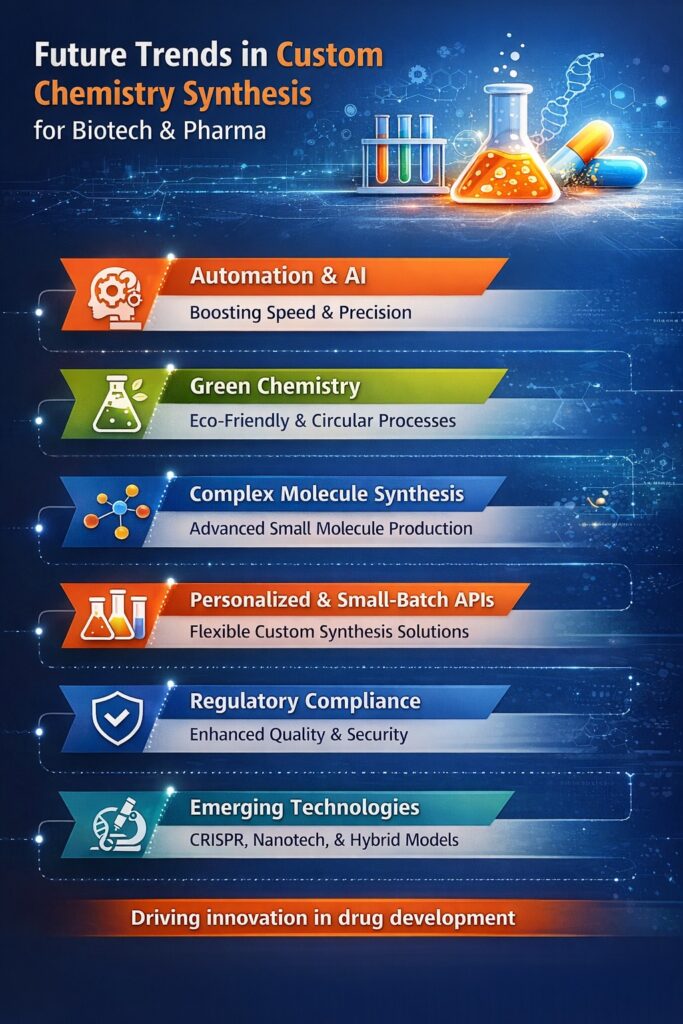
- Automation, AI, and digital twins are transforming custom chemical synthesis by improving speed, precision, and decision-making across discovery and scale-up.
- Sustainability-driven innovation, including green chemistry, circular processes, and waste valorization, is reshaping synthesis practices to reduce environmental impact.
- Advances in complex molecule synthesis, such as peptides, oligonucleotides, and novel small-molecule modalities, are enabling next-generation therapeutics.
- Personalized medicine and small-batch API manufacturing are increasing demand for flexible, on-demand custom synthesis solutions.
- Regulatory compliance and digital quality systems are becoming more data-centric, emphasizing traceability, security, and global standards.
- Emerging technologies like CRISPR, synthetic biology, nanotechnology, and hybrid synthesis models are expanding the boundaries of custom chemical synthesis.
1. Automation and AI-Driven Custom Chemical Synthesis
Automation and artificial intelligence (AI) are transforming custom chemical synthesis by improving precision, reproducibility, and efficiency. AI-powered systems can predict reaction outcomes, optimize synthetic pathways, and reduce waste, making the process faster and cost-effective.
- Automated Flow Chemistry: Continuous flow reactors enable precise control over reaction conditions, improving product purity and yield [1].
- AI-Based Reaction Prediction: Machine learning models assist in predicting reaction feasibility and optimizing reaction conditions [2].
- Robotic High-Throughput Screening: AI-driven robotic platforms expedite the screening of reaction conditions, reducing labor costs and human error
Learn how AI is revolutionizing synthesis workflows – How AI Is Revolutionizing Custom Polymer Synthesis
1A. Digital Twins and In Silico Process Design
Digital twin technology is emerging as a powerful tool in custom chemical synthesis, allowing scientists to create virtual replicas of chemical processes before executing them in the laboratory. These digital models simulate reaction kinetics, heat transfer, solvent behavior, and impurity formation under different conditions. By running multiple scenarios in silico, researchers can identify optimal pathways while avoiding costly trial-and-error experimentation. This approach significantly reduces development timelines, particularly for complex multistep syntheses.
For biotech and pharma organizations, digital twins improve decision-making across the entire synthesis lifecycle. Process risks can be identified early, scale-up challenges anticipated, and regulatory documentation strengthened with predictive data. As computational power increases, digital twins will increasingly integrate AI-driven learning loops, continuously improving accuracy with experimental feedback. This convergence positions digital simulation as a core component of future-ready custom synthesis platforms.
2. Green Chemistry and Sustainability
Environmental concerns are driving the adoption of green chemistry principles in custom chemical synthesis. Sustainable practices include using bio-based solvents, minimizing hazardous waste, and adopting energy-efficient synthesis routes.
- Biocatalysis: Enzyme-catalyzed reactions offer greener alternatives to traditional chemical synthesis .
- Solvent-Free and Micellar Catalysis: Reduces reliance on harmful organic solvents, promoting eco-friendly processes .
- Carbon Capture in Synthesis: Innovative techniques to incorporate CO2 into chemical processes, reducing carbon footprint.
Explore the sustainability challenges in custom synthesis – Top Challenges and Opportunities in Custom Polymer Synthesis
2A. Circular Chemistry and Waste Valorization
Beyond reducing environmental impact, future custom chemical synthesis will increasingly focus on circular chemistry principles. Waste streams generated during synthesis—such as spent catalysts, solvents, or by-products—are being re-evaluated as potential inputs for secondary processes. Advanced recovery and purification technologies allow valuable intermediates to be reclaimed and reused, reducing raw material dependency and overall production costs.
For pharmaceutical manufacturers, waste valorization improves sustainability metrics while supporting regulatory and ESG commitments. CROs offering circular chemistry capabilities gain a competitive advantage by delivering both environmental and economic benefits. As regulatory agencies emphasize lifecycle sustainability, synthesis partners that demonstrate closed-loop process thinking will become preferred collaborators for long-term development programs.
3. Advancements in Peptide and Oligonucleotide Synthesis
The demand for custom peptides and oligonucleotides has surged due to their applications in precision medicine, RNA-based therapies, and vaccine development.
- Solid-Phase Peptide Synthesis (SPPS) Enhancements: Improved resin technology for higher purity peptides .
- Automated Oligonucleotide Synthesis: Enables the rapid production of RNA and DNA sequences for gene therapies.
- Peptidomimetics: Novel peptide-like molecules with enhanced stability and bioavailability.
Explore innovations in complex molecule design – What is Custom Synthesis of Small Molecules? A Beginner’s Guide
3A. Expansion of Complex Small Molecule Modalities
Custom chemical synthesis is increasingly required to support complex small-molecule modalities that fall outside traditional medicinal chemistry frameworks. These include bifunctional molecules, covalent inhibitors, and molecular glues that demand precise structural control. Such compounds often require unconventional synthetic routes, specialized reagents, and advanced purification strategies to achieve desired biological activity.
As drug discovery pipelines diversify, synthesis partners must demonstrate adaptability across emerging chemical architectures. CROs with experience in handling molecular complexity reduce development risk by anticipating synthetic bottlenecks early. This trend highlights the importance of deep chemical expertise rather than volume-based synthesis, especially in programs targeting novel biological mechanisms.
4. Personalized Medicine and Custom Chemical Synthesis
The rise of personalized medicine is driving demand for custom active pharmaceutical ingredients (APIs) tailored to individual patient needs.
- Precision Drug Synthesis: Tailor-made APIs for targeted therapies in oncology and rare diseases.
- On-Demand API Manufacturing: Small-batch production of APIs for niche therapies.
- 3D Printing of Pharmaceuticals: Custom dosage forms with controlled release properties.
Learn about small batch API manufacturing – Why Custom API Synthesis is Essential for Generic and Specialty Pharmaceuticals
5. Regulatory Compliance and Quality Assurance
As custom synthesis companies expand globally, adherence to regulatory standards is crucial for ensuring drug safety and efficacy.
- ICH and FDA Guidelines: Compliance with international quality standards for drug synthesis.
- Advanced Analytical Techniques: Use of NMR, HPLC, and LC-MS for stringent quality control.
- Digital Documentation and Blockchain: Secure and transparent record-keeping for regulatory audits.
Learn how compliance is built into custom synthesis – What is Custom Synthesis? A Comprehensive Guide for Researchers
5A. Data Integrity, Traceability, and Digital Quality Systems
Future regulatory expectations extend beyond final product quality to include full traceability of data generated throughout synthesis workflows. Digital quality systems now capture raw experimental data, analytical results, deviations, and corrective actions in real time. These systems improve transparency and reduce the likelihood of compliance gaps during inspections or technology transfers.
For custom synthesis providers, robust data integrity frameworks enhance client confidence and streamline regulatory submissions. Digital audit trails and secure access controls ensure accountability while supporting global collaboration. As regulatory scrutiny increases, CROs that invest in advanced digital quality infrastructures will set higher industry benchmarks for reliability and compliance.
6. CRISPR and Synthetic Biology in Custom Chemical Synthesis
CRISPR and synthetic biology are revolutionizing custom chemical synthesis by enabling precise gene-editing and biotechnological applications.
- Gene-Edited Microbial Factories: Engineered microbes for producing complex pharmaceutical intermediates.
- Synthetic Biology-Driven Metabolic Pathways: Custom-designed biosynthetic routes for high-value compounds .
- DNA-Based Catalysts: Novel enzymatic catalysts for selective chemical transformations.
See how custom organic synthesis is done in North America – Custom Organic Synthesis in Montreal, Canada or United States
7. Integration of Nanotechnology in Drug Delivery Systems
Nanotechnology is reshaping custom chemical synthesis by enabling the design of nanoscale drug carriers for enhanced bioavailability and targeted delivery.
- Lipid Nanoparticles (LNPs): Widely used for mRNA vaccine delivery
- Polymeric Nanoparticles: Tailored for sustained and controlled drug release.
- Nanocarrier Functionalization: Customizable surface modifications for targeted therapy.
Learn how cyclodextrin-based systems enhance therapy – Cyclodextrin-Based Dendrimers: A Promising Tool for Oral Insulin Delivery
7A. Hybrid Chemical–Biological Synthesis Models
The boundary between chemical synthesis and biological manufacturing is increasingly blurring. Hybrid synthesis models combine chemical transformations with biological systems to create complex therapeutic molecules. These approaches enable efficient construction of structures that would be difficult or uneconomical using purely chemical methods alone.
For biotech and pharma companies, hybrid models expand design flexibility while improving scalability and sustainability. CROs capable of integrating chemical and biological synthesis workflows provide a strategic advantage in developing next-generation therapeutics. This convergence reflects a broader shift toward multidisciplinary innovation in custom chemical synthesis.
Conclusion
The future of custom chemical synthesis for biotech and pharma is defined by convergence—of digital tools, sustainability principles, biological integration, and advanced chemical expertise. As innovation accelerates, synthesis is no longer a standalone function but a strategic enabler of faster, smarter drug development. Emerging technologies such as AI, digital twins, circular chemistry, and hybrid synthesis models are reshaping how compounds are designed, produced, and scaled.
For organizations navigating increasingly complex pipelines, partnering with forward-thinking synthesis providers is essential. CROs that combine technical depth, regulatory rigor, and digital readiness will play a pivotal role in advancing next-generation therapies. By embracing these future trends, biotech and pharma companies can achieve greater efficiency, resilience, and long-term innovation success.
REFERENCES
- Clomburg, J. M., Crumbley, A. M., & Gonzalez, R. (2017). Industrial biomanufacturing: The future of chemical production. Science, 355(6320), Article aag0804. https://doi.org/10.1126/science.aag0804
- Sarsaiya, S., Shi, J., & Chen, J. (2019). Bioengineering tools for the production of pharmaceuticals: Current perspective and future outlook. Bioengineered, 10(1), 469–492. https://doi.org/10.1080/21655979.2019.1682108
LET’S CONNECT
Looking for a trusted custom chemical synthesis partner? ResolveMass Laboratories Inc. offers tailored synthesis solutions for biotech and pharma.
GMP Release and Stability Testing Services at a CDMO: Scope, Turnaround, and Deliverables
Introduction Engaging specialized GMP Release and Stability Testing Services at a CDMO enables biopharmaceutical developers…

Solid-State Characterization and Polymorph Screening at a CDMO: XRPD, DSC, TGA, and Beyond
1. Introduction Solid-state characterization and polymorph screening are essential components of pharmaceutical development because the…

How Can You Verify the Identity and Purity of Compounded or Research-Grade Peptides?
Introduction: Peptide Identity and Purity Testing is essential for determining whether a compounded or research-grade…
Case Study: Identifying Peptide Acylation Impurities in a PLGA Depot Formulation by LC-HRMS
Introduction: Peptide Acylation Impurity Analysis is the targeted detection, identification and, where possible, quantitation of…
FDA’s Draft Guidance on Comparative Efficacy Studies: What Your Analytical Package Must Show to Skip Phase III
Introduction Under the FDA’s Draft Guidance on Comparative Efficacy Studies, prospective biosimilar applicants may be…

“No Clinically Meaningful Differences”: How FDA Defines the Standard for Biosimilar Approval
Introduction Under Section 351(k) of the Public Health Service (PHS) Act, the U.S. Food and…

