Introduction
In the ever-evolving field of pharmaceuticals, the development of advanced drug delivery systems has become crucial for enhancing the efficacy, safety, and patient compliance of therapeutic agents. Among various strategies, controlled drug delivery systems have gained significant attention due to their potential to deliver drugs at a predetermined rate, improve therapeutic outcomes, and minimize side effects. Custom polymer synthesis plays a pivotal role in designing and fabricating these sophisticated drug delivery systems. At Resolvemass Laboratories, we leverage our expertise in custom synthesis and analytical services to develop tailor-made polymers that meet the specific requirements of controlled drug delivery applications.
Key Highlights
- Controlled drug delivery improves treatment effectiveness, safety, and patient compliance.
- Custom polymers enable precise, sustained, and targeted drug release.
- Functionalized and biodegradable polymers enhance drug stability and performance.
- Polymer structure and nanotechnology help optimize delivery and therapeutic outcomes.
- Resolvemass Laboratories offers complete custom polymer design, synthesis, and testing solutions.
Custom Polymer Functionalization Strategies
Functionalization is a critical aspect of custom polymer synthesis that enhances the performance of drug delivery systems. By attaching specific chemical groups to the polymer backbone, scientists can modify properties such as solubility, stability, and interaction with biological tissues. These modifications allow polymers to carry drugs more efficiently and improve their ability to reach the desired target site. Functionalization also enables the incorporation of responsive elements that react to environmental changes within the body.
Moreover, functionalized polymers can be designed to improve compatibility with different types of drugs, including hydrophilic and hydrophobic molecules. This flexibility allows researchers to develop delivery systems for a wide range of therapeutic compounds. The ability to precisely modify polymer properties provides significant advantages in designing advanced and effective drug delivery solutions. As a result, functionalization remains a key strategy in modern polymer-based pharmaceutical development.
Explore more : Custom Polymer Synthesis
The Need for Controlled Drug Delivery
Traditional drug delivery methods often face challenges such as fluctuating drug levels, poor bioavailability, and short half-lives, which can result in suboptimal therapeutic outcomes and increased side effects. Controlled drug delivery systems address these issues by releasing the drug at a controlled rate, maintaining therapeutic drug levels for extended periods, and targeting specific sites within the body. This approach not only improves patient compliance but also enhances the overall efficacy of the treatment.
Emerging Challenges in Modern Therapeutics
As modern medicine evolves, the complexity of diseases being treated has increased significantly. Chronic conditions such as cancer, diabetes, neurological disorders, and autoimmune diseases often require long-term therapy with precise dosing schedules. Conventional delivery approaches frequently fail to maintain optimal drug concentrations over extended durations, resulting in therapeutic gaps or toxic peaks. This variability can compromise treatment effectiveness and increase the risk of adverse reactions. Therefore, there is a growing demand for advanced delivery systems capable of maintaining stable drug levels while reducing the burden on patients.
Additionally, many newer drug molecules, including biologics, peptides, and nucleic acid-based therapeutics, are inherently unstable or rapidly degraded within the body. These molecules require protective delivery vehicles that can preserve their structure and function until they reach the target site. Custom-designed polymer systems provide a protective environment that shields drugs from premature degradation and improves their circulation time. This capability has become especially important as personalized medicine and biologic therapies continue to expand in clinical practice.
Role of Custom Polymers in Controlled Drug Delivery
Polymers are the cornerstone of controlled drug delivery systems. Their unique properties, such as biocompatibility, biodegradability, and tunable physical and chemical characteristics, make them ideal candidates for designing drug delivery platforms. Custom polymer synthesis allows for the creation of polymers with tailored properties to achieve specific drug release profiles, target specific tissues, and respond to physiological conditions.
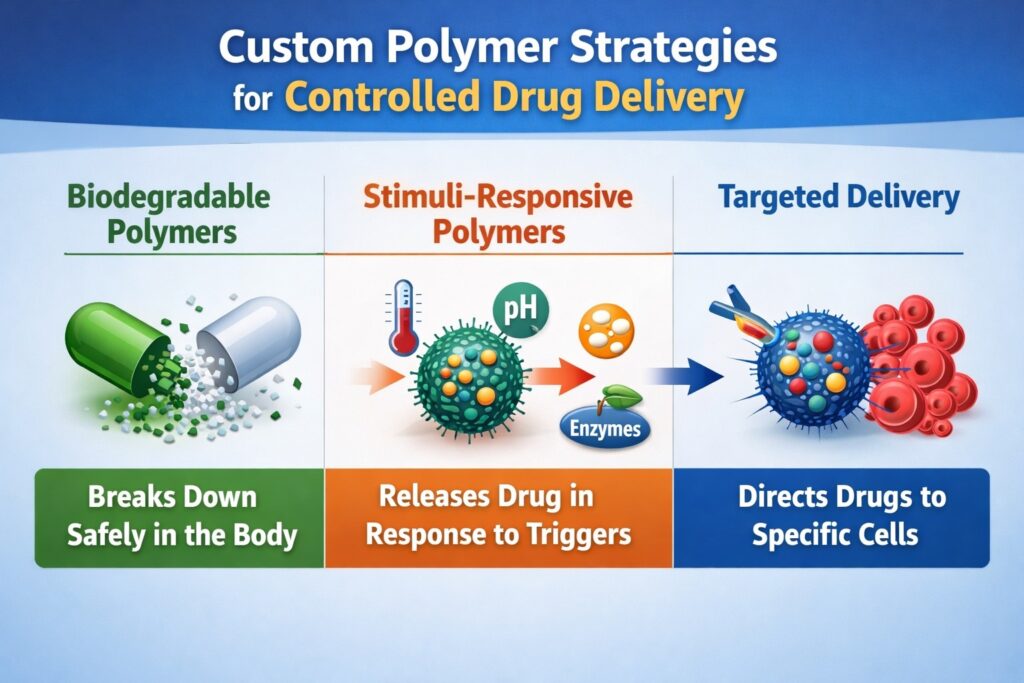
- Biodegradable Polymers: These polymers degrade into non-toxic byproducts within the body, eliminating the need for surgical removal. Examples include poly(lactic acid) (PLA), poly(glycolic acid) (PGA), and their copolymers (PLGA). By adjusting the ratio of monomers and molecular weight, the degradation rate and drug release profile can be precisely controlled.
- Stimuli-Responsive Polymers: These polymers undergo physical or chemical changes in response to external stimuli such as pH, temperature, or enzymes. This responsiveness can be harnessed to trigger drug release at specific sites or under specific conditions. For instance, pH-sensitive polymers can release drugs in the acidic environment of a tumor or inflamed tissue.
- Targeted Delivery: Custom polymers can be functionalized with ligands or antibodies that recognize and bind to specific receptors on target cells or tissues. This targeted approach ensures that the drug is delivered precisely where it is needed, minimizing off-target effects and improving therapeutic efficacy.
Influence of Polymer Architecture on Drug Release
The structural architecture of polymers plays a crucial role in determining the performance of drug delivery systems. Parameters such as polymer chain length, branching, crosslinking density, and crystallinity directly affect drug encapsulation efficiency and release kinetics. For example, highly crosslinked polymers tend to release drugs more slowly due to restricted molecular mobility, whereas linear polymers may allow faster diffusion. By precisely controlling these architectural parameters, scientists can design delivery systems that meet specific therapeutic timelines.
Furthermore, advanced polymer architectures such as block copolymers and graft polymers offer unique advantages for drug delivery. These structures can self-assemble into nanoscale carriers like micelles and vesicles, which enhance drug solubility and stability. The ability to fine-tune polymer structure provides exceptional flexibility in designing systems capable of responding to different physiological environments. This level of control enables the development of highly sophisticated delivery platforms tailored for diverse clinical needs.
Our Approach at Resolvemass Laboratories
At Resolvemass Laboratories, we specialize in the custom synthesis of polymers for controlled drug delivery applications. Our comprehensive approach involves several key steps:
Consultation and Requirement Analysis: We begin by understanding the specific needs of our clients, including the desired drug release profile, target site, and any special considerations such as biocompatibility and biodegradability.
Polymer Design and Synthesis: Leveraging our expertise in polymer chemistry, we design and synthesize polymers with the desired properties. This includes selecting appropriate monomers, optimizing polymerization conditions, and functionalizing the polymers with targeting moieties or stimuli-responsive groups.
Characterization and Quality Control: Our state-of-the-art analytical facilities enable us to thoroughly characterize the synthesized polymers, ensuring they meet the required specifications. Techniques such as NMR, GPC, DSC, and FTIR are employed to assess molecular weight, composition, thermal properties, and chemical structure.
Importance of Polymer Purity and Reproducibility
Ensuring polymer purity is essential for the safety and effectiveness of drug delivery systems. Even small amounts of residual monomers, catalysts, or solvents can affect biocompatibility and cause unintended biological responses. Therefore, rigorous purification processes are implemented during polymer synthesis to remove impurities and achieve high-quality materials. Advanced analytical techniques help confirm that the final polymer meets strict pharmaceutical standards.
Reproducibility is equally important, especially when scaling up production for clinical or commercial applications. Consistent polymer properties ensure predictable drug release behavior and reliable therapeutic outcomes. Careful control of synthesis parameters, including temperature, reaction time, and reactant concentration, helps maintain batch-to-batch consistency. This reliability is critical for regulatory approval and long-term success in pharmaceutical development.
Formulation and Testing: We collaborate with our clients to formulate the polymers into drug delivery systems, such as nanoparticles, microspheres, or hydrogels. These formulations are then subjected to rigorous in vitro and in vivo testing to evaluate their performance, including drug release kinetics, stability, and biocompatibility.
Advances in Nanotechnology-Based Polymer Systems
Recent advancements in nanotechnology have significantly expanded the capabilities of polymer-based drug delivery systems. Polymer nanoparticles can improve drug solubility, enhance cellular uptake, and enable targeted delivery to specific tissues. Their small size allows them to circulate efficiently in the bloodstream and penetrate biological barriers that are difficult to access with traditional formulations. This has opened new possibilities for treating diseases that were previously challenging to manage.
In addition, nanoscale polymer systems can be engineered to release drugs in response to specific biological triggers. This level of precision helps maximize therapeutic effects while minimizing damage to healthy tissues. Researchers are continuously exploring new nanostructured polymers to improve treatment outcomes and reduce side effects. These innovations represent a major step forward in the evolution of controlled drug delivery technologies.
Case Study: PLGA-Based Microspheres for Sustained Release of Anti-Cancer Drugs
One of our recent projects involved the development of PLGA-based microspheres for the sustained release of an anti-cancer drug. The objective was to achieve a prolonged release profile, reducing the frequency of administration and improving patient compliance. Through careful selection of PLGA copolymers and optimization of the microsphere fabrication process, we were able to achieve a consistent release of the drug over several weeks. In vitro and in vivo studies demonstrated the efficacy of the formulation, highlighting the potential of custom polymer synthesis in advancing controlled drug delivery systems.
Regulatory and Safety Considerations in Polymer-Based Drug Delivery
The development of polymer-based drug delivery systems must comply with strict regulatory guidelines to ensure patient safety. Regulatory agencies require extensive evaluation of polymer materials, including their toxicity, degradation behavior, and interaction with biological systems. Comprehensive testing helps confirm that the polymer and its degradation products are safe for medical use. Meeting these requirements is essential before a product can enter clinical trials or reach the market.
Safety considerations also extend to long-term performance and stability of the polymer system. Researchers must ensure that the polymer maintains its intended function throughout the treatment period without causing harmful effects. Continuous monitoring and testing help identify potential risks and ensure reliable performance. This thorough evaluation process helps build confidence in polymer-based drug delivery technologies and supports their successful clinical adoption.
Conclusion
Custom polymer synthesis is a powerful tool in the development of controlled drug delivery systems, offering the flexibility to design and fabricate polymers with tailored properties for specific therapeutic applications. At Resolvemass Laboratories, our expertise in custom synthesis and analytical services enables us to deliver high-quality, innovative solutions for the pharmaceutical industry. By partnering with us, clients can leverage our technical capabilities and experience to develop advanced drug delivery systems that enhance therapeutic outcomes and improve patient quality of life.
REFERENCES
- Bajpai, A. K., Shukla, S. K., Bhanu, S., & Kankane, S. (2008). Responsive polymers in controlled drug delivery. Progress in Polymer Science, 33(11), 1088–1118. https://doi.org/10.1016/j.progpolymsci.2008.07.005
- Coelho, J. F., Ferreira, P. C., Alves, P., Cordeiro, R., Fonseca, A. C., Góis, J. R., & Gil, M. H. (2010). Drug delivery systems: Advanced technologies potentially applicable in personalized treatments. EPMA Journal, 1(1), 164–209. https://doi.org/10.1007/s13167-010-0001-x
- Borandeh, S., van Bochove, B., Teotia, A., & Seppälä, J. (2021). Polymeric drug delivery systems by additive manufacturing. Advanced Drug Delivery Reviews, 173, 349–373. https://doi.org/10.1016/j.addr.2021.03.022
GET IN TOUCH
For more information about our custom polymer synthesis services and how we can assist in your drug delivery projects, please visit Resolvemass laboratories

Case Study: Immunogenicity Risk Assessment of a New Impurity in a Generic Peptide ANDA
Introduction: Immunogenicity Risk Assessment of Peptide Impurities is a key part of pharmaceutical development whenever…
Is Peptide Synthesis the Same as Protein Manufacturing?
Introduction: Peptide Synthesis vs Protein Manufacturing is an important distinction in pharmaceutical development, biotechnology, and…

Is It Better to Use One Integrated CDMO or Multiple Specialized Vendors?
Introduction Selecting between an integrated contract development and manufacturing organization (CDMO) and multiple specialized vendors…
Afucosylation, Sialylation, and High Mannose: What Glycan Profiling Analysis for Biosimilar Characterization Reveals About Efficacy and Safety
Introduction Glycan profiling analysis for biosimilar characterization provides valuable insights into how critical N-glycoforms, particularly…
Same Sequence, Different Shape: Why Higher Order Structure Analysis for Biosimilar Characterization Can’t Be Skipped
Introduction Higher Order Structure Analysis for Biosimilar Characterization is essential because proteins with identical primary…

Clinical Trial Material Manufacturing at a CDMO: Phase I and II Supply Planning
Introduction: Clinical Trial Material Manufacturing for Phase I and II is a critical part of…