Introduction
In the evolving landscape of pharmaceutical sciences, the development of novel drug delivery systems is critical to addressing the limitations of conventional therapies. Controlled drug delivery, which focuses on releasing therapeutic agents at a predetermined rate, is vital for enhancing the efficacy, safety, and patient compliance of medications. Among the various strategies explored for controlled drug delivery, cyclodextrin-based dendrimers have emerged as a promising class of nanocarriers. These hybrid molecules, combining the unique properties of cyclodextrins and dendrimers, offer significant advantages in drug encapsulation, stability, and targeted delivery. This blog delves into the role of cyclodextrin-based dendrimers in controlled drug delivery, exploring their structure, synthesis, and applications in enhancing the therapeutic outcomes of various drugs.
Share via:
Quick Summary
- Cyclodextrin-based dendrimers are advanced nanocarriers that combine the benefits of cyclodextrins and dendrimers for efficient drug delivery.
- They significantly improve drug solubility, stability, and bioavailability, especially for poorly water-soluble drugs.
- These systems enable targeted drug delivery through surface functionalization, reducing side effects and enhancing therapeutic outcomes.
- Controlled and stimuli-responsive drug release ensures precise delivery at the desired site and time.
- They are widely applicable in areas like cancer therapy, gene delivery, oral and transdermal drug delivery, and personalized medicine.
- Despite challenges like complex synthesis and potential toxicity, ongoing research is driving innovation and expanding their clinical potential.
Understanding Cyclodextrin-Based Dendrimers
Cyclodextrin-based dendrimers are intricate nanostructures that integrate the beneficial attributes of cyclodextrins and dendrimers. To understand their significance in controlled drug delivery, it is essential to explore the characteristics of each component:
Cyclodextrins: Cyclodextrins are cyclic oligosaccharides composed of glucose units linked by α-1,4-glycosidic bonds. These molecules are characterized by their unique toroidal shape, featuring a hydrophobic interior cavity and a hydrophilic exterior. This structure allows cyclodextrins to form inclusion complexes with various hydrophobic drugs, enhancing their solubility and stability. The ability of cyclodextrins to improve the bioavailability of poorly water-soluble drugs makes them highly valuable in drug formulation. Additionally, their biocompatibility and non-toxic nature contribute to their widespread use in pharmaceuticals.
Dendrimers: Dendrimers are highly branched, tree-like macromolecules with a well-defined architecture. They consist of a central core, branching units (dendrons), and terminal functional groups. The precise control over dendrimer size, shape, and surface functionality during synthesis allows for the creation of molecules with tailored properties for specific applications. Dendrimers are particularly noted for their multivalency, which enables the attachment of multiple functional groups or active agents, making them ideal carriers for drug delivery, targeting, and imaging applications.
Explore our expertise in complex host-guest chemistry: Advanced Solutions for Cyclodextrin Applications
Physicochemical Properties and Their Impact on Drug Delivery
Cyclodextrin-based dendrimers exhibit unique physicochemical properties that significantly influence their performance as drug delivery systems. Parameters such as particle size, surface charge, and molecular weight play a crucial role in determining their interaction with biological membranes and their distribution within the body. Smaller-sized dendrimers often demonstrate enhanced cellular uptake, while surface charge influences their ability to interact with negatively charged cell membranes. By carefully tuning these properties, researchers can optimize the biodistribution and pharmacokinetics of the drug-loaded nanocarriers.
Another critical property is the solubility profile of these hybrid systems. The presence of cyclodextrin units enhances aqueous solubility, while the dendritic framework provides structural stability. Additionally, their ability to avoid rapid clearance by the reticuloendothelial system improves circulation time in the bloodstream. These combined properties make cyclodextrin-based dendrimers highly efficient carriers, particularly for drugs that require prolonged systemic exposure and controlled release.
Ensure the highest purity for your drug delivery systems: High-Performance Liquid Chromatography (HPLC) Analysis Services
The Synergy of Cyclodextrin-Based Dendrimers
The fusion of cyclodextrins and dendrimers into a single nanocarrier creates a synergistic platform that enhances the capabilities of each component in controlled drug delivery:
Enhanced Drug Solubility and Stability:
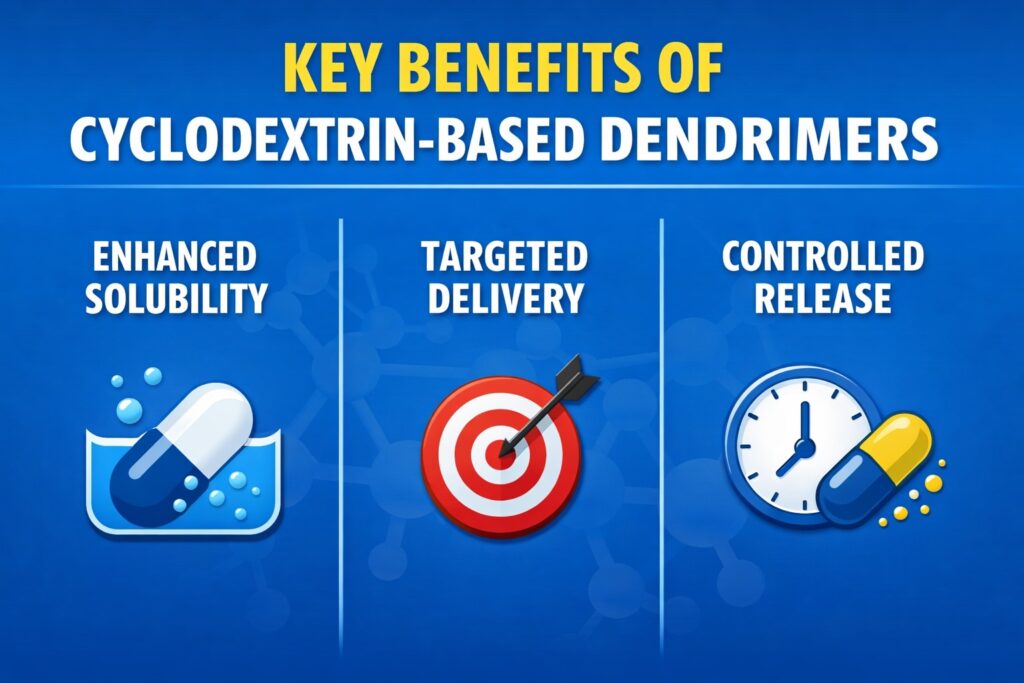
- Cyclodextrin-based dendrimers are particularly effective at encapsulating hydrophobic drugs within the cyclodextrin cavity, improving their solubility and bioavailability. This is crucial for drugs with poor water solubility, which often face challenges in formulation and therapeutic application.
- The dendritic structure further stabilizes the encapsulated drug, protecting it from degradation due to environmental factors such as light, oxygen, and enzymes. This stabilization is vital for maintaining the drug’s therapeutic efficacy over extended periods, reducing the frequency of administration, and ensuring a consistent therapeutic effect.
Targeted Drug Delivery:
- One of the most significant advantages of cyclodextrin-based dendrimers is their ability to be functionalized with targeting ligands, such as antibodies, peptides, or small molecules. These ligands allow the nanocarrier to recognize and bind to specific receptors on target cells, ensuring that the drug is delivered precisely where it is needed. This targeted approach minimizes off-target effects and enhances the therapeutic index of the drug.
- The multivalency of dendrimers allows for the attachment of multiple targeting ligands, increasing the likelihood of successful binding to target cells. This feature is particularly valuable in the treatment of diseases such as cancer, where precise targeting of tumor cells is essential to avoid damage to healthy tissues.
Controlled Release Mechanisms:
- The ability to control the release of drugs from cyclodextrin-based dendrimers is a key factor in their role in controlled drug delivery. These nanocarriers can be designed to release their payload in response to specific environmental triggers, such as changes in pH, temperature, or ionic strength. This trigger-responsive release ensures that the drug is delivered at the optimal time and location, maximizing its therapeutic effect while minimizing side effects.
- Additionally, the release profile of the drug can be tailored by modifying the dendrimer structure or the type of cyclodextrin used. This flexibility allows for the development of drug delivery systems that meet the specific needs of different therapeutic applications, from sustained release formulations to pulsatile delivery systems.
Biocompatibility and Reduced Toxicity:
- Cyclodextrins are derived from natural sources and are known for their biocompatibility and low toxicity. When combined with dendrimers, the resulting cyclodextrin-based dendrimers retain these favorable properties, making them suitable for use in a wide range of pharmaceutical applications.
- The choice of dendrimer core and surface modifications can further enhance the biocompatibility of these nanocarriers, ensuring that they are well-tolerated by the body and minimizing the risk of adverse reactions. This aspect is particularly important in controlled drug delivery, where the safety of the delivery system is as crucial as its efficacy.
Pharmacokinetics and Biodistribution Considerations
Understanding the pharmacokinetics of cyclodextrin-based dendrimers is essential for their successful application in drug delivery. These nanocarriers can significantly alter the absorption, distribution, metabolism, and excretion (ADME) profile of therapeutic agents. By encapsulating drugs within their संरuc ture, they protect them from premature degradation and enzymatic metabolism, thereby increasing their half-life in circulation. This leads to improved therapeutic efficacy, especially for drugs that are rapidly cleared from the body.
Biodistribution is another critical factor influenced by the structural design of dendrimers. Surface modifications, such as polyethylene glycol (PEG)ylation, can reduce opsonization and enhance circulation time. Additionally, targeting ligands can direct the nanocarriers to specific tissues or organs, improving drug accumulation at the desired site. These features collectively enable more precise and efficient drug delivery, reducing systemic exposure and minimizing adverse effects.
Synthesis of Cyclodextrin-Based Dendrimers
The synthesis of cyclodextrin-based dendrimers involves the conjugation of cyclodextrins to dendritic structures, creating a hybrid molecule with properties tailored for controlled drug delivery. There are several approaches to achieving this synthesis:
Covalent Conjugation:
- Covalent conjugation involves the formation of strong, stable bonds between cyclodextrins and the dendrimer core. This method ensures that the cyclodextrins are securely attached, preventing their dissociation under physiological conditions. Covalent conjugation allows for precise control over the number and orientation of cyclodextrin units on the dendrimer surface, which is essential for optimizing drug encapsulation and release characteristics.
Non-Covalent Assembly:
- Non-covalent assembly relies on weaker interactions, such as hydrogen bonding, electrostatic forces, or host-guest interactions, to attach cyclodextrins to the dendrimer. This approach allows for reversible assembly and disassembly of the dendrimer structure, which can be advantageous in applications where dynamic release or exchange of the cyclodextrin component is desired. Non-covalent assembly is particularly useful for creating stimuli-responsive drug delivery systems.
Surface Functionalization:
- Post-synthetic modification of cyclodextrin-based dendrimers involves adding functional groups to the dendrimer surface, which can be used for targeting, imaging, or other purposes. Surface functionalization enhances the versatility of the dendrimer and allows for customization according to specific application requirements. Functional groups can be selected based on the intended route of administration, desired interactions with biological targets, or the need for additional diagnostic or therapeutic functionalities.
Characterization Techniques for Cyclodextrin-Based Dendrimers
The successful development of cyclodextrin-based dendrimers relies heavily on advanced characterization techniques. Analytical methods such as nuclear magnetic resonance (NMR) spectroscopy and Fourier-transform infrared (FTIR) spectroscopy are commonly used to confirm the chemical structure and functional group modifications. These techniques provide detailed insights into the successful conjugation of cyclodextrin units with dendrimer frameworks, ensuring structural integrity.
In addition to structural analysis, techniques like dynamic light scattering (DLS) and transmission electron microscopy (TEM) are employed to evaluate particle size, morphology, and dispersion. Zeta potential analysis helps determine surface charge, which is crucial for predicting stability and interaction with biological systems. Together, these characterization methods ensure reproducibility, quality control, and optimal performance of the nanocarriers in drug delivery applications.
Verify your structural integrity with advanced spectroscopy: NMR Analysis for Small Molecules and Polymers
Applications in Controlled Drug Delivery
Cyclodextrin-based dendrimers hold immense potential for various applications in controlled drug delivery:
Role in Personalized Medicine
Cyclodextrin-based dendrimers are increasingly being explored in the field of personalized medicine, where treatments are tailored to individual patient profiles. Their customizable structure allows for the incorporation of specific targeting ligands and drug combinations based on genetic, molecular, or pathological characteristics of the patient. This adaptability enhances treatment precision and effectiveness, particularly in complex diseases such as cancer and genetic disorders.
Furthermore, these nanocarriers can be engineered to respond to patient-specific biological markers, enabling smart drug delivery systems. For example, dendrimers can be designed to release drugs in response to specific enzymes or biomarkers present in diseased tissues. This level of customization not only improves therapeutic outcomes but also minimizes unnecessary drug exposure, paving the way for more efficient and patient-centric healthcare solutions.
Anticancer Drug Delivery:
- Cyclodextrin-based dendrimers are particularly promising for delivering chemotherapeutic agents. Their ability to enhance the solubility and stability of hydrophobic drugs, combined with their targeting capabilities, makes them ideal candidates for improving the therapeutic index of anticancer drugs. Controlled release mechanisms ensure that the drug is delivered at the tumor site, reducing systemic toxicity and improving patient outcomes.
Oral Drug Delivery:
- The poor solubility of many drugs limits their bioavailability when administered orally. Cyclodextrin-based dendrimers can overcome this challenge by enhancing the solubility of poorly water-soluble drugs, improving their absorption in the gastrointestinal tract. Additionally, the controlled release properties of these nanocarriers can be leveraged to ensure that the drug is released at the optimal site within the digestive system, enhancing its therapeutic effect.
Gene Therapy:
- The multivalency of dendrimers allows for the attachment of nucleic acids, such as DNA or RNA, for gene delivery applications. Cyclodextrin-based dendrimers can protect the nucleic acid payload from degradation, facilitate cellular uptake, and enhance transfection efficiency, making them valuable tools for gene therapy. Targeted gene delivery using these nanocarriers can improve therapeutic outcomes by ensuring that the genetic material is delivered specifically to diseased cells, reducing the risk of off-target effects.
Transdermal Drug Delivery:
- Cyclodextrin-based dendrimers can be used in transdermal drug delivery systems, where they enhance the penetration of drugs through the skin. The ability to control the release of drugs from these nanocarriers ensures that the drug is delivered at a steady rate over an extended period, improving patient compliance and therapeutic efficacy.
Achieve comprehensive regulatory compliance for your drug product: Impurity Profiling and Characterization Using LC-MS
Challenges and Limitations
Despite their promising potential, cyclodextrin-based dendrimers face several challenges that must be addressed for widespread clinical application. One major concern is the complexity of their synthesis, which can be time-consuming and costly. Achieving uniformity in structure and scalability in production remains a significant hurdle for industrial implementation. Additionally, variations in batch production may affect consistency and performance.
Another limitation is the potential toxicity associated with certain dendrimer generations or surface groups. While cyclodextrins are generally biocompatible, the dendrimer component may induce cytotoxicity if not properly modified. Researchers are actively working on designing safer and more biocompatible systems through surface engineering and biodegradable linkages. Addressing these challenges is essential to fully realize the clinical potential of these advanced drug delivery systems.
Deep dive into complex peptide-based dendrimer systems: Specialized NMR Services for Peptides and Proteins
Future Perspectives and Emerging Trends
The future of cyclodextrin-based dendrimers in drug delivery is highly promising, with ongoing research focusing on enhancing their functionality and clinical applicability. Emerging trends include the development of stimuli-responsive systems that can precisely control drug release in response to multiple triggers such as pH, temperature, and enzymes. These advancements aim to create smarter drug delivery platforms capable of adapting to dynamic biological environments.
In addition, the integration of nanotechnology with artificial intelligence and data-driven design is opening new avenues for optimizing dendrimer-based systems. Predictive modeling can help in designing more efficient nanocarriers with improved targeting and reduced toxicity. As interdisciplinary research continues to evolve, cyclodextrin-based dendrimers are expected to play a transformative role in next-generation therapeutics and precision medicine.
Conclusion
Cyclodextrin-based dendrimers have emerged as a powerful and versatile platform in the realm of controlled drug delivery, bridging the gap between innovative nanotechnology and practical therapeutic applications. Their ability to enhance drug solubility, stability, and targeting efficiency makes them highly valuable in addressing the limitations of conventional drug delivery systems. With continuous advancements in synthesis techniques, functionalization strategies, and characterization methods, these hybrid nanocarriers are becoming increasingly refined and effective.
Moreover, their potential applications extend beyond traditional drug delivery into areas such as personalized medicine, gene therapy, and smart responsive systems. While certain challenges related to scalability and safety remain, ongoing research is actively addressing these limitations. As the field progresses, cyclodextrin-based dendrimers are poised to redefine modern pharmacotherapy, offering more precise, efficient, and patient-friendly treatment solutions for a wide range of diseases.
Frequently Asked Questions
These systems improve solubility by trapping poorly water-soluble drugs inside the hydrophobic cavity of cyclodextrins. The dendrimer structure further stabilizes the drug and helps disperse it uniformly in aqueous environments. This dual mechanism significantly enhances the bioavailability of drugs. It is especially useful for compounds with low dissolution rates.
Dendrimers have multiple surface functional groups that can be modified with targeting molecules such as antibodies or peptides. This allows them to selectively bind to specific cells or tissues. Their controlled size and shape also enable better penetration into target sites. As a result, drugs can be delivered more precisely with fewer side effects.
Cyclodextrins are generally considered safe and biocompatible, which contributes to the overall safety of these systems. However, the dendrimer component may cause toxicity if not properly engineered. Surface modification and careful design help reduce potential adverse effects. Ongoing research continues to improve their safety profile for clinical use.
Cyclodextrin-based dendrimers can carry a wide range of therapeutic agents, including hydrophobic drugs, anticancer compounds, and genetic material like DNA or RNA. Their versatile structure allows them to accommodate different drug types. This flexibility makes them suitable for multiple therapeutic areas. They are particularly useful in complex treatments like cancer and gene therapy.
Drug release from these nanocarriers can be designed to respond to environmental triggers such as pH, temperature, or enzymes. By modifying the dendrimer structure or bonding interactions, scientists can control how quickly or slowly the drug is released. This ensures that the drug acts at the right place and time. It helps improve treatment efficiency and reduce unwanted effects.
One major challenge is the complexity and cost of synthesizing these highly structured nanocarriers. Ensuring consistency and scalability for large-scale production is also difficult. Additionally, concerns about long-term toxicity and regulatory approval need to be addressed. Despite these challenges, research is actively working toward making them more practical for clinical use.
Reference:
- González-Gaitano, G., Isasi, J. R., Velaz, I., & Zornoza, A. (2022). Cyclodextrin-based drug delivery systems: Current status and future perspectives. Pharmaceutics, 14(11), 2388. https://doi.org/10.3390/pharmaceutics14112388
- Wang, H., Shao, N., Qiao, S., & Cheng, Y. (2012). Host–guest chemistry of dendrimer–cyclodextrin conjugates: Selective encapsulations of guests within dendrimer or cyclodextrin cavities revealed by NOE NMR techniques. The Journal of Physical Chemistry B, 116(36), 11217–11224. https://doi.org/10.1021/jp3062916
- Zhang, Y., Xu, Y., Li, H., Sun, Y., & Chen, G. (2022). β-Cyclodextrin and oligoarginine peptide-based dendrimer-entrapped gold nanoparticles for improving drug delivery to the inner ear. Frontiers in Bioengineering and Biotechnology, 10, 838508. https://doi.org/10.3389/fbioe.2022.838508