Introduction:
Cyclodextrin-Based Dendrimers for Delivering Hydrophobic Drugs are an advanced class of nanocarriers designed to overcome one of the biggest challenges in pharmaceutical science: poor water solubility of many potent drug molecules. Hydrophobic drugs often exhibit low bioavailability, limited therapeutic efficiency, and inconsistent absorption profiles. By integrating cyclodextrins with dendritic architectures, scientists have created a highly effective system that improves drug solubility, stability, and delivery precision.
At ResolveMass Laboratories Inc., we specialize in innovative drug delivery technologies, and cyclodextrin-based dendrimers represent a powerful solution in modern pharmaceutical research.
Summary:
- Cyclodextrin-based dendrimers significantly improve the solubility of hydrophobic drugs.
- They combine the inclusion capability of cyclodextrins with the multivalency of dendrimers.
- These nanocarriers enhance bioavailability, targeted delivery, and controlled release.
- Widely explored in oncology, antiviral therapy, and gene delivery systems.
- Offer low toxicity, high biocompatibility, and tunable surface functionality.
- Represent a promising future in precision drug delivery and nanomedicine.
1: What Are Cyclodextrin-Based Dendrimers?
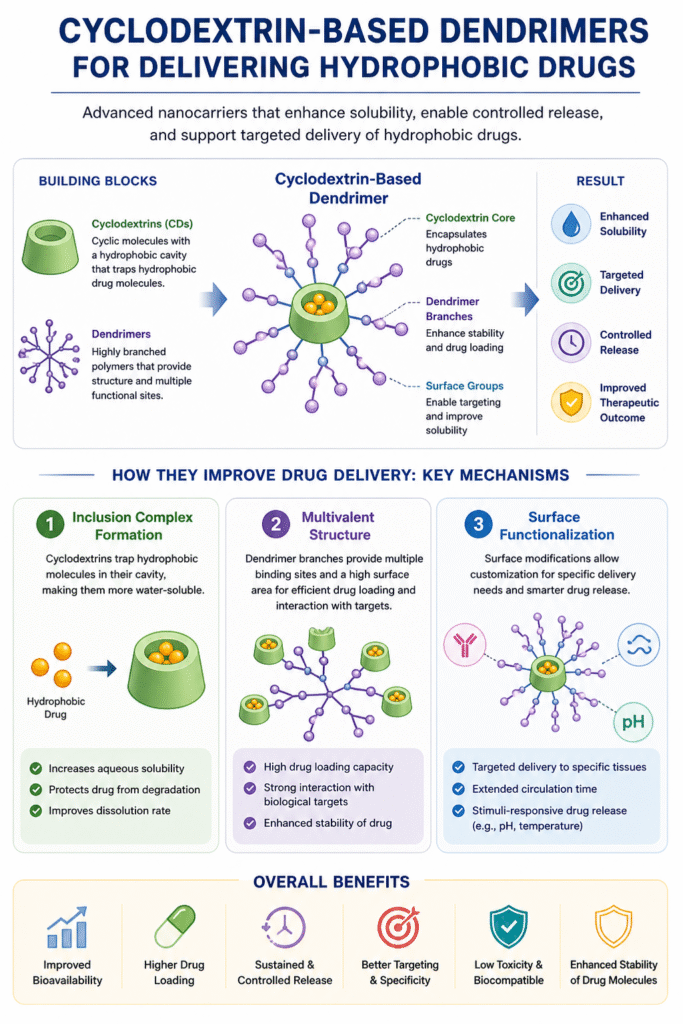
Cyclodextrin-based dendrimers are hybrid nanostructures that encapsulate hydrophobic drugs within cyclodextrin cavities, while dendrimer branches enhance stability, solubility, and targeting efficiency.
They are formed by combining two key components:
- Cyclodextrins (CDs): Cyclic molecules that trap hydrophobic drug molecules inside their cavity
- Dendrimers: Highly branched polymers that provide structural support and multiple functional sites
Structural Features
| Component | Function |
|---|---|
| Cyclodextrin Core | Encapsulates hydrophobic drugs |
| Dendrimer Branches | Enhance stability and drug loading |
| Surface Groups | Enable targeting and improve solubility |
2: Why Are Hydrophobic Drugs Challenging?
Hydrophobic drugs are difficult to deliver because they do not dissolve well in water, leading to poor absorption and reduced therapeutic effectiveness.
Key Challenges
- Poor dissolution in biological fluids: Limits the drug’s ability to be absorbed
- Low bioavailability: Only a small portion reaches the bloodstream
- Rapid elimination: Reduces how long the drug stays active in the body
- Inconsistent dosing outcomes: Causes variability in effectiveness and safety
These challenges make it essential to use advanced delivery systems, such as cyclodextrin-based dendrimers, to improve solubility and overall drug performance.
3: How Cyclodextrin-Based Dendrimers Improve Drug Delivery
Cyclodextrin-based dendrimers improve drug delivery by enhancing solubility, enabling controlled release, and supporting targeted delivery of hydrophobic drugs.
Mechanisms
1. Inclusion Complex Formation
Cyclodextrins encapsulate hydrophobic drug molecules within their cavity, increasing their water solubility and stability.
2. Multivalent Structure
Dendrimers provide:
- High drug loading capacity
- Strong interaction with biological targets
3. Surface Functionalization
Surface modifications enable:
- Targeted delivery to specific tissues
- Extended circulation time in the body
- Stimuli-responsive drug release (e.g., pH or temperature-sensitive)
4: Advantages of Cyclodextrin-Based Dendrimers
Cyclodextrin-based dendrimers offer improved solubility, targeted delivery, enhanced safety, and controlled drug release compared to conventional drug delivery systems.
Key Benefits
- Improved solubility: Enhances dissolution of poorly water-soluble drugs
- High drug loading efficiency: Multivalent structure allows greater drug encapsulation
- Controlled and sustained release: Maintains consistent therapeutic levels over time
- Target-specific delivery: Enables precise delivery to desired tissues or cells
- Biocompatibility and low toxicity: Safe for biological applications
- Enhanced stability: Protects drug molecules from degradation and environmental factors
5: Applications in Pharmaceutical and Biomedical Fields
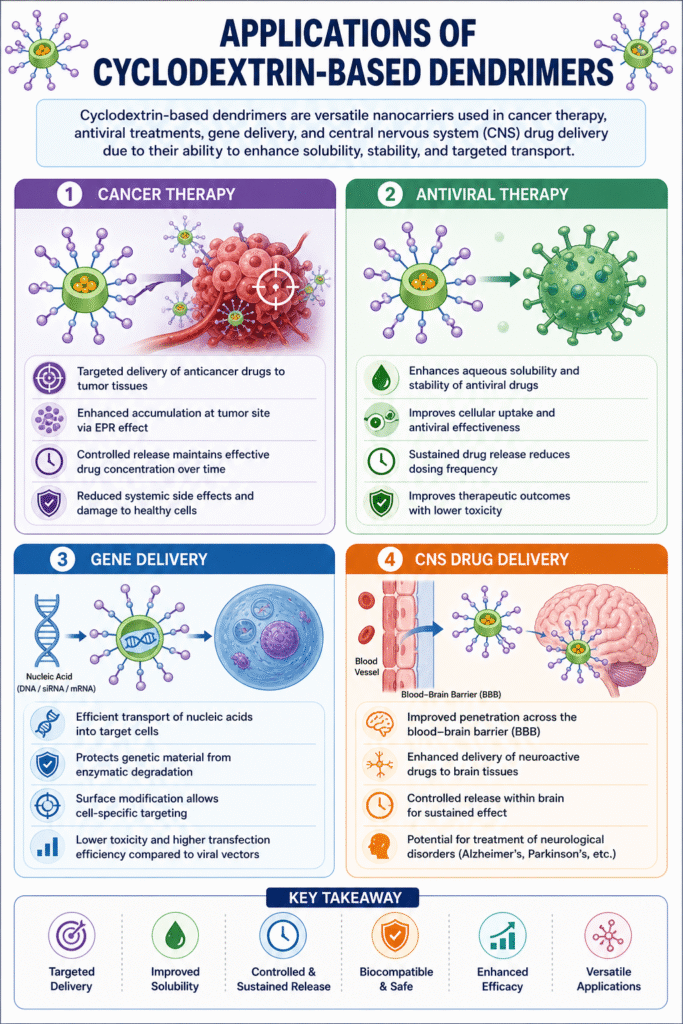
Cyclodextrin-based dendrimers are used in cancer therapy, antiviral treatments, gene delivery, and CNS drug delivery because they enhance solubility, stability, and targeted transport of therapeutic agents.
Major Applications
Cancer Therapy
Cyclodextrin-based dendrimers play a significant role in oncology by improving the delivery of hydrophobic anticancer drugs.
- Enable targeted delivery to tumor tissues, reducing damage to healthy cells
- Increase drug accumulation at the tumor site through enhanced permeability and retention (EPR effect)
- Support controlled release, maintaining effective drug concentration over time
- Help reduce common side effects associated with chemotherapy
Antiviral Therapy
These nanocarriers improve the effectiveness of antiviral drugs that suffer from poor solubility.
- Enhance aqueous solubility and stability of antiviral agents
- Improve cellular uptake, leading to better therapeutic response
- Allow sustained drug release, reducing dosing frequency
Gene Delivery
Cyclodextrin-based dendrimers are widely explored as non-viral vectors for gene therapy.
- Facilitate efficient transport of nucleic acids (DNA, siRNA, mRNA) into cells
- Protect genetic material from enzymatic degradation
- Offer lower toxicity compared to viral vectors
- Allow surface modification for cell-specific targeting
CNS Drug Delivery
Delivering drugs to the brain is challenging due to the blood-brain barrier (BBB), but these systems offer promising solutions.
- Improve penetration across the blood-brain barrier
- Enhance delivery of neuroactive drugs
- Provide controlled release within brain tissues
- Potential applications in treating neurological disorders
6: Comparison with Conventional Drug Delivery Systems
Cyclodextrin-based dendrimers offer superior performance compared to conventional drug delivery systems, particularly in solubility, targeting, and controlled release.
Key Comparison
| Feature | Conventional Systems | Cyclodextrin-Based Dendrimers |
|---|---|---|
| Solubility | Limited | High |
| Drug Loading | Moderate | High |
| Targeting | Low | High |
| Release Control | Poor | Excellent |
| Biocompatibility | Variable | High |
Why This Matters
- Improved solubility ensures better absorption of hydrophobic drugs
- Higher drug loading increases therapeutic efficiency
- Enhanced targeting reduces side effects by focusing on specific tissues
- Controlled release maintains consistent drug levels in the body
- Better biocompatibility improves safety and patient outcomes
This comparison highlights why cyclodextrin-based dendrimers are emerging as a more advanced and reliable approach in modern drug delivery.
7: Challenges and Limitations
The main challenges of cyclodextrin-based dendrimers include complex synthesis, scalability issues, and regulatory considerations.
Key Limitations
- Complex manufacturing process: Multi-step synthesis requires precise control and expertise
- Higher production costs: Advanced materials and processes increase overall cost
- Scalability challenges: Difficult to produce consistently at an industrial scale
- Extensive safety requirements: Requires thorough toxicity and long-term safety studies
ResolveMass Laboratories Inc. addresses these challenges through advanced synthesis optimization, scalable process development, and rigorous analytical validation to ensure reliability and compliance.
8: Future Perspectives
Straight Answer: These systems will play a key role in personalized medicine and advanced nanotherapeutics.
Emerging Trends
- Smart, stimuli-responsive dendrimers
- AI-driven drug design
- Precision-targeted therapies
- Multi-drug delivery systems
9: Why Choose ResolveMass Laboratories Inc.?
ResolveMass Laboratories Inc. provides expertise in:
- Advanced drug delivery systems
- Analytical testing and characterization
- Custom formulation development
- Regulatory-compliant research
Our approach ensures scientifically robust and industry-relevant solutions.
Conclusion
Cyclodextrin-Based Dendrimers for Delivering Hydrophobic Drugs are transforming pharmaceutical science by solving the critical challenge of poor drug solubility. Their ability to enhance bioavailability, enable targeted delivery, and provide controlled release makes them a powerful tool in modern medicine.
As innovation continues, these nanocarriers will play an increasingly important role in developing safer and more effective therapies.
Frequently Asked Questions:
Cyclodextrin-based dendrimers address the major challenge of poor water solubility in hydrophobic drugs. Many drugs fail to perform effectively because they cannot dissolve properly in biological fluids. These nanocarriers improve solubility, allowing better absorption in the body. As a result, the drug becomes more effective at lower doses. They also help in maintaining consistent therapeutic levels. This makes them highly valuable in modern drug formulation.
Unlike conventional nanoparticles, cyclodextrin-based dendrimers combine two functional systems in one structure. Cyclodextrins encapsulate hydrophobic drugs, while dendrimers provide a highly branched surface for multiple interactions. This dual functionality improves drug loading and delivery efficiency. They also allow precise surface modifications for targeting. Their structure is more controlled and uniform compared to many nanoparticles. This results in better reproducibility and performance.
Yes, they significantly enhance drug bioavailability by improving solubility and stability. When a drug dissolves better, it can be more easily absorbed into the bloodstream. They also protect drugs from premature degradation. This ensures that a larger fraction of the drug reaches the target site. Additionally, controlled release helps maintain drug levels over time. All these factors contribute to improved therapeutic outcomes.
Cyclodextrin-based dendrimers can help reduce side effects by enabling targeted drug delivery. Instead of distributing the drug throughout the body, they can direct it to specific tissues or cells. This reduces exposure to healthy tissues. Controlled release further prevents sudden spikes in drug concentration. As a result, toxicity and adverse reactions are minimized. This improves overall patient safety and treatment experience.
They can be used in oral drug delivery, especially for poorly soluble drugs. By improving solubility, they enhance drug absorption in the gastrointestinal tract. However, formulation stability and interaction with digestive enzymes must be considered. Surface modifications can help improve their performance in oral systems. In some cases, they also protect drugs from degradation in the stomach. Overall, they show strong potential in oral formulations.
Cyclodextrin-based dendrimers are widely used in the pharmaceutical and biotechnology industries. They are particularly valuable in drug delivery research and development. Nanomedicine and precision medicine fields also rely on these systems. Academic and clinical research institutions actively study their applications. They are also gaining interest in advanced therapeutic development. Their versatility makes them relevant across multiple scientific domains.
Yes, their highly branched structure allows them to carry multiple drug molecules simultaneously. This is especially useful for combination therapies. Different drugs can be loaded either inside the cyclodextrin cavity or on the dendrimer surface. This enables synergistic treatment approaches. It also reduces the need for multiple formulations. Such capability is highly beneficial in complex diseases like cancer.
Reference
- Topuz F, Uyar T. Recent advances in cyclodextrin‐based nanoscale drug delivery systems. Wiley Interdisciplinary Reviews: Nanomedicine and Nanobiotechnology. 2024 Nov;16(6):e1995.https://wires.onlinelibrary.wiley.com/doi/abs/10.1002/wnan.1995
- Vyas A, Saraf S, Saraf S. Cyclodextrin based novel drug delivery systems. Journal of inclusion phenomena and macrocyclic chemistry. 2008 Oct;62(1):23-42.https://link.springer.com/article/10.1007/s10847-008-9456-y
- Pandey A. Cyclodextrin-based nanoparticles for pharmaceutical applications: A review. Environmental Chemistry Letters. 2021 Dec;19(6):4297-310.https://link.springer.com/article/10.1007/s10311-021-01275-y
- Mellet CO, Fernández JM, Benito JM. Cyclodextrin-based gene delivery systems. Chemical Society Reviews. 2011;40(3):1586-608.https://pubs.rsc.org/en/content/articlehtml/2011/cs/c0cs00019a
- Gadade DD, Pekamwar SS. Cyclodextrin based nanoparticles for drug delivery and theranostics. Advanced pharmaceutical bulletin. 2020 Feb 18;10(2):166.https://pmc.ncbi.nlm.nih.gov/articles/PMC7191229/
- Hussein I, Krabicová I, Hoti G, Er-Rahmani S, Matencio A, Caldera F, Trotta F. Cyclodextrin-based carriers for targeted drug delivery. Expert Opinion on Drug Delivery. 2026 Mar 4;23(3):537-55.https://www.tandfonline.com/doi/abs/10.1080/17425247.2025.2596707