Introduction:
Cyclodextrin-Based Dendrimers in Oral Drug Delivery are emerging as highly promising nanotechnology platforms for improving oral pharmaceutical formulations. Many modern drug molecules suffer from poor aqueous solubility, low intestinal permeability, instability in gastrointestinal fluids, and extensive first-pass metabolism. These limitations often result in reduced therapeutic efficacy and inconsistent bioavailability.
Cyclodextrin-based dendrimers address these challenges by combining two powerful molecular systems:
- Cyclodextrins, which enhance drug solubility through inclusion complex formation
- Dendrimers, which provide highly branched nanoscale architectures capable of controlled drug encapsulation and transport
This multifunctional combination creates advanced oral delivery systems capable of improving drug absorption, protecting sensitive molecules, and enabling controlled release behavior.
As pharmaceutical innovation increasingly focuses on complex APIs, biologics, and poorly soluble compounds, cyclodextrin dendrimers are gaining significant attention in formulation science and nanomedicine research.
Summary:
- Cyclodextrin-Based Dendrimers in Oral Drug Delivery are advanced nanocarriers designed to improve the solubility, stability, permeability, and bioavailability of poorly water-soluble drugs.
- These hybrid systems combine the inclusion-complex capabilities of cyclodextrins with the highly branched architecture of dendrimers.
- They are increasingly studied for oral delivery of peptides, anticancer drugs, antifungal agents, and poorly permeable APIs.
- Major benefits include controlled drug release, enhanced intestinal absorption, reduced toxicity, and improved patient compliance.
- Pharmaceutical researchers are exploring these systems for next-generation oral formulations, particularly for challenging molecules with low bioavailability.
- Regulatory characterization, analytical testing, and formulation optimization remain critical for successful development and commercialization.
1: What Are Cyclodextrin-Based Dendrimers?
Cyclodextrin-based dendrimers are nanoscale branched polymers that incorporate cyclodextrin units either at the core, branching points, or surface of the dendrimer structure.
These systems integrate the advantages of both technologies into a single multifunctional carrier.
Key Structural Components
| Component | Function |
|---|---|
| Cyclodextrin | Enhances solubility and forms inclusion complexes |
| Dendrimer Core | Provides structural framework |
| Branched Arms | Enable drug encapsulation and surface modification |
| Functional Surface Groups | Improve targeting, mucoadhesion, or permeability |
Common Cyclodextrins Used
- α-Cyclodextrin
- β-Cyclodextrin
- γ-Cyclodextrin
- Hydroxypropyl-β-cyclodextrin (HPβCD)
Common Dendrimer Types
- PAMAM dendrimers
- PPI dendrimers
- Polyester dendrimers
- Polylysine dendrimers
These nanosystems can carry both hydrophilic and hydrophobic drugs, making them highly versatile for oral pharmaceutical applications.
2: Why Oral Drug Delivery Remains Challenging
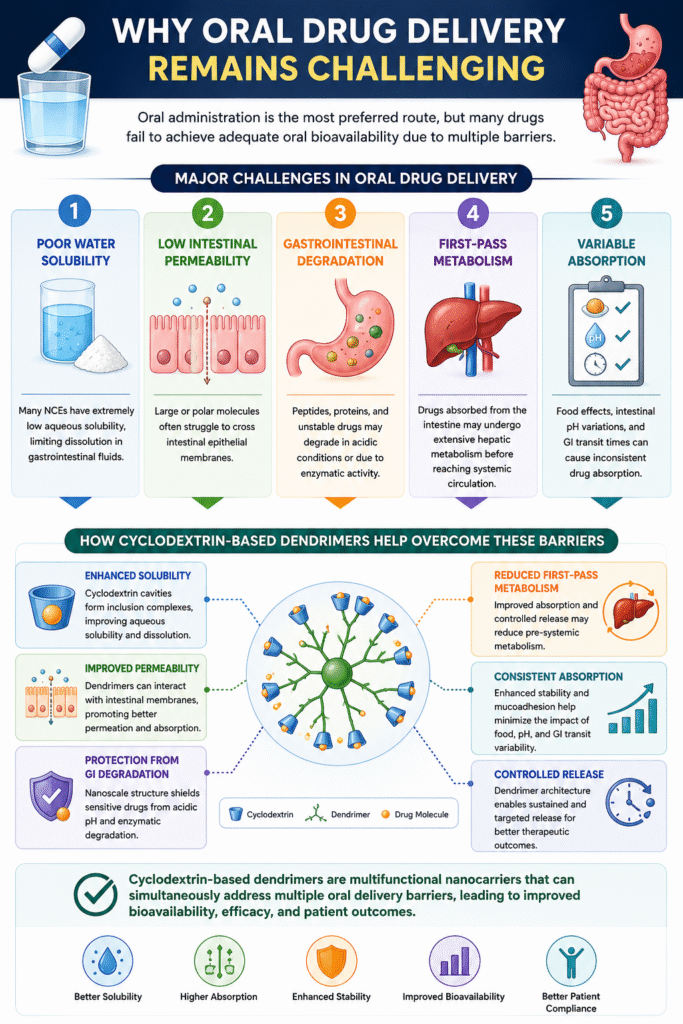
Oral drug delivery is the most widely used route of administration because it is convenient, non-invasive, cost-effective, and generally preferred by patients. However, achieving consistent and efficient oral bioavailability remains a major challenge in pharmaceutical development. Many modern drug molecules, especially poorly water-soluble compounds and biologics, face significant barriers within the gastrointestinal (GI) tract that limit therapeutic effectiveness.
Major Challenges in Oral Drug Delivery:
1. Poor Water Solubility
A large number of newly developed pharmaceutical compounds exhibit poor aqueous solubility. Since drugs must dissolve in gastrointestinal fluids before absorption can occur, limited solubility often leads to poor dissolution rates and reduced bioavailability.
Common consequences include:
- Incomplete drug absorption
- Delayed onset of action
- Variable therapeutic response
- Increased dose requirements
This challenge is particularly common among lipophilic drugs and many modern new chemical entities (NCEs).
2. Low Intestinal Permeability
Even if a drug dissolves successfully, it must still cross the intestinal epithelium to enter systemic circulation. Large molecular weight compounds, hydrophilic drugs, and highly polar molecules often exhibit poor membrane permeability.
Factors affecting permeability include:
- Molecular size
- Lipophilicity
- Charge characteristics
- Efflux transporter activity
Low permeability significantly limits oral absorption of peptides, proteins, and many advanced therapeutics.
3. Gastrointestinal Degradation
The gastrointestinal tract presents a harsh environment for sensitive drug molecules. Acidic gastric conditions and digestive enzymes can rapidly degrade unstable compounds before absorption occurs.
Drugs particularly susceptible include:
- Peptides
- Proteins
- Nucleic acid therapeutics
- Certain biologics
Enzymatic degradation can drastically reduce therapeutic activity and oral bioavailability.
4. First-Pass Metabolism
After absorption, many drugs undergo extensive metabolism in the liver before reaching systemic circulation. This phenomenon, known as first-pass metabolism, can significantly decrease the amount of active drug available in the bloodstream.
Major impacts include:
- Reduced bioavailability
- Increased dose requirements
- Shortened therapeutic duration
- Greater interpatient variability
Some drugs lose a substantial percentage of their activity during this process.
5. Variable Absorption
Oral drug absorption is influenced by numerous physiological factors that can vary widely between patients and dosing conditions.
These factors include:
- Food intake
- Gastric emptying time
- Intestinal transit rate
- Gastrointestinal pH
- Age and disease state
As a result, oral formulations may produce inconsistent plasma concentrations and unpredictable therapeutic outcomes.
Role of Cyclodextrin-Based Dendrimers
Cyclodextrin-based dendrimers are being investigated as advanced nanocarrier systems capable of addressing multiple oral delivery barriers simultaneously. Their multifunctional architecture may improve:
- Drug solubility
- Membrane permeability
- Gastrointestinal stability
- Controlled release behavior
- Overall oral bioavailability
By combining cyclodextrin inclusion complexation with dendrimer-based nanoscale transport properties, these systems offer promising opportunities for next-generation oral pharmaceutical formulations.
3: How Cyclodextrin-Based Dendrimers Improve Oral Drug Delivery
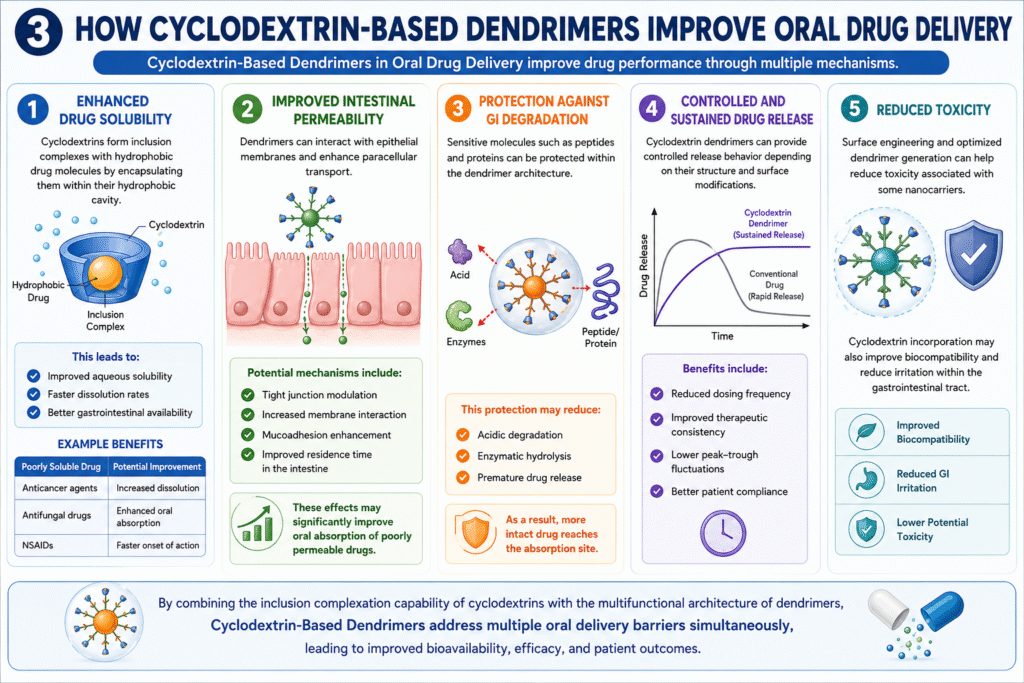
Cyclodextrin-Based Dendrimers in Oral Drug Delivery improve pharmaceutical performance through multiple complementary mechanisms. These advanced nanocarriers combine the solubility-enhancing properties of cyclodextrins with the multifunctional transport capabilities of dendrimers, helping overcome several major barriers associated with oral drug administration.
1. Enhanced Drug Solubility
One of the biggest limitations in oral drug delivery is poor aqueous solubility. Many modern drug molecules are highly hydrophobic, which reduces dissolution in gastrointestinal fluids and limits absorption.
Cyclodextrins improve solubility by forming inclusion complexes with hydrophobic drug molecules. Their hydrophobic internal cavity can encapsulate poorly soluble compounds while the hydrophilic outer surface improves dispersion in aqueous environments.
Benefits of Improved Solubility
- Increased aqueous solubility
- Faster dissolution rates
- Enhanced gastrointestinal availability
- Improved absorption consistency
Examples of Potential Improvements
| Poorly Soluble Drug Category | Potential Benefit |
|---|---|
| Anticancer agents | Increased dissolution |
| Antifungal drugs | Enhanced oral absorption |
| NSAIDs | Faster onset of action |
Improved solubility is especially important for Biopharmaceutics Classification System (BCS) Class II and IV drugs.
2. Improved Intestinal Permeability
Even after dissolution, drugs must cross the intestinal epithelium to reach systemic circulation. Dendrimers can enhance permeability by interacting with epithelial membranes and promoting drug transport across intestinal barriers.
Potential Mechanisms
- Tight junction modulation
- Increased membrane interaction
- Enhanced mucoadhesion
- Prolonged intestinal residence time
These mechanisms may significantly improve the oral absorption of poorly permeable compounds such as peptides, proteins, and hydrophilic molecules.
Advantages
- Improved therapeutic efficiency
- Increased bioavailability
- Better transport across epithelial membranes
- Enhanced uptake of large molecules
3. Protection Against GI Degradation
Sensitive therapeutic molecules are often degraded by acidic gastric conditions or digestive enzymes before absorption can occur.
Cyclodextrin-based dendrimers can protect encapsulated drugs within their nanoscale architecture, reducing premature degradation during gastrointestinal transit.
Protection Mechanisms
- Shielding from acidic stomach pH
- Reduced enzymatic hydrolysis
- Prevention of premature drug release
- Stabilization of sensitive biomolecules
This protection is particularly beneficial for:
- Peptides
- Proteins
- Biologics
- RNA-based therapeutics
As a result, more intact drug reaches the intestinal absorption site, improving therapeutic performance.
4. Controlled and Sustained Drug Release
Cyclodextrin dendrimers can be engineered to provide controlled or sustained drug release depending on their composition, surface chemistry, and structural design.
Benefits of Controlled Release
- Reduced dosing frequency
- Improved therapeutic consistency
- Lower peak-trough plasma fluctuations
- Better patient compliance
- Reduced side effects
Sustained release formulations may also help maintain optimal drug concentrations over longer periods, improving overall treatment outcomes.
5. Reduced Toxicity
Traditional nanocarriers may sometimes exhibit cytotoxicity or gastrointestinal irritation. Surface engineering of dendrimers can significantly reduce these concerns.
Cyclodextrin incorporation may further improve biocompatibility and reduce adverse interactions within the gastrointestinal tract.
Potential Safety Advantages
- Lower cytotoxicity
- Reduced gastrointestinal irritation
- Improved biocompatibility
- Safer long-term administration
Optimization of dendrimer generation and surface charge is critical for balancing efficacy and safety.
4: Drug Loading Mechanisms
Cyclodextrin-based dendrimers can incorporate and retain drug molecules through multiple loading mechanisms. These interactions allow the nanocarrier system to improve drug solubility, stability, controlled release behavior, and oral bioavailability. The specific loading mechanism depends on the physicochemical properties of both the drug and the dendrimer system.
1. Inclusion Complex Formation
Inclusion complex formation is one of the primary mechanisms used in cyclodextrin-based drug delivery systems. Cyclodextrins possess a unique molecular structure with a hydrophobic inner cavity and hydrophilic outer surface.
Hydrophobic drug molecules can become physically encapsulated within the cyclodextrin cavity, forming a non-covalent inclusion complex.
How It Works
- Hydrophobic regions of the drug enter the cyclodextrin cavity
- The outer hydrophilic surface improves aqueous compatibility
- Drug molecules become more soluble and stable in gastrointestinal fluids
Key Advantages
- Improved aqueous solubility
- Enhanced dissolution rates
- Increased oral bioavailability
- Protection from degradation
Commonly Loaded Drugs
| Drug Type | Benefit of Inclusion Complex |
|---|---|
| Anticancer drugs | Improved dissolution |
| Antifungal agents | Enhanced absorption |
| Hydrophobic APIs | Increased solubility |
This mechanism is particularly valuable for poorly water-soluble drugs.
2. Electrostatic Interactions
Electrostatic interactions occur between charged dendrimer surfaces and oppositely charged drug molecules. Dendrimers often contain surface functional groups such as amines or carboxyl groups that can interact ionically with drugs.
Mechanism
- Positively charged dendrimers bind negatively charged drugs
- Negatively charged dendrimers interact with cationic compounds
- Ionic attraction stabilizes drug loading within the nanocarrier
Benefits
- High drug loading efficiency
- Improved carrier stability
- Controlled drug release potential
- Enhanced retention within the delivery system
Applications
Electrostatic loading is commonly explored for:
- Peptides
- Proteins
- Nucleic acid therapeutics
- Charged small molecules
The strength of ionic interactions can often be optimized by adjusting pH and surface chemistry.
3. Hydrogen Bonding
Hydrogen bonding is another important non-covalent interaction involved in drug incorporation. Functional groups present on dendrimers and cyclodextrins can form hydrogen bonds with compatible drug molecules.
Typical Functional Groups Involved
- Hydroxyl groups
- Amine groups
- Carbonyl groups
- Carboxyl groups
Advantages of Hydrogen Bonding
- Improved drug-carrier stability
- Enhanced encapsulation efficiency
- Controlled release behavior
- Better formulation integrity
Hydrogen bonding can work alongside inclusion complexation and electrostatic interactions to further stabilize the drug delivery system.
4. Covalent Conjugation
In some advanced formulations, drugs are chemically linked directly to the dendrimer structure through covalent bonds. This approach is commonly used for targeted delivery and sustained release applications.
How Covalent Conjugation Works
- Drug molecules are chemically attached to functional groups on the dendrimer surface
- Linkers may be designed to release the drug under specific physiological conditions
- Cleavage can occur through enzymatic activity, pH changes, or hydrolysis
Major Advantages
- Precise control of drug release
- Reduced premature drug leakage
- Improved targeting potential
- Enhanced systemic stability
Applications
Covalent conjugation is often investigated for:
- Anticancer therapies
- Targeted nanomedicine
- Long-acting formulations
- Stimuli-responsive delivery systems
Although highly effective, covalent systems may require more complex synthesis and regulatory characterization.
5: Applications of Cyclodextrin-Based Dendrimers in Oral Drug Delivery
These advanced carriers are being investigated across multiple therapeutic areas.
1. Oral Delivery of Anticancer Drugs
Many anticancer agents have poor oral bioavailability.
Cyclodextrin dendrimers may improve:
- Solubility
- Stability
- Tumor-targeted accumulation
- Controlled release
Potentially studied drugs include:
- Paclitaxel
- Doxorubicin
- Curcumin
2. Oral Peptide and Protein Delivery
Peptides traditionally require injection due to poor oral absorption.
Cyclodextrin dendrimers may help by:
- Protecting peptides from enzymatic degradation
- Enhancing intestinal permeability
- Increasing residence time
This area is particularly important for future oral biologic formulations.
3. Antifungal and Antimicrobial Formulations
Poorly soluble antifungal drugs often benefit from nanoscale delivery systems.
Potential advantages include:
- Improved dissolution
- Enhanced mucosal penetration
- Better systemic exposure
4. Delivery of Nutraceuticals and Natural Compounds
Many natural compounds suffer from poor bioavailability.
Examples include:
- Curcumin
- Resveratrol
- Quercetin
Cyclodextrin dendrimers may significantly improve oral uptake and therapeutic performance.
6: Advantages of Cyclodextrin-Based Dendrimers in Oral Drug Delivery
1. Multifunctional Carrier System
These systems simultaneously improve:
- Solubility
- Stability
- Permeability
- Controlled release
2. High Drug Loading Capacity
The branched architecture provides multiple interaction sites for drug incorporation.
3. Tunable Surface Chemistry
Researchers can modify surface groups to optimize:
- Mucoadhesion
- Targeting
- Release kinetics
- Biocompatibility
4. Improved Patient Compliance
Enhanced oral delivery may reduce reliance on injectable therapies.
5. Potential for Personalized Medicine
Tailored nanocarriers may support individualized therapeutic strategies in the future.
7: Limitations and Challenges
Although cyclodextrin-based dendrimers offer significant advantages for advanced oral drug delivery, several scientific, manufacturing, and regulatory challenges still limit their widespread commercial application. Addressing these limitations is essential for achieving safe, scalable, and regulatory-compliant pharmaceutical products.
1. Toxicity Concerns
One of the primary concerns associated with dendrimer-based nanocarriers is potential cytotoxicity. Certain dendrimer generations, particularly highly cationic systems, may interact strongly with biological membranes and cause cellular damage.
Factors Influencing Toxicity
- Surface charge
- Dendrimer generation size
- Concentration
- Surface functional groups
- Exposure duration
Positively charged dendrimers may disrupt cell membranes, leading to:
- Cellular irritation
- Membrane destabilization
- Oxidative stress
- Inflammatory responses
Strategies to Reduce Toxicity
Researchers often use surface modification approaches to improve biocompatibility, including:
- PEGylation
- Cyclodextrin incorporation
- Surface neutralization
- Biocompatible functional groups
Careful optimization of dendrimer architecture and dosage is critical for balancing therapeutic performance and safety.
2. Manufacturing Complexity
Large-scale production of cyclodextrin-based dendrimers remains technically challenging. These nanosystems require highly controlled multistep synthesis processes to ensure reproducibility and consistent product quality.
Challenges include:
- Batch consistency
- Purification
- Structural characterization
- Cost of production
3. Regulatory Uncertainty
Nanomedicine-based pharmaceutical products often face evolving and sometimes unclear regulatory pathways. Because cyclodextrin dendrimers involve nanoscale structures and multifunctional delivery mechanisms, regulatory agencies may require extensive supporting data.
Regulatory agencies may require:
- Detailed physicochemical analysis
- Toxicological evaluation
- Stability studies
- Bioavailability assessment
4. Stability Issues
Long-term stability is a major consideration for any nanocarrier-based pharmaceutical system. Cyclodextrin-based dendrimers must maintain their structural integrity, drug loading efficiency, and release profile throughout storage and transportation.
Potential Stability Concerns
- Particle aggregation
- Drug leakage
- Structural degradation
- Moisture sensitivity
- Temperature-dependent instability
Environmental conditions such as:
- Humidity
- Light exposure
- Temperature fluctuations
- pH changes
may affect formulation performance over time.
Importance of Stability Testing
Comprehensive stability studies help evaluate:
- Shelf life
- Packaging compatibility
- Storage requirements
- Product reproducibility
Robust formulation design and optimized storage conditions are necessary to maintain consistent therapeutic quality.
8: Analytical Characterization Requirements
Comprehensive analytical characterization is essential for the successful development of cyclodextrin-based dendrimer formulations. Since these nanoscale drug delivery systems possess complex architectures and multifunctional properties, detailed physicochemical analysis is necessary to ensure formulation quality, stability, reproducibility, and regulatory compliance.
Analytical characterization helps researchers understand how the formulation behaves under physiological and storage conditions while also supporting process optimization and quality control during pharmaceutical development.
Important Analytical Parameters
| Parameter | Analytical Technique |
|---|---|
| Particle size | Dynamic Light Scattering (DLS) |
| Surface charge | Zeta potential analysis |
| Drug loading | HPLC / LC-MS |
| Structural confirmation | NMR / FTIR |
| Morphology | TEM / SEM |
| Release profile | Dissolution testing |
Advanced analytical laboratories play an important role in ensuring formulation quality, reproducibility, and regulatory compliance.
9: Future Perspectives
The future of Cyclodextrin-Based Dendrimers in Oral Drug Delivery appears highly promising as pharmaceutical research increasingly targets poorly bioavailable and complex therapeutic molecules.
Emerging areas include:
- Oral biologics
- RNA therapeutics
- Precision nanomedicine
- Stimuli-responsive delivery systems
- Targeted gastrointestinal delivery
Artificial intelligence and advanced formulation modeling may further accelerate optimization of these nanosystems.
As nanotechnology-based therapeutics continue to evolve, cyclodextrin dendrimers may become key enabling platforms for next-generation oral drug products.
Conclusion:
Cyclodextrin-Based Dendrimers in Oral Drug Delivery represent a powerful and innovative pharmaceutical strategy for improving the oral performance of challenging drug molecules. By combining the solubilization capabilities of cyclodextrins with the multifunctional architecture of dendrimers, these nanosystems can enhance solubility, permeability, stability, and controlled release simultaneously.
Although challenges related to toxicity, manufacturing, and regulatory requirements remain, ongoing advancements in nanomedicine and analytical science continue to strengthen their potential for future pharmaceutical applications.
For pharmaceutical companies developing advanced oral formulations, robust analytical characterization, formulation optimization, and regulatory support are essential for successful product development.
Frequently Asked Questions:
Cyclodextrins contain a hydrophobic inner cavity and hydrophilic outer surface. Hydrophobic drug molecules can enter the cavity and form inclusion complexes, which improve aqueous solubility and dissolution rates. This process helps increase gastrointestinal availability and oral absorption of poorly soluble drugs.
Dendrimers provide a highly branched nanoscale framework capable of carrying drug molecules through encapsulation, electrostatic interactions, or covalent conjugation. They can improve permeability, protect drugs from degradation, and support sustained release behavior, making them highly valuable for oral nanomedicine applications.
These systems are especially useful for:
-Poorly water-soluble drugs
-Anticancer agents
-Antifungal drugs
-Peptides and proteins
-Biologics
-Nutraceuticals such as curcumin and resveratrol
They are widely studied for drugs with low oral bioavailability.
Cyclodextrin dendrimers may enhance intestinal permeability through membrane interaction, tight junction modulation, and improved mucoadhesion. These effects can increase drug transport across intestinal epithelial barriers and improve systemic absorption after oral administration.
Yes. These nanosystems can protect sensitive drug molecules from acidic gastric conditions and enzymatic degradation within the gastrointestinal tract. This protection is especially beneficial for peptides, proteins, and unstable therapeutic compounds.
Safety depends on factors such as dendrimer generation, surface charge, concentration, and formulation design. Some dendrimers may exhibit cytotoxicity, particularly highly cationic systems. Surface modification and careful optimization are important for improving biocompatibility and reducing toxicity.
Reference
- Topuz F, Uyar T. Recent advances in cyclodextrin‐based nanoscale drug delivery systems. Wiley Interdisciplinary Reviews: Nanomedicine and Nanobiotechnology. 2024 Nov;16(6):e1995.https://wires.onlinelibrary.wiley.com/doi/abs/10.1002/wnan.1995
- Vyas A, Saraf S, Saraf S. Cyclodextrin based novel drug delivery systems. Journal of inclusion phenomena and macrocyclic chemistry. 2008 Oct;62(1):23-42.https://link.springer.com/article/10.1007/s10847-008-9456-y
- Uekama K, Hirayama F, Arima H. Recent aspect of cyclodextrin-based drug delivery system. Journal of inclusion phenomena and macrocyclic chemistry. 2006 Oct;56(1):3-8.https://link.springer.com/article/10.1007/s10847-006-9052-y
- Pandey A. Cyclodextrin-based nanoparticles for pharmaceutical applications: A review. Environmental Chemistry Letters. 2021 Dec;19(6):4297-310.https://link.springer.com/article/10.1007/s10311-021-01275-y
- Păduraru DN, Niculescu AG, Bolocan A, Andronic O, Grumezescu AM, Bîrlă R. An updated overview of cyclodextrin-based drug delivery systems for cancer therapy. Pharmaceutics. 2022 Aug 22;14(8):1748.https://www.mdpi.com/1999-4923/14/8/1748
- Gadade DD, Pekamwar SS. Cyclodextrin based nanoparticles for drug delivery and theranostics. Advanced pharmaceutical bulletin. 2020 Feb 18;10(2):166.https://pmc.ncbi.nlm.nih.gov/articles/PMC7191229/
- Hussein I, Krabicová I, Hoti G, Er-Rahmani S, Matencio A, Caldera F, Trotta F. Cyclodextrin-based carriers for targeted drug delivery. Expert Opinion on Drug Delivery. 2026 Mar 4;23(3):537-55.https://www.tandfonline.com/doi/abs/10.1080/17425247.2025.2596707