

Introduction:
Cyclodextrin-Based Dendrimers in the Treatment of Neurological Disorders are gaining significant attention in pharmaceutical nanotechnology because they address one of the biggest challenges in neurotherapeutics: efficient drug delivery to the brain. Traditional neurological therapies often fail due to poor solubility, rapid degradation, systemic toxicity, and limited penetration through the blood-brain barrier (BBB).
Cyclodextrin-based dendrimers offer a highly versatile platform capable of encapsulating hydrophobic drugs, enhancing pharmacokinetics, and enabling targeted delivery to diseased brain tissues. Their multifunctional structure combines the cavity-forming properties of cyclodextrins with the branched nanoscale architecture of dendrimers, creating a sophisticated drug delivery vehicle suitable for complex neurological conditions.
As neurological disorders continue to rise globally, pharmaceutical and biotech companies are increasingly exploring advanced nanomedicine approaches to improve therapeutic outcomes while minimizing adverse effects.
Summary:
- Cyclodextrin-Based Dendrimers in the Treatment of Neurological Disorders are emerging as advanced nanocarriers that improve drug delivery across the blood-brain barrier (BBB).
- These systems combine the drug encapsulation ability of cyclodextrins with the multifunctional architecture of dendrimers.
- They show promising applications in treating neurological disorders such as:
- Alzheimer’s disease
- Parkinson’s disease
- Brain tumors
- Epilepsy
- Huntington’s disease
- Neuroinflammation
- Key advantages include:
- Enhanced drug solubility
- Controlled drug release
- Targeted brain delivery
- Reduced toxicity
- Improved therapeutic efficacy
- Advanced analytical characterization and bioanalytical support are critical for successful development and regulatory approval.
1: Understanding Cyclodextrin-Based Dendrimers
Cyclodextrin-based dendrimers are hybrid nanostructures formed by integrating cyclodextrin molecules into dendrimer architectures.
What Are Cyclodextrins?
Cyclodextrins are cyclic oligosaccharides with:
- A hydrophilic outer surface
- A hydrophobic inner cavity
This structure enables them to:
- Encapsulate poorly soluble drugs
- Improve aqueous solubility
- Enhance drug stability
- Reduce drug degradation
Common cyclodextrins include:
- Alpha-cyclodextrin
- Beta-cyclodextrin
- Gamma-cyclodextrin
What Are Dendrimers?
Dendrimers are highly branched nanoscale polymers characterized by:
- Precise molecular architecture
- Controlled size
- High surface functionality
- Monodispersity
Key properties include:
- Multiple attachment sites
- Tunable surface chemistry
- Controlled drug release capability
- High drug-loading efficiency
Why Combine Cyclodextrins and Dendrimers?
The combination creates multifunctional nanocarriers that provide:
| Feature | Benefit |
|---|---|
| Cyclodextrin cavity | Drug encapsulation |
| Dendrimer branching | High loading capacity |
| Surface modification | Targeted delivery |
| Nanoscale size | BBB penetration |
| Controlled architecture | Reproducibility |
This synergy makes them highly suitable for neurological drug delivery applications.
2: Why Neurological Drug Delivery Is Challenging
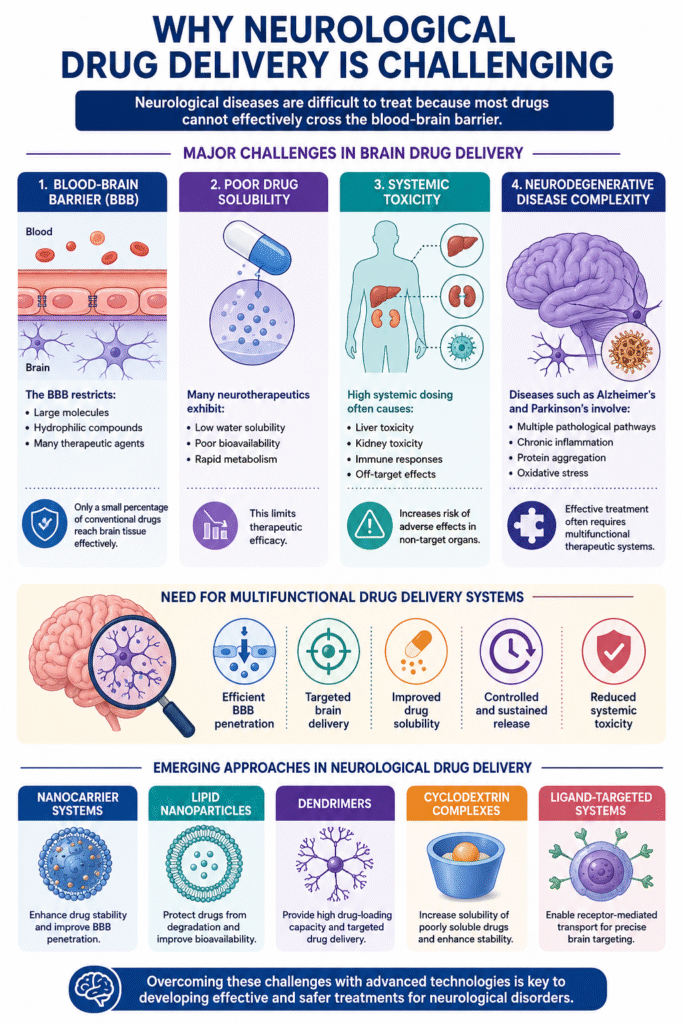
Neurological disorders remain among the most difficult diseases to treat because delivering therapeutic agents to the brain is highly complex. Most conventional drugs fail to achieve effective concentrations in the central nervous system (CNS) due to biological barriers, poor pharmacokinetics, and disease complexity.
One of the biggest obstacles is the blood-brain barrier (BBB), which strictly regulates the movement of substances from the bloodstream into brain tissue. As a result, many promising neurotherapeutics demonstrate limited clinical success despite strong pharmacological activity.
Major Challenges in Brain Drug Delivery:
1. Blood-Brain Barrier (BBB)
The BBB restricts:
- Large molecules
- Hydrophilic compounds
- Many therapeutic agents
Only a small percentage of conventional drugs reach brain tissue effectively.
2. Poor Drug Solubility
Many neurotherapeutics exhibit:
- Low water solubility
- Poor bioavailability
- Rapid metabolism
This limits therapeutic efficacy.
3. Systemic Toxicity
High systemic dosing often causes:
- Liver toxicity
- Kidney toxicity
- Immune responses
- Off-target effects
4. Neurodegenerative Disease Complexity
Diseases such as Alzheimer’s and Parkinson’s involve:
- Multiple pathological pathways
- Chronic inflammation
- Protein aggregation
- Oxidative stress
Effective treatment often requires multifunctional therapeutic systems.
3: How Cyclodextrin-Based Dendrimers Improve Neurological Therapy
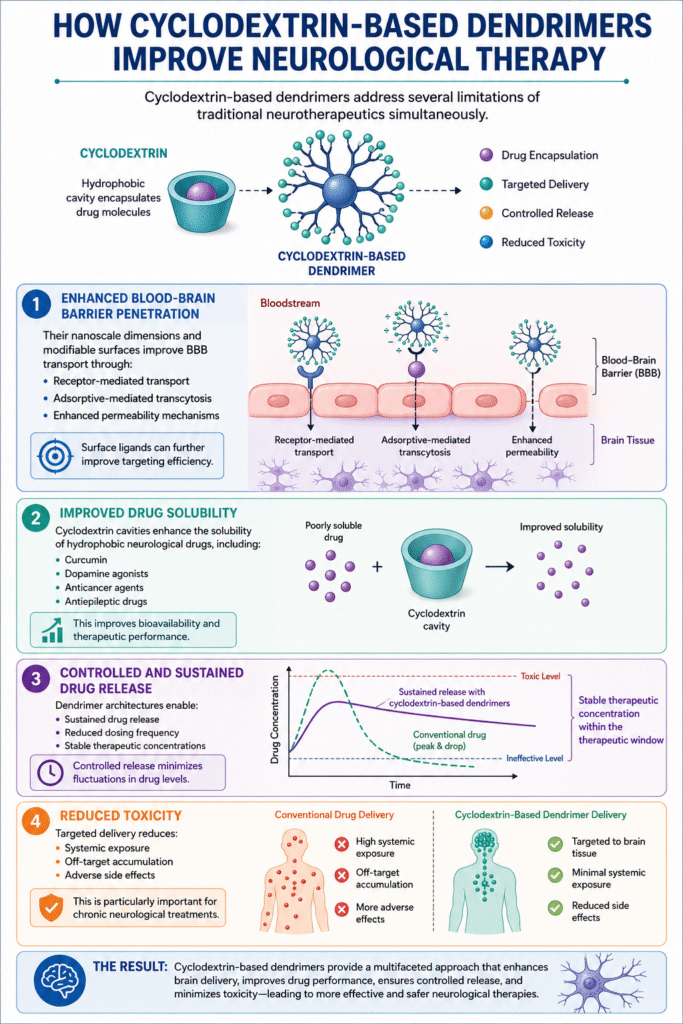
Cyclodextrin-based dendrimers are emerging as highly promising nanocarriers for neurological drug delivery because they simultaneously address multiple limitations associated with conventional neurotherapeutics. Their multifunctional architecture improves blood-brain barrier penetration, enhances drug solubility, enables controlled release, and reduces systemic toxicity.
These advantages make cyclodextrin-based dendrimers particularly valuable for the treatment of complex neurological disorders such as Alzheimer’s disease, Parkinson’s disease, epilepsy, and brain tumors.
1. Enhanced Blood-Brain Barrier Penetration
Their nanoscale dimensions and modifiable surfaces improve BBB transport through:
- Receptor-mediated transport
- Adsorptive-mediated transcytosis
- Enhanced permeability mechanisms
Surface ligands can further improve targeting efficiency.
2. Improved Drug Solubility
Cyclodextrin cavities enhance the solubility of hydrophobic neurological drugs, including:
- Curcumin
- Dopamine agonists
- Anticancer agents
- Antiepileptic drugs
This improves bioavailability and therapeutic performance.
3. Controlled and Sustained Drug Release
Dendrimer architectures enable:
- Sustained drug release
- Reduced dosing frequency
- Stable therapeutic concentrations
Controlled release minimizes fluctuations in drug levels.
4. Reduced Toxicity
Targeted delivery reduces:
- Systemic exposure
- Off-target accumulation
- Adverse side effects
This is particularly important for chronic neurological treatments.
4: Applications of Cyclodextrin-Based Dendrimers in Neurological Disorders
Cyclodextrin-based dendrimers are being extensively investigated for the treatment of various neurological disorders due to their ability to improve drug solubility, enhance blood-brain barrier (BBB) penetration, provide controlled drug release, and reduce systemic toxicity. Their multifunctional architecture makes them highly promising for complex central nervous system (CNS) diseases that require targeted and sustained therapeutic delivery.
These advanced nanocarriers are showing significant potential in neurodegenerative diseases, brain tumors, epilepsy, and gene-based neurological therapies.
1. Alzheimer’s Disease
Cyclodextrin-based dendrimers are being explored for Alzheimer’s disease because they can:
- Improve delivery of anti-amyloid drugs
- Enhance antioxidant transport
- Reduce neuroinflammation
- Improve cholinesterase inhibitor bioavailability
Potential Benefits
| Therapeutic Goal | Role of Cyclodextrin-Based Dendrimers |
|---|---|
| Amyloid plaque reduction | Enhanced targeted delivery |
| Oxidative stress reduction | Antioxidant encapsulation |
| Cognitive improvement | Sustained CNS drug release |
Researchers are also investigating their role in delivering gene therapies and RNA-based therapeutics.
2. Parkinson’s Disease
Parkinson’s disease therapies often suffer from poor brain bioavailability and rapid metabolism.
Cyclodextrin-based dendrimers can:
- Improve dopamine replacement therapy
- Enhance levodopa stability
- Deliver neuroprotective agents
- Reduce motor fluctuations
Advantages in Parkinson’s Therapy
- Better brain targeting
- Reduced peripheral degradation
- Lower dosing requirements
- Improved patient compliance
3. Brain Tumors
Brain cancer treatment remains difficult because chemotherapeutics poorly penetrate the BBB.
Cyclodextrin-based dendrimers help by:
- Delivering anticancer drugs directly to tumors
- Enhancing local drug concentration
- Minimizing systemic toxicity
- Supporting combination therapies
Drugs Commonly Investigated
- Doxorubicin
- Paclitaxel
- Temozolomide
Targeted dendrimer systems may also improve imaging and theranostic applications.
4. Epilepsy
Antiepileptic drugs often exhibit:
- Poor solubility
- Variable absorption
- CNS side effects
Cyclodextrin-based dendrimers improve:
- Drug stability
- Controlled release
- CNS targeting
This may help maintain consistent seizure control.
5. Huntington’s Disease
Huntington’s disease involves progressive neurodegeneration caused by mutant protein aggregation.
Cyclodextrin-based dendrimers may:
- Deliver gene silencing therapies
- Enhance RNA delivery
- Improve neuroprotective drug transport
These approaches are still largely in the experimental stage but show strong therapeutic potential.
6. Targeting Brain Receptors
Ligands may target:
- Transferrin receptors
- Insulin receptors
- Low-density lipoprotein receptors
This improves selective brain uptake.
5: Analytical Characterization Requirements
Robust analytical characterization is essential for the successful development of nanomedicine platforms such as cyclodextrin-based dendrimers. Comprehensive characterization helps ensure product quality, reproducibility, stability, safety, and regulatory compliance throughout the drug development lifecycle.
Because nanocarrier systems possess complex physicochemical properties, advanced analytical evaluation is necessary to understand their structure, performance, and biological behavior. Proper analytical support also plays a critical role in accelerating translational and clinical success.
Critical Characterization Parameters:
1. Physicochemical Characterization
Includes:
- Particle size analysis
- Zeta potential
- Surface morphology
- Molecular weight distribution
2. Drug Loading and Encapsulation Efficiency
Determines:
- Drug incorporation levels
- Stability
- Release kinetics
3. In Vitro Release Studies
Evaluate:
- Controlled release behavior
- Stability profiles
- Drug diffusion mechanisms
4. Bioanalytical Evaluation
Supports:
- Pharmacokinetic studies
- Biodistribution analysis
- BBB penetration assessment
- Toxicity profiling
Advanced analytical support ensures reproducibility, regulatory compliance, and translational success.
6: Regulatory and Manufacturing Considerations
Although cyclodextrin-based dendrimers show significant promise in neurological drug delivery, their successful clinical translation requires overcoming several regulatory and manufacturing challenges. Due to their complex nanoscale architecture and multifunctional properties, these systems demand rigorous quality control, advanced analytical characterization, and extensive safety evaluation.
Pharmaceutical developers must address issues related to manufacturing scalability, reproducibility, regulatory compliance, and long-term safety before these nanocarriers can achieve widespread clinical adoption.
Key Challenges:
1. Manufacturing Complexity
Challenges include:
- Multistep synthesis
- Batch reproducibility
- Scale-up difficulties
2. Regulatory Expectations
Regulatory agencies require:
- Comprehensive safety data
- Toxicological assessment
- Stability validation
- Nanoparticle characterization
3. Long-Term Toxicity Assessment
Potential concerns involve:
- Nanoparticle accumulation
- Immunogenicity
- Chronic exposure effects
Careful preclinical evaluation remains essential.
7: Future Outlook of Cyclodextrin-Based Dendrimers in Neurology
The future of neurological nanomedicine is increasingly focused on multifunctional targeted systems.
Personalized Neurological Therapies
Future systems may enable:
- Patient-specific formulations
- Precision-targeted treatment
- Biomarker-guided therapy
Combination Therapeutics
Cyclodextrin-based dendrimers may simultaneously deliver:
- Small molecules
- siRNA
- Peptides
- Imaging agents
This could improve therapeutic synergy.
AI-Driven Nanomedicine Design
Artificial intelligence and computational modeling are accelerating:
- Nanocarrier optimization
- Predictive toxicity assessment
- Drug formulation development
6: Role of Advanced Analytical Support
Successful development of cyclodextrin-based dendrimers requires sophisticated analytical capabilities throughout the product lifecycle.
Essential Support Areas
- Structural characterization
- Nanoparticle stability studies
- Bioanalytical method development
- Pharmacokinetic analysis
- Drug release profiling
- Regulatory documentation support
Comprehensive analytical expertise helps pharmaceutical innovators accelerate development while maintaining scientific and regulatory rigor.
Conclusion:
Cyclodextrin-Based Dendrimers in the Treatment of Neurological Disorders represent a promising advancement in targeted brain drug delivery. Their unique hybrid architecture enables improved solubility, enhanced BBB penetration, controlled release, and reduced systemic toxicity.
These nanocarriers are being actively investigated for applications in Alzheimer’s disease, Parkinson’s disease, epilepsy, Huntington’s disease, and brain cancer therapy. As nanomedicine technologies continue to evolve, cyclodextrin-based dendrimers may play a critical role in the next generation of neurological therapeutics.
With strong analytical characterization, robust formulation development, and regulatory-focused research strategies, pharmaceutical and biotech companies can accelerate the successful translation of these innovative delivery systems into clinical applications.
Frequently Asked Questions:
These nanocarriers improve brain drug delivery by enhancing blood-brain barrier penetration and increasing drug bioavailability. Their nanoscale size allows better transport into brain tissues. Surface modifications further improve targeting efficiency through receptor-mediated transport. They also protect drugs from degradation during circulation. As a result, higher therapeutic concentrations can reach the central nervous system.
Yes, cyclodextrin-based dendrimers are designed to improve blood-brain barrier penetration. Their small size and modifiable surface properties support transport through biological barriers. They can utilize receptor-mediated transport and adsorptive-mediated transcytosis pathways. Surface ligands further enhance selective brain uptake. This improves the delivery of therapeutic agents to diseased brain tissues.
Cyclodextrin-based dendrimers may improve the delivery of anti-amyloid drugs and antioxidants in Alzheimer’s disease therapy. They help reduce neuroinflammation and oxidative stress while improving drug stability. These systems also support sustained CNS drug release for better therapeutic consistency. Researchers are investigating their role in gene and RNA delivery as well. Their multifunctional properties make them promising for advanced Alzheimer’s treatment strategies.
In Parkinson’s disease, cyclodextrin-based dendrimers help improve dopamine replacement therapy and levodopa stability. They enhance drug bioavailability and reduce peripheral drug degradation. Controlled release helps maintain stable therapeutic drug levels in the brain. This may reduce motor fluctuations and improve treatment consistency. Lower dosing requirements may also reduce systemic side effects.
Cyclodextrin-based dendrimers help deliver anticancer drugs directly to brain tumors while improving BBB penetration. They increase local drug concentration within tumor tissues and reduce systemic toxicity. These systems are being investigated for drugs such as doxorubicin and temozolomide. Their targeted delivery capability may improve therapeutic effectiveness. They also show potential in imaging and theranostic applications.
These nanocarriers offer several advantages over traditional drug delivery systems. They improve drug solubility, enhance BBB penetration, and provide controlled drug release. Their multifunctional surface allows targeted delivery and reduced systemic toxicity. They also offer high drug-loading efficiency and better pharmacokinetic performance. These benefits make them highly valuable for neurological therapies.
Reference
- Xing Y, Meng B, Chen Q. Cyclodextrin-containing drug delivery systems and their applications in neurodegenerative disorders. International Journal of Molecular Sciences. 2024 Oct 9;25(19):10834.https://www.mdpi.com/1422-0067/25/19/10834
- Waqar MA, Mubarak N, Khan AM, Ahmad S, Zaib M, Kanwal U, Khan IN, Ayesha M, Mughal M, Fahad M. Innovation in nanomedicine: nanocarriers for central nervous system disorders management. International journal of polymeric materials and polymeric biomaterials. 2025 Aug 13;74(12):1110-27.https://www.tandfonline.com/doi/abs/10.1080/00914037.2024.2399271
- Văruț RM, Popescu AI, Gaman S, Niculescu CE, Niculescu AȘ, Dop D, Stepan MD, Ionovici N, Singer CE, Popescu C. Cyclodextrin-Based Drug Delivery Systems for Depression: Improving Antidepressant Bioavailability and Targeted Central Nervous System Delivery. Pharmaceutics. 2025 Mar 10;17(3):355.https://www.mdpi.com/1999-4923/17/3/355
- Topuz F, Uyar T. Recent advances in cyclodextrin‐based nanoscale drug delivery systems. Wiley Interdisciplinary Reviews: Nanomedicine and Nanobiotechnology. 2024 Nov;16(6):e1995.https://wires.onlinelibrary.wiley.com/doi/abs/10.1002/wnan.1995
- Hussein I, Krabicová I, Hoti G, Er-Rahmani S, Matencio A, Caldera F, Trotta F. Cyclodextrin-based carriers for targeted drug delivery. Expert Opinion on Drug Delivery. 2026 Mar 4;23(3):537-55.https://www.tandfonline.com/doi/abs/10.1080/17425247.2025.2596707

