

Introduction:
Selecting the right Deuterated Benzene-d6 Supplier for OLED manufacturing is no longer just a purchasing decision; it is a strategic move that directly influences display performance and long-term reliability. In the modern OLED industry, electronic-grade Deuterated Benzene-d6 (C₆D₆) with isotopic enrichment greater than 99.96 atom % D plays a vital role in stabilizing blue emissive layers. This high level of deuteration helps slow the rapid degradation commonly observed in blue OLED materials, which are traditionally less stable than red and green emitters. As display technologies become more advanced and performance expectations continue to rise, the importance of sourcing high-purity isotopic precursors has significantly increased.
Explore our specialized solutions for OLED stability: Why Benzene-d6 Improves Stability in OLED
Bulk procurement of Deuterated Benzene-d6 is no longer treated as a routine solvent purchase. Instead, it is considered a critical material decision that affects T90 and LT95 lifetime benchmarks in automotive displays, premium smartphones, televisions, and next-generation Micro-OLED panels. The structural integrity of blue host materials depends heavily on isotopic purity, and even small variations can influence luminance decay rates over time. As a result, manufacturers now assess suppliers based not only on cost competitiveness, but also on analytical transparency, purification capability, regulatory compliance, and the ability to scale production to metric-ton quantities without compromising quality.
Article Summary
- Deuterated Benzene-d6 (C₆D₆) with ≥99.96 atom % D is critical for improving the stability and lifetime of blue OLED emitters, helping overcome the long-standing degradation challenges associated with blue light emission.
- Supplier selection directly impacts OLED performance, reliability, and production consistency, making isotopic purity, impurity control, and analytical validation essential evaluation criteria.
- Deuterium substitution strengthens molecular bonds and reduces vibrational energy, lowering degradation rates and significantly improving key metrics such as T90 lifetime, efficiency, and operating stability.
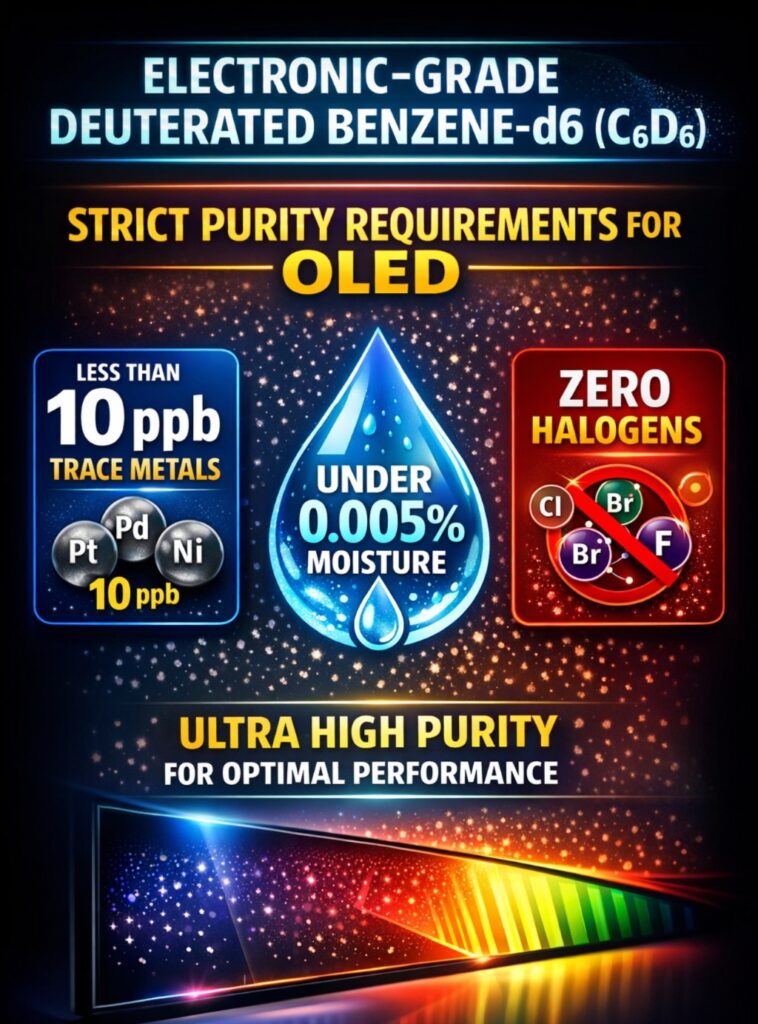
- Electronic-grade purity standards are extremely strict, requiring ultra-low trace metals (<10 ppb), minimal moisture (<0.005%), and advanced purification and testing methods to ensure optimal device performance.
- Advanced synthesis technologies and strong supply chain infrastructure enable scalable, high-purity production, ensuring consistent quality and uninterrupted supply for large-scale OLED manufacturing.
- Despite higher upfront costs, high-purity deuterated materials deliver major economic and technical benefits, including longer device lifetimes, higher efficiency, improved energy performance, and reduced long-term failure rates.
Identifying the Premium Deuterated Benzene-d6 Supplier for OLED Material Synthesis
A premium Deuterated Benzene-d6 Supplier for OLED provides more than just a chemical compound; it supplies a molecular foundation that enhances the stability of blue emitters and host materials. By replacing hydrogen atoms with deuterium, the resulting C–D bonds exhibit lower vibrational frequency and reduced zero-point energy compared to C–H bonds. These physical differences increase resistance to bond cleavage under high electrical excitation, which is particularly intense in blue light emission. This molecular reinforcement directly addresses the long-standing “blue gap” challenge in OLED technology, where blue materials historically degrade faster than their red and green counterparts.
Access high-purity aromatic precursors for your synthesis: Deuterated Aromatic Compounds for OLED
The scientific basis for this improvement lies in vibrational mechanics and bond dissociation energy. In protonated molecules, the C–H stretching frequency is approximately 3203 cm⁻¹, whereas the C–D stretching frequency shifts downward to around 2376 cm⁻¹ because of the greater reduced mass (μ) of deuterium. The vibrational frequency (ν) can be expressed as:
ν = (1 / 2π) √(k / μ)
where k represents the bond force constant. Since deuterium has roughly twice the mass of protium (hydrogen-1), the vibrational frequency decreases, reducing the probability of non-radiative decay and exciton-induced bond rupture. This shift stabilizes the potential energy surface and suppresses degradation pathways that typically shorten device lifetime. Over prolonged operation at high brightness, these molecular-level advantages translate into measurable improvements in T90 performance and overall device durability.
For display manufacturers, evaluating a Deuterated Benzene-d6 Supplier for OLED requires strict confirmation of isotopic consistency at production scale. While NMR-grade Benzene-d6 may offer enrichment levels around 99.5 atom % D, advanced host synthesis for carbazole, fluorene, and phenylbenzene derivatives demands enrichment of at least 99.96 atom % D. Even minimal residual protium content can introduce weak molecular points within the emissive matrix, potentially reducing uniformity in large-area OLED panels. Therefore, maintaining precise isotopic control across bulk quantities is essential for ensuring consistent device performance across multiple production batches.
Secure your supply of electronic-grade Benzene-d6: Buy Deuterated Benzene-d6 for OLED
Property Comparison of Protonated and Deuterated Bonds
| Property | C–H Bond (Protonated) | C–D Bond (Deuterated) | Impact on OLED |
|---|---|---|---|
| Vibrational Frequency | ~3203 cm⁻¹ | ~2376 cm⁻¹ | Lower phonon-related energy loss and reduced exciton decay |
| Bond Stability | Lower | Higher | Greater resistance to radical formation and bond cleavage |
| Zero-Point Energy | Higher | Lower | More energy required to initiate degradation |
| Molecular Packing Density | 1.114 g/cm³ | 1.139 g/cm³ | Improved thin-film rigidity and higher glass transition temperature (Tg) |
Technical Purity Thresholds for a Deuterated Benzene-d6 Supplier for OLED Manufacturing
A specialized Deuterated Benzene-d6 Supplier for OLED must meet strict chemical and elemental purity thresholds suitable for electronic-grade applications. Chemical purity should be equal to or greater than 99.9 percent, but this specification alone is not sufficient for OLED fabrication. The material must also exhibit extremely low trace metal content and minimal moisture levels to prevent adverse interactions within the device stack. In OLED structures, impurities can interfere with charge transport layers, emissive materials, and electrode interfaces, potentially leading to efficiency loss or premature device failure.
Learn more about our rigorous testing protocols: Analytical Characterization of Deuterated Compounds
Trace halogens such as chlorine or bromine must be non-detectable, as even parts-per-million levels can accelerate corrosion of Indium Tin Oxide (ITO) electrodes and destabilize organic layers. Moisture content should remain below 0.005 percent, verified by Karl Fischer titration, because water molecules can quench electroluminescence and contribute to dark spot formation. Over time, residual moisture may compromise encapsulation integrity and reduce long-term display reliability. Maintaining ultra-dry and contaminant-free C₆D₆ is therefore essential for high-performance OLED production.
Group 10 metals, including Palladium (Pd), Platinum (Pt), and Nickel (Ni), are frequently encountered as residual catalysts in aromatic synthesis. If present above acceptable limits, these metals can create non-radiative recombination centers within the OLED stack, lowering luminous efficiency and increasing defect density. Electronic-grade standards typically restrict such metals to below 10 ppb, requiring advanced detection methods such as Inductively Coupled Plasma Mass Spectrometry (ICP-MS). A reliable Deuterated Benzene-d6 Supplier for OLED implements multiple purification and verification steps to consistently achieve these stringent impurity thresholds.
Consult with a leading North American partner: Deuterated Labelled Synthesis Company in Canada
Electronic-Grade vs. NMR-Grade Specifications
| Contaminant | NMR-Grade Solvent | Electronic-Grade Precursor | Consequence of Failure |
|---|---|---|---|
| Isotopic Purity | ≥ 99.5 atom % D | ≥ 99.96 atom % D | Reduced blue device T90 and faster luminance decay |
| Trace Metals | Not strictly limited | < 10 ppb | Charge trapping and mass adduct formation |
| Residual Water | ≤ 0.05 percent | < 0.005 percent | Cathode degradation and dark spot growth |
| Halogens | Not specified | Not Detectable | Corrosion of transparent conductive electrodes |
| Organic Impurities | ≤ 0.5 percent | < 0.1 percent | Irregular thin-film crystallization and instability |
ResolveMass Laboratories applies comprehensive quality control procedures to every production lot. High-resolution ¹H-NMR verifies minimal residual proton signals, while GC-MS analysis screens for trace organic contaminants that may affect glass transition temperature and film morphology. Additional ICP-MS testing ensures trace metals remain below electronic-grade thresholds. Through these strict validation protocols, the company reinforces its position as a dependable Deuterated Benzene-d6 Supplier for OLED manufacturing at commercial scale.
How a Deuterated Benzene-d6 Supplier for OLED Optimizes Isotopic Enrichment
To achieve enrichment levels exceeding 99.96 atom % D, leading suppliers use advanced synthesis techniques such as microwave-assisted flow chemistry. Traditional batch deuteration processes may suffer from inconsistent reaction control, longer processing times, and higher catalyst degradation. In contrast, flow chemistry enables precise management of reaction temperature, residence time, and reagent ratios, leading to improved isotopic exchange efficiency and reduced side-product formation.
Discover our full range of available isotopes: Availability of All the Deuterated Chemicals
Microwave-assisted reactors can rapidly reach temperatures near 200°C within approximately 90 seconds, significantly accelerating hydrogen–deuterium exchange reactions. This rapid heating improves throughput while maintaining strict isotopic integrity, which is essential for electronic-grade materials. For global display manufacturers requiring large and consistent volumes, scalable production technology ensures uninterrupted supply without compromising enrichment quality. A technologically advanced Deuterated Benzene-d6 Supplier for OLED therefore combines process innovation with rigorous analytical validation.
Supply Chain Resilience and Choosing a Deuterated Benzene-d6 Supplier for OLED Bulk Orders
Beyond chemical purity, selecting a qualified Deuterated Benzene-d6 Supplier for OLED requires evaluating logistical strength and regulatory compliance. Deuterated Benzene-d6 is classified as UN1114, Class 3, Packing Group II, and is designated as a Category 2 Flammable Liquid and Group 1A Carcinogen. Safe transportation requires UN-certified stainless steel containers, inert gas blanketing such as nitrogen or argon, and proper grounding measures to prevent static discharge during handling. Compliance with OSHA, DOT, and IATA regulations is mandatory for international shipments.
Source from a globally recognized chemical provider: Supplier of Deuterated Reagents
The global supply of deuterium originates primarily from heavy water (D₂O), which is also used in nuclear, pharmaceutical, and semiconductor industries. This shared demand can create supply pressure and potential shortages. Forward-thinking suppliers implement circular recovery and re-enrichment programs that allow depleted Benzene-d6 to be restored to ≥ 99.96 atom % D. Such initiatives reduce dependency on new raw isotope extraction, stabilize supply chains, and lower overall material costs for manufacturers engaged in large-scale OLED fabrication.
Global Logistics and Handling Standards
| Factor | Requirement | Implementation |
|---|---|---|
| UN Classification | UN1114, Class 3, PG II | Hazard labeling, compliant manifests, and certified transport |
| Packaging Material | 316L Stainless Steel | Prevents contamination and material leaching |
| Inert Atmosphere | Nitrogen or Argon | Minimizes oxidation and moisture exposure |
| Safety Compliance | OSHA, DOT, IATA | Mandatory for domestic and international shipping |
| Documentation | CoA, CoQ, SDS | Ensures traceability, validation, and regulatory transparency |
ResolveMass Laboratories maintains regional inventory hubs and robust distribution networks to reduce procurement lead times. Standard chemical procurement cycles may range from 10 to 30 days, but proactive inventory management allows faster response to urgent R&D or production requirements. Reliable logistics support manufacturers in adapting to fluctuating demand while maintaining consistent device fabrication schedules.
Analytical Rigor from a Global Deuterated Benzene-d6 Supplier for OLED Research
An established Deuterated Benzene-d6 Supplier for OLED must provide complete analytical documentation confirming isotopic composition, elemental purity, and chemical stability. Verification processes typically include Nuclear Magnetic Resonance (NMR), Mass Spectrometry (MS), Gas Chromatography (GC), and Inductively Coupled Plasma Mass Spectrometry (ICP-MS). These analytical methods ensure that bulk supply aligns precisely with the strict performance requirements of advanced OLED architectures.
Explore specialized reagents for advanced NMR studies: Deuterated Acrylamide Derivatives for Advanced NMR Research
¹H-NMR analysis quantifies residual proton content and confirms compliance with the ≥ 99.96 atom % D specification. High-resolution mass spectrometry can detect partially deuterated isotopologues such as C₆D₅H, which may influence long-term chemical behavior in host synthesis. Additional GC-MS and moisture testing further confirm chemical integrity before materials enter production environments. Comprehensive Certificates of Analysis allow manufacturers to correlate device efficiency and lifetime data with specific material batches, strengthening quality assurance practices across the supply chain.
Economic and Performance Impact of High-Purity Deuterated Materials
Although high-purity deuterated precursors may increase initial synthesis costs by approximately 10 to 30 percent, the resulting performance gains often justify the investment. Improvements in operational lifetime ranging from twofold to eightfold significantly reduce burn-in risks and warranty claims, particularly in continuously operating displays such as automotive dashboards and commercial televisions. Enhanced molecular stability also supports consistent brightness levels over extended usage periods.
Inquire about tailored isotopic solutions for your project: Custom Deuterated Compounds
Performance benefits extend beyond durability alone. Deuterated host materials have demonstrated External Quantum Efficiency (EQE) values up to 27.4 percent and power efficiencies of 41.2 lm/W in deep-blue phosphorescent OLED systems. Operating voltage reductions of approximately 0.3 V at 1000 cd/m² decrease heat generation and improve overall device energy efficiency. These measurable gains confirm that sourcing from a reliable Deuterated Benzene-d6 Supplier for OLED contributes directly to both technical and economic advantages in next-generation display manufacturing.
Comparative Performance Metrics in Blue PhOLEDs
| Performance Metric | Protonated Host Baseline | Deuterated Host (C₆D₆ Derived) | Improvement |
|---|---|---|---|
| T90 Lifetime (1000 cd/m²) | ~230 hours | ~370 hours | 1.6× increase |
| Maximum EQE | 24.1 percent | 27.4 percent | +13.7 percent relative |
| Power Efficiency | 31.4 lm/W | 41.2 lm/W | +31.2 percent relative |
| Operating Voltage | 3.9 V | 3.6 V | 7.7 percent reduction |
| CIEy (Color Purity) | 0.172 | 0.165 | Improved deep-blue emission |
Future Market Projections and Isotopic Demand Trends (2025–2026)
The global OLED market is projected to reach 114.75 billion by 2030, driven by expansion in foldable devices, transparent displays, automotive interfaces, and Micro-OLED technologies for AR/VR systems. As device architectures evolve toward tandem and multi-stack designs, the consumption of high-purity C₆D₆ will increase proportionally. A technically capable Deuterated Benzene-d6 Supplier for OLED will therefore remain central to enabling stable, high-resolution, and energy-efficient display platforms.
Emerging trends include greater adoption of PHOLED and TADF materials, higher pixel density requirements in Micro-OLED panels, and stricter regulatory scrutiny of impurities and hazardous substances. Suppliers with ISO-certified quality systems, strong analytical transparency, and sustainable recovery programs will be best positioned to support long-term industry growth. As isotopic engineering becomes standard practice rather than an experimental approach, strategic partnerships with reliable material suppliers will define competitive advantage in the display sector.
Conclusion: Strategic Value of a Reliable Deuterated Benzene-d6 Supplier for OLED
The commercialization of advanced OLED displays depends heavily on molecular stability achieved through precise isotopic engineering. As a specialized Deuterated Benzene-d6 Supplier for OLED, ResolveMass Laboratories delivers electronic-grade C₆D₆ with enrichment levels of at least 99.96 atom % D and trace metal content below 10 ppb. These specifications directly support extended blue emitter lifetime, improved energy efficiency, and enhanced device reliability across demanding applications.
In an industry defined by performance benchmarks and long operational expectations, raw material quality forms the foundation of success. Through advanced synthesis technology, comprehensive analytical validation, and resilient supply chain management, ResolveMass Laboratories ensures consistent support for large-scale OLED production. Partnering with a trusted Deuterated Benzene-d6 Supplier for OLED is therefore not simply a procurement decision, but a strategic investment in durability, color precision, and sustainable innovation in next-generation display systems.
Frequently Asked Questions (FAQs)
Benzene-d6 is mainly used as a deuterated solvent in Nuclear Magnetic Resonance (NMR) spectroscopy. Because its hydrogen atoms are replaced with deuterium, it produces minimal background signals in ¹H-NMR analysis, allowing clear detection of sample peaks. In advanced industries, it is also used as a precursor for synthesizing deuterated organic compounds, especially in OLED materials and pharmaceutical research. Its high isotopic purity makes it valuable in applications where molecular stability and analytical precision are important.
Benzene-d6 is produced by replacing hydrogen atoms in benzene with deuterium through a hydrogen–deuterium (H–D) exchange process. This reaction typically uses deuterium oxide (D₂O) or deuterium gas in the presence of a catalyst under controlled temperature and pressure. Multiple exchange cycles may be required to achieve high isotopic enrichment. The final product is purified and tested to confirm both chemical purity and deuterium content.
Deuterated benzene is prepared through catalytic deuteration, where standard benzene reacts with a deuterium source such as heavy water or deuterium gas. The reaction is carried out using suitable metal catalysts to promote efficient hydrogen replacement. Careful control of reaction conditions ensures high conversion and minimal side products. After synthesis, the material undergoes purification and analytical verification to reach the desired isotopic enrichment level.
Electronic-grade 99.96% enrichment is important because even a tiny amount of residual protium (¹H) can become a weak spot in the material. In blue OLED operation, these C–H bonds face high electrical stress and tend to break earlier than C–D bonds. Once bond breakage starts, the organic layers degrade faster and brightness drops sooner. Higher purity means almost all hydrogen is replaced with deuterium, so the Kinetic Isotope Effect works at its best.
KIE works because deuterium is heavier than regular hydrogen, which makes carbon–deuterium bonds vibrate more slowly and hold together better. Lower vibrational energy reduces the chance of bond breaking during excited-state operation. This slows down chemical damage inside the emissive and host materials. Over time, it helps the OLED keep its brightness longer and reduces rapid aging.
NMR-grade Benzene-d6 is mainly made for lab spectroscopy and typically has around ~99.5% deuterium enrichment. It usually does not have strict limits for trace metals or ultra-low moisture. Electronic-grade material is designed for OLED material synthesis, so it requires ≥99.96% enrichment, <10 ppb trace metals, and extremely low water content. These tighter limits help prevent quenching, charge trapping, and early pixel failure.
Group 10 metals such as Palladium (Pd), Platinum (Pt), and Nickel (Ni) are among the most damaging contaminants. Even at very low levels, they can create charge traps and non-radiative recombination sites. This reduces light output and wastes electrical energy as heat. Over time, these metals can shorten OLED lifetime and lower efficiency.
Reference
- Yuan, W., Huang, T., Zhou, J., Tang, M.-C., Zhang, D., & Duan, L. (2025). High-efficiency and long-lifetime deep-blue phosphorescent OLEDs using deuterated exciplex-forming host. Nature Communications, 16, 4446. https://doi.org/10.1038/s41467-025-59583-8
- Yuan, W., Huang, T., Zhou, J., Tang, M.-C., Zhang, D., & Duan, L. (2024). High-efficiency and long-lifetime deep-blue phosphorescent OLEDs using deuterated exciplex-forming host (ChemRxiv Preprint). ChemRxiv. https://doi.org/10.26434/chemrxiv-2024-8bn7g
Get In Touch With Us
About The Author


