

Introduction:
A successful Dexamethasone ANDA Submission involves far more than demonstrating that a generic product contains the same active pharmaceutical ingredient (API) as the innovator drug. Today’s FDA reviewers expect comprehensive scientific evidence proving that the proposed generic product matches the Reference Listed Drug (RLD) in terms of quality, safety, performance, manufacturing consistency, and therapeutic equivalence.
For pharmaceutical companies, one of the largest challenges is preparing a complete Chemistry, Manufacturing, and Controls (CMC) package supported by robust analytical data. From API characterization and formulation development to impurity profiling, stability testing, and validated analytical methods, every aspect of development must withstand regulatory scrutiny.
This is especially important for injectable dexamethasone products, where sterility, particulate control, container compatibility, degradation pathways, and long-term stability all influence regulatory approval. Companies that begin analytical characterization early often reduce development timelines, avoid costly reformulation, and minimize FDA review questions.
At ResolveMass Laboratories, our scientists support pharmaceutical companies throughout the generic development lifecycle by providing advanced analytical characterization, reverse engineering, impurity identification, and regulatory-ready reports designed to strengthen Dexamethasone ANDA Submission programs.
Summary:
- A successful Dexamethasone ANDA Submission requires demonstrating pharmaceutical equivalence, bioequivalence, and comprehensive Chemistry, Manufacturing, and Controls (CMC) compliance.
- Reverse engineering of the Reference Listed Drug (RLD) helps identify Critical Quality Attributes (CQAs) that guide generic product development.
- FDA reviewers expect robust analytical characterization, validated analytical methods, impurity profiling, stability studies, and risk-based quality assessments.
- Injectable and long-acting dexamethasone formulations require additional attention to sterility assurance, formulation compatibility, container closure systems, and extractables and leachables.
- Early analytical characterization significantly reduces development risks, minimizes regulatory deficiencies, and accelerates ANDA approval.
- ResolveMass Laboratories provides advanced analytical services that support every stage of generic dexamethasone development, from reverse engineering through regulatory-ready CMC documentation.
1: Understanding the FDA ANDA Pathway
The FDA’s Abbreviated New Drug Application (ANDA) allows manufacturers to market generic drugs without repeating expensive clinical efficacy studies.
Instead, applicants must demonstrate:
- Pharmaceutical equivalence
- Bioequivalence
- Comparable quality
- Manufacturing consistency
- Appropriate labeling (except permitted differences)
For Dexamethasone products, these requirements apply regardless of dosage form, whether tablets, injections, ophthalmic preparations, topical products, or implants.
2: Why is Dexamethasone Considered a Challenging Generic Product?
Although Dexamethasone itself is a well-established corticosteroid, generic development can become complex depending on the dosage form.
Challenges include:
- Multiple strengths
- Various dosage forms
- Sterile manufacturing requirements
- Impurity control
- Particle size control (suspensions)
- Polymorphic characterization
- Excipient compatibility
- Container closure compatibility
- Stability under multiple storage conditions
Each dosage form introduces different regulatory expectations.
3: Regulatory Framework for Dexamethasone ANDA Submission
The FDA evaluates several technical sections during review.
| Regulatory Component | Primary Objective |
|---|---|
| Drug Substance | API characterization |
| Drug Product | Formulation equivalence |
| CMC Documentation | Manufacturing consistency |
| Bioequivalence | Comparable exposure |
| Stability | Shelf-life support |
| Microbiology | Sterility (if applicable) |
| Analytical Validation | Reliable testing methods |
| Risk Assessment | Patient safety |
These components collectively demonstrate that the proposed generic performs similarly to the RLD.
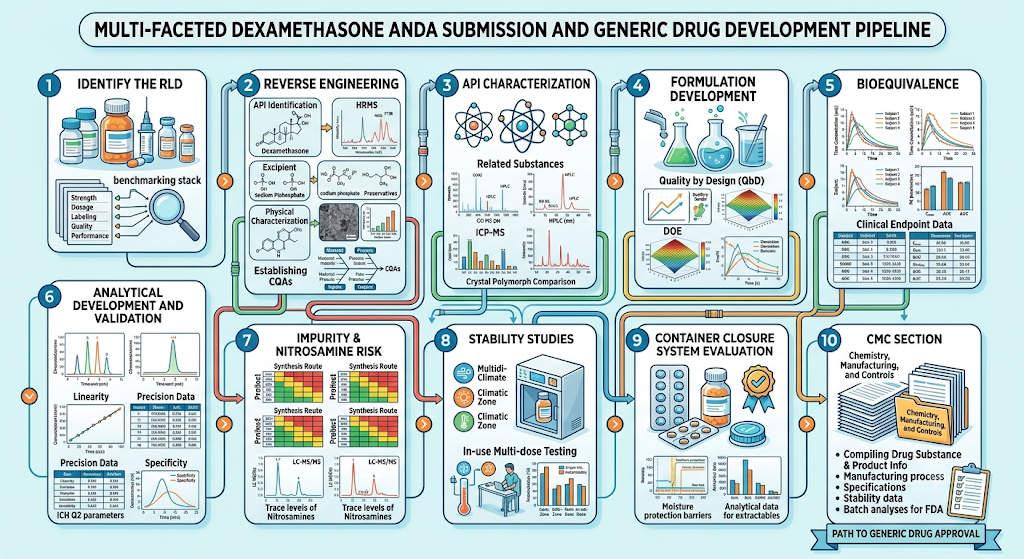
Step 1: Identify the Reference Listed Drug (RLD)
Every Dexamethasone ANDA Submission begins with identifying the appropriate Reference Listed Drug.
The RLD establishes the benchmark for:
- Strength
- Dosage form
- Route of administration
- Labeling
- Quality attributes
- Performance characteristics
Reverse engineering studies frequently begin at this stage.
Step 2: Reverse Engineering of the Reference Product
Reverse engineering provides valuable insights into the formulation and manufacturing characteristics of the innovator product.
Typical analytical investigations include:
API Identification
- LC-MS/MS
- HRMS
- FTIR
- NMR
Excipient Characterization
- Polymer identification
- Sugar analysis
- Preservatives
- Buffers
- Stabilizers
Physical Characterization
- Particle size
- Morphology
- Surface analysis
- Crystallinity
- Density
Thermal Characterization
- DSC
- TGA
Structural Analysis
- SEM
- XRD
- Raman spectroscopy
The resulting data establish Critical Quality Attributes (CQAs) that guide formulation development.
Step 3: Comprehensive API Characterization
The API must be fully characterized before formulation development proceeds.
Typical studies include:
| Characterization Study | Analytical Technique |
|---|---|
| Identity | LC-MS/MS |
| Molecular Weight | HRMS |
| Related Substances | HPLC |
| Residual Solvents | GC-MS |
| Elemental Impurities | ICP-MS |
| Water Content | Karl Fischer |
| Polymorphism | XRD |
| Thermal Properties | DSC |
These studies support raw material qualification and regulatory compliance.
Step 4: Formulation Development
FDA reviewers evaluate whether the proposed formulation matches the RLD in critical quality characteristics.
Important considerations include:
- Excipient compatibility
- Dissolution profile
- Drug release
- Uniformity
- pH
- Osmolality
- Viscosity (where applicable)
- Preservative effectiveness
Quality by Design (QbD) principles are commonly applied during development.
Step 5: Bioequivalence Studies
Bioequivalence confirms that the generic delivers the same therapeutic exposure as the reference product.
Depending on dosage form, studies may include:
- Pharmacokinetic studies
- Comparative dissolution
- In vitro release testing
- Clinical endpoint studies
- Pharmacodynamic studies (when appropriate)
FDA product-specific guidance determines the exact requirements.
Step 6: Analytical Method Development and Validation
Validated analytical methods form the foundation of every regulatory submission.
Methods typically evaluate:
- Assay
- Impurities
- Related substances
- Dissolution
- Content uniformity
- Stability
- Preservatives
Validation follows ICH Q2 recommendations.
Validation parameters include:
- Accuracy
- Precision
- Linearity
- Robustness
- Ruggedness
- Specificity
- Detection limits
- Quantitation limits
Step 7: Impurity Profiling and Nitrosamine Risk Assessment
FDA continues to emphasize impurity control throughout generic drug development.
Required investigations include:
Organic impurities
- Process impurities
- Degradation products
- Related compounds
Residual solvents
Measured using validated GC methods.
Elemental impurities
Assessed according using ICP-MS and ICH Q3D requirements.
Nitrosamine Risk Assessment
Sponsors should evaluate:
- API synthetic route
- Raw materials
- Solvents
- Catalysts
- Packaging
- Manufacturing process
If necessary, confirmatory testing using highly sensitive LC-MS/MS or GC-MS/MS methods should be performed.
Step 8: Stability Studies
Long-term stability demonstrates that product quality is maintained throughout shelf life.
Typical studies include:
| Stability Study | Purpose |
|---|---|
| Long-term | Shelf-life determination |
| Accelerated | Predict degradation |
| Intermediate | Support climatic conditions |
| Photostability | Light sensitivity |
| In-use stability | Multi-dose products |
| Freeze-thaw | Certain formulations |
Critical parameters monitored include:
- Assay
- Degradation products
- Appearance
- Dissolution
- pH
- Water content
Step 9: Container Closure System Evaluation
Packaging materials can significantly affect product quality.
FDA expects evaluation of:
- Container Closure Integrity (CCI)
- Extractables
- Leachables
- Moisture protection
- Oxygen permeability
- Compatibility
Common analytical tools include:
- LC-HRMS
- GC-MS
- ICP-MS
- Headspace GC
Step 10: Preparing the CMC Section
The CMC section represents one of the largest components of an ANDA.
Typical contents include:
- Drug substance information
- Drug product information
- Manufacturing process
- Process controls
- Specifications
- Analytical methods
- Validation reports
- Stability data
- Batch analyses
- Packaging information
High-quality analytical data significantly reduce regulatory questions during FDA review.
4: Common FDA Deficiencies in Dexamethasone ANDA Submission
Many ANDA review delays result from incomplete analytical evidence.
Common deficiencies include:
- Inadequate impurity characterization
- Poor method validation
- Incomplete stability data
- Insufficient dissolution justification
- Missing extractables and leachables assessment
- Inadequate process validation
- Weak scientific rationale
- Incomplete CMC documentation
Early analytical planning helps minimize these issues.
5: Analytical Technologies Supporting Dexamethasone ANDA Submission
Modern pharmaceutical characterization requires multiple complementary analytical platforms.
| Technology | Application |
|---|---|
| LC-MS/MS | Assay, impurities |
| LC-HRMS | Unknown impurity identification |
| GC-MS/MS | Residual solvents |
| GC-HRMS | Trace contaminants |
| ICP-MS | Elemental impurities |
| FTIR | Functional group identification |
| NMR | Structural confirmation |
| DSC | Thermal behavior |
| XRD | Polymorphism |
| SEM | Particle morphology |
| Raman Spectroscopy | Material identification |
| Karl Fischer | Moisture analysis |
6: How ResolveMass Laboratories Supports ANDA Development
Successful Dexamethasone ANDA Submission programs require scientifically defensible analytical data that withstand regulatory scrutiny.
ResolveMass Laboratories supports pharmaceutical companies through:
- Reverse engineering studies
- Comprehensive API characterization
- Formulation characterization
- LC-MS/MS method development
- HRMS impurity identification
- Nitrosamine testing
- Extractables & Leachables studies
- Container closure compatibility
- Stability-indicating methods
- Elemental impurity testing
- Residual solvent analysis
- Regulatory-ready analytical reports
- CMC data packages supporting FDA submissions
Our multidisciplinary analytical scientists utilize advanced instrumentation to generate accurate, reproducible, and submission-ready data aligned with FDA and ICH expectations. By integrating orthogonal analytical techniques and risk-based study designs, we help sponsors better understand their products, strengthen CMC documentation, and reduce the likelihood of regulatory review deficiencies.
7: Best Practices for a Successful Dexamethasone ANDA Submission
To improve the probability of first-cycle approval:
- Begin analytical characterization early.
- Perform detailed reverse engineering of the RLD.
- Identify all Critical Quality Attributes (CQAs).
- Validate analytical methods according to ICH recommendations.
- Conduct comprehensive impurity and degradation studies.
- Include nitrosamine risk assessment where applicable.
- Generate stability data using stability-indicating methods.
- Evaluate packaging compatibility through E&L studies.
- Maintain complete GMP-compliant documentation.
- Prepare regulatory-ready reports with clear scientific justification.
Conclusion:
A successful Dexamethasone ANDA Submission is built upon rigorous scientific characterization, regulatory-compliant analytical testing, and comprehensive CMC documentation. While demonstrating pharmaceutical equivalence and bioequivalence remains fundamental, today’s regulatory expectations extend far beyond these requirements. Sponsors must also provide robust evidence for impurity control, stability, container closure compatibility, method validation, and overall product quality.
By combining advanced analytical technologies—including LC-MS/MS, HRMS, GC-MS, ICP-MS, FTIR, NMR, and thermal characterization—with regulatory expertise, pharmaceutical companies can significantly reduce development risks and streamline FDA review. Working with an experienced analytical partner such as ResolveMass Laboratories enables developers to generate high-quality, submission-ready data that supports confident regulatory submissions and accelerates the path toward market approval.
Frequently Asked Questions:
The FDA’s target review timeline for most ANDA applications is approximately 10 months after the application is accepted for review under the Generic Drug User Fee Amendments (GDUFA). However, the actual timeline may be longer if the FDA requests additional information, identifies deficiencies, or schedules manufacturing facility inspections. A complete, well-organized submission with robust analytical data can help reduce review delays and improve the likelihood of first-cycle approval.
Pharmaceutical equivalence means the generic product contains the same active ingredient, dosage form, strength, route of administration, and meets the same quality standards as the Reference Listed Drug (RLD). Bioequivalence demonstrates that the generic delivers the drug into the body at a similar rate and extent as the RLD. Both are essential requirements for FDA approval of a generic dexamethasone product.
Yes. Although some differences in inactive ingredients are permitted, excipients should not significantly affect the product’s safety, efficacy, stability, or bioavailability. Manufacturers must scientifically justify any formulation differences and demonstrate that they do not alter the product’s performance. Comparative studies may be required depending on the dosage form and FDA guidance.
Critical Quality Attributes (CQAs) are measurable physical, chemical, biological, or microbiological properties that directly influence product quality and clinical performance. Examples include assay, impurity levels, dissolution profile, particle size, moisture content, and polymorphic form. Identifying and controlling CQAs helps ensure consistent manufacturing and regulatory compliance throughout the product lifecycle.
Impurity identification is essential because unknown or excessive impurities may impact product safety, efficacy, and stability. Regulatory agencies expect manufacturers to identify, quantify, and control process-related and degradation impurities according to ICH guidelines. Comprehensive impurity profiling using advanced analytical techniques helps minimize regulatory questions and supports successful FDA review.
Dissolution testing measures how quickly the active ingredient is released from the dosage form under controlled conditions. It is a critical quality test used to compare the generic product with the Reference Listed Drug and to ensure batch-to-batch consistency. Dissolution data may also support formulation optimization and regulatory submissions by demonstrating comparable in vitro performance.
Forced degradation studies expose the drug product to stress conditions such as heat, humidity, oxidation, light, acidic, and alkaline environments. These studies identify degradation pathways and confirm that analytical methods can accurately detect degradation products. They also support the development of stability-indicating methods required for regulatory submissions and long-term stability programs.
Different polymorphic forms of dexamethasone can exhibit variations in solubility, dissolution rate, stability, and bioavailability. Proper polymorph characterization ensures that the selected crystal form remains consistent throughout manufacturing and storage. Techniques such as X-ray diffraction (XRD) and Differential Scanning Calorimetry (DSC) are commonly used to evaluate polymorphic properties.
Reference
- Fu L, Dong S, Xie R, Jia G, Zhao N, Xiang Q, Ji X, Zhao X, Chen X, Ma L, Cui Y. A multi-dimensional comparative study of 505 (b)(2) NDAs approved by FDA and Class 2 NDAs approved by NMPA from 2017 to 2023: Uncovering trends, characteristics, and regulation of modified new drugs. Regulatory Toxicology and Pharmacology. 2025 Nov 1;162:105864.https://www.sciencedirect.com/science/article/pii/S0273230025000947
- Manohari PJ, Seshadri VC, Munirathnam I, Ramesh AA, Kunchithapatham J, Maanvizhi S. Quality by Design Based Pharmaceutical Development Report of Cost-effective Dexamethasone Tablets, 20 mg for Regulatory Submission. Journal of Pharmaceutical Research International. 2025 May 19;37(5):89-117.https://www.researchgate.net/profile/Packiaraj-Jeyachandran-Manohari/publication/391870958_Quality_by_Design_Based_Pharmaceutical_Development_Report_of_Cost-effective_Dexamethasone_Tablets_20_mg_for_Regulatory_Submission/links/682b68578a76251f22e2d7b6/Quality-by-Design-Based-Pharmaceutical-Development-Report-of-Cost-effective-Dexamethasone-Tablets-20-mg-for-Regulatory-Submission.pdf
- Lourenço D, Miranda M, Sousa JJ, Vitorino C. Therapeutic-driven framework for bioequivalence assessment of complex topical generic drug products. International Journal of Pharmaceutics. 2024 Aug 15;661:124398.https://www.sciencedirect.com/science/article/pii/S037851732400632X
- Braddy AC, Conner DP. Regulatory Standards for Approval of Topical Dermatological Drug Products. InDermal Drug Delivery 2020 Jan 21 (pp. 331-360). CRC Press.https://api.taylorfrancis.com/content/chapters/edit/download?identifierName=doi&identifierValue=10.1201/9781315374215-10&type=chapterpdf
- Ames TW, Sigler A. ANDA Regulatory Approval Process. Generic drug product development: solid oral dosage forms. 2005:211-25.https://books.google.com/books?hl=en&lr=&id=1SUAAQAAQBAJ&oi=fnd&pg=PA207&dq=Regulatory+Pathway+for+Dexamethasone+ANDA+Submission&ots=cdDoC3pojV&sig=IGaSN1UucF-ec2DpAuHb_HVwWPA
- Dhulia I, Patel H, Chauhan N, Pardeshi N. FDA’s drug regulatory pathways, its development strategies and regulatory considerations. Int J Drug Regul Aff. 2021;9(2):6-15.https://indianjournals.com/api/article-view/ijdra-9-2-002
About the Author


