

Introduction:
Dexamethasone Injection Development has become increasingly sophisticated as pharmaceutical companies pursue preservative-free injectable products designed to meet evolving clinical and regulatory expectations. Removing antimicrobial preservatives introduces additional formulation and manufacturing challenges because the product must maintain sterility, stability, potency, and safety throughout its intended shelf life.
Preservative-free injectable formulations are particularly important in situations where repeated exposure to preservatives may be undesirable or where single-dose presentations provide clinical advantages. However, eliminating preservatives means every aspect of development—from formulation optimization and aseptic manufacturing to analytical characterization and container closure selection—must be carefully controlled.
At ResolveMass Laboratories Inc., scientific expertise in pharmaceutical analytical services, mass spectrometry, extractables and leachables studies, bioanalysis, and formulation support helps pharmaceutical innovators generate the robust analytical data required throughout injectable drug development.
Summary:
- Preservative-free dexamethasone injection development requires specialized formulation strategies to maintain drug stability without antimicrobial agents that can cause tissue irritation or systemic toxicity
- Single-dose, preservative-free formats are increasingly preferred for intrathecal, epidural, and ophthalmic routes where preservatives pose safety risks
- Key development challenges include pH optimization, oxidative degradation control, container closure compatibility, and sterility assurance
- Analytical characterization spans forced degradation studies, extractables and leachables (E&L) testing, and stability-indicating HPLC methods
- Regulatory pathways differ for 505(b)(2) NDAs versus ANDAs, with FDA guidance placing heightened scrutiny on preservative-free injectable products following past safety incidents
1: What Is Preservative-Free Dexamethasone Injection Development?
Preservative-free dexamethasone injection development is the process of formulating, manufacturing, and validating a corticosteroid injectable that excludes antimicrobial preservatives such as benzyl alcohol or methylparaben, typically packaged in single-dose containers to eliminate multi-use contamination risk. This approach has become standard practice for high-risk administration routes where preservatives themselves can cause harm, most notably neuraxial (spinal and epidural) injections.
Dexamethasone sodium phosphate, the water-soluble salt form typically used in injectable formulations, is particularly sensitive to oxidative and hydrolytic degradation, which makes preservative-free formulation more technically demanding than standard multi-dose products. Sponsors evaluating salt form selection early in development often compare dexamethasone phosphate vs. acetate properties, since solubility and release characteristics differ significantly between the two and directly influence whether a preservative-free injectable or a depot-style product is the better fit. For programs pursuing sustained-release alternatives, dexamethasone implant PLGA characterization work offers a useful comparison point against conventional injectable routes.
2: Why Choose a Preservative-Free Injectable Formulation?
Preservative-free formulations are increasingly selected for both scientific and clinical reasons.
Potential Advantages
| Benefit | Description |
|---|---|
| Reduced preservative exposure | Eliminates antimicrobial preservatives from the formulation |
| Simplified excipient profile | Fewer formulation components may reduce formulation complexity |
| Suitable for single-dose presentations | Designed for one-time administration |
| Regulatory alignment | Supports products intended for preservative-free use |
| Improved compatibility | May be advantageous for certain sensitive applications |
Although preservative-free products eliminate preservative-related considerations, they demand significantly higher control over manufacturing and sterility assurance.
3: Critical Considerations in Dexamethasone Injection Development
Successful Dexamethasone Injection Development depends on simultaneously optimizing formulation, manufacturing, analytical characterization, and packaging.
Several development factors must be evaluated together.
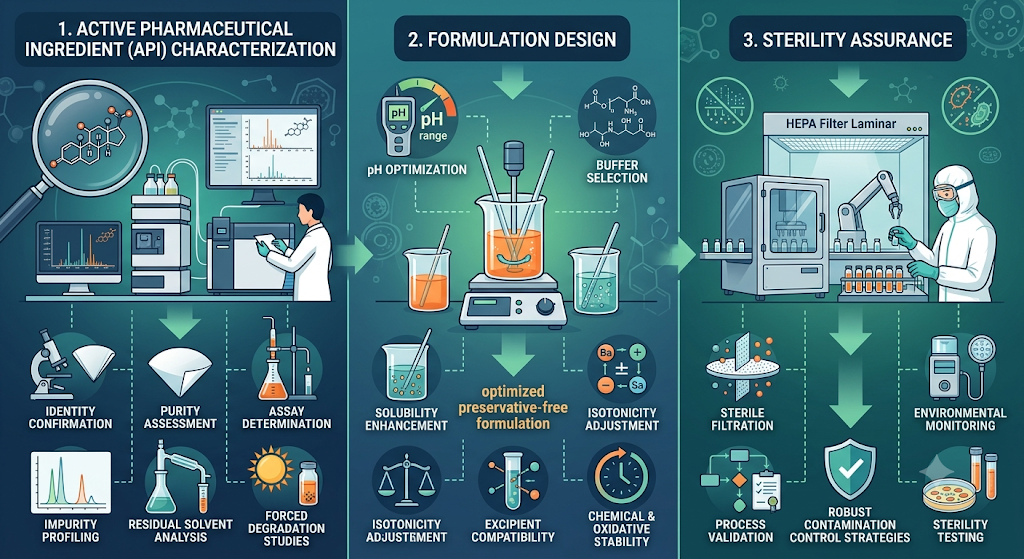
1. Active Pharmaceutical Ingredient (API) Characterization
The API should undergo extensive characterization, including:
- Identity confirmation
- Purity assessment
- Assay determination
- Impurity profiling
- Residual solvent analysis
- Forced degradation studies
Advanced analytical techniques such as LC-MS and high-resolution mass spectrometry provide detailed impurity characterization throughout development.
2. Formulation Design
An optimized preservative-free formulation requires balancing numerous variables.
Typical formulation considerations include:
- pH optimization
- Buffer selection
- Solubility enhancement
- Isotonicity adjustment
- Excipient compatibility
- Chemical stability
- Oxidative stability
Each excipient should be scientifically justified and evaluated for compatibility with the active ingredient.
3. Sterility Assurance
Without preservatives, sterility assurance becomes one of the most critical aspects of development.
Manufacturers rely on:
- Aseptic manufacturing
- Sterile filtration
- Environmental monitoring
- Personnel qualification
- Process validation
- Sterility testing
Robust contamination control strategies help ensure product quality throughout manufacturing.
4: Why Are Preservative-Free Formulations Necessary for Dexamethasone?
Preservative-free dexamethasone formulations are necessary because certain preservatives have been directly linked to neurotoxicity when introduced into the central nervous system via epidural or intrathecal injection. Benzyl alcohol, one of the most common injectable preservatives, has been associated with arachnoiditis and other adverse neurological outcomes when used in these routes.
This safety concern intensified following the 2012–2013 fungal meningitis outbreak in the United States, which was traced to contaminated compounded injectable steroids. That event prompted FDA to tighten oversight of injectable corticosteroids and pushed the industry toward single-dose, preservative-free presentations manufactured under stricter sterility controls.
Beyond neuraxial use, preservative-free versions are also preferred for:
- Intra-articular injections in patients with repeated dosing schedules
- Intraocular and periocular administration, where preservatives can damage corneal epithelium
- Pediatric and neonatal populations, who have reduced capacity to metabolize benzyl alcohol
- Patients with known hypersensitivity to sulfite-based or paraben-based preservatives
5: What Formulation Challenges Arise in Preservative-Free Dexamethasone Development?
The central formulation challenge is maintaining chemical and microbiological stability throughout shelf life without the antimicrobial and antioxidant support preservatives typically provide. Development teams must rely entirely on formulation design, packaging, and manufacturing controls to achieve equivalent safety margins. A broader discussion of these hurdles, including excipient interactions and scale-up issues, is covered in our overview of dexamethasone development challenges.
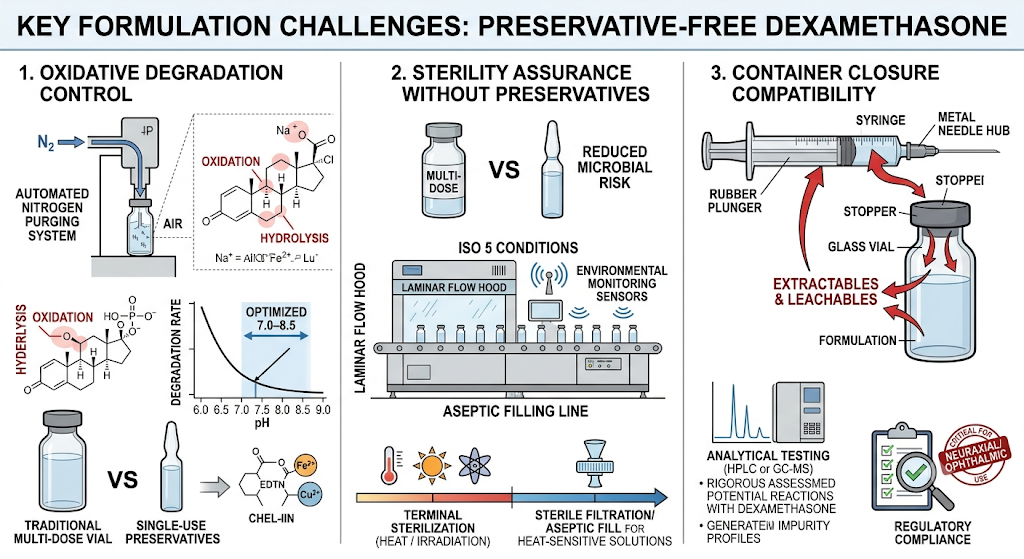
Oxidative Degradation Control
Dexamethasone sodium phosphate degrades primarily through oxidation and hydrolysis. Without antioxidant preservatives, formulators typically address this through:
- Headspace nitrogen or argon purging during filling to displace dissolved oxygen
- Use of chelating agents such as EDTA to sequester trace metal catalysts
- Selection of low-oxygen-permeability container closure systems
- pH optimization, generally in the 7.0–8.5 range for the phosphate ester, to balance solubility against hydrolytic degradation rate
Detailed excipient and pH strategies specific to this salt form are addressed in our guide to dexamethasone sodium phosphate formulation.
Sterility Assurance Without Preservatives
Since preservatives can no longer serve as a secondary barrier against microbial ingress, sterility must be assured through the manufacturing process itself. This typically means:
- Terminal sterilization where compatible with drug stability, or aseptic processing when heat sensitivity precludes it
- Validated aseptic filling lines with environmental monitoring meeting ISO 5 conditions at the point of fill
- Single-dose, ready-to-use presentations (ampoules or single-use vials) that eliminate the multi-entry contamination risk preservatives were originally designed to mitigate
Container Closure Compatibility
Because preservative-free formulations often use novel container systems (e.g., cyclic olefin copolymer vials, pre-filled syringes), extractables and leachables testing becomes critical. Compounds leaching from rubber stoppers, plungers, or plastic components can react with dexamethasone or introduce unacceptable impurities, particularly relevant for neuraxial or ophthalmic use where systemic exposure sensitivity is high. Our dedicated resource on extractables and leachables in dexamethasone injectables outlines the testing scope and regulatory expectations in more depth.
6: How Does Analytical Testing Support Preservative-Free Dexamethasone Development?
Analytical testing supports preservative-free dexamethasone development by confirming that the formulation remains stable, pure, and free of harmful degradation products or leachables across its intended shelf life, replacing the safety net that preservatives would otherwise provide. A robust analytical package typically includes the following:
| Test Category | Purpose | Typical Method |
|---|---|---|
| Assay & Related Substances | Quantify dexamethasone content and degradation products | Stability-indicating HPLC (RP-HPLC with UV detection) |
| Forced Degradation | Establish degradation pathways under stress (heat, light, oxidation, hydrolysis) | ICH Q1A(R2)-aligned stress studies |
| Sterility Testing | Confirm absence of viable microorganisms | USP <71> membrane filtration |
| Bacterial Endotoxin | Verify pyrogen-free status, critical for neuraxial routes | USP <85> LAL assay |
| Extractables & Leachables | Identify container-derived compounds that may migrate into the drug product | GC-MS, LC-MS, ICP-MS per USP <1663>/<1664> |
| Particulate Matter | Ensure compliance with injectable particulate limits | USP <788> light obscuration |
| pH and Osmolality | Confirm formulation remains within specification | Potentiometric and osmometric analysis |
Forced degradation studies are especially important during early development because they identify the dominant degradation pathway, information that directly informs excipient selection, pH targeting, and packaging strategy before formulation lock. Our detailed methodology for forced degradation of dexamethasone walks through stress-testing conditions and degradation product identification in greater detail.
Related impurity profiling is equally important, since regulatory submissions require full characterization and qualification of any degradation products or process-related impurities above identification thresholds. Our dexamethasone impurities analysis resource covers impurity identification, structural elucidation, and qualification strategy. Broader method development considerations, including chromatographic conditions and validation parameters, are discussed in our overview of dexamethasone injection analytical methods, while long-term and accelerated shelf-life data strategy is addressed in our article on dexamethasone injection stability.
7: What Regulatory Pathway Applies to Preservative-Free Dexamethasone Injections?
The regulatory pathway for a preservative-free dexamethasone injection depends on whether the product is a generic equivalent of an existing reference listed drug (ANDA) or introduces a formulation, route, or presentation change relative to existing approvals (505(b)(2) NDA). A preservative-free reformulation of an already-approved multi-dose product frequently qualifies for the 505(b)(2) pathway, since it references existing safety and efficacy data for the active ingredient while requiring new data to support the modified formulation and packaging.
For sponsors pursuing the generic route specifically, our article on dexamethasone injection generic development outlines the comparative bioavailability, impurity qualification, and dissolution requirements unique to ANDA filings.
Key regulatory considerations include:
- Demonstrating comparative bioavailability or bioequivalence where applicable
- Providing full characterization of any new excipients or container closure systems, including E&L data
- Supporting the preservative-free claim with sterility assurance and container integrity data (e.g., USP <1207> container closure integrity testing)
- Addressing FDA’s heightened scrutiny of injectable corticosteroids for neuraxial use, informed by post-2012 guidance and safety communications
Health Canada and EMA apply parallel but jurisdiction-specific requirements, and companies pursuing multi-region filings should map differences in E&L expectations and sterility assurance level (SAL) documentation early in development to avoid late-stage rework.
8: How Can a CDMO Partner Support Dexamethasone Injection Development?
An experienced CDMO partner supports dexamethasone injection development by providing integrated formulation science, stability-indicating analytical method development, and regulatory-ready documentation under one program, reducing the technical risk inherent in preservative-free parenteral development. Given the narrow margin for error in oxidative stability, sterility assurance, and container compatibility, sponsors benefit from a partner with direct experience in corticosteroid injectables and small-molecule parenteral characterization rather than general-purpose formulation support.
ResolveMass Laboratories works with pharmaceutical innovators and generic manufacturers on the analytical and formulation-support work that underpins preservative-free injectable development, including forced degradation studies, stability-indicating method validation, extractables and leachables testing, and sterility and endotoxin testing aligned with USP and ICH expectations. Sponsors can learn more about our end-to-end service model on our dexamethasone injectable CRO page.
Conclusion:
Preservative-free dexamethasone injection development demands a formulation and analytical strategy built specifically around the risks that preservatives were originally designed to manage: microbial contamination and chemical instability. Success depends on tightly controlled pH and oxidation management, careful container closure selection backed by extractables and leachables data, and a sterility assurance strategy robust enough to replace the antimicrobial function preservatives once provided. For sponsors navigating this complexity, partnering with a CDMO experienced in both corticosteroid chemistry and stability-indicating analytical methods can significantly reduce development risk and timeline uncertainty in dexamethasone injection development.
Frequently Asked Questions:
Preservative-free dexamethasone injections are developed to eliminate antimicrobial preservatives from the formulation, which may be preferred for certain clinical applications and single-dose presentations. Since preservatives are absent, greater emphasis is placed on aseptic processing, sterile packaging, and contamination control. These formulations require carefully optimized manufacturing processes to maintain sterility throughout the product’s shelf life. Developers also conduct extensive stability and compatibility studies to ensure long-term product quality. Robust analytical testing and validated manufacturing practices are essential to support product safety and regulatory compliance.
Some of the main challenges include:
-Maintaining sterility without preservatives
-Achieving long-term chemical and physical stability
-Selecting compatible excipients
-Preventing particulate formation
-Ensuring container closure integrity
-Meeting regulatory expectations through comprehensive analytical testing
Essential analytical tests include:
-Assay and potency testing
-Related substances and impurity profiling
-Sterility testing
-Bacterial endotoxin testing
-Particulate matter analysis
-pH and osmolality testing
-Stability-indicating methods
-Container closure integrity testing
Stability studies evaluate how the formulation performs under various storage conditions over time. They help determine whether the product maintains its potency, purity, sterility, appearance, and overall quality throughout its intended shelf life. These studies also identify potential degradation pathways and establish appropriate storage recommendations. Both accelerated and long-term stability testing are conducted to support regulatory submissions. Stability data are critical for assigning expiration dates and ensuring consistent product performance. Without robust stability studies, product quality and patient safety cannot be adequately demonstrated.
Packaging is essential for protecting preservative-free injectable formulations from contamination and environmental exposure. The container closure system must maintain sterility while preventing moisture, oxygen, and light from affecting product stability. Developers evaluate compatibility between the formulation and packaging materials through extractables and leachables studies. Container closure integrity testing confirms that the packaging remains secure throughout storage and transportation. Selecting the appropriate vial, syringe, or polymer container can significantly influence product performance. Proper packaging is therefore an integral part of successful injectable product development.
Quality by Design (QbD) helps developers build quality into the product from the earliest stages of development. It involves identifying Critical Quality Attributes (CQAs), assessing risks, and optimizing formulation and manufacturing parameters through scientific studies. QbD also supports consistent process performance and reduces variability between production batches. This systematic approach improves manufacturing efficiency while enhancing product quality and regulatory readiness. Regulatory agencies encourage the adoption of QbD because it promotes a better understanding of both the product and the manufacturing process. Overall, QbD contributes to a more robust and reliable development program.
Reference
- Kim H, Lee SY, Lee CH. An In Vitro Study of the Physicochemical Stability of Ropivacaine and Dexamethasone Formulations Containing Different Preservatives: Establishing a Safety Guideline. Pain Physician. 2026 Mar 1;29(2):E101-9.https://www.painphysicianjournal.com/current/pdf/ODEzNA%3D%3D
- Yuen MV, Gianturco SL, Pavlech LL, Storm KD, Mattingly AN. Dexamethasone sodium phosphate: Summary Report.https://archive.hshsl.umaryland.edu/entities/publication/13b8ec2e-af1c-4df7-a478-3684e0f48c82
- Brooks CC, Jabbehdari S, Gupta PK. Dexamethasone 0.4 mg sustained-release intracanalicular insert in the management of ocular inflammation and pain following ophthalmic surgery: design, development and place in therapy. Clinical Ophthalmology. 2020 Jan 13:89-94.https://www.tandfonline.com/doi/abs/10.2147/OPTH.S238756
- Figus M, Agnifili L, Lanzini M, Brescia L, Sartini F, Mastropasqua L, Posarelli C. Topical preservative-free ophthalmic treatments: an unmet clinical need. Expert opinion on drug delivery. 2021 Jun 3;18(6):655-72.https://www.tandfonline.com/doi/abs/10.1080/17425247.2021.1860014
About the Author


