


Introduction
The fundamental distinction between a fit-for-purpose and a fully validated bioanalytical method is determined by the extent of experimental assessment, the strictness of the predefined acceptance criteria, and the regulatory significance of the decisions that the resulting data are intended to support. Fit-for-purpose methods use customized, phase-appropriate qualification studies to address exploratory or early-stage drug development objectives, while fully validated methods undergo a comprehensive and standardized series of evaluations in accordance with ICH M10 and FDA guidelines to generate data suitable for pivotal clinical, safety, and regulatory submission decisions. Recognizing the technical distinctions between a fit-for-purpose and a fully validated bioanalytical method is critical for establishing efficient, risk-based analytical strategies throughout the biopharmaceutical development lifecycle.
In contemporary pharmaceutical development, bioanalytical methods generate quantitative and qualitative information about the concentrations of therapeutics, metabolites, biomarkers, and anti-drug antibodies in biological matrices, including plasma, serum, whole blood, urine, and tissue homogenates. Traditional drug development approaches frequently relied on complete method validation irrespective of the development stage, largely because of a risk-averse approach to analytical testing. However, applying a uniform validation strategy can result in avoidable expenses, prolonged development timelines, and inefficient use of analytical resources during discovery and early development. On the other hand, using inadequately characterized assays during pivotal studies can create significant risks, including regulatory rejection, clinical holds, and the potential invalidation of safety or efficacy conclusions. A stage-gated bioanalytical strategy provides a more appropriate approach by matching analytical rigor to the level of risk associated with each development decision.
👉 Learn more about building a tailored development plan: Explore Strategic Bioanalytical Planning Across Drug Development Stages
Share via:
Quick Summary:
- Fit-for-purpose (FFP) methods are designed for exploratory and early-stage studies, using phase-appropriate testing and flexible acceptance criteria to support rapid scientific decisions.
- Fully validated methods provide comprehensive, documented evidence of analytical performance and are required for pivotal nonclinical and clinical studies, regulatory submissions, and bioequivalence assessments under ICH M10.
- Bioanalytical methods progress through four tiers: Screening → Research → Qualified → Fully Validated, with increasing rigor, reference standard requirements, and regulatory expectations.
- Technical differences include accuracy, precision, selectivity, matrix effects, stability, and dilution integrity. Fully validated assays require multi-day testing, multiple matrix lots, and tighter acceptance criteria.
- Incurred Sample Reanalysis (ISR) is an important reproducibility check for pivotal studies, while FFP methods generally focus on the specific performance characteristics needed for immediate research objectives.
- Method selection should follow the drug development lifecycle: screening and research in discovery, qualified assays in early development, and fully validated methods for GLP safety studies and pivotal clinical trials.
- Specialized assays for biomarkers, anti-drug antibodies, ADCs, oligonucleotides, and gene therapies require customized, risk-based strategies. The key principle is to match analytical rigor to the study’s scientific and regulatory risk.
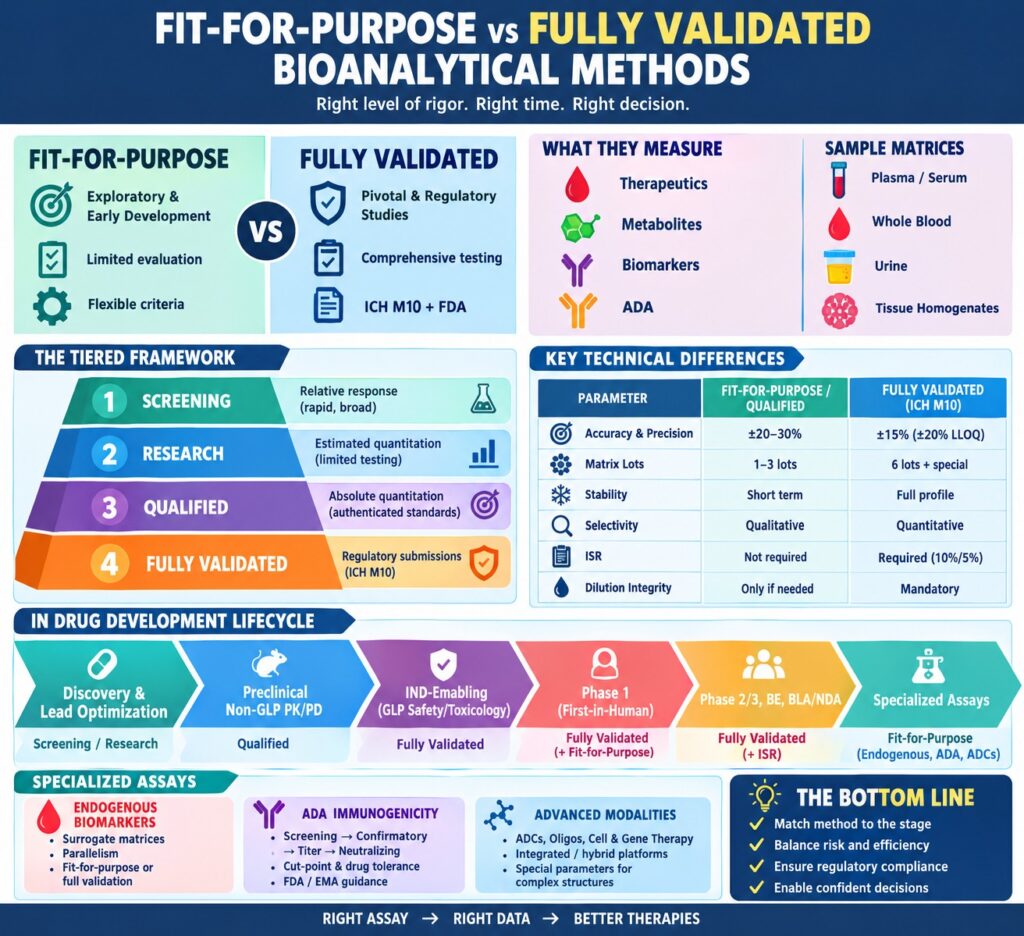
Structural and Regulatory Foundations: The Regulatory Difference Between a Fit-for-Purpose and a Fully Validated Bioanalytical Method
Regulatory agencies expect fully validated bioanalytical methods for pivotal nonclinical and clinical investigations to establish confidence in data integrity, whereas fit-for-purpose methods function within flexible, risk-based frameworks intended for exploratory and developmental applications. This fundamental structural difference allows analytical effort to increase proportionally with the ethical, scientific, and regulatory risks associated with conclusions regarding drug safety and efficacy.
The ICH M10 guidance, which has been adopted internationally by regulatory authorities such as the US Food and Drug Administration (FDA) and the European Medicines Agency (EMA), represents a major international standard for the validation of bioanalytical methods used to support pharmacokinetic (PK) and toxicokinetic (TK) assessments. The guidance establishes standardized procedures and acceptance criteria for chromatographic techniques, including Liquid Chromatography-Tandem Mass Spectrometry (LC-MS/MS), as well as Ligand Binding Assays (LBA), including Enzyme-Linked Immunosorbent Assays (ELISA) and Meso Scale Discovery (MSD) platforms.
👉 Need help navigating global guidelines? Review the Key Principles of ICH M10 Bioanalytical Method Validation Guidelines
Regulatory expectations differ according to the intended purpose of the assay and the stage of the study:
- Pharmacokinetic and Toxicokinetic Assays: Full validation in accordance with ICH M10 is required for pivotal nonclinical TK studies performed under Good Laboratory Practice (GLP), as well as pivotal clinical studies, including Phase 1 through Phase 3 trials, bioequivalence studies, and drug-drug interaction studies.
- Biomarker Assays: Biomarker quantification is outside the formal scope of ICH M10 and is instead addressed through separate regulatory guidance documents that support a fit-for-purpose validation approach. The level of validation should correspond to the role of the biomarker, ranging from an exploratory endpoint to a pivotal surrogate endpoint used to support product labeling.
- Immunogenicity Assays (Anti-Drug Antibodies – ADA): ADA assays are also outside the scope of ICH M10. These assays are governed by dedicated, risk-based regulatory frameworks that emphasize cut-point determination, drug tolerance, and tiered testing strategies involving screening, confirmatory, and neutralizing assays.
👉 Comparing global regulatory agencies? Discover the Main Technical Differences Between EMA and FDA Bioanalytical Guidelines
| Feature or Dimension | Fit-for-Purpose (FFP) Method | Fully Validated Method (ICH M10) |
|---|---|---|
| Primary Objective | Tailored characterization for internal decision-making or exploratory endpoints. | Standardized, defensible quantification supporting pivotal regulatory filings. |
| Regulatory Scope | Non-GLP discovery, lead optimization, early exploratory biomarkers, internal MIST studies. | GLP nonclinical safety/TK, Phase 1–3 clinical PK/BE, pivotal biomarker endpoints. |
| Governing Guidance | Stage-appropriate SOPs, AAPS whitepapers, FDA Biomarker FFP guidance. | ICH M10 Guideline, FDA Bioanalytical Method Validation Guidance (2018/2022). |
| Reference Standard Requirements | Authenticated or estimated source; certified purity and CoA not strictly required. | Fully characterized reference standard with documented identity, purity, lot number, and CoA. |
| Acceptance Criteria Stringency | Broader, purpose-defined limits (e.g., ±20% to ±30% accuracy/precision). | Tightly defined limits (Chromatographic: ±15%/20% LLOQ; LBA: ±20%/25% LLOQ/ULOQ). |
| Execution Complexity | Compressed evaluation (1–2 runs, limited matrix lots and stability challenges). | Comprehensive evaluation (minimum 3 independent accuracy/precision runs over multiple days). |
Tiered Framework: Categorizing the Method Spectrum
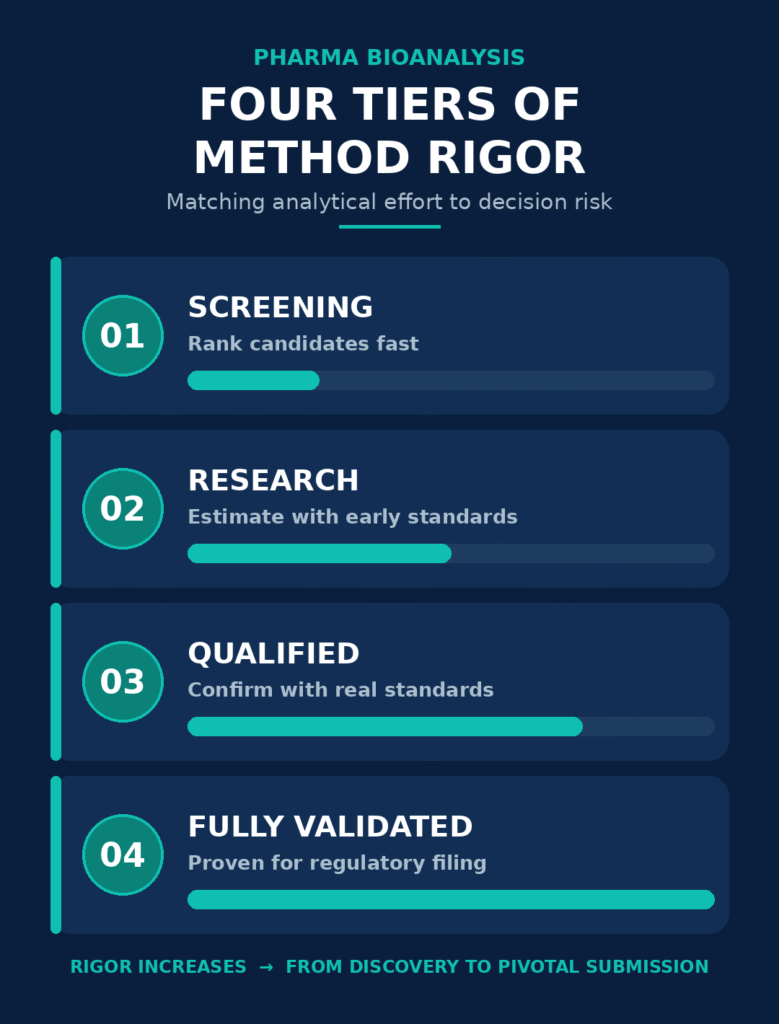
The tiered framework divides bioanalytical method characterization into several defined levels—screening, research, qualified, and fully validated—according to the intended use of the generated data and the availability and quality of assay reagents. This progressive framework enables bioanalysts to systematically develop assay performance, beginning with exploratory compound ranking and progressing toward analytical methods capable of meeting global regulatory submission requirements.
Consensus initiatives developed by organizations such as the European Bioanalysis Forum (EBF) and the Global Bioanalysis Consortium (GBC) establish this hierarchy through four distinct operational tiers:
Screening Bioanalytical Assays
Screening assays constitute the initial level of bioanalytical testing and are primarily intended to assess relative analyte response rather than determine absolute analyte concentrations. These assays generally do not use authentic reference standards or formal calibration curves. Instead, they may rely on instrument response ratios to rank drug candidates or assess metabolic stability in vitro. Acceptance criteria are generally broad or may not be formally defined, allowing research teams to rapidly evaluate large compound libraries during the early stages of lead identification.
Research Bioanalytical Assays
Research assays generate estimated quantitative measurements using uncertified comparator materials or reference standards synthesized in situ. Their performance is characterized through a limited assessment of parameters such as linearity, precision, and analytical range, generally using less stringent accuracy and precision requirements, such as ±25% to ±30%. These methods are useful for internal scientific decision-making, early dose-range-finding (DRF) studies, and non-regulated metabolite identification, including Metabolites in Safety Testing (MIST).
Qualified Bioanalytical Assays
Qualified assays represent the most advanced level within the fit-for-purpose framework and provide absolute quantitative measurements against predefined accuracy and precision requirements. These assays are conducted with authenticated reference standards having established identity and purity. Qualification typically examines critical analytical characteristics, including calibration range, selectivity, intra-assay precision, and short-term matrix stability. Qualified methods are commonly used for non-GLP preclinical pharmacokinetic studies, early phase-appropriate biomarker investigations, and secondary exploratory endpoints during early clinical development.
👉 Accelerating early-stage candidate decisions? Access Rapid Bioanalytical Proof-of-Concept Services for Lead Candidates
Fully Validated Bioanalytical Assays
Fully validated assays constitute the established standard for regulated bioanalysis and provide comprehensive, documented evidence that the analytical method is suitable for its intended regulatory application. These methods are operated according to formal validation protocols and predefined Standard Operating Procedures (SOPs) and undergo extensive multi-day evaluation of all relevant performance characteristics specified by ICH M10. Fully validated assays are required for bioanalytical data intended to support Investigational New Drug (IND), New Drug Application (NDA), and Biologics License Application (BLA) submissions.
Technical Parameter Differences in Bioanalytical Method Execution
The technical execution of bioanalytical methods differs considerably between method tiers because fully validated assays require extensive multi-day assessment of operational variables, whereas fit-for-purpose methods selectively evaluate the characteristics that are most important for the immediate scientific objective. Consequently, a fully validated assay has a considerably larger experimental footprint, involving greater replication, multiple independent matrix lots, and comprehensive stability assessments.
Accuracy and Precision
For chromatographic methods such as LC-MS/MS, full validation requires accuracy, expressed as %bias, and precision, expressed as %coefficient of variation, %CV, to be assessed across a minimum of three independent validation runs performed over multiple days. Each analytical run should contain at least four Quality Control (QC) concentration levels, consisting of Lower Limit of Quantitation (LLOQ), Low QC, Medium QC, and High QC, with replicate analysis, typically n=5 at each concentration level. Within-run and between-run accuracy must remain within ±15% of the nominal concentration, except at the LLOQ, where a limit of ±20% is acceptable. Similarly, within-run and between-run precision should not exceed 15% CV, with a limit of 20% CV permitted at the LLOQ. For LBAs, the corresponding criteria are ±20%, with ±25% permitted at the LLOQ and ULOQ. In fit-for-purpose assays, accuracy and precision are often assessed in a single analytical run using two or three QC concentration levels, and the acceptance criteria may be broadened to ±20% or ±30%, depending on the intended purpose of the assay.
Selectivity, Specificity, and Matrix Factor
Full validation requires selectivity to be assessed using at least six independent individual sources of the target biological matrix. The analytical procedure must demonstrate that interfering signals are absent or adequately controlled at the retention times of the analyte and internal standard. Interference should remain below 20% of the LLOQ response for the analyte and below 5% of the internal standard (IS) response. For LC-MS/MS methods, matrix effects must be quantitatively assessed across six independent matrix lots by determining the IS-Normalized Matrix Factor. The %CV across the evaluated lots should not exceed 15%. By comparison, fit-for-purpose qualification may use pooled matrix lots and assess selectivity and matrix interference qualitatively through techniques such as post-column infusion or post-extraction spikes.
👉 Troubleshooting MS signal suppression or enhancement? Learn How to Identify and Overcome Matrix Effects in LC-MS/MS Bioanalysis
Stability Evaluations
Comprehensive stability assessment is required for fully validated methods to address the various conditions to which study samples may be exposed throughout collection, processing, storage, and analysis. This evaluation includes benchtop or room temperature stability, freeze-thaw stability involving a minimum of three cycles, long-term storage stability in matrix at the intended storage temperatures (-20°C and -80°C), processed sample or autosampler stability, and stock solution stability. Fit-for-purpose qualification generally concentrates on the operational periods that are immediately relevant to the study, such as short-term benchtop handling and one or two freeze-thaw cycles. Long-term stability assessment may subsequently be completed using real-time study sample analysis as the development program advances.
👉 Managing complex sample storage requirements? Explore Comprehensive Stability Testing Strategies in Bioanalysis
Incurred Sample Reanalysis (ISR)
Incurred Sample Reanalysis (ISR) is a regulatory expectation for pivotal nonclinical and clinical studies in which fully validated bioanalytical methods are used. ISR assesses the reproducibility of the analytical method using actual study samples that may contain endogenous metabolites, circulating protein complexes, and variable matrix compositions. A predefined proportion of study samples, typically 10% of the first 1,000 samples and 5% of subsequent samples, must be re-analyzed. At least 67% of the re-analyzed samples should demonstrate agreement within ±20% of the original concentration for chromatography and within ±30% for LBAs. ISR is not generally included within fit-for-purpose qualification activities.
👉 Ensuring sample reproducibility in pivotal studies? Understand the Requirements for Incurred Sample Reanalysis (ISR)
| Validation Parameter | Fit-for-Purpose (FFP) / Qualified Assays | Fully Validated Assays (ICH M10) |
|---|---|---|
| Accuracy & Precision Runs | 1 to 2 runs; often single-day execution. | Minimum 3 independent runs across multiple days. |
| QC Concentration Levels | 2 to 3 levels (Low, Medium, High); n=3–4 replicates. | Minimum 4 levels (LLOQ, Low, Medium, High); n=5 replicates. |
| Chromatographic Criteria | Accuracy: ±20% to ±30%; Precision: ≤20% to 30% CV. | Accuracy: ±15% (±20% LLOQ); Precision: ≤15% CV (≤20% LLOQ). |
| LBA Criteria | Accuracy: ±25% to ±30%; Precision: ≤25% to 30% CV. | Accuracy: ±20% (±25% LLOQ/ULOQ); Precision: ≤20% CV (≤25% LLOQ/ULOQ). |
| Matrix Lot Selectivity | Single pooled lot or 2–3 individual lots. | Minimum 6 individual matrix lots (plus lipemic/hemolyzed). |
| Matrix Factor / Effect | Qualitative screening (e.g., post-column infusion). | Quantitative evaluation across 6 lots; IS-normalized %CV ≤15%. |
| Stability Testing | Short-term handling (benchtop, 1–2 freeze-thaw cycles). | Complete profile: benchtop, long-term (-20°C/-80°C), autosampler, stock. |
| Dilution Integrity | Evaluated only if sample concentrations exceed ULOQ. | Mandatory pre-validation testing using dilution QCs. |
| Incurred Sample Reanalysis | Excluded. | Mandatory for pivotal clinical and GLP nonclinical studies. |
Lifecycle Application: Applying the Difference Between a Fit-for-Purpose and a Fully Validated Bioanalytical Method
Selecting the appropriate bioanalytical method tier at each stage of the drug development lifecycle enables efficient allocation of analytical resources while preserving full regulatory compliance when regulatory decision points are reached. Bioanalytical assays generally progress from screening-level approaches during discovery to qualified methods during early development and, ultimately, to fully validated methods during IND-enabling toxicology and clinical development.
The systematic progression through these lifecycle stages allows analytical rigor to remain aligned with the objectives and risk profile of each study:
- Discovery and Lead Optimization: During early drug discovery, bioanalytical methods are used to evaluate hundreds of lead candidates through in vitro metabolic stability screening, permeability assessments, and preliminary animal dosing studies. High-throughput LC-MS/MS methods operating within screening or research tier frameworks are commonly used, with greater emphasis placed on processing speed and broad analytical range than on stringent accuracy and precision requirements.
- Preclinical Non-GLP PK/PD Studies: Non-GLP pharmacokinetic and pharmacodynamic studies conducted in animals are used to establish preliminary dose ranges, half-life, bioavailability, and target tissue distribution. At this stage, bioanalytical methods generally progress toward qualified fit-for-purpose assays that use authenticated reference standards. This provides sufficiently reliable exposure data to support internal scientific and development decisions.
- IND-Enabling Nonclinical GLP Safety and Toxicology: Toxicokinetic (TK) studies performed under Good Laboratory Practice (GLP) to establish No-Observed-Adverse-Effect-Levels (NOAEL) require fully validated bioanalytical methods. Because TK exposure results contribute directly to the determination of safe starting doses for human clinical studies, regulatory agencies expect comprehensive evidence demonstrating method accuracy, precision, matrix effects, selectivity, and stability in accordance with ICH M10 requirements.
- Early Phase Clinical Trials (Phase 1): First-in-Human (FIH) Phase 1 studies assess human single and multiple ascending doses with the primary objectives of evaluating safety, tolerability, and PK. Primary human PK assays must be fully validated according to ICH M10 before study sample analysis. Nevertheless, exploratory biomarkers, secondary metabolites, and early immunogenicity screening assays incorporated into Phase 1 studies may be supported by qualified fit-for-purpose methods when their intended use does not require full validation.
- Pivotal Clinical Trials (Phase 2/3, Bioequivalence, BLA/NDA Filings): Bioanalytical assays used to support primary safety, efficacy, bioequivalence (BE), drug-drug interaction (DDI), and pediatric endpoints in pivotal Phase 2 and Phase 3 studies require full method validation. Incurred Sample Reanalysis (ISR) is also performed systematically during sample analysis to demonstrate method reproducibility in clinical populations and strengthen confidence in the resulting bioanalytical data.
👉 Scaling up for late-phase regulatory trials? Explore High-Throughput Bioanalytical CRO Services for Phase II and Phase III Trials
Specialized Assays: Biomarkers, Immunogenicity, and Advanced Modalities
Endogenous biomarkers, anti-drug antibody immunogenicity assays, and complex therapeutic modalities such as antibody-drug conjugates require customized analytical strategies because several assumptions applicable to conventional drug assays may not be appropriate for these specialized applications. These assays frequently rely on fit-for-purpose principles to address challenges associated with endogenous matrix components, reagent variability, and structural complexity.
Endogenous Biomarker Assays
Biomarker quantification presents distinct analytical challenges because endogenous analytes are naturally present within biological matrices, recombinant reference standards may vary in quality, and interactions between the analyte and matrix components can be difficult to predict. When a biological matrix that is completely devoid of the target biomarker cannot be obtained, surrogate matrices, such as phosphate-buffered saline containing bovine serum albumin, or standard addition approaches may be used. The analytical strategy must demonstrate appropriate parallelism between calibration curves prepared in the surrogate matrix and responses generated by the endogenous analyte in authentic biological matrix. When a biomarker is being measured to investigate exploratory pharmacodynamic trends, a qualified fit-for-purpose assay is generally adequate. However, when biomarker results directly contribute to pivotal conclusions concerning efficacy, safety, or labeled dosing instructions, the analytical method requires comprehensive validation tailored to the specific characteristics and intended use of the biomarker.
Anti-Drug Antibody (ADA) Immunogenicity Assays
Biologic therapeutics may trigger unwanted immune responses in clinical subjects, leading to the formation of anti-drug antibodies (ADAs). These antibodies can potentially reduce therapeutic activity, neutralize drug efficacy, or contribute to adverse events. Immunogenicity assays follow a tiered, risk-based testing strategy governed by specialized FDA and EMA guidances rather than ICH M10. The testing sequence generally begins with a screening assay designed to achieve an appropriate false-positive rate, commonly targeting 5% through a statistically established cut-point. Samples that meet the screening criteria proceed to a confirmatory assay in which drug competition is used to demonstrate specificity. Additional testing may then include titer determination and neutralizing antibody characterization. Important validation characteristics include drug tolerance, sensitivity, cut-point stability, and matrix selectivity.
Advanced Therapeutic Modalities
Emerging therapeutic modalities, including Antibody-Drug Conjugates (ADCs), oligonucleotides, cell therapies, and viral vector-based gene therapies such as AAVs, often require integrated or hybrid bioanalytical platforms. For example, bioanalysis of ADCs may require concurrent measurement of total antibody, conjugated antibody, and free payload. Free payload quantification using LC-MS/MS can generally follow the established principles of ICH M10 chromatographic validation. In contrast, measurements of total antibody and conjugated species using hybrid LC-MS/MS or LBA platforms may require specialized fit-for-purpose parameters to account for structural heterogeneity, target shedding, and matrix interference.
👉 Developing complex nucleic acid therapies? Learn About Specialized Bioanalytical Solutions for Oligonucleotide Therapeutics
Conclusion
A clear understanding of the operational difference between a fit-for-purpose and a fully validated bioanalytical method enables pharmaceutical sponsors to establish analytical development strategies that are efficient, compliant, and appropriately balanced against scientific and regulatory risk. During early candidate selection, agile fit-for-purpose qualified assays can provide the timely information required for rapid scientific decisions. As development progresses toward pivotal nonclinical safety studies and human clinical trials, comprehensive ICH M10-compliant method validation becomes essential for maintaining data integrity and supporting reliable regulatory decisions. By adopting a phase-appropriate and risk-managed bioanalytical strategy, drug developers can effectively connect early lead discovery with later-stage clinical development and regulatory authorization.
👉 Looking for an end-to-end laboratory partner? Partner with an Integrated Chemistry and Bioanalytical CRO
To discuss customized bioanalytical method development, stage-appropriate qualification, or formal ICH M10 validation requirements for your program, connect with the scientific team through the ResolveMass Laboratories Contact Page.
Frequently Asked Questions
A fit-for-purpose bioanalytical method may be appropriate when the resulting data are intended to support exploratory objectives rather than definitive regulatory conclusions. Such methods can be used for exploratory endpoints, early nonclinical investigations, secondary biomarker assessments, and preliminary metabolite characterization, including Metabolites in Safety Testing (MIST). When data directly support pivotal safety, efficacy, bioequivalence, or labeling decisions, a fully validated method is generally required.
Biomarker assays frequently involve endogenous analytes that are already present in biological matrices, making the preparation of a true blank matrix and conventional calibration standards challenging. A fit-for-purpose strategy allows parameters such as parallelism, surrogate matrix performance, recovery, and biological variability to be assessed according to the intended use of the biomarker. The required level of qualification therefore depends on whether the biomarker supports exploratory or pivotal conclusions.
Incurred Sample Reanalysis (ISR) is used to verify that a bioanalytical method produces reproducible results when applied to actual study samples rather than only prepared Quality Control (QC) samples. Real biological samples can contain variable matrix components, endogenous metabolites, circulating protein complexes, and other factors that may influence assay performance. ISR helps identify analytical inconsistencies that may not be apparent during conventional validation experiments.
For chromatographic methods such as LC-MS/MS, ICH M10 generally establishes accuracy and precision limits of ±15% and ≤15% CV, respectively, with wider limits of ±20% and ≤20% CV at the LLOQ. For Ligand Binding Assays (LBA), the corresponding general limits are ±20% for accuracy and ≤20% CV for precision. At the LLOQ and ULOQ, LBA acceptance limits may extend to ±25% and ≤25% CV.
The requirement for full validation depends on the intended role of the pharmacokinetic data. Primary PK assays used to support important safety, exposure, or dose-related decisions generally require full validation before analysis of clinical samples. In contrast, secondary analytes, exploratory PK measurements, or exploratory tissue distribution assessments may use qualified fit-for-purpose methods when they are not intended to support pivotal regulatory conclusions.
Partial validation is performed when an established bioanalytical method has already undergone full validation but requires assessment following a specific modification, such as a change in matrix species, anticoagulant, or sample volume. The evaluation focuses on analytical characteristics potentially affected by that modification. Fit-for-purpose qualification is different because it is a customized initial assessment intended to demonstrate adequate assay performance for a defined early-stage or non-regulated purpose.
Fully validated bioanalytical methods generally require thoroughly characterized reference standards with documented information regarding source, identity, purity, lot number, and Certificate of Analysis (CoA). For fit-for-purpose qualified assays, reference materials may have less extensive certification or preliminary characterization when appropriate for the intended application. However, their source, identity, and estimated potency should still be adequately documented to support reliable interpretation of the analytical results.
Over-validation during early discovery can require substantial analytical resources for compounds that may later be modified, deprioritized, or discontinued. Performing extensive regulatory-level experiments at this stage can increase costs, delay development activities, and reduce the flexibility needed for rapidly changing discovery programs. A proportionate fit-for-purpose strategy avoids unnecessary testing while still generating sufficient data for scientific decision-making.
For chromatographic bioanalytical methods such as LC-MS/MS, ICH M10 requires matrix effect assessment using multiple independent sources of the relevant biological matrix. The evaluation commonly involves determining the IS-normalized Matrix Factor by comparing analyte responses in extracted matrix with responses obtained in appropriate reference solutions. The variability across the evaluated matrix lots is assessed using %CV, with an acceptance criterion of ≤15% generally applied.
Reference:
- Lowes, S., Hucker, R., Jemal, M., Marini, J. C., Rezende, V. M., Shoup, R., Singhal, P., Timmerman, P., Yoneyama, T., Weng, N., & Zimmer, D. (2015). Tiered approaches to chromatographic bioanalytical method performance evaluation: Recommendation for best practices and harmonization from the Global Bioanalysis Consortium harmonization team. The AAPS Journal, 17(1), 17–23. https://doi.org/10.1208/s12248-014-9656-x
- U.S. Food and Drug Administration. (2026, April). Bioanalytical method validation for biomarkers: Guidance for industry. U.S. Department of Health and Human Services. FDA guidance PDF
- Timmerman, P., Barfield, M., Bertran Portabella, E., Calogero, S., Cowan, K., Faber, J., Ferrari, L., Golob, M., Goodman, J., Goodwin, L., Gnoth, M. J., Hughes, R., Ivanova, T., Jordan, G., Laurén, A., Maux, D., McDougall, S., Milushewa, P., Nelson, R., … Zeiser, K. (2024). Recommendations and feedback from the European Bioanalysis Forum Workshop: 1 year into ICH M10 – Keeping our finger on the pulse. Bioanalysis, 16(5), 259–270. https://doi.org/10.4155/bio-2024-0013
- European Medicines Agency. (2019). Overview of comments received on draft ICH guideline M10 on bioanalytical method validation (Step 2b). European Medicines Agency. EMA document
Get In Touch With Us
About The Author


