

Introduction
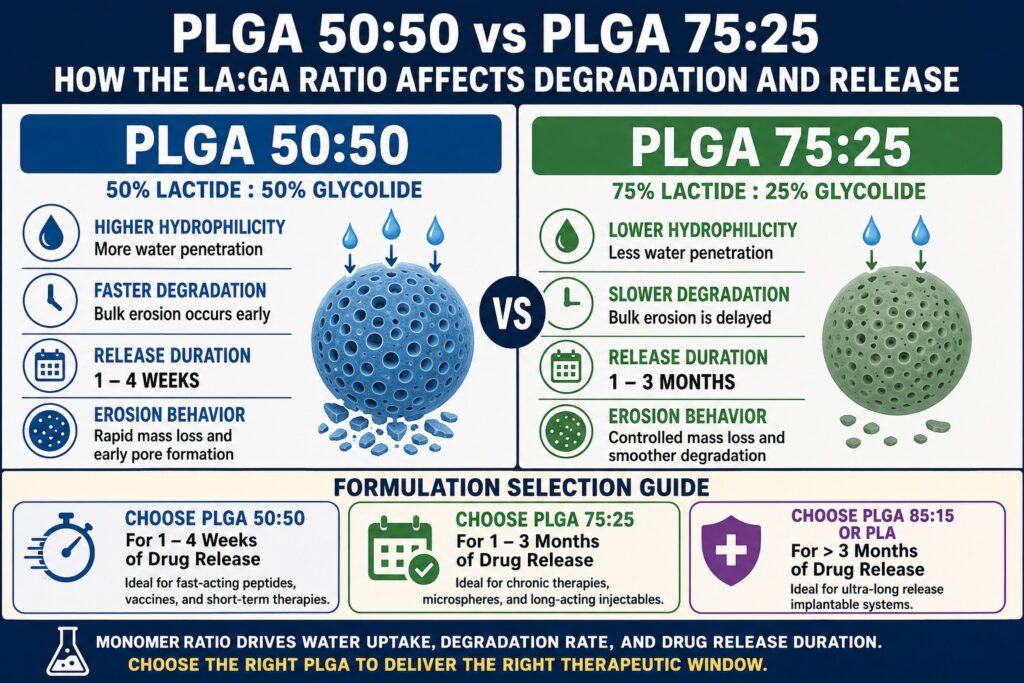
The primary biophysical distinction between PLGA 50:50 and PLGA 75:25 is defined by their monomer composition, specifically the ratio of hydrophobic lactic acid to hydrophilic glycolic acid. This compositional difference directly influences the rate of hydrolytic degradation and the kinetics of drug release. PLGA 50:50, which contains equal proportions of lactic acid and glycolic acid, undergoes rapid hydration and degrades within approximately 1 to 4 weeks. In contrast, the higher lactide content (75%) in PLGA 75:25 reduces water penetration, enabling sustained drug release over a period of 1 to 3 months.
For the development of long-acting injectable depots and bioresorbable implants, understanding the fundamental differences between PLGA 50:50 and PLGA 75:25 is essential for achieving a predictable therapeutic window. Poly(lactic-co-glycolic acid) (PLGA) is a well-established biodegradable and biocompatible copolymer extensively employed in controlled-release drug delivery systems and implantable medical devices. Regulatory authorities, including the US Food and Drug Administration (FDA) and the European Medicines Agency (EMA), have approved PLGA for numerous pharmaceutical and biomedical applications. Within the body, PLGA degrades through non-enzymatic hydrolysis of its ester backbone, producing lactic acid and glycolic acid as degradation products. These naturally occurring metabolites are subsequently metabolized through the tricarboxylic acid (TCA) cycle, thereby minimizing systemic accumulation and reducing the risk of tissue toxicity. ResolveMass Laboratories Inc. supplies premium-quality standard PLGA grades along with comprehensive analytical characterization services to support these advanced formulation and development requirements.
Explore advanced formulation strategies: Read our complete guide on PLGA long-acting injectable formulations to optimize your sustained-release drug delivery systems.
Article Summary:
- PLGA 50:50 and PLGA 75:25 differ primarily in their lactide-to-glycolide (LA:GA) ratio, which directly determines polymer hydrophobicity, water uptake, degradation speed, and the duration of controlled drug release. A higher glycolide content accelerates degradation, whereas a higher lactide content extends release.
- PLGA 50:50 absorbs water more rapidly and degrades much faster, making it suitable for formulations requiring therapeutic release within approximately 1–4 weeks. In contrast, PLGA 75:25 slows water penetration, preserving polymer integrity and enabling sustained drug delivery for 1–3 months.
- Drug release from PLGA systems follows a predictable multi-stage process, beginning with an initial burst release, followed by a controlled diffusion phase, and finally a rapid erosion-driven release as the polymer matrix breaks down. Polymer composition strongly influences the duration of each phase.
- Hydrolytic degradation occurs throughout the entire polymer matrix rather than only at the surface. As ester bonds are cleaved, molecular weight decreases first, followed by pore formation, bulk erosion, and eventual conversion of the polymer into biodegradable lactic acid and glycolic acid metabolites.
- Glass transition temperature (Tg), molecular weight, end-group chemistry, and polymer architecture all contribute to the mechanical properties and degradation profile of PLGA. These material characteristics allow formulation scientists to fine-tune release kinetics for specific therapeutic applications.
- FDA-approved long-acting injectable products demonstrate the practical importance of selecting the appropriate PLGA grade. Products requiring shorter treatment intervals commonly utilize PLGA 50:50, while therapies designed for extended dosing schedules frequently incorporate PLGA 75:25 to achieve prolonged drug release.
- Successful development of PLGA-based formulations requires comprehensive analytical characterization, including techniques such as Gel Permeation Chromatography (GPC), Differential Scanning Calorimetry (DSC), and Nuclear Magnetic Resonance (NMR). These analyses ensure consistent polymer quality, support regulatory compliance, and help achieve predictable formulation performance.
Macromolecular Chemistry: Lactic and Glycolic Acid Backbones
The molecular architecture of PLGA governs its hydrophobicity, polymer chain mobility, and water absorption behavior, all of which are determined by the relative proportions of methyl-substituted lactic acid units and non-substituted glycolic acid units. As the glycolide fraction increases, the copolymer becomes progressively more hydrophilic, leading to an accelerated rate of ester bond hydrolysis.
Lactic acid contains a hydrophobic methyl side group (−CH₃), whereas glycolic acid lacks this substituent. The absence of the methyl group makes glycolic acid significantly more hydrophilic, allowing water molecules to penetrate the polymer matrix more readily and promote faster hydrolytic degradation. Consequently, increasing the glycolide content lowers the overall hydrophobicity of the copolymer and enhances water uptake. Furthermore, the lactide component generally consists of D,L-lactide, which produces an amorphous polymer by disrupting the crystalline structures typically observed in poly(glycolic acid) (PGA) and poly(L-lactic acid) (PLLA). As a result, both PLGA 50:50 and PLGA 75:25 exhibit predominantly amorphous morphologies. This amorphous structure is particularly important because it facilitates uniform water diffusion throughout the polymer matrix, thereby promoting bulk erosion rather than surface erosion.
Dive deeper into erosion mechanisms: Compare bulk erosion vs surface erosion in PLGA systems to understand how matrix structural changes alter performance.
| Parameter / Feature | PLGA 50:50 | PLGA 75:25 |
|---|---|---|
| Monomer Ratio (LA:GA) | 50:50 (equal lactide and glycolide content) | 75:25 (75% lactide, 25% glycolide) |
| Backbone Hydrophilicity | High (due to 50% glycolic acid units) | Moderate (lower glycolic acid content with higher lactic acid fraction) |
| Hydrophobic Methyl Groups | Lower density throughout the polymer chain | Higher density, reducing water penetration |
| Water Uptake Behavior | Extremely rapid and extensive (200–300% of initial mass) | Gradual and controlled water absorption |
| Crystalline Melt Transition (Tm) | Amorphous (completely disordered polymer structure) | Amorphous (completely disordered polymer structure) |
| Solvent Solubility | Soluble in dichloromethane, chloroform, THF, and ethyl acetate | Soluble in chlorinated solvents, THF, ethyl acetate, and benzyl alcohol |
| In Vitro Degradation Window | 1–2 months (typically < 3 months) | 3–4 months (typically < 6 months) |
| Erosion Characteristics | Rapid bulk erosion with early onset of mass loss | Controlled and delayed bulk erosion with smoother degradation profile |
Thermodynamic Behavior and Glass Transition Temperature (Tg) Dynamics
The glass transition temperature (Tg) of PLGA determines whether the polymer exists in a rigid glassy state or a flexible rubbery state under physiological conditions, thereby directly influencing drug diffusion and release kinetics. As the proportion of lactide increases, the dry-state Tg correspondingly rises from approximately 45–50 °C for PLGA 50:50 to around 50–55 °C for PLGA 75:25.
Following in vivo administration at physiological temperature (37 °C), dry PLGA particles initially remain below their glass transition temperature and therefore exist in a glassy state. In this condition, molecular motion is highly restricted, limiting both polymer chain mobility and drug diffusion. However, once exposed to physiological fluids, water rapidly infiltrates the polymer matrix. Water serves as an effective plasticizer by disrupting intermolecular hydrogen bonding and increasing the free volume between adjacent polymer chains. This plasticization phenomenon lowers the Tg of both PLGA formulations by approximately 15 °C, reducing the effective operating Tg of the hydrated polymer to nearly 30 °C. Since this hydrated Tg falls below normal physiological temperature (37 °C), the polymer undergoes an in situ transition from the glassy state to the rubbery state. The resulting increase in polymer chain mobility enables encapsulated active pharmaceutical ingredients (APIs) to diffuse more readily through the matrix, substantially enhancing diffusion-controlled drug release.
| Polymer Grade / Copolymer Type | Lactide:Glycolide Ratio | Weight-Average Molecular Weight (Mw, kDa) | Glass Transition Temperature (Tg, Dry) | Operating Tg with Drug / Water |
|---|---|---|---|---|
| Resomer® RG 502 S | 50:50 | 13 kDa | 32.74 °C | 30.35 ± 0.50 °C |
| Resomer® RG 752 S | 75:25 | 1 kDa | 35.82 °C | 25.05 ± 1.00 °C |
| Resomer® RG 755 S | 75:25 | 68 kDa | 46.74 °C | 39.75 ± 0.70 °C |
| Resomer® RG 756 S | 75:25 | 103 kDa | 49.76 °C | 42.65 ± 0.10 °C |
| Resomer® RG 750 S | 75:25 | 128 kDa | 49.00 °C | 40.65 ± 5.20 °C |
The Seven-Stage Hydrolytic Degradation Pathway of PLGA 50:50
PLGA 50:50 undergoes a well-defined seven-stage hydrolytic degradation process that ultimately leads to the complete dissolution and elimination of its degradation products. This accelerated degradation sequence begins with rapid water absorption and progresses through random internal chain scission before culminating in extensive mass loss within a relatively short timeframe.
A comprehensive understanding of the degradation behavior of PLGA 50:50 requires examining the sequential structural and morphological transformations that occur throughout the following stages:
- Surface Hydrolysis: Water molecules initially adsorb onto the outer surface of the polymer matrix, where they begin cleaving readily accessible ester bonds and initiate the degradation process.
- Outer Layer Hydrolysis: As water penetrates deeper into the superficial regions of the polymer, localized swelling occurs, accompanied by a reduction in polymer density within the outer layers.
- Formation of Water-Soluble Oligomers: Progressive hydrolytic cleavage reduces long polymer chains into low molecular weight oligomeric fragments (Mw < 6,400 Da). These fragments become increasingly hydrophilic and readily dissolve in aqueous environments.
- Diffusion of Water-Soluble Oligomers: The soluble oligomeric degradation products migrate from the outer layers into the surrounding release medium. Their outward diffusion initiates pore formation and contributes to the early stages of polymer mass loss.
- Bulk Hydrolysis and Release of Degradation Products: As water uniformly penetrates the interior of the polymer matrix, random ester bond cleavage occurs throughout the bulk material, resulting in a rapid and exponential reduction in molecular weight across the entire particle.
- Bulk-Catalyzed Hydrolysis: Carboxylic acid end groups generated during degradation accumulate within the polymer core because of limited outward diffusion. These acidic species create localized acidic microenvironments that autocatalytically accelerate further hydrolysis of the ester backbone.
- Formation of a Fragile Porous Structure: Continuous loss of soluble degradation products transforms the polymer into a highly porous, honeycomb-like structure. As degradation progresses, this weakened framework eventually collapses, leading to complete dissolution of the microparticle or implant.
Compare degradation timelines: Review our detailed PLGA, PLA, and PCL degradation rates comparison to pick the exact baseline chemistry needed for your targeted delivery profile.
Causal Comparison: How LA:GA Ratios Influence Mass Loss and Matrix Erosion
The fundamental distinction between PLGA 50:50 and PLGA 75:25 lies in their degradation behavior. PLGA 50:50 undergoes rapid and early mass loss due to accelerated bulk erosion, whereas PLGA 75:25 preserves its structural integrity for a significantly longer period, resulting in a slower erosion profile that extends over several months. This difference arises primarily from variations in water penetration rates and the accumulation of acidic degradation products within the polymer matrix.
Comparing Degradation of PLGA 50:50 and PLGA 75:25
Molecular Weight (Mw) Decline vs. Mass Loss Over Time
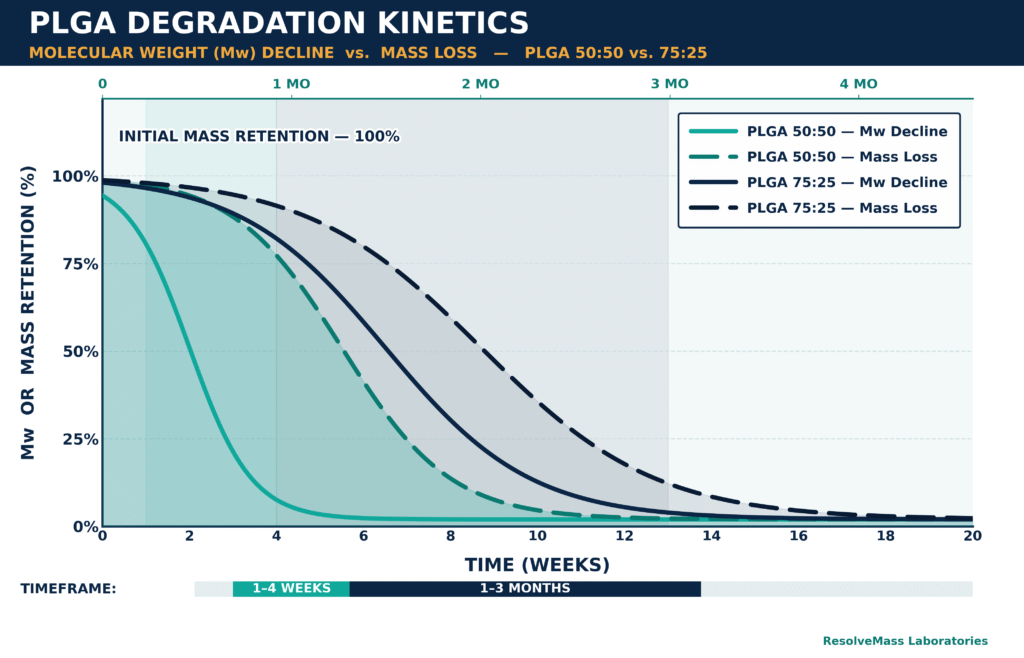
During hydrolytic degradation, PLGA experiences random chain scission, meaning ester bond cleavage occurs uniformly throughout the bulk of the polymer rather than progressing inward from the surface. In the initial phase of degradation, both the weight-average molecular weight (Mw) and number-average molecular weight (Mn) decline exponentially without producing measurable mass loss because the resulting oligomeric fragments remain sufficiently large and hydrophobic to remain trapped within the polymer matrix. For PLGA 50:50, this induction period typically lasts about 28 days. Following this stage, rapid formation of water-soluble oligomers results in substantial weight loss, extensive pore development, and eventual collapse of the polymer matrix. In comparison, the higher concentration of hydrophobic methyl groups in PLGA 75:25 slows water diffusion into the polymer, prolonging the molecular weight reduction phase and delaying significant mass loss for approximately 8 to 12 weeks. Additionally, autocatalytic degradation caused by the accumulation of carboxylic acid end groups further accelerates hydrolysis within the polymer core. Consequently, larger implants and microspheres often degrade more rapidly internally than smaller particles because acidic degradation products become trapped within the central regions of the matrix.
Mitigate manufacturing hurdles: Learn about handling complex matrices by reading about common challenges in PLGA microsphere development.
Engineering Drug Release: Triphasic Kinetics and the Pore-Closure Mechanism
Drug release from PLGA-based microparticles generally follows either a triphasic or biphasic kinetic profile that is governed by the combined effects of surface drug dissolution, diffusion through the polymer matrix, and eventual polymer erosion. The duration and magnitude of each release phase are strongly influenced by the pore-closure mechanism, which depends on polymer hydration, swelling, and structural reorganization.
The conventional PLGA drug release profile consists of three well-defined kinetic stages:
Phase I (Initial Burst)
The initial burst release is primarily driven by the rapid dissolution of drug molecules located on or near the surface of the microspheres, together with the initial hydration of the polymer matrix. The magnitude of this phase depends heavily on formulation variables, including the manufacturing process, particle morphology, and the drug-to-polymer ratio.
Phase II (Lag Phase / Zero-Order Release)
The second phase is characterized by slow, diffusion-controlled drug release through the dense polymer matrix. During this period, hydrolytic cleavage of the polymer chains continues progressively; however, the overall matrix structure remains largely intact because significant polymer erosion has not yet occurred.
Phase III (Erosion-Mediated Release)
The final phase begins when the polymer molecular weight decreases below a critical threshold. At this point, extensive formation of water-soluble oligomers occurs, leading to polymer mass loss, structural collapse of the matrix, and a rapid secondary release of the remaining encapsulated active pharmaceutical ingredient (API).
The duration of the second phase is largely determined by the pore-closure phenomenon. Under physiological conditions (pH 7.4), the negatively charged carboxyl end groups present in acid-terminated PLGA become increasingly hydrophilic and mobile. This promotes swelling of the polymer network, which rapidly seals surface pores within approximately 24 hours. Closure of these pores effectively traps the encapsulated drug inside the polymer core, thereby terminating the initial burst release and initiating the sustained lag phase. In contrast, under acidic conditions (approximately pH 3.0), pore closure is primarily driven by hydrophobic interactions between polymer chains that minimize free energy while simultaneously displacing interfacial water from the matrix.
Maximize encapsulation efficiency: Understand the physical chemistry of loading by browsing our technical review on encapsulating hydrophilic vs hydrophobic APIs in PLGA matrices.
Clinical Applications of the Difference Between PLGA 50:50 and PLGA 75:25 in FDA-Approved Products
The clinical significance of the differences between PLGA 50:50 and PLGA 75:25 is demonstrated by their distinct applications in FDA-approved long-acting parenteral formulations designed to provide weekly, monthly, or multi-month drug delivery. Formulation scientists carefully select the appropriate lactide-to-glycolide ratio to achieve the pharmacokinetic profile required for each active pharmaceutical ingredient.
The commercial success of biodegradable PLGA formulations is illustrated by several widely used pharmaceutical products. For instance, Bydureon® (exenatide) employs PLGA 50:50 microspheres to provide sustained glycemic control for patients with Type 2 diabetes through once-weekly subcutaneous administration. This formulation benefits from the rapid hydration and degradation characteristics of PLGA 50:50. Conversely, Risperdal Consta® (risperidone) and Vivitrol® (naltrexone) utilize PLGA 75:25 microspheres to achieve prolonged release over two-week and four-week dosing intervals, respectively. The slower degradation profile minimizes early dose dumping while improving patient adherence to therapy. A particularly notable example is Eligard® (leuprolide acetate), which demonstrates how modifying the PLGA monomer ratio can precisely tailor therapeutic duration. The one-month 7.5 mg formulation uses PLGA 50:50, whereas the three-month 22.5 mg and 30 mg formulations utilize PLGA 75:25, highlighting the lactide-to-glycolide ratio as a critical determinant of sustained drug release within the same product family.
Expand specialized application knowledge: See how these polymers operate in localized targeted anatomy like PLGA-based ocular drug delivery systems.
| Approved Drug Product | Active Pharmaceutical Ingredient (API) | PLGA Monomer Ratio Used | Formulation Architecture | Clinical Indication | Administration Frequency |
|---|---|---|---|---|---|
| Bydureon® | Exenatide | 50:50 | Extended-release microspheres with sucrose | Type 2 Diabetes | Subcutaneous injection every 7 days |
| Eligard® (7.5 mg) | Leuprolide acetate | 50:50 | In situ-forming gel depot (45–50% PLGA, 50–55% NMP) | Advanced Prostate Cancer | Subcutaneous injection once monthly |
| Risperdal Consta® | Risperidone | 75:25 | Lyophilized poly(lactide-co-glycolide) microspheres | Schizophrenia and Bipolar I Disorder | Intramuscular injection every 2 weeks |
| Vivitrol® | Naltrexone | 75:25 | Extended-release PLG microspheres | Alcohol and Opioid Dependence | Deep intramuscular injection once monthly |
| Zilretta® | Triamcinolone acetonide | 75:25 | Microspheres designed for localized intra-articular release | Osteoarthritis Knee Pain | Single intra-articular injection every 3 months |
| Eligard® (22.5 mg) | Leuprolide acetate | 75:25 | In situ-forming gel depot (45–50% PLGA, 50–55% NMP) | Advanced Prostate Cancer | Subcutaneous injection every 3 months |
Material Synthesis and Quality Attributes for Generic Drug Development
The clinical performance and regulatory bioequivalence of complex PLGA drug products depend on comprehensive characterization of both the raw polymer and the final drug-loaded microparticles. Manufacturing methods such as Ring-Opening Polymerization (ROP) enable the production of polymers with high molecular weight and narrow molecular weight distributions, both of which represent critical quality attributes (CQAs) required for successful generic formulation development.
Synthesis Mechanisms of High-Performance PLGA
(1) Ring-Opening Polymerization (ROP) vs. (2) Direct Polycondensation
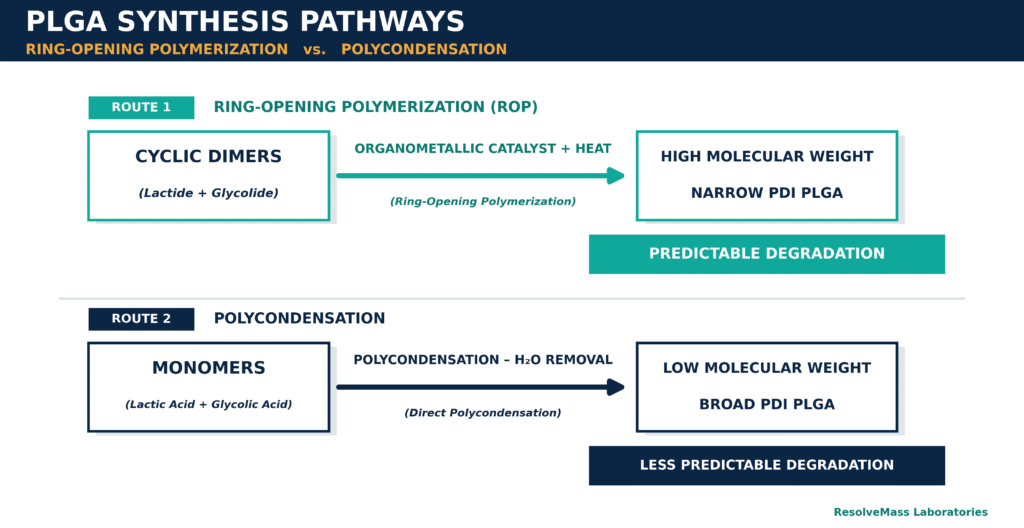
Ring-opening polymerization (ROP) of cyclic lactide and glycolide dimers remains the preferred industrial manufacturing approach because it provides precise control over molecular weight, monomer sequence distribution, and copolymer composition. Catalysts such as tin(II) 2-ethylhexanoate (stannous octoate) are commonly employed to initiate melt polymerization and produce high-quality PLGA with predictable degradation characteristics. In comparison, direct polycondensation of lactic acid and glycolic acid monomers is a less expensive manufacturing method but generally produces polymers with lower molecular weights (less than 10 kDa) and broader molecular weight distributions, reflected by higher polydispersity indices. As a result, polymers synthesized by direct polycondensation often exhibit less predictable degradation behavior and drug release kinetics.
For manufacturers developing generic PLGA-based drug products, demonstrating both qualitative (Q1) and quantitative (Q2) sameness is an essential regulatory requirement. FDA product-specific guidance recommends matching the reference product with respect to the polymer composition (LA:GA ratio), initial molecular weight, molecular weight distribution, polydispersity, glass transition temperature, end-group chemistry, and ester-capped status. Comprehensive analytical characterization using Gel Permeation Chromatography (GPC) to determine molecular weight distribution, Differential Scanning Calorimetry (DSC) to evaluate glass transition behavior, and Nuclear Magnetic Resonance (NMR) spectroscopy to assess monomer sequence distribution and end-group capping is indispensable for establishing formulation equivalence and obtaining regulatory approval.
Navigate regulatory requirements: Review our framework for Q1/Q2 polymer equivalence assessments to streamline your bioequivalence submission pathway.
Comprehensive Guide to Polymer Grade Customization
Customizing secondary polymer characteristics—including molecular weight, end-group chemistry, and copolymer architecture—enables formulation scientists to optimize drug delivery systems beyond simply adjusting the lactide-to-glycolide ratio. These structural modifications provide greater flexibility in controlling water uptake, mechanical strength, degradation behavior, and long-term formulation stability.
Several key polymer attributes can be tailored to meet specific formulation requirements:
Molecular Weight Selection
The molecular weight of PLGA has a significant influence on degradation rate and mechanical performance. Low molecular weight grades (10–25 kDa) degrade rapidly and are particularly suitable for microencapsulation technologies and nanoparticle formulations. Medium molecular weight polymers (40–60 kDa) offer an effective balance between structural integrity and biodegradation, making them appropriate for polymeric films and tissue engineering scaffolds. High molecular weight PLGA grades (80–120 kDa) provide superior mechanical strength and prolonged degradation, making them ideal for long-acting implantable drug delivery systems designed to release therapeutics over several months.
End-Group Modification
Chemical modification of the polymer end groups also influences degradation kinetics. Ester-capping the terminal carboxylic acid groups increases the hydrophobicity of the polymer, thereby reducing water diffusion into the matrix. As a result, ester-capped PLGA generally exhibits slower hydrolysis while providing enhanced stability during storage, transportation, and sterilization compared with acid-terminated polymers.
PEGylation (PEG-PLGA)
Introducing hydrophilic polyethylene glycol (PEG) segments into PLGA to form copolymers such as mPEG-b-PLGA or PLGA-PEG-PLGA triblock structures creates highly water-attractive domains within the polymer matrix. This modification increases initial particle porosity and facilitates faster diffusion of hydrophilic drug molecules, helping overcome the intrinsic hydrophobic barrier associated with conventional PLGA formulations.
Evaluate alternative biomaterials: Compare PLA vs PLGA vs PCL matrices to select the right biodegradable polymer architecture for your drug program.
| Polymer Parameter | Physical Customization Options | Primary Impact on Formulation | Target Clinical Application |
|---|---|---|---|
| Inherent Viscosity (IV) | Range: 0.15–1.0 dL/g | Directly correlates with molecular weight | Nanoparticle formulations versus structural films |
| End-Group Capping | Free Acid vs. Ester-Capped | Controls hydrolysis rate and autocatalytic degradation | Short-term drug release versus improved sterilization stability |
| Copolymer Architecture | Linear vs. Branched/Star-Shaped | Determines polymer chain entanglement density | Highly stable star glucose-PLGA depot formulations |
| Packaging & Handling | Nitrogen-purged, foil-sealed containers | Prevents premature hydrolysis caused by ambient moisture | Long-term shelf-life maintenance of GMP-grade polymers |
Optimize material storage: Understand environmental factors affecting the shelf life of PLGA, PLA, and PCL to protect your strategic polymer supply chains.
Actionable Selection Framework for Formulators
Selecting between PLGA 50:50 and PLGA 75:25 requires careful evaluation of the desired therapeutic duration, physicochemical stability of the active pharmaceutical ingredient (API), and the intended route of administration. A systematic decision-making framework helps formulation scientists progress efficiently from early polymer screening through GMP-compliant product development and clinical manufacturing.
The following guidelines can assist during formulation selection:
Select PLGA 50:50 for Therapeutic Durations of 1–4 Weeks
The relatively high glycolic acid content promotes rapid water uptake, accelerated polymer degradation, and faster drug release. Consequently, PLGA 50:50 is particularly well suited for fast-acting peptide therapeutics, vaccine adjuvants, and small-molecule formulations that require rapid onset of therapeutic activity.
Select PLGA 75:25 for Therapeutic Durations of 1–3 Months
The increased lactide content enhances polymer hydrophobicity, reducing water penetration and providing a more stable diffusion barrier around the encapsulated API. This slower degradation profile minimizes early burst release while extending sustained drug delivery, making PLGA 75:25 particularly appropriate for chronic therapies, ophthalmic microspheres, and complex generic peptide formulations.
Select PLGA 85:15 or PLA for Ultra-Long Drug Release (>3 Months)
When therapeutic applications require drug release extending beyond three months, highly hydrophobic polymers such as PLGA 85:15 or poly(lactic acid) (PLA) provide superior long-term matrix stability. These polymers retain structural integrity for extended periods and undergo gradual chain degradation with minimal early-stage autocatalytic hydrolysis.
To reduce formulation development risks and accelerate product optimization, ResolveMass Laboratories Inc. offers comprehensive polymer characterization services, including Gel Permeation Chromatography (GPC), Differential Scanning Calorimetry (DSC), Nuclear Magnetic Resonance (NMR), and customized analytical method development. These capabilities enable developers to accurately match polymer properties with specific clinical and regulatory objectives.
Match the reference standard: Learn about comprehensive PLGA characterization for RLD comparisons to safely de-risk reverse engineering programs.
Conclusion
Selecting and thoroughly characterizing the appropriate lactide-to-glycolide ratio is one of the most critical aspects of designing high-performance parenteral drug delivery systems. The differences between PLGA 50:50 and PLGA 75:25 influence every stage of formulation performance, from initial water penetration and diffusion-controlled drug release to polymer erosion, matrix degradation, and ultimate clearance from the body.
Through precise molecular engineering, the lactide-to-glycolide ratio serves as a powerful tool for controlling polymer hydration, matrix plasticization, degradation kinetics, and the onset of bulk erosion. PLGA 50:50 offers rapid hydration and accelerated drug release, making it particularly suitable for short-duration therapeutic applications that require high initial bioavailability. In contrast, PLGA 75:25 provides enhanced hydrophobicity and slower degradation, creating an effective barrier against premature drug release while supporting sustained delivery for chronic treatment regimens.
Successfully navigating the regulatory requirements for complex injectable formulations and establishing bioequivalence demands advanced analytical characterization and formulation expertise. ResolveMass Laboratories Inc. delivers comprehensive polymer characterization, custom synthesis services, analytical method development, and phase-appropriate validation strategies that help transform complex PLGA-based drug delivery systems from early feasibility studies through commercial-scale manufacturing.
Evaluate polydispersity impact: Read how tracking the PLGA PDI in pharmaceutical development helps control critical polymer variations and batch-to-batch repeatability.
For inquiries regarding custom polymer synthesis, analytical testing, or formulation support, contact the scientific team at ResolveMass Laboratories Inc. through the ResolveMass Contact Page.
Frequently Asked Questions (FAQs)
PLGA 50:50 exhibits a faster degradation profile than both poly(lactic acid) (PLA) and poly(glycolic acid) (PGA) because its random copolymer structure is predominantly amorphous, allowing water to diffuse uniformly throughout the polymer matrix. Pure PLA is relatively hydrophobic, while PGA possesses significant crystallinity that limits water accessibility despite its hydrophilic nature. The combination of high glycolide content and an amorphous microstructure enables PLGA 50:50 to undergo more rapid hydrolytic degradation than either homopolymer.
The drug release duration of PLGA formulations depends largely on the selected monomer ratio. PLGA 50:50 generally supports controlled drug delivery for approximately one to six weeks, making it suitable for therapies requiring relatively rapid release. In comparison, PLGA 75:25 is designed to provide sustained release for approximately one to three months, making it ideal for long-acting injectable depots. Selecting the appropriate ratio allows formulation scientists to align polymer degradation with the intended dosing schedule and therapeutic objective.
Once PLGA is exposed to physiological fluids, absorbed water penetrates the polymer network and acts as a plasticizer by increasing the free volume between polymer chains. This process disrupts intermolecular interactions and lowers the glass transition temperature (Tg), allowing the polymer to transition from a rigid glassy state to a more flexible rubbery state at body temperature. The increased chain mobility facilitates diffusion of the encapsulated drug while contributing to the controlled release characteristics of the formulation.
Acid-terminated PLGA contains free carboxylic acid end groups that readily interact with water, resulting in faster hydrolysis and increased autocatalytic degradation. Ester-terminated PLGA, on the other hand, has chemically capped end groups that make the polymer more hydrophobic and less susceptible to moisture. Consequently, acid-terminated grades are commonly selected for formulations requiring relatively rapid drug release, whereas ester-terminated grades are preferred when prolonged stability, slower degradation, and improved storage performance are desired.
Polymer molecular weight has a significant impact on both degradation behavior and drug release kinetics. High molecular weight PLGA forms a denser and more entangled polymer network that requires extensive hydrolytic cleavage before erosion occurs, thereby prolonging sustained drug release. In contrast, lower molecular weight PLGA degrades more rapidly because fewer ester bonds need to be cleaved before soluble degradation products are generated. By adjusting molecular weight, formulation scientists can precisely control the onset and duration of erosion-mediated drug release.
Autocatalysis refers to the self-accelerating degradation process that occurs when acidic degradation products accumulate within the interior of a PLGA matrix during hydrolysis. These carboxylic acid byproducts reduce the local pH, which further accelerates ester bond cleavage and polymer degradation. Because diffusion of acidic oligomers from the polymer core is often restricted, the center of larger microspheres or implants may degrade faster than the outer layers, resulting in internal pore formation and progressive structural collapse.
Particle size and internal porosity significantly influence both the initial burst release and the subsequent degradation profile of PLGA microspheres. Smaller particles with higher porosity possess a greater surface-area-to-volume ratio, allowing faster water penetration and increased early drug diffusion. Larger or denser particles restrict water ingress, producing slower erosion and more prolonged drug release. In many formulations, polymer swelling gradually closes surface pores after administration, helping reduce excessive initial burst release while maintaining sustained delivery.
To protect sensitive proteins and peptides from acidic microenvironments generated during PLGA degradation, formulation scientists frequently incorporate buffering excipients directly into the polymer matrix. Materials such as nanohydroxyapatite (nHAP), magnesium hydroxide, and calcium carbonate help neutralize acidic degradation products as they form, thereby maintaining a more stable local pH. This buffering strategy reduces the risk of protein denaturation, aggregation, and loss of biological activity while preserving the therapeutic performance of the encapsulated biologic.
The choice between PLGA 50:50 and PLGA 75:25 depends primarily on the desired duration of drug release rather than the type of active pharmaceutical ingredient alone. PLGA 50:50 is commonly selected for formulations requiring relatively rapid release over several weeks, making it suitable for short-acting peptide therapies. PLGA 75:25 is preferred for long-acting injectable depots designed to deliver peptides or small molecules over one to three months. Additional optimization, including selection of appropriate polymer end groups and consideration of drug hydrophobicity, further improves encapsulation efficiency and release performance.
Reference:
- Makadia, H. K., & Siegel, S. J. (2021). Poly lactic-co-glycolic acid (PLGA) as biodegradable controlled drug delivery carrier. Polymers, 13(15), 1–23. https://doi.org/10.3390/polym13152518
- Qian, S., Ma, L., Liu, C., Lin, Y., Wu, J., & Wang, X. (2026). How PLGA microspheres are emerging as a key drug delivery system. International Journal of Nanomedicine, 21, 600160. https://doi.org/10.2147/IJN.S600160
- Danhier, F., Ansorena, E., Silva, J. M., Coco, R., Le Breton, A., & Préat, V. (2012). PLGA-based nanoparticles: An overview of biomedical applications. Journal of Controlled Release, 161(2), 505–522. https://doi.org/10.1016/j.jconrel.2012.01.043
- Kamaly, N., Yameen, B., Wu, J., & Farokhzad, O. C. (2016). Degradable controlled-release polymers and polymeric nanoparticles: Mechanisms of controlling drug release. Chemical Reviews, 116(4), 2602–2663. https://doi.org/10.1021/acs.chemrev.5b00346
- Siepmann, J., & Siepmann, F. (2025). Release mechanisms of PLGA-based drug delivery systems: A review. International Journal of Pharmaceutics: X, 10, 100440. https://doi.or
- Yeo, Y., Park, K., & Lee, T. R. (2013). Mechanism of drug release from double-walled PDLLA(PLGA) microspheres. Journal of Controlled Release, 166(1), 18–27. https://doi.org/10.1016/j.jconrel.2012.12.019
- Zolnik, B. S., & Burgess, D. J. (2007). Effect of acidic pH on PLGA microsphere degradation and release. Journal of Controlled Release, 122(3), 338–344. https://doi.org/10.1016/j.jconrel.2007.05.034
Get In Touch With Us
About The Author


