

Introduction:
Disulfide Bond Mapping in Therapeutic Peptides is a critical analytical process used to verify the structural integrity and biological functionality of peptide therapeutics. Disulfide bonds stabilize peptide conformations, influence receptor binding, improve resistance to degradation, and directly impact therapeutic efficacy.
As peptide-based therapeutics continue to expand across oncology, metabolic disorders, endocrinology, and rare diseases, accurate characterization of disulfide linkages has become essential for pharmaceutical development, regulatory compliance, and product quality assurance.
Liquid Chromatography–Mass Spectrometry (LC-MS) has emerged as the preferred analytical platform for disulfide bond mapping because it offers:
- High sensitivity
- Precise molecular characterization
- Sequence-level confirmation
- Detection of disulfide scrambling
- Identification of structural variants
However, mapping disulfide bonds in therapeutic peptides also presents significant analytical challenges. Complex folding patterns, multiple cysteine residues, and sample preparation artifacts can complicate interpretation and reduce analytical confidence.
This article explores LC-MS strategies used for disulfide bond mapping, key analytical considerations, common challenges, and emerging solutions used in modern peptide characterization laboratories.
Summary:
- Disulfide Bond Mapping in Therapeutic Peptides is critical for confirming peptide structure, stability, efficacy, and safety.
- LC-MS-based analytical workflows are widely used to identify correct disulfide linkages and detect scrambling or mispairing.
- Advanced techniques such as high-resolution mass spectrometry, ETD fragmentation, and peptide digestion strategies improve mapping accuracy.
- Analytical challenges include disulfide scrambling, incomplete digestion, low-abundance species, and complex peptide structures.
- Regulatory agencies increasingly expect robust characterization data for peptide therapeutics during development and commercialization.
- ResolveMass Laboratories Inc. supports peptide characterization using advanced LC-MS workflows tailored for biopharmaceutical applications.
1: Why Disulfide Bond Mapping Matters in Therapeutic Peptides
Disulfide bonds are covalent sulfur-sulfur linkages formed between cysteine residues. These bonds are essential for maintaining the correct three-dimensional structure of many therapeutic peptides.
Key Reasons for Disulfide Bond Mapping
| Importance | Impact |
|---|---|
| Structural Confirmation | Verifies correct peptide folding |
| Stability Assessment | Evaluates degradation pathways |
| Safety Assurance | Detects misfolded or scrambled species |
| Regulatory Compliance | Supports characterization requirements |
| Batch Consistency | Confirms manufacturing reproducibility |
| Bioactivity Correlation | Links structure to pharmacological function |
Incorrect disulfide pairing can lead to:
- Reduced potency
- Immunogenicity risks
- Aggregation
- Loss of stability
- Altered pharmacokinetics
Therefore, robust disulfide mapping is essential throughout drug development and quality control.
2: Common Therapeutic Peptides Containing Disulfide Bonds
Many clinically important peptide therapeutics contain one or multiple disulfide bonds. These covalent sulfur-sulfur linkages are essential for maintaining structural stability, receptor binding affinity, biological activity, and resistance to enzymatic degradation. In peptide drug development, accurate characterization of these disulfide linkages is critical for ensuring therapeutic performance and product consistency.
Examples of Therapeutic Peptides
| Therapeutic Peptide | Number of Disulfide Bonds |
|---|---|
| Insulin | 3 |
| Oxytocin | 1 |
| Vasopressin | 1 |
| Calcitonin | 1 |
| Conotoxins | Multiple |
| GLP-1 Analogues | Variable |
| Peptide Hormones | Often 1–3 |
Therapeutic peptides containing multiple cysteine residues often exhibit highly complex folding patterns. Incorrect disulfide pairing can alter biological activity, reduce stability, and increase the risk of degradation or immunogenicity. As a result, complex peptide therapeutics require highly sensitive and carefully optimized LC-MS workflows to accurately identify native disulfide connectivity and avoid false assignments caused by disulfide scrambling or incomplete digestion.
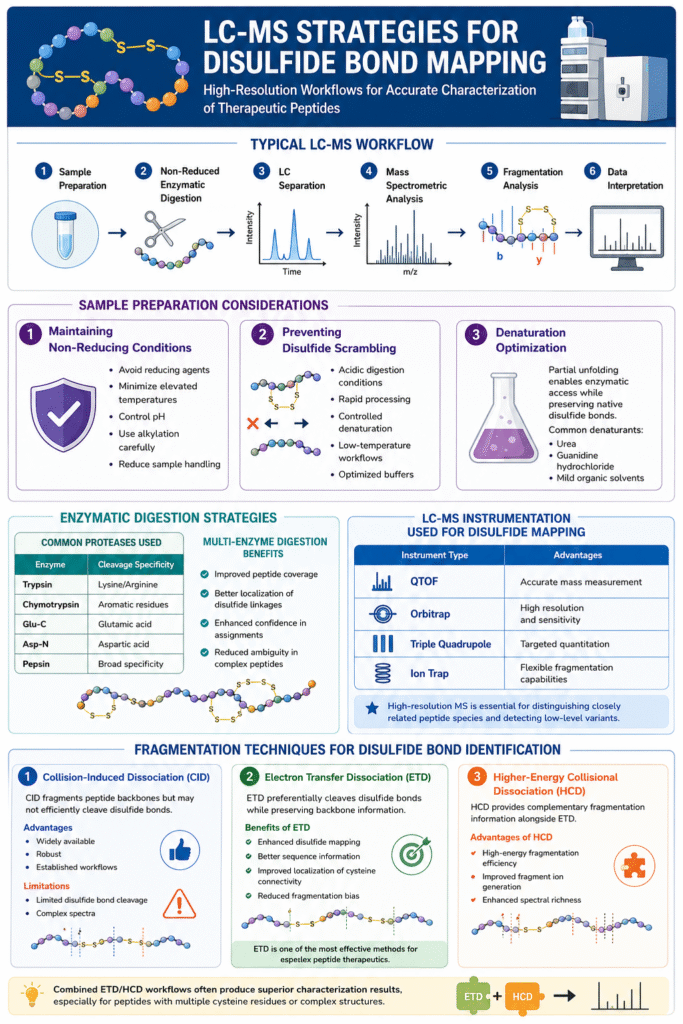
3: LC-MS Strategies for Disulfide Bond Mapping
LC-MS-based workflows are widely used for Disulfide Bond Mapping in Therapeutic Peptides because they provide high-resolution molecular characterization while enabling peptide-level separation and structural confirmation. These workflows help identify native disulfide linkages, detect disulfide scrambling, and characterize structural variants that may impact therapeutic performance.
Typical LC-MS Workflow
The standard workflow for Disulfide Bond Mapping in Therapeutic Peptides includes:
- Sample preparation
- Non-reduced enzymatic digestion
- LC separation
- Mass spectrometric analysis
- Fragmentation analysis
- Data interpretation
Sample Preparation Considerations
Proper sample preparation is critical because disulfide scrambling can occur during handling.
Important Sample Preparation Factors
1. Maintaining Non-Reducing Conditions
Disulfide bonds must remain intact during analysis.
Common precautions include:
- Avoiding reducing agents
- Minimizing elevated temperatures
- Controlling pH
- Using alkylation carefully
2. Preventing Disulfide Scrambling
Scrambling can generate artificial disulfide pairings.
Strategies include:
- Acidic digestion conditions
- Rapid processing
- Controlled denaturation
- Low-temperature workflows
3. Denaturation Optimization
Partial unfolding may be required for enzymatic access without disrupting native disulfide bonds.
Common denaturants include:
- Urea
- Guanidine hydrochloride
- Mild organic solvents
Enzymatic Digestion Strategies
Enzymatic digestion generates peptide fragments suitable for LC-MS analysis while preserving disulfide linkages.
Common Proteases Used
| Enzyme | Cleavage Specificity |
|---|---|
| Trypsin | Lysine/Arginine |
| Chymotrypsin | Aromatic residues |
| Glu-C | Glutamic acid |
| Asp-N | Aspartic acid |
| Pepsin | Broad specificity |
Using multiple enzymes often improves sequence coverage and disulfide bond confirmation.
Multi-Enzyme Digestion Benefits
- Improved peptide coverage
- Better localization of disulfide linkages
- Enhanced confidence in assignments
- Reduced ambiguity in complex peptides
LC-MS Instrumentation Used for Disulfide Mapping
Modern high-resolution mass spectrometers provide accurate identification of disulfide-linked peptides.
Common LC-MS Platforms
| Instrument Type | Advantages |
|---|---|
| QTOF | Accurate mass measurement |
| Orbitrap | High resolution and sensitivity |
| Triple Quadrupole | Targeted quantitation |
| Ion Trap | Flexible fragmentation |
High-resolution MS is particularly important for distinguishing closely related peptide species.
Fragmentation Techniques for Disulfide Bond Identification
Fragmentation strategies are central to identifying disulfide connectivity.
Collision-Induced Dissociation (CID)
CID fragments peptide backbones but may not efficiently cleave disulfide bonds.
Advantages
- Widely available
- Robust
- Established workflows
Limitations
- Limited disulfide bond cleavage
- Complex spectra
Electron Transfer Dissociation (ETD)
ETD is highly valuable because it preferentially cleaves disulfide bonds while preserving backbone information.
Benefits of ETD
- Enhanced disulfide mapping
- Better sequence information
- Improved localization of cysteine connectivity
- Reduced fragmentation bias
ETD is increasingly considered one of the most effective fragmentation methods for complex peptide therapeutics.
Higher-Energy Collisional Dissociation (HCD)
HCD can provide complementary fragmentation information alongside ETD.
Combined ETD/HCD workflows often produce superior characterization results.
4: Major Analytical Challenges in Disulfide Bond Mapping
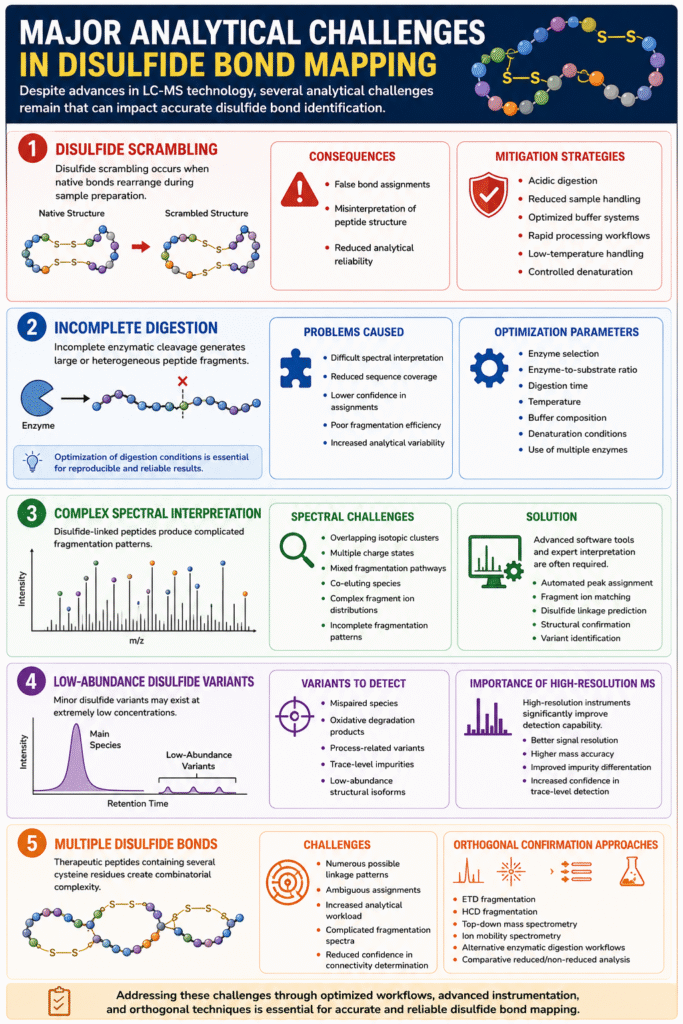
Despite major advances in LC-MS instrumentation and peptide characterization workflows, several analytical challenges still complicate accurate Disulfide Bond Mapping in Therapeutic Peptides. These challenges can affect structural interpretation, analytical reproducibility, and confidence in disulfide bond assignments.
1. Disulfide Scrambling
Disulfide scrambling occurs when native disulfide bonds break and reform incorrectly during sample preparation or digestion. This is one of the most significant sources of analytical error in peptide characterization.
Consequences of Disulfide Scrambling
- False bond assignments
- Misinterpretation of peptide structure
- Reduced analytical reliability
- Incorrect confirmation of cysteine connectivity
- Potential regulatory concerns during characterization studies
Even small amounts of scrambling can complicate LC-MS data interpretation and generate misleading structural conclusions.
Mitigation Strategies
Carefully optimized sample preparation conditions help minimize scrambling.
Common mitigation approaches include:
- Acidic digestion conditions
- Reduced sample handling
- Optimized buffer systems
- Rapid processing workflows
- Low-temperature preparation
- Controlled denaturation conditions
Analytical workflows designed specifically for disulfide preservation significantly improve mapping accuracy.
2. Incomplete Digestion
Incomplete enzymatic cleavage produces large, partially digested, or heterogeneous peptide fragments that are difficult to analyze.
Problems Caused by Incomplete Digestion
- Difficult spectral interpretation
- Reduced sequence coverage
- Lower confidence in assignments
- Poor fragmentation efficiency
- Increased analytical variability
Large disulfide-linked fragments may also generate highly complex spectra with overlapping ions and multiple charge states.
Importance of Digestion Optimization
Optimizing digestion conditions is essential for reproducible and reliable disulfide mapping.
Important optimization parameters include:
- Enzyme selection
- Enzyme-to-substrate ratio
- Digestion time
- Temperature
- Buffer composition
- Denaturation conditions
Multi-enzyme digestion strategies are often used to improve peptide coverage and structural confirmation.
3. Complex Spectral Interpretation
Disulfide-linked peptides frequently produce highly complicated fragmentation spectra that require advanced interpretation strategies.
Common Spectral Challenges
- Overlapping isotopic clusters
- Multiple charge states
- Mixed fragmentation pathways
- Co-eluting peptide species
- Complex fragment ion distributions
- Incomplete fragmentation patterns
These issues become even more significant in peptides containing multiple disulfide bonds or extensive structural heterogeneity.
Role of Advanced Data Analysis
Specialized bioinformatics software and expert manual review are often necessary for accurate interpretation.
Advanced analytical tools help with:
- Automated peak assignment
- Fragment ion matching
- Disulfide linkage prediction
- Structural confirmation
- Variant identification
Combining software-assisted analysis with experienced scientific interpretation provides the highest confidence in final assignments.
4. Low-Abundance Disulfide Variants
Minor disulfide variants may exist at extremely low concentrations but can still affect product quality, stability, and biological activity.
Sensitive LC-MS Methods Are Required to Detect:
- Mispaired disulfide species
- Oxidative degradation products
- Process-related variants
- Trace-level impurities
- Low-abundance structural isoforms
Detection of these species is especially important during stability studies, biosimilar characterization, and impurity profiling.
Importance of High-Resolution Instrumentation
Modern high-resolution LC-MS systems significantly improve detection sensitivity and selectivity for low-level variants.
Advantages include:
- Improved signal resolution
- Enhanced mass accuracy
- Better impurity differentiation
- Increased confidence in trace-level detection
Orbitrap and QTOF platforms are commonly used for these advanced characterization studies.
5. Multiple Disulfide Bonds
Therapeutic peptides containing several cysteine residues create substantial analytical complexity because many possible disulfide linkage patterns may exist.
Challenges Associated with Multiple Disulfide Bonds
- Numerous possible linkage combinations
- Ambiguous structural assignments
- Increased analytical workload
- Complicated fragmentation spectra
- Reduced confidence in connectivity determination
Highly cross-linked peptides often require extensive optimization of digestion and fragmentation strategies.
Orthogonal Confirmation Approaches
Orthogonal analytical techniques are frequently required to confirm disulfide connectivity in highly complex peptide therapeutics.
Complementary approaches may include:
- ETD fragmentation
- HCD fragmentation
- Top-down mass spectrometry
- Ion mobility spectrometry
- Alternative enzymatic digestion workflows
- Comparative reduced/non-reduced analysis
Combining multiple analytical strategies improves confidence in final structural characterization and regulatory documentation.
5: Role of High-Resolution Mass Spectrometry
High-resolution MS has dramatically improved peptide characterization capabilities.
Key Advantages
- Accurate mass determination
- Improved selectivity
- Better impurity differentiation
- Enhanced confidence in disulfide assignments
- Improved detection of low-level variants
Modern Orbitrap and QTOF systems are now standard in advanced peptide characterization laboratories.
6: Data Analysis and Bioinformatics Tools
Specialized software platforms help interpret complex LC-MS datasets.
Common Data Analysis Capabilities
| Capability | Importance |
|---|---|
| Automated Peak Assignment | Improves efficiency |
| Disulfide Linkage Prediction | Reduces manual interpretation |
| Fragment Matching | Enhances confidence |
| Sequence Mapping | Confirms peptide identity |
| Variant Detection | Identifies impurities |
Combining automated tools with expert manual review provides the highest confidence in final assignments.
7: Regulatory Expectations for Peptide Characterization
Regulatory agencies expect detailed structural characterization of therapeutic peptides.
Regulatory Focus Areas
- Structural integrity
- Impurity profiling
- Process consistency
- Stability assessment
- Product comparability
Comprehensive disulfide bond mapping supports submissions to agencies such as:
- FDA
- Health Canada
- EMA
- PMDA
Robust analytical documentation also strengthens biosimilar and generic peptide development programs.
8: How ResolveMass Laboratories Inc. Supports Peptide Characterization
ResolveMass Laboratories Inc. provides advanced analytical solutions for peptide therapeutics using modern LC-MS technologies and scientifically rigorous workflows.
Capabilities include:
- Disulfide bond mapping
- Peptide impurity profiling
- Structural characterization
- Forced degradation studies
- Stability-indicating methods
- High-resolution LC-MS analysis
- Method development and validation
By combining analytical expertise with advanced instrumentation, ResolveMass supports pharmaceutical and biotechnology organizations developing complex peptide therapeutics.
Conclusion:
Disulfide Bond Mapping in Therapeutic Peptides is essential for confirming peptide structure, ensuring product quality, and supporting regulatory compliance. Accurate mapping helps identify correct cysteine connectivity, detect structural variants, and minimize risks associated with misfolded peptide species.
LC-MS remains the leading analytical platform for disulfide characterization due to its sensitivity, specificity, and structural elucidation capabilities. However, successful implementation requires careful optimization of sample preparation, digestion strategies, fragmentation methods, and data analysis workflows.
As therapeutic peptides become increasingly complex, advanced analytical approaches such as ETD fragmentation, high-resolution mass spectrometry, and AI-assisted interpretation will continue to play an expanding role in peptide characterization.
Organizations developing peptide therapeutics benefit significantly from experienced analytical partners capable of delivering scientifically robust and regulatory-aligned characterization data.
Frequently Asked Questions:
Disulfide bond mapping is an analytical technique used to identify the connectivity between cysteine residues in therapeutic peptides. It helps confirm correct peptide folding, structural integrity, and biological functionality. This process is essential for ensuring product quality, safety, and stability during pharmaceutical development. LC-MS is commonly used because it provides accurate molecular and structural information. Proper mapping also supports regulatory submissions and manufacturing consistency.
Disulfide bonds stabilize peptide structure and directly influence biological activity and therapeutic performance. Incorrect disulfide pairing can lead to reduced potency, instability, aggregation, or immunogenicity risks. Disulfide bond mapping ensures that the peptide maintains its intended native structure throughout development and production. It also helps detect structural variants and degradation products. Accurate characterization improves both product reliability and regulatory confidence.
Liquid Chromatography–Mass Spectrometry (LC-MS) is the most widely used analytical platform for disulfide bond mapping. High-resolution instruments such as Orbitrap and QTOF systems provide accurate mass measurements and fragmentation data. Techniques like ETD, CID, and HCD fragmentation help identify cysteine connectivity. These methods allow scientists to characterize disulfide-linked peptide fragments with high sensitivity. Advanced software tools are also used for data interpretation and structural confirmation.
Disulfide scrambling occurs when native disulfide bonds rearrange during sample preparation or digestion. This creates artificial disulfide linkages that may lead to incorrect structural assignments. Scrambling is one of the most common analytical challenges in peptide characterization. Factors such as pH, temperature, and sample handling can contribute to this issue. Optimized preparation workflows help minimize scrambling and improve analytical reliability.
Non-reducing conditions preserve native disulfide bonds throughout sample preparation and LC-MS analysis. Reducing agents can break sulfur-sulfur linkages and destroy important structural information. Maintaining intact disulfide bonds allows accurate determination of cysteine connectivity. Careful control of pH and temperature also helps preserve peptide structure. Non-reducing workflows are therefore essential for reliable disulfide bond mapping studies.
Reference
- Lakbub JC, Shipman JT, Desaire H. Recent mass spectrometry-based techniques and considerations for disulfide bond characterization in proteins. Analytical and bioanalytical chemistry. 2017 Dec 18;410(10):2467.https://pmc.ncbi.nlm.nih.gov/articles/PMC5857437/
- Weinfurtner D. Analysis of disulfide bond formation in therapeutic proteins.https://books.rsc.org/books/edited-volume/711/chapter/417574
- Chaturvedi S, Bawake S, Sharma N. Recent advancements in disulfide bridge characterization: Insights from mass spectrometry. Rapid Communications in Mass Spectrometry. 2024 Apr 15;38(7):e9713.https://analyticalsciencejournals.onlinelibrary.wiley.com/doi/abs/10.1002/rcm.9713
- Kang L, Weng N, Jian W. LC–MS bioanalysis of intact proteins and peptides. Biomedical chromatography. 2020 Jan;34(1):e4633.https://analyticalsciencejournals.onlinelibrary.wiley.com/doi/abs/10.1002/bmc.4633
- Dong Q, Yan X, Liang Y, Markey SP, Sheetlin SL, Remoroza CA, Wallace WE, Stein SE. Comprehensive analysis of tryptic peptides arising from disulfide linkages in NISTmAb and their use for developing a mass spectral library. Journal of proteome research. 2021 Feb 8;20(3):1612-29.https://pubs.acs.org/doi/abs/10.1021/acs.jproteome.0c00823
About the Author


