

Introduction:
Disulfide Bond Mapping of Cyclic Peptides is one of the most technically demanding — and most heavily scrutinized — analytical activities in generic peptide drug development. For Abbreviated New Drug Applications (ANDAs), the U.S. FDA requires sponsors to demonstrate that a synthetic peptide’s higher-order structure, including the position and connectivity of every disulfide bridge, is identical to that of the approved reference product. Even a single mismatched cysteine pairing can change a peptide’s biological activity, stability, or immunogenicity profile, putting an entire ANDA submission at risk. This case study walks through how ResolveMass Laboratories Inc., a USFDA-registered Canadian contract research organization, approached disulfide bond mapping and structural confirmation for a client developing a generic cyclic peptide injectable, and what the project reveals about doing this work correctly the first time.
Summary:
- Disulfide Bond Mapping of Cyclic Peptides confirms that synthetic generic peptides fold into the exact same three-dimensional disulfide architecture as the reference listed drug (RLD), which is a non-negotiable requirement for ANDA approval.
- A combination of non-reduced/reduced peptide mapping, enzymatic digestion under non-reducing conditions, and high-resolution LC-MS/MS is required to localize disulfide bonds with residue-level precision.
- Cyclic peptides present unique analytical challenges — ring strain, disulfide scrambling, and incomplete proteolytic cleavage — that demand specialized digestion and fragmentation strategies.
- In this case study, ResolveMass Laboratories Inc. resolved an ambiguous disulfide connectivity issue for a client’s cyclic peptide generic candidate using orthogonal MS-based workflows, supporting a successful ANDA structural equivalence package.
- A robust disulfide mapping report strengthens the Quality Overall Summary (QOS) and reduces the risk of FDA information requests during ANDA review.
1: Why Disulfide Bond Mapping Matters for Generic Cyclic Peptides
Disulfide bonds lock a peptide into its biologically active conformation, so confirming their exact position is what separates a structurally equivalent generic from a structurally similar — but functionally different — molecule. Cyclic peptides such as octreotide, lanreotide, and desmopressin-class molecules rely on one or more disulfide bridges to maintain receptor-binding geometry, and the FDA’s structural equivalence expectations for synthetic peptide ANDAs make disulfide connectivity a primary review focus.
Key reasons disulfide mapping is treated as mission-critical in regulatory filings include:
- Bioactivity dependence: Disulfide-constrained loops define the receptor-binding pharmacophore; incorrect pairing can silence or alter potency.
- Immunogenicity risk: Mis-paired or scrambled disulfides can create non-native epitopes that increase immunogenic potential.
- Stability and degradation: Disulfide position affects oxidative degradation pathways and shelf-life behavior.
- Regulatory expectation: FDA’s guidance for ANDAs referencing certain highly purified synthetic peptide drug products explicitly calls for orthogonal structural characterization, including disulfide mapping, as part of demonstrating that the generic is the “same” active ingredient as the RLD.
2: The Regulatory Context: ANDA Structural Equivalence Requirements
An ANDA for a synthetic peptide cannot rely on identity claims alone — it must be supported by physicochemical and structural data that leave no ambiguity about disulfide architecture. The FDA evaluates synthetic peptide generics against criteria similar to those used for complex generics, since peptides can have multiple theoretically possible disulfide pairings even when the amino acid sequence and molecular formula are correct.
Typical structural equivalence elements expected in an ANDA peptide package include:
| Structural Element | Why It’s Required | Common Analytical Method |
|---|---|---|
| Primary sequence confirmation | Verifies amino acid order matches RLD | LC-MS/MS peptide mapping |
| Disulfide bond connectivity | Confirms correct cysteine pairing and ring topology | Non-reduced vs. reduced peptide mapping |
| Higher-order structure | Confirms folding/conformation equivalence | CD spectroscopy, NMR |
| Impurity and degradant profile | Identifies process- and product-related impurities | HPLC, HRMS |
| Counterion and salt form | Confirms formulation-relevant identity | Ion chromatography, NMR |
Because disulfide mis-assignment is invisible to standard intact-mass analysis (a scrambled isomer can have an identical molecular weight to the correctly folded peptide), dedicated disulfide bond mapping is the only reliable way to close this regulatory gap.
3: Case Study Overview: The Analytical Challenge
A pharmaceutical client developing a generic version of a cyclic, disulfide-bridged peptide injectable approached ResolveMass Laboratories Inc. after an in-house attempt at disulfide mapping produced inconclusive and partially contradictory MS/MS data. The peptide contained a single intramolecular disulfide bridge linking two cysteine residues within a constrained ring structure, and the client needed unambiguous, audit-ready evidence of connectivity to support their ANDA structural equivalence package.
The core analytical obstacles were:
- Ring strain and steric hindrance limiting access of proteolytic enzymes to the disulfide-bridged region.
- Disulfide scrambling risk during sample handling, which can introduce artificial mis-pairings that don’t reflect the drug substance’s true structure.
- Incomplete fragmentation coverage in standard non-reduced LC-MS/MS runs, leaving gaps around the cysteine-containing loop.
4: Our Analytical Strategy for Disulfide Bond Mapping of Cyclic Peptides
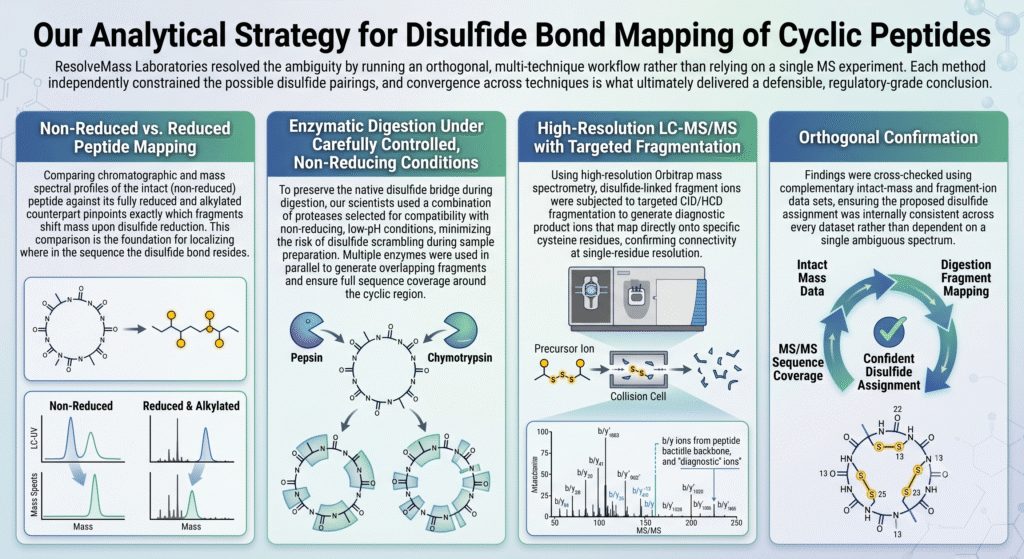
ResolveMass Laboratories resolved the ambiguity by running an orthogonal, multi-technique workflow rather than relying on a single MS experiment. Each method independently constrained the possible disulfide pairings, and convergence across techniques is what ultimately delivered a defensible, regulatory-grade conclusion.
Non-Reduced vs. Reduced Peptide Mapping
Comparing chromatographic and mass spectral profiles of the intact (non-reduced) peptide against its fully reduced and alkylated counterpart pinpoints exactly which fragments shift mass upon disulfide reduction. This comparison is the foundation for localizing where in the sequence the disulfide bond resides.
Enzymatic Digestion Under Carefully Controlled, Non-Reducing Conditions
To preserve the native disulfide bridge during digestion, our scientists used a combination of proteases selected for compatibility with non-reducing, low-pH conditions, minimizing the risk of disulfide scrambling during sample preparation. Multiple enzymes were used in parallel to generate overlapping fragments and ensure full sequence coverage around the cyclic region.
High-Resolution LC-MS/MS with Targeted Fragmentation
Using high-resolution Orbitrap mass spectrometry, disulfide-linked fragment ions were subjected to targeted CID/HCD fragmentation to generate diagnostic product ions that map directly onto specific cysteine residues, confirming connectivity at single-residue resolution.
Orthogonal Confirmation
Findings were cross-checked using complementary intact-mass and fragment-ion data sets, ensuring the proposed disulfide assignment was internally consistent across every dataset rather than dependent on a single ambiguous spectrum.
5: Results: Structural Confirmation Achieved
The orthogonal workflow eliminated the ambiguity present in the client’s earlier data and produced a single, internally consistent disulfide assignment consistent with the RLD’s known structure. Key outcomes from the engagement included:
- Unambiguous localization of the disulfide bridge to the correct cysteine pair, ruling out an alternative scrambled isomer that had matched intact mass in the client’s prior dataset.
- Full sequence coverage across the cyclic region, closing the fragmentation gaps that had caused the original inconclusive result.
- A structural confirmation report formatted to support direct inclusion in the ANDA’s Quality Overall Summary and analytical comparability section.
6: Why This Level of Rigor Matters for ANDA Filings
A disulfide mapping result that can’t withstand FDA scientific scrutiny doesn’t just slow down a single review cycle — it can trigger a Complete Response Letter or repeated information requests that cost months of development time. Building the analytical package correctly the first time, with orthogonal data rather than a single inconclusive MS run, is consistently the more efficient path to approval.
For sponsors developing cyclic, disulfide-bridged peptide generics, the practical takeaways from this case study are:
- Never rely on intact mass alone to confirm disulfide connectivity — scrambled isomers can be mass-identical to the correct structure.
- Build in orthogonal confirmation (multiple enzymes, non-reduced/reduced comparison, targeted fragmentation) from the start of the program, not as a fallback after an ambiguous result.
- Document disulfide bond mapping data in a format that maps directly to FDA’s structural equivalence expectations for synthetic peptide ANDAs.
7: How ResolveMass Laboratories Supports Peptide ANDA Programs
ResolveMass Laboratories Inc. is a USFDA-registered Canadian CRO built around PhD-level analytical and synthetic chemists with deep experience in peptide characterization, mass spectrometry, and regulatory-facing structural confirmation work. Our peptide drug development services span the full lifecycle of generic and novel peptide injectables — from sequence confirmation and impurity profiling to disulfide bond mapping and higher-order structure analysis — using high-resolution Orbitrap HRMS, HPLC, MALDI-TOF, and NMR platforms. Because our scientific and client support teams operate around the clock, sponsors working against ANDA review timelines get direct access to the analysts running their data, not a layer of project management between them and the bench.
Conclusion:
Disulfide Bond Mapping of Cyclic Peptides is not a checkbox analytical exercise — it’s the structural evidence that an ANDA reviewer will scrutinize most closely when deciding whether a generic peptide is truly equivalent to its reference listed drug. As this case study shows, an orthogonal, multi-technique approach that combines non-reduced/reduced peptide mapping, carefully controlled enzymatic digestion, and high-resolution LC-MS/MS fragmentation is what turns an ambiguous result into regulatory-grade structural confirmation. For sponsors navigating a cyclic peptide ANDA, getting this analysis right early — with a partner experienced in both the chemistry and the regulatory expectations — can be the difference between a smooth review cycle and a costly delay.
Frequently Asked Questions:
Disulfide bond mapping is the process of identifying and confirming the connections between cysteine residues in a peptide molecule. These disulfide bonds are essential for maintaining the peptide’s three-dimensional structure and biological function. Using advanced techniques such as LC-MS/MS, scientists can determine the exact bond arrangement. This analysis helps verify structural integrity and product consistency. It is a critical step in peptide characterization and regulatory submissions.
Disulfide Bond Mapping of Cyclic Peptides helps demonstrate that a generic peptide drug has the same structural characteristics as the reference listed drug. Regulatory agencies expect evidence that critical quality attributes, including disulfide connectivity, are equivalent. Incorrect bond arrangements can affect efficacy, stability, and safety. Comprehensive mapping reduces regulatory concerns and strengthens ANDA submissions. It provides confidence in the pharmaceutical sameness of the product.
Yes, disulfide bond mapping is specifically designed to detect both correct and incorrect cysteine pairings. Advanced mass spectrometry techniques can identify mispaired or scrambled disulfide bonds that may arise during synthesis or processing. Such structural variations can impact the drug’s biological activity and stability. Early detection allows manufacturers to address quality issues before submission. This helps ensure compliance with regulatory requirements.
One major challenge is disulfide scrambling, where native bonds rearrange during sample preparation. Cyclic peptides can also be difficult to digest because of their compact and stable structures. Complex MS/MS spectra may require specialized expertise for interpretation. Optimized digestion protocols and careful sample handling are often necessary. Advanced instrumentation and experienced analysts help overcome these challenges and ensure reliable results.
Disulfide scrambling occurs when natural disulfide bonds rearrange into different configurations during sample preparation or analysis. This can create misleading analytical results and obscure the true structure of the peptide. Scrambling may lead to incorrect linkage assignments if not properly controlled. Scientists use optimized workflows to minimize this risk. Preventing scrambling is essential for obtaining accurate and regulatory-compliant characterization data.
Comprehensive peptide characterization provides strong evidence of product quality, identity, and structural consistency. Regulatory agencies expect detailed analytical data to support ANDA and other submission pathways. Disulfide bond mapping contributes to demonstrating structural equivalence and controlling critical quality attributes. Thorough characterization can reduce review questions and approval delays. It also strengthens confidence in the safety and performance of the drug product.
Reference
- Northfield SE, Wang CK, Schroeder CI, Durek T, Kan MW, Swedberg JE, Craik DJ. Disulfide-rich macrocyclic peptides as templates in drug design. European Journal of Medicinal Chemistry. 2014 Apr 22;77:248-57.https://www.sciencedirect.com/science/article/pii/S0223523414002153
- Gongora-Benitez M, Tulla-Puche J, Albericio F. Multifaceted roles of disulfide bonds. Peptides as therapeutics. Chemical Reviews. 2014 Jan 22;114(2):901-26.https://pubs.acs.org/doi/full/10.1021/cr400031z
- Giri T, Sakharwade S, Subbappa P, Chinnakadoori SR, Sharma N. Regulatory Considerations in Synthetic Peptide Characterization: Techniques and Compliance. Separation Science Plus. 2025 Jun;8(6):e70057.https://analyticalsciencejournals.onlinelibrary.wiley.com/doi/abs/10.1002/sscp.70057
- Tyler TJ, Durek T, Craik DJ. Native and engineered cyclic disulfide-rich peptides as drug leads. Molecules. 2023 Apr 3;28(7):3189.https://www.mdpi.com/1420-3049/28/7/3189
About the Author


