

Introduction
The decision to adopt a consolidated or split Drug Substance vs Drug Product CDMO model plays a pivotal role in shaping the risk profile, regulatory strategy, and long-term scalability of a pharmaceutical development program. Rather than focusing solely on whether manufacturing activities should be outsourced, contemporary biotechnology and pharmaceutical companies must carefully design their outsourcing framework to support the increasingly complex technical requirements of advanced therapeutic modalities. While an integrated manufacturing approach can reduce technology transfer complexities, a split strategy enables sponsors to access highly specialized facilities, minimize exposure to geopolitical and supply chain disruptions, and align unique scientific expertise with the significantly different regulatory requirements governing active pharmaceutical ingredient (API) production and final drug product manufacturing.
As development pipelines continue to shift toward highly potent active pharmaceutical ingredients (HPAPIs), recombinant biologics, antibody-drug conjugates (ADCs), and other sophisticated therapies, the technical relationship between manufacturing the active molecule and formulating it into a stable, effective dosage form has become increasingly distinct. The processes, infrastructure, expertise, and regulatory expectations associated with each stage now differ substantially. This report presents a comprehensive, expert-level evaluation of the technical, analytical, and regulatory considerations that influence the separation of these manufacturing functions, providing a strategic framework to help sponsors determine when specialized split providers offer advantages over a fully integrated end-to-end manufacturing model.
Looking for tailored outsourcing solutions for complex modalities? Discover our end-to-end Peptide CDMO Services designed to accelerate your pipeline from early development through production.
Share via:
Article Summary:
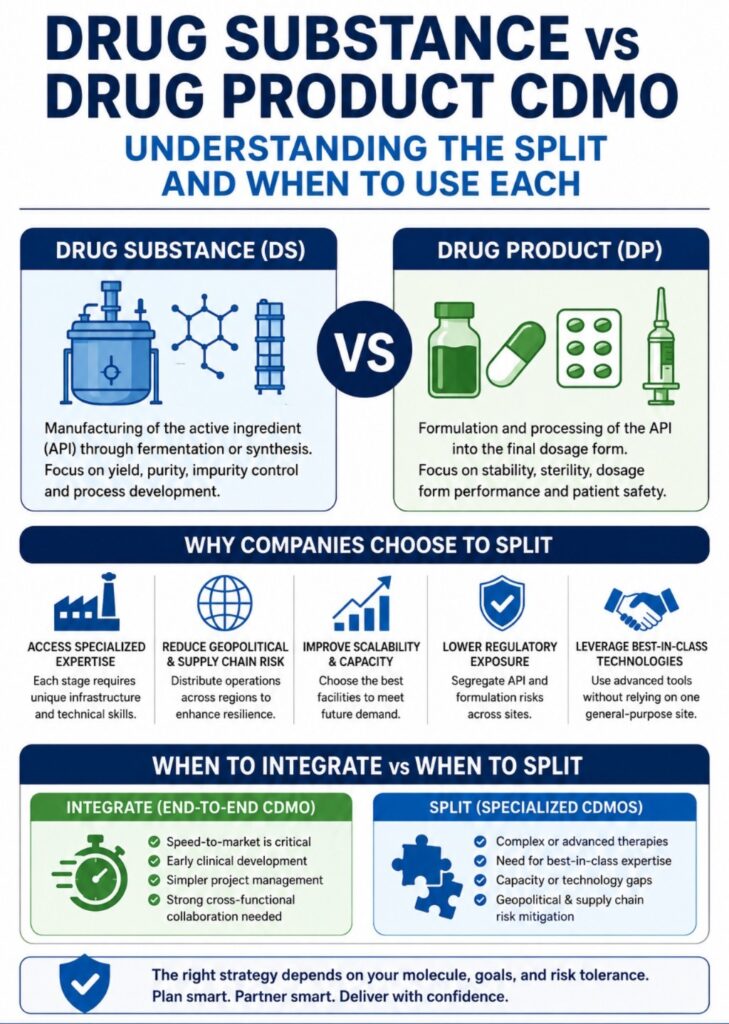
- Drug Substance (DS) manufacturing focuses on producing the active pharmaceutical ingredient (API) through chemical synthesis, fermentation, or biological processes, with emphasis on yield, purity, and impurity control.
- Drug Product (DP) manufacturing converts the API into the final dosage form (tablets, capsules, injectables, etc.), focusing on formulation, stability, sterility, and patient safety.
- Companies often choose a split CDMO model to access specialized expertise, advanced infrastructure, and best-in-class technologies that may not exist within a single manufacturing facility.
- A split strategy improves supply chain resilience by reducing dependence on one location, helping mitigate geopolitical, regulatory, capacity, and operational risks.
- ICH Q11 primarily governs drug substance development and impurity control, while ICH Q8 focuses on formulation development and Quality by Design (QbD) principles for drug products.
- Successful split manufacturing requires robust technology transfer, analytical comparability studies, quality agreements, and lifecycle management plans to ensure product consistency and regulatory compliance.
- Integrated CDMOs are ideal when speed and simplified project management are priorities, whereas split CDMOs are often preferred for complex therapies requiring specialized capabilities, greater flexibility, and long-term supply security.
Strategic Drivers for a Drug Substance vs Drug Product CDMO Split
The decision to separate manufacturing activities is primarily driven by the need to access specialized infrastructure, reduce facility-specific regulatory exposure, and strengthen overall supply chain resilience. The capabilities required for advanced upstream fermentation, recombinant protein production, or complex chemical synthesis rarely coexist within the same facility as the sophisticated sterile processing equipment, automated fill-finish systems, and lyophilization technologies required for drug product manufacturing.
From a technical perspective, these two manufacturing stages operate within fundamentally different scientific disciplines. Drug substance (DS) manufacturing for biologics involves activities such as cell line engineering, strain development, upstream bioprocessing, fermentation optimization, and downstream purification through chromatographic techniques. The primary objective at this stage is to maximize yield while ensuring effective impurity removal and establishing a robust impurity control strategy. In contrast, drug product (DP) manufacturing focuses on formulation development, excipient compatibility assessments, sterile filtration, container-closure system selection, and ensuring long-term product stability throughout its shelf life.
Unsure which outsourcing model fits your technical requirements? Read our comprehensive comparison on Peptide CDMO vs CRO to determine the right operational fit for your program.
In addition to technical considerations, broader economic and geopolitical factors increasingly influence manufacturing network design. The adoption of the “China+1” sourcing strategy and the emergence of trade restrictions and tariffs affecting pharmaceutical supply chains have shifted decision-making priorities away from pure cost optimization toward supply security and operational resilience. By distributing DS and DP operations across different geographic locations, sponsors can reduce dependence on a single region and protect commercial supply from localized regulatory actions, natural disasters, political instability, or trade-related disruptions.
Capacity constraints also frequently drive the need for a split manufacturing model. A sponsor may collaborate with a highly specialized CDMO possessing exceptional expertise in synthetic chemistry for a novel peptide API but lacking sufficient commercial-scale oral solid dosage or sterile injectable manufacturing capabilities. Under such circumstances, transferring bulk drug substance to a separate high-capacity drug product manufacturer becomes a strategic necessity to support anticipated market demand and future commercial growth.
Evaluating full-service versus traditional manufacturing partners? Compare key differences in our detailed breakdown of Peptide CDMO vs CMO.
| Operational Vector | Drug Substance (DS) Facility Focus | Drug Product (DP) Facility Focus | Strategic Implication of Splitting |
|---|---|---|---|
| Core Infrastructure | Bioreactors, large-scale chromatography systems, high-containment chemical reactors. | ISO-classified cleanrooms, automated fill-finish systems, lyophilizers, robotic isolators. | Enables sponsors to access specialized, best-in-class technologies without relying on a single general-purpose facility. |
| Technical Priority | Cell line development, impurity control, process optimization, and scalable biological expression. | Formulation optimization, excipient compatibility, sterile processing, and product stability. | Separates manufacturing risks associated with API production from formulation and delivery-related risks. |
| Supply Chain Role | Serves as the critical point for raw material procurement and active ingredient generation. | Acts as the final safeguard for product quality, stability, and patient safety before commercialization. | Diversifies regulatory, operational, and geopolitical risks across multiple manufacturing locations. |
ICH Q11 and ICH Q8: Regulatory Frameworks Dictating the Split
Regulatory expectations differ significantly between drug substance and drug product manufacturing. ICH Q11 primarily governs API development and manufacturing, with an emphasis on process understanding, impurity control, and starting material selection. In contrast, ICH Q8 focuses on pharmaceutical development, formulation design, and establishing a scientifically justified design space. The challenge of effectively managing both disciplines under a single Quality Management System (QMS) has historically contributed to the growing appeal of specialized CDMOs that focus on one area of expertise.
The International Council for Harmonisation (ICH) clearly distinguishes the regulatory requirements associated with each manufacturing phase. ICH Q11, titled Development and Manufacture of Drug Substances, emphasizes comprehensive process understanding, scientifically justified starting material selection, and the development of a control strategy linking process parameters to Critical Quality Attributes (CQAs). One of the most heavily scrutinized regulatory issues within drug substance manufacturing is the justification of starting materials. Regulatory authorities frequently challenge proposed starting materials that closely resemble the final API structure, requiring detailed impurity fate and purge studies to demonstrate the effective elimination of upstream contaminants prior to bulk storage.
Moving from pilot synthesis to larger commercial volumes? Learn how to navigate technical hurdles in our guide on Peptide API Scale-Up.
Conversely, ICH Q8(R2), Pharmaceutical Development, introduces the Quality by Design (QbD) framework specifically for drug product development. This approach requires sponsors to define a Quality Target Product Profile (QTPP) and establish a scientifically supported design space that describes the multidimensional interaction of formulation variables and process parameters capable of consistently delivering product quality. Drug product development therefore requires extensive investigations into how the physicochemical characteristics of the drug substance interact with excipients and manufacturing conditions to influence dissolution, bioavailability, stability, and degradation behavior throughout the product lifecycle.
Because the analytical methodologies required to validate impurity purge efficiency under ICH Q11 differ substantially from the statistical Design of Experiments (DoE) methodologies used to establish formulation design spaces under ICH Q8, many CDMOs naturally develop deep expertise within one regulatory discipline rather than attempting to maintain equal specialization across both.
Technology Transfer Challenges in a Drug Substance vs Drug Product CDMO Model
Technology transfer between separate CDMOs introduces significant operational risks related to analytical method transfer, inter-laboratory variability, and material integrity during transportation. These risks require comprehensive planning, robust governance structures, and strict adherence to ISPE-guided technology transfer practices. When manufacturing activities are divided across multiple organizations, the transfer of process knowledge, analytical methodologies, and physical materials becomes one of the most critical and vulnerable stages within the product lifecycle.
The International Society for Pharmaceutical Engineering (ISPE) recommends structured stage-gate methodologies for successful technology transfer programs. Effective transfers require the systematic consolidation of explicit and tacit process knowledge, detailed gap assessments between sending and receiving organizations, and successful analytical method transfers before process qualification activities commence. For complex molecules, even subtle differences in impurity profiles that were previously considered acceptable by the drug substance manufacturer may trigger significant formulation instability, aggregation, or compatibility issues when introduced into the drug product manufacturer’s specific formulation system.
Managing these risks requires highly detailed Quality Agreements (QAs) between sponsors and manufacturing partners. Such agreements must clearly define responsibilities related to deviation management, Out of Specification (OOS) investigations, change control procedures, and batch disposition activities. Although the drug product CDMO may perform manufacturing and initial release testing, Quality Agreements typically establish that the sponsor’s Quality Unit retains ultimate authority over final product release decisions. Furthermore, these agreements must define notification requirements for process modifications, ensuring that seemingly minor changes at the drug substance facility do not inadvertently affect validated manufacturing processes, stability data, or regulatory commitments associated with the drug product.
Ready to transition your process to a third-party site? Discover critical strategies when you Outsource Peptide Manufacturing to a CDMO.
| Tech Transfer Phase | Key Activities in a Split CDMO Ecosystem | Primary Risk Factors |
|---|---|---|
| Knowledge Consolidation | Transfer of process maps, unit operations, historical manufacturing data, development reports, and operational know-how between DS and DP organizations. | Incomplete communication of process variability and critical development insights that may affect downstream manufacturing. |
| Analytical Method Transfer | Cross-validation of analytical procedures and establishment of reproducibility between laboratories for CQAs and impurity testing. | Inter-laboratory variability and differences in instrument sensitivity potentially obscuring meaningful product differences. |
| Process Qualification (PPQ) | Execution of engineering studies and process qualification batches using transferred drug substance at the receiving facility. | Scale-up challenges, formulation incompatibilities, and unforeseen container-closure interactions. |
Lifecycle Management and Post-Approval Change Management Protocols (PACMP)
The implementation of a Post-Approval Change Management Protocol (PACMP) under ICH Q12 enables sponsors to proactively define how future manufacturing changes involving multiple CDMOs will be managed, significantly reducing regulatory review timelines and operational complexity. In split manufacturing models, lifecycle management becomes particularly challenging because changes introduced at the drug substance facility frequently have downstream implications for the final drug product.
For example, modifications such as changes in bioreactor scale, chromatography media, purification processes, or manufacturing sites may trigger regulatory reporting obligations related to the finished product. ICH Q12 provides a harmonized framework that allows sponsors and regulatory authorities to agree in advance on the studies, comparability assessments, and acceptance criteria necessary to support future manufacturing changes.
Through a well-defined PACMP, sponsors can establish predefined pathways for activities such as adding secondary manufacturing sites, introducing alternate suppliers, or expanding commercial production capacity. If a sponsor seeks to qualify an additional drug product CDMO to strengthen supply chain resilience, a previously approved PACMP may permit rapid implementation following internal verification of Established Conditions (ECs), eliminating the need for lengthy prior-approval supplement submissions. This enhanced regulatory predictability becomes especially valuable when coordinating manufacturing activities across multiple external partners operating within different regions and regulatory jurisdictions.
Analytical Comparability: Bridging the Gap Between Facilities
Analytical comparability serves as the scientific foundation for demonstrating that manufacturing transfers, process scaling activities, and formulation operations do not alter the safety, efficacy, or quality profile of the therapeutic product. Within a Drug Substance vs Drug Product CDMO split model, regulatory agencies require compelling evidence that the highly purified drug substance maintains its critical quality attributes throughout drug product manufacturing despite exposure to mechanical stress, filtration processes, formulation components, and storage conditions.
Guided by ICH Q5E and other relevant regulatory frameworks applicable to biologics and highly complex molecules, comparability programs extend well beyond routine release testing. Comprehensive assessments typically include enhanced molecular characterization, forced degradation studies, stability evaluations, and detailed impurity profiling. Industry best practices often follow the “Rule of Three” approach, whereby three representative GMP batches manufactured under the original process are compared directly against three batches produced following transfer or process modification. To minimize analytical variability, testing is ideally conducted within the same laboratory using identical analytical platforms and procedures.
Ensure robust molecular identity during technical transfer with our advanced Peptide Analytical Characterization Services.
Advanced mass spectrometry technologies have become indispensable for establishing analytical comparability. Liquid Chromatography-Tandem Mass Spectrometry (LC-MS/MS) and High-Resolution Mass Spectrometry (HRMS) now provide significantly greater analytical depth than traditional profile-based techniques such as UV/Vis spectroscopy or conventional HPLC methods. These advanced technologies enable site-specific quantification of post-translational modifications (PTMs), oxidation products, deamidation events, glycosylation variants, and trace-level degradation products.
The adoption of Multi-Attribute Method (MAM) workflows further enhances comparability assessments by enabling the simultaneous monitoring of numerous CQAs within a single analytical platform. Through these approaches, sponsors can provide regulators with robust evidence demonstrating that molecular integrity, structural fidelity, and product performance remain unchanged despite transitions between drug substance and drug product manufacturing environments.
Review real-world analytical strategies for blockbuster therapeutics in our Peptide Characterization Case Study of Semaglutide.
Nitrosamine Impurity Risk in Split Drug Substance vs Drug Product CDMO Ecosystems
The transition of materials from a Drug Substance (DS) facility to a Drug Product (DP) manufacturing site can significantly increase the risk of unintended nitrosamine formation. Residual secondary or tertiary amines originating from API synthesis may react with trace nitrites present in formulation excipients, creating conditions that favour nitrosamine generation. As a result, highly sensitive LC-MS/MS-based analytical screening has become essential for risk assessment and regulatory compliance. Nitrosamines are recognized as probable human carcinogens and have become a major focus of global regulatory scrutiny following widespread recalls involving sartan-containing products and ranitidine. Regulatory oversight is guided by ICH M7, along with continuously evolving FDA and EMA recommendations.
Within a split manufacturing model, nitrosamine risk management becomes considerably more challenging. A drug substance manufacturer may successfully reduce nitrosamine levels below detectable limits during API production, thereby meeting established release specifications. However, even when nitrosamines are absent, trace levels of nitrosamine-forming amines may remain within the purified drug substance. Once this material is transferred to a drug product facility, new opportunities for nitrosamine formation emerge. During formulation activities, the API may be combined with commonly used excipients that contain low levels of nitrites introduced through their own manufacturing processes or environmental exposure. In addition, formulation operations involving elevated temperatures, specific solvents, or prolonged processing conditions may further facilitate in situ nitrosamine formation within the finished dosage form.
Regulatory authorities require sponsors to conduct comprehensive nitrosamine risk assessments covering the entire product lifecycle, including raw material sourcing, manufacturing processes, storage conditions, and container-closure interactions. These assessments must demonstrate that nitrosamine concentrations remain below highly restrictive Acceptable Intake (AI) limits established for specific compounds. For example, N-nitrosodimethylamine (NDMA) is subject to an AI limit of 96 ng/day, necessitating exceptionally sensitive analytical methodologies.
Addressing complex impurity profiles for metabolic therapies? Explore our dedicated methods for GLP-1 Peptide Analytical Characterization.
Achieving reliable detection at such trace levels requires advanced analytical capabilities that are often unavailable within conventional manufacturing environments. ResolveMass Laboratories Inc. provides independent, third-party analytical testing services designed to address this critical gap within the pharmaceutical supply chain. Utilizing High-Resolution LC-MS/MS platforms, including Q-Exactive Orbitrap technology, alongside advanced GC-MS/MS instrumentation, ResolveMass enables quantitation limits that are substantially below current regulatory thresholds.
Whether performing comprehensive nitrosamine risk assessments, developing analytical methods for novel Drug Substance-Related Nitrosamine Impurities (NDSRIs), or conducting routine batch release testing, collaboration with a specialized analytical laboratory provides sponsors with the scientific confidence needed to manage the transition between DS and DP manufacturing partners. Through rigorous analytical characterization and data-driven risk evaluation, sponsors can maintain regulatory compliance while demonstrating strong E-E-A-T principles supported by robust scientific evidence.
Synthesizing the Decision: When to Integrate vs. When to Split
A split manufacturing strategy is often the preferred choice for complex biologics, highly potent compounds, antibody-drug conjugates (ADCs), and other advanced therapeutic modalities that require specialized expertise and infrastructure. In contrast, integrated manufacturing models may be better suited for accelerated clinical development programs where reducing timelines and simplifying project management take precedence over access to highly specialized facilities. Ultimately, the optimal strategy depends on the sponsor’s internal capabilities, the technical requirements of the molecule, commercial objectives, and overall risk tolerance.
The Case for Integration (End-to-End CDMOs)
Historically, consolidating drug substance and drug product development within a single organization has offered significant operational advantages. Integrated CDMOs reduce fragmentation across the development process, improve communication between technical teams, and often shorten development timelines. By eliminating the administrative complexity associated with managing multiple Master Services Agreements (MSAs), coordinating separate quality systems, and aligning different organizational procedures, sponsors can often accelerate progression through clinical development.
Integrated organizations also benefit from enhanced cross-functional collaboration. Scientists involved in drug substance development can work directly with formulation experts, enabling potential solubility, stability, or manufacturability challenges to be identified and addressed much earlier in the development process. This collaborative environment allows modifications to API characteristics, solid-state properties, impurity profiles, or formulation strategies before issues become costly obstacles during later-stage development. As a result, integrated CDMOs can offer substantial advantages for programs where speed-to-market represents a critical strategic objective.
The Case for Separation (Split CDMOs)
Despite the efficiencies associated with integrated manufacturing, the “one-stop-shop” approach may require sponsors to compromise on technical specialization. For highly complex therapies, it is uncommon for a single organization to possess industry-leading expertise across every stage of manufacturing, from advanced biological expression systems and complex chemical synthesis to aseptic processing and commercial-scale fill-finish operations.
A split manufacturing strategy allows sponsors to select best-in-class providers for each critical activity, ensuring that every phase of development benefits from specialized infrastructure and deep technical expertise. This approach is particularly valuable for advanced modalities where unique manufacturing requirements exceed the capabilities of many integrated organizations.
Evaluating potential development partners for your pipeline? Learn key benchmarks in our guide on How to Choose a Peptide CDMO in the US.
Separating manufacturing activities also provides an important safeguard against vendor dependency. When all manufacturing operations are concentrated within a single organization, regulatory enforcement actions, facility shutdowns, capacity limitations, or operational failures can significantly disrupt development and commercial supply. Under a split model, these risks are distributed across multiple organizations. For example, if a drug product facility encounters regulatory compliance challenges, sponsors may continue manufacturing and storing bulk drug substance while initiating technology transfer activities to qualify an alternative drug product manufacturing partner. This built-in operational flexibility can substantially enhance long-term supply chain resilience and business continuity.
Assessing regional advantages for your manufacturing footprint? Read our comparison between Canadian vs US Peptide CDMOs.
Conclusion
Selecting an appropriate Drug Substance vs Drug Product CDMO strategy represents one of the most critical Chemistry, Manufacturing, and Controls (CMC) decisions facing pharmaceutical and biotechnology sponsors. While integrated manufacturing models offer clear advantages in terms of speed, coordination, and administrative simplicity, the increasing complexity of modern therapeutics frequently necessitates access to specialized infrastructure that is only available through a split manufacturing approach.
Successfully executing a split strategy requires a thorough understanding of multiple regulatory frameworks, including the impurity control expectations outlined in ICH Q11 and the formulation-focused Quality by Design principles established under ICH Q8. It also requires effective technology transfer programs, proactive lifecycle management supported by ICH Q12 Post-Approval Change Management Protocols (PACMPs), and comprehensive analytical comparability assessments to ensure product consistency across manufacturing sites.
Perhaps most importantly, the transition of a drug substance into its final dosage form introduces significant chemical and quality risks, including the potential formation of carcinogenic nitrosamines. Managing these risks requires highly sensitive analytical methodologies capable of detecting impurities at extremely low concentrations and generating scientifically defensible data that withstands regulatory scrutiny.
ResolveMass Laboratories Inc. supports pharmaceutical sponsors throughout these critical transitions by providing advanced bioanalytical testing, biomarker analysis, impurity characterization, nitrosamine assessment, and quantitative analytical services. Through the application of state-of-the-art mass spectrometry platforms and deep scientific expertise, ResolveMass helps organizations validate CDMO transfers, establish analytical comparability, and maintain regulatory compliance throughout the product lifecycle.
To strengthen your pharmaceutical supply chain and ensure confidence during critical manufacturing transitions, contact the analytical experts at ResolveMass Laboratories Inc. today.
Contact ResolveMass Laboratories Inc.
Frequently Asked Questions
Different ICH guidelines address distinct stages of pharmaceutical development and manufacturing. ICH Q11 focuses on drug substance development, emphasizing process understanding, starting material selection, impurity control, and manufacturing consistency. In contrast, ICH Q8 is centred on drug product development and requires a scientific approach to formulation design, product performance, stability, and Quality by Design (QbD), making specialized expertise necessary for each manufacturing stage.
An integrated CDMO can simplify project management and reduce coordination challenges, but it may not always offer leading-edge expertise across every manufacturing function. Complex biologics often require highly specialized technologies for both upstream production and downstream fill-finish operations. If a facility lacks advanced capabilities in one area, sponsors may face limitations in scalability, process optimization, or product quality during commercial development.
The “China+1” strategy encourages companies to diversify manufacturing activities across multiple regions rather than relying on a single country. By separating drug substance and drug product manufacturing sites geographically, sponsors can reduce exposure to trade restrictions, regulatory actions, political uncertainties, and supply chain disruptions. This approach strengthens business continuity and improves overall supply chain resilience.
A Post-Approval Change Management Protocol (PACMP), described in ICH Q12, is a regulatory mechanism that allows companies to plan and document how future manufacturing changes will be assessed and managed. For organizations using separate DS and DP CDMOs, a PACMP helps streamline change implementation by defining agreed-upon testing and comparability requirements in advance, reducing regulatory uncertainty and accelerating approvals.
Analytical comparability is established through extensive testing that demonstrates the product remains consistent before and after a manufacturing transfer. This typically includes structural characterization, impurity profiling, stability assessments, and stress testing. Following principles outlined in ICH Q5E, multiple representative batches from each manufacturing site are compared using validated analytical methods to confirm product similarity.
LC-MS/MS provides a highly sensitive and detailed assessment of molecular structure and product quality attributes that may not be detectable through conventional analytical techniques. During technology transfers, it enables the identification and quantification of impurities, post-translational modifications (PTMs), oxidation products, and other critical quality attributes. This level of analytical insight helps confirm that the therapeutic molecule remains unchanged throughout the transfer process.
Nitrosamine risk can increase during the transition from drug substance to drug product manufacturing because residual amines present in the API may interact with trace nitrites found in excipients or introduced during formulation processing. Factors such as heat, solvents, and manufacturing conditions can further promote nitrosamine formation. As a result, comprehensive risk assessments and highly sensitive analytical testing are essential throughout product development.
Regardless of how many contract manufacturing organizations are involved, the pharmaceutical sponsor or market authorization holder remains ultimately responsible for product quality, safety, and regulatory compliance. The sponsor must oversee all outsourced activities, maintain appropriate quality agreements, manage manufacturing changes, and ensure that all GMP requirements are consistently met across the entire supply chain.
Engaging a Drug Product CDMO during late preclinical development or early Phase I studies is generally considered a best practice. Early collaboration allows formulation requirements to be aligned with drug substance characteristics such as particle size, polymorphic form, solubility, and stability. This proactive approach helps minimize development risks, prevent formulation challenges, and support a smoother path toward clinical and commercial manufacturing.
Reference:
- International Council for Harmonisation of Technical Requirements for Pharmaceuticals for Human Use. (2012). ICH Q11: Development and manufacture of drug substances (chemical entities and biotechnological/biological entities). European Medicines Agency. https://www.ema.europa.eu/en/documents/scientific-guideline/ich-guideline-q11-development-and-manufacture-drug-substances-chemical-entities-and-biotechnologicalbiological-entities_en.pdf
- Savale, S. K. (2021). Technology transfer in pharmaceutical industry: Process transfer from development to commercialization. World Journal of Pharmacy and Pharmaceutical Sciences, 10(8), 972–981. https://doi.org/10.20959/wjpps20218-19588
- European Medicines Agency & U.S. Food and Drug Administration. (2023). EMA–FDA joint Q&As on quality and GMP aspects of PRIME/Breakthrough therapy applications (EMA/CHMP/531552/2023). European Medicines Agency. https://www.ema.europa.eu/en/documents/other/ema-fda-joint-qas-quality-and-gmp-aspects-prime-breakthrough-therapy-applications_en.pdf
- International Council for Harmonisation of Technical Requirements for Pharmaceuticals for Human Use. (2020). ICH Q12: Technical and regulatory considerations for pharmaceutical product lifecycle management (EMA/CHMP/ICH/804273/2017). European Medicines Agency. https://www.ema.europa.eu/en/ich-q12-technical-regulatory-considerations-pharmaceutical-product-lifecycle-management-scientific-guideline
- Ambrogelly, A., Gozo, S., Katiyar, A., Dellatore, S., Kune, Y., Bhat, R., Sun, J., Li, N., Wang, D., Nowak, C., Neill, A., Ponniah, G., King, C., Mason, B., Beck, A., & Liu, H. (2018). Analytical comparability study of recombinant monoclonal antibody therapeutics. MAbs, 10(4), 513–538. https://doi.org/10.1080/19420862.2018.1438797
Get In Touch With Us
About The Author


