


Article Summary
- Differential Scanning Calorimetry (DSC) measures heat flow to analyze thermal transitions such as melting, crystallization, and degradation.
- The technique is widely used in polymers, pharmaceuticals, food, and materials science for both research and quality control.
- Accurate DSC results depend on key factors such as sample preparation, controlled heating rates, and proper instrument calibration.
- Montreal offers advantages for DSC testing including local expertise, fast turnaround times, regulatory alignment, and reduced logistics costs.
- DSC services in Montreal support industries such as biotech, aerospace, packaging, and energy in material development and stability testing.
- Future trends include AI-assisted data interpretation and integration with other thermal and spectroscopic techniques.
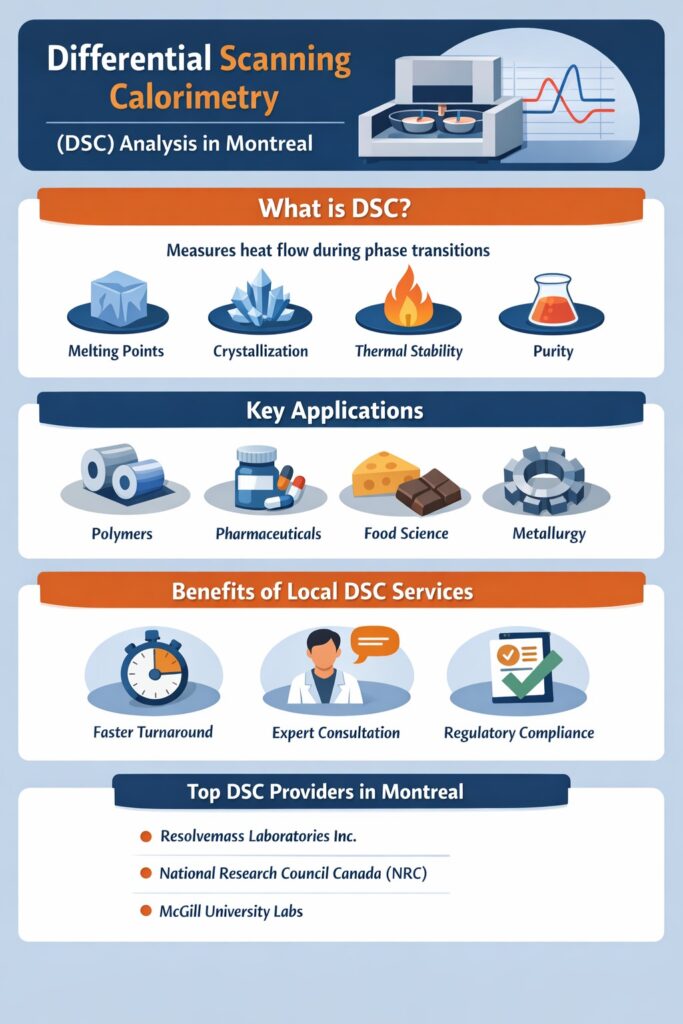
Differential Scanning Calorimetry (DSC) is a powerful thermal analysis technique widely used in materials science, pharmaceuticals, polymers, and food industries. By measuring the heat flow associated with phase transitions, DSC provides crucial insights into material properties such as melting points, crystallization, thermal stability, and purity.
For companies and research institutions in Montreal, Canada, access to reliable DSC analysis services is vital. This guide explores DSC analysis, its principles, applications, and the top DSC analysis service providers in Montreal.
What is Differential Scanning Calorimetry (DSC)?
DSC is a thermal analytical technique that determines the heat flow associated with a material’s physical or chemical transitions. It operates by heating or cooling a sample and monitoring the energy required to maintain a constant temperature difference between the sample and a reference material.
Principle of DSC Analysis
The fundamental principle of DSC involves:
- Sample and Reference Comparison: A sample and an inert reference material are placed in separate pans within a controlled furnace.
- Heat Flow Measurement: The instrument applies heat, and the difference in heat flow between the sample and reference is recorded.
- Endothermic and Exothermic Transitions: The heat absorbed or released during melting, crystallization, or decomposition is analyzed.
The resulting DSC curve displays peaks corresponding to thermal events such as glass transitions, melting, and degradation.
Expert Insight: Understanding the physics behind these measurements is key to interpreting data correctly. For a deep dive into the underlying mechanics, you can read more about the Differential Scanning Calorimetry (DSC) Analysis Principle.
Types of DSC Instruments
Modern DSC instruments come in various configurations tailored for different analytical needs. Standard heat-flux DSC systems are widely used in laboratories for routine characterization due to their reliability and versatility. Meanwhile, power-compensation DSC instruments are known for their fast response and higher accuracy during rapid temperature changes, making them suitable for kinetic studies and sensitive samples. Understanding the operational differences between these systems helps researchers choose the ideal technology for their applications.
In addition to equipment design, the level of automation and temperature range plays a significant role in analytical performance. High-end instruments offer automated sample loading, nitrogen purge control, and calibration routines that support continuous workflows. In contrast, portable benchtop models, while less feature-heavy, provide cost-effective solutions for smaller labs and educational environments. This variety ensures DSC can be applied across research, educational, and industrial settings without compromising analytical quality.
Applications of DSC Analysis
1. Polymer Characterization
- Determines glass transition temperature (Tg) and melting points (Tm).
- Measures degree of crystallinity, helping in polymer formulation.
- Evaluates thermal degradation and oxidation resistance.
2. Pharmaceutical Analysis
- Identifies polymorphic forms in drugs, ensuring stability.
- Determines drug-excipient compatibility in formulation development.
- Helps in assessing the thermal stability of active pharmaceutical ingredients (APIs).
Case Study Reference: To see how these principles are applied in real-world drug development, explore this DSC Analysis Pharmaceutical Case Study which highlights the detection of instabilities and polymorphic transitions.
3. Food Science & Nutritional Studies
- Monitors fat crystallization in chocolate and margarine.
- Assesses protein denaturation in food processing.
- Ensures quality control in dairy and bakery products.
4. Material Science & Metallurgy
- Measures thermal behavior of ceramics, metals, and composites.
- Helps in developing heat-resistant materials.
- Supports the study of supercooled liquids and amorphous phases.
5. Petrochemicals and Lubricants
- Evaluates oxidation stability of lubricants.
- Helps in quality control of petroleum-based products.
- Determines thermal stability of polymers used in fuel systems.
Learn More: If you are working with temperature-sensitive biologics or amorphous polymers, consider reviewing a detailed Vitrification Study by DSC to understand how to prevent harmful ice formation.
Sample Preparation and Testing Procedures
Proper sample preparation significantly influences the accuracy of DSC measurements. Materials must be weighed in precisely controlled amounts and enclosed in compatible pans to avoid contamination or thermal lag. The use of hermetically sealed pans is especially important when analyzing volatile substances or samples prone to decomposition. Researchers also evaluate pan material, shape, and heat transfer properties to ensure consistent results across multiple tests.
Testing procedures may vary depending on whether the experiment involves heating, cooling, or multiple cycling stages. For instance, polymers are frequently subjected to heat–cool–heat cycles to differentiate between processing artifacts and true thermal properties. The choice of heating rate also affects sensitivity; slower rates reveal subtle transitions, while faster rates simulate real-world thermal loads. These procedural adjustments allow DSC to be tailored to both exploratory studies and standardized industrial compliance tests.
Technical Guide: For specialists requiring high precision, you can find a breakdown of advanced methodologies in this guide on DSC Glass Transition Analysis for Accurate Tg Detection.
Why Choose a Local DSC Analysis Provider in Montreal?
For businesses and researchers in Montreal, choosing a local DSC analysis service offers several benefits:
- Faster Turnaround Time: Local services reduce shipping delays.
- Expert Consultation: Easy access to specialists for project discussions.
- Regulatory Compliance: Adherence to Canadian and international standards (ISO, ASTM, USP, Ph. Eur.).
- Cost-Effectiveness: Reduced logistics costs compared to outsourcing abroad.
Factors to Consider When Selecting a DSC Service Lab
When choosing a DSC service provider, clients should consider the type of materials being analyzed and the lab’s specialization. A lab experienced in polymer characterization may not always be ideal for pharmaceutical polymorphism studies. Additionally, labs equipped with advanced temperature control ranges can handle cryogenic or high-temperature analyses that standard labs cannot. Evaluating a provider’s technical capabilities ensures that the data generated aligns with project requirements.
Turnaround time, data reporting formats, and interpretive support also play an essential role in decision-making. Some labs offer only raw DSC curves, while others provide advanced analysis that includes peak integration, transition enthalpies, and kinetic modeling. For companies working under regulatory frameworks, documentation compliance with standards such as ASTM, ISO, or pharmacopeial guidelines is crucial. These considerations help organizations avoid costly delays and guarantee robust analytical outputs.
Top DSC Analysis Services in Montreal, Canada
1. Resolvemass Laboratories Inc.
- Expertise: Advanced thermal analysis for polymers, pharmaceuticals, and materials.
- Services: Offering a comprehensive suite including DSC Analysis in Montreal and specialized Glass Transition Temperature Testing.
- Location: Montreal, QC
2. National Research Council Canada (NRC)
- Expertise: Research-driven DSC services for industrial applications.
- Services: Polymer analysis, phase transitions, thermal stability testing.
- Location: Montreal, QC
3. McGill University Analytical Laboratories
- Expertise: Academic research and industrial collaborations.
- Services: DSC, TGA, rheology, spectroscopy.
- Location: Montreal, QC
Industries Benefiting from DSC Analysis in Montreal
Montreal’s diverse industrial ecosystem creates strong demand for thermal analysis services. Aerospace manufacturers utilize DSC to evaluate composite materials and adhesives that must withstand extreme temperature fluctuations. The biotechnology sector relies on DSC to study protein unfolding and assess formulation stability for therapeutic products. These applications highlight the city’s strong focus on innovation and materials engineering.
Montreal’s food and packaging industries also leverage DSC to optimize production processes and enhance product quality. Fat crystallization in chocolate, shelf-stability in dairy products, and thermal sealing in flexible packaging all benefit from precise thermal data. As companies work to meet sustainability goals, DSC enables testing of biodegradable polymers and bio-based packaging alternatives, positioning Montreal as a hub for green materials research.
Future Trends in DSC Technology and Research
Advancements in DSC technology are rapidly expanding its capabilities in both research and industrial environments. Integration with artificial intelligence and machine learning is enabling automated interpretation of complex thermal patterns, reducing the burden on specialists and improving data reproducibility. Furthermore, improvements in sensor sensitivity and thermal modulation allow for the detection of subtle transitions previously masked by background noise.
Researchers are increasingly combining DSC with complementary techniques such as thermogravimetric analysis (TGA), rheology, and spectroscopy. These multi-technique workflows create a richer understanding of material behavior under stress, heat, or chemical transformation. As sustainability and new material development continue to drive innovation, DSC remains an essential tool for validating performance, ensuring regulatory compliance, and supporting next-generation materials research.
Conclusion
Differential Scanning Calorimetry continues to play a vital role in characterizing the thermal behavior of materials across numerous scientific and industrial fields. Its ability to detect phase transitions, assess purity, and evaluate stability makes it indispensable for research, product development, and quality assurance. With applications extending from pharmaceuticals to aerospace materials and food systems, DSC analysis remains one of the most versatile thermal techniques available today.
If you are looking for professional lab support, you can explore the full range of DSC Analysis Services by Resolvemass Labs to see how they support industries across North America, including specialized DSC Analysis in the United States.
For organizations in Montreal, access to qualified DSC service providers enhances innovation and accelerates decision-making. Whether used to validate formulations, screen materials, or support regulatory submissions, local DSC laboratories offer technical expertise along with logistical advantages. As technology advances and new analytical integrations emerge, DSC will continue to evolve, offering even deeper insights into material performance and supporting the growth of industries that rely on thermal science.
REFERENCES
- Gill, P., Tohidi Moghadam, T., & Ranjbar, B. (2010). Differential scanning calorimetry techniques: Applications in biology and nanoscience. Journal of Biomolecular Techniques, 21(4), 167–193. https://www.ncbi.nlm.nih.gov/pmc/articles/PMC2977967/
- Kuril, A. K. (2024). Differential scanning calorimetry: A powerful and versatile tool for analyzing proteins and peptides. Journal of Pharmaceutical Research International, 36(7), 179–187. https://doi.org/10.9734/jpri/2024/v36i77549
- Amarachi, A. (2020). Differential scanning calorimetry: A review. International Journal of Applied Biology, Short Communication and Pharmaceutical Technology, 1(2). https://www.iomcworld.org/articles/differential-scanning-calorimetry.pdf
LET’S CONNECT
For DSC analysis and other advanced material testing services, contact Resolvemass Laboratories Inc. today.

Case Study: Identifying Peptide Acylation Impurities in a PLGA Depot Formulation by LC-HRMS
Introduction: Peptide Acylation Impurity Analysis is the targeted detection, identification and, where possible, quantitation of…

FDA’s Draft Guidance on Comparative Efficacy Studies: What Your Analytical Package Must Show to Skip Phase III
Introduction Under the FDA’s Draft Guidance on Comparative Efficacy Studies, prospective biosimilar applicants may be…

“No Clinically Meaningful Differences”: How FDA Defines the Standard for Biosimilar Approval
Introduction Under Section 351(k) of the Public Health Service (PHS) Act, the U.S. Food and…

FDA Withdraws Its 2015 Biosimilarity Guidance: What Replaces It and What Changes for Developers
Introduction On March 9, 2026, the U.S. Food and Drug Administration (FDA) officially announced the…
Oligonucleotide Drug Development at a CDMO: Analytical Characterization and Impurity Challenges
Introduction: Oligonucleotide CDMO Services give drug developers a single, analytically grounded route from sequence design…

Statistical Approaches to Analytical Similarity: Quality Ranges, Equivalence Testing and How FDA Judges the Data
Introduction Statistical Approaches to Analytical Similarity encompass quantitative, risk-based frameworks used by regulatory authorities and…

