

Introduction: Why E&L Testing for Pre-Filled Syringes Requires a Specialized Strategy
E&L Testing for Pre-Filled Syringes is much more complex than standard vial or bottle testing. Pre-filled syringes contain several materials and multiple product-contact surfaces that can interact with the drug product during storage and use. Because of this complexity, pharmaceutical companies need a detailed and science-based approach to identify and control extractables and leachables.
The demand for ready-to-use injectable systems continues to grow, especially for biologics, biosimilars, vaccines, and specialty injectable therapies. Pre-filled syringes improve dosing accuracy, patient convenience, and administration efficiency. However, they also increase the risk of chemical migration from packaging materials into the drug product. These migrated substances may impact drug stability, product quality, and patient safety.
Learn more about our comprehensive testing solutions: Explore ResolveMass Extractables and Leachables Testing Services
A typical pre-filled syringe (PFS) system may contain borosilicate glass barrels, rubber plunger stoppers, silicone oil lubricants, thermoplastic elastomer needle shields, stainless steel needles, and adhesive materials. Each component has its own extractable profile and compatibility concerns. Factors such as sterilization, storage temperature, formulation chemistry, and transportation conditions can further affect migration behavior.
As a result, E&L Testing for Pre-Filled Syringes requires advanced analytical methods, experienced scientists, and carefully designed studies.
This article explains the major scientific, analytical, and regulatory challenges associated with E&L Testing for Pre-Filled Syringes and highlights practical solutions for building a reliable lifecycle-focused testing program.
Share via:
📋 Article Summary — Key Takeaways at a Glance
- Extractables and leachables (E&L) evaluation for pre-filled syringes is particularly challenging because injectable formulations remain in continuous contact with several packaging components, including the glass barrel, rubber plunger, needle shield, tip cap, and internal lubricants.
- In contrast to traditional vial systems, pre-filled syringes commonly contain silicone oil to improve plunger movement. This lubricant can become a source of leachables and may negatively affect sensitive biologic formulations by promoting protein instability or aggregation.
- Current regulatory expectations are largely guided by frameworks such as ICH Q3E, USP <1663>, USP <1664>, and EU GMP Annex 1. Applying these guidelines effectively to pre-filled syringe systems often requires significant scientific interpretation and product-specific expertise.
- Establishing appropriate safety and analytical thresholds — including SCT, AET, and qualification limits — remains one of the most important aspects of a successful E&L strategy. Incorrect threshold selection may either overlook potential risks or generate unnecessary testing burdens.
- Factors such as material interaction behavior, syringe design, storage conditions, and temperature-dependent migration patterns play a major role in leachable formation and must be carefully evaluated during study design.
- Among all testing activities, silicone oil analysis, nitrosamine assessment, and compatibility studies for biologic products are generally considered the most technically complex components of pre-filled syringe E&L programs.
- ResolveMass Laboratories Inc. delivers comprehensive extractables and leachables testing solutions designed specifically for pre-filled syringe systems, supporting pharmaceutical companies from early-stage development through long-term commercial lifecycle management.
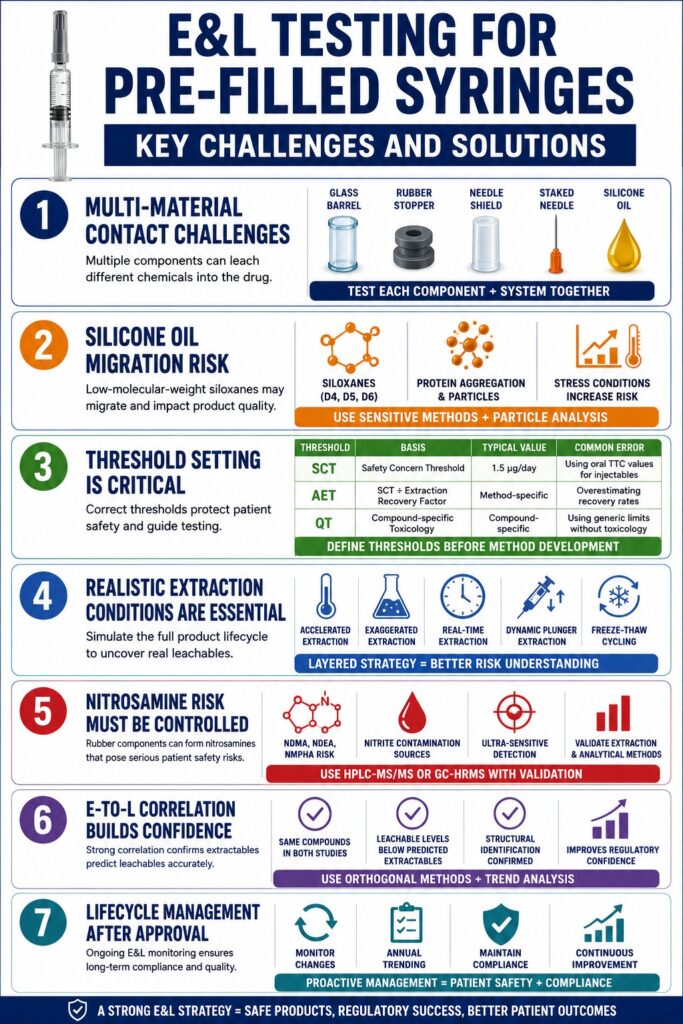
1. Multi-Material Contact Challenges in E&L Testing for Pre-Filled Syringes
One of the biggest challenges in pre-filled syringe testing is the presence of multiple materials that come into direct or indirect contact with the drug product. Unlike conventional vial systems, PFS systems contain several independent contact surfaces that can release different chemical compounds over time.
| PFS Component | Primary Materials | Key Extractable Concerns |
|---|---|---|
| Glass barrel | Borosilicate glass (Type I) | Metal ions (Ba²⁺, Al³⁺), delamination risk |
| Plunger stopper | Bromobutyl / Chlorobutyl rubber | Nitrosamines, antioxidants, vulcanization residues, zinc compounds |
| Needle shield | Thermoplastic elastomer (Hytrel®, Santoprene®) | Plasticizers, UV stabilizers, processing aids |
| Staked needle | Stainless steel + epoxy adhesive | Adhesive leachables, metallic ions |
| Silicone oil | Polydimethylsiloxane (PDMS) | Siloxanes (D4, D5, D6), protein adsorption risks |
| Tip cap | Rubber / plastic composite | Cross-contamination from elastomeric additives |
Every component should be analyzed individually before system-level extraction studies begin. Skipping component-level testing can make it difficult to identify the source of detected leachables during regulatory review.
Material variability is another major concern. Small changes in rubber additives, curing agents, silicone coating levels, or manufacturing processes can change the extractables profile. Supplier-to-supplier variation may also create batch inconsistencies.
In addition, interactions between materials may produce secondary leachables that are not detected during isolated testing. For this reason, both component-level and system-level studies are important in a complete E&L strategy.
Understand the complexities of high-risk drug products: Extractables and Leachables in Biopharma and Biologics
2. Silicone Oil Challenges in E&L Testing for Pre-Filled Syringes
Silicone oil is commonly used inside pre-filled syringes to reduce friction between the barrel and plunger. Although it improves syringe functionality, it can also create analytical and formulation challenges.
Low-molecular-weight siloxanes such as D4, D5, and D6 may migrate into the formulation under certain storage conditions. These compounds are especially concerning for biologic and protein-based drugs.
Silicone droplets may interact with proteins and trigger aggregation, denaturation, or particulate formation. This can affect product stability, potency, and patient safety.
Transportation stress, freeze-thaw cycles, temperature changes, and syringe movement can all influence silicone oil migration. Because of this, realistic worst-case testing conditions are essential.
Explore E&L considerations for advanced therapies: Extractables and Leachables in Biologics and ATMPs
2.1 Quantifying Silicone Oil Migration
The amount of silicone oil in a syringe barrel usually ranges from 0.5–2.0 mg, but migration behavior can vary widely.
Detecting siloxanes at very low levels in biologic formulations requires highly sensitive methods. Standard GC-MS and ICP-MS techniques often need additional optimization for protein-rich samples.
Regulators pay close attention to silicone oil because it may contribute to protein aggregation and visible or subvisible particles. Therefore, E&L studies are often combined with:
- Micro-Flow Imaging (MFI)
- Light obscuration testing
- Particle characterization studies
Protein-containing formulations can also interfere with analytical measurements. Laboratories should perform matrix suitability and spike-recovery studies to confirm method reliability.
2.2 Analytical Method Gaps for Siloxane Detection
- GC-MS headspace methods can identify volatile cyclic siloxanes such as D4–D6 but may miss higher molecular weight species.
- Many compendial methods were not originally designed for silicone-coated PFS systems.
- Spike-recovery studies are necessary because proteins can suppress analytical signals.
- Orthogonal analytical methods improve identification confidence and quantitative accuracy.
Advanced workflows may include:
- GC-MS
- LC-MS
- FTIR spectroscopy
- Particle analysis techniques
This combined strategy improves siloxane detection and supports better understanding of long-term migration behavior.
3. Threshold Setting in E&L Testing for Pre-Filled Syringes
Threshold determination is one of the most important parts of an E&L program. Incorrect threshold values can either increase unnecessary testing or fail to detect patient safety risks.
Although ICH Q3E provides guidance, threshold calculations for pre-filled syringes must consider:
- Dose volume
- Route of administration
- Frequency of use
- Patient population
- Duration of therapy
For example, a daily injectable therapy creates a different exposure risk than a once-monthly injection.
Threshold Reference Table (Illustrative for Parenteral Routes)
| Threshold Type | Basis | Typical Parenteral Value | Common Error |
|---|---|---|---|
| SCT (Safety Concern Threshold) | TTC / toxicological concern | 1.5 µg/day | Using oral TTC values for injectable products |
| AET (Analytical Evaluation Threshold) | SCT ÷ extraction recovery factor | Method-specific | Overestimating recovery rates |
| QT (Qualification Threshold) | Compound-specific toxicology | Compound-specific | Using generic limits without toxicology support |
A strong E&L strategy defines threshold values before analytical method development begins. This ensures that methods are sensitive enough from the start.
Long-term therapies should also consider cumulative exposure from repeated dosing.
Stay compliant with the latest global standards: A Comprehensive Guide to ICH Q3E Guidelines for E&L
4. Designing Extraction Conditions for Realistic PFS Stress Testing
Extraction studies should simulate the full product lifecycle, including:
- Manufacturing
- Sterilization
- Transportation
- Storage
- Patient administration
Generic extraction studies may not reflect real-world stress conditions and can underestimate potential leachable risks.
Recommended Extraction Condition Hierarchy for PFS
- Accelerated extraction: 40°C × 60 days using formulation buffer or simulated formulation
- Exaggerated extraction: Elevated-temperature solvent extraction for component screening
- Real-time extraction: Storage at labeled shelf-life conditions
- Dynamic plunger extraction: Simulated syringe actuation studies
- Freeze-thaw cycling: Important for biologics stored frozen before use
Dynamic studies are especially important because plunger movement can release additional particles and leachables.
A layered extraction strategy combining exaggerated, accelerated, and real-time studies provides better understanding of product behavior throughout the lifecycle.
Discover the requirements for successful study design: ICH Q3E Extractables and Leachables Study Requirements
5. Nitrosamine Risk in Pre-Filled Syringe Components
Nitrosamines are now a major regulatory concern for injectable drug products.
These compounds may form when rubber accelerators react with nitrosating agents during manufacturing or storage. Examples include:
- NDMA
- NDEA
- NMPhA
Pre-filled syringes present increased risk because elastomeric stoppers remain in direct contact with the formulation during the entire shelf life.
Potential nitrite contamination sources include:
- Process water
- Excipients
- Manufacturing equipment
- Packaging materials
Detecting nitrosamines requires ultra-sensitive analytical methods because acceptable intake limits are extremely low.
Commonly used techniques include:
- HPLC-MS/MS
- GC-HRMS
- Isotope dilution methods
Laboratories must validate extraction efficiency, matrix effects, and analytical robustness to ensure accurate quantification.
Mitigate risks associated with packaging interactions: Understanding Packaging Leachables and Nitrosamine Risks
6. Extractables-to-Leachables Correlation in PFS Programs
A strong extractables-to-leachables (E-to-L) correlation helps demonstrate that extractables data can accurately predict leachables found during storage.
A reliable correlation should confirm:
- The same compounds appear in both studies
- Leachable levels remain below predicted extractable levels
- Analytical identification is structurally confirmed
Unexpected leachables that are absent from extractables studies may indicate:
- Packaging issues
- Material variability
- Chemical reactions within the formulation
- Manufacturing changes
Strong E-to-L correlation improves regulatory confidence and reduces the need for repeat testing.
To strengthen correlation quality, laboratories often use:
- Orthogonal analytical techniques
- Statistical trend analysis
- Targeted and non-targeted screening methods
Essential guidance for regulatory filings: E&L Testing for Drug Safety in NDA and ANDA Submissions
7. Regulatory Lifecycle Considerations for E&L Testing for Pre-Filled Syringes
E&L programs should continue after product approval. Regulatory agencies expect ongoing monitoring throughout the commercial lifecycle.
Post-approval changes that may require reassessment include:
- Component supplier changes
- Formulation modifications
- Packaging updates
- Sterilization changes
- Shelf-life extensions
Annual trending programs should monitor key leachables identified during development.
Lifecycle management supports:
- Regulatory compliance
- Product quality
- Continuous improvement
- Faster post-approval submissions
Companies that maintain ongoing E&L monitoring programs are better prepared for future regulatory expectations.
Learn about market-specific regulatory demands: Extractables and Leachables Requirements for U.S. Market Authorization
Why Laboratory Expertise Matters in E&L Testing for Pre-Filled Syringes
The complexity of pre-filled syringe systems requires specialized laboratory expertise. Successful programs depend on strong knowledge of:
- Elastomer chemistry
- Silicone oil behavior
- Toxicology
- Biologic compatibility
- Advanced analytical instrumentation
ResolveMass Laboratories Inc. provides expert support for E&L Testing for Pre-Filled Syringes, from early-stage extractables studies to post-approval lifecycle monitoring.
Our scientists have extensive experience with:
- ICH Q3E
- USP <1663>
- USP <1664>
- ISO 10993-18
- EU GMP Annex 1
We develop scientifically sound methods that support biologics, monoclonal antibodies, vaccines, and combination products while helping companies maintain regulatory readiness and long-term product quality.
Partner with a leading testing facility: Top CRO for Extractables and Leachables Testing in Canada
Conclusion: Building a Future-Ready E&L Program for Pre-Filled Syringes
E&L Testing for Pre-Filled Syringes requires a complete scientific strategy that combines analytical chemistry, toxicology, material science, extraction design, and regulatory knowledge.
Pre-filled syringe systems present unique challenges, including:
- Multi-material interactions
- Silicone oil migration
- Threshold determination
- Nitrosamine contamination
- Extractables-to-leachables correlation
These areas are also among the most closely reviewed during regulatory submissions.
A successful E&L program starts with strong study design, realistic extraction conditions, accurate thresholds, and complete material characterization. Poor planning can lead to costly delays, repeat studies, and regulatory concerns.
A future-focused E&L strategy should be proactive, lifecycle-driven, and scientifically reliable. Companies that invest in comprehensive testing programs are better positioned to protect patient safety, maintain compliance, and support successful commercialization.
📩 Ready to build a scientifically rigorous E&L program for your pre-filled syringe platform?
Contact ResolveMass Laboratories Inc.
Frequently Asked Questions (FAQs)
E&L Testing for Pre-Filled Syringes is more challenging because pre-filled syringes contain several materials that stay in contact with the drug product for long periods. These materials include glass, rubber, silicone oil, adhesives, and metal components. Each material can release different chemical compounds into the formulation. In comparison, vial systems usually involve fewer contact surfaces and simpler interactions.
Silicone oil and siloxane compounds are commonly analyzed using advanced techniques such as GC-MS or ICP-based methods. In biologic formulations, testing becomes more difficult because proteins can interfere with the analytical signal. Laboratories usually perform matrix-matched calibration and recovery studies to improve accuracy. Sensitive methods are important to detect silicone-related compounds at very low levels.
Nitrosamine testing for injectable products requires highly sensitive instruments because acceptable limits are extremely low. Most laboratories use HPLC-MS/MS or high-resolution GC-MS methods for accurate detection. These techniques provide better sensitivity and selectivity compared to traditional HPLC-UV systems. Proper method validation is also necessary to confirm reliable results in complex pharmaceutical samples.
E&L studies should begin early during the container and packaging selection phase of product development. Early extractables screening helps companies choose suitable syringe materials before clinical studies start. Performing testing at an early stage can prevent costly packaging changes later in development. Full leachables qualification studies are generally completed before regulatory submission.
The Analytical Evaluation Threshold (AET) is calculated using safety-based toxicological limits along with product-specific factors such as dose volume and extraction recovery. Injectable products require stricter thresholds than oral products because they enter the body directly. The calculation must also consider dosing frequency and route of administration. Correct AET selection helps ensure patient safety while avoiding unnecessary testing.
Regulatory agencies expect companies to clearly connect extractables data with observed leachables found in the drug product. Identified leachables should be chemically characterized, quantified, and evaluated for toxicological risk. Any unknown or unexplained compound usually requires further investigation. Strong extractables-to-leachables correlation improves regulatory confidence in the packaging system.
No, different syringe materials require different extraction solvents because each material contains unique chemical additives. Rubber components may need both aqueous and organic solvents, while glass and thermoplastic materials often require different extraction conditions. Using only one solvent may fail to detect important extractable compounds. A multi-solvent strategy provides broader chemical coverage and more reliable results.
Post-approval monitoring frequency depends on product risk, formulation type, and packaging complexity. High-risk products, especially biologics and products with elastomeric components, are often monitored annually. Additional testing may also be required after manufacturing or supplier changes. Continuous lifecycle monitoring helps maintain product quality and regulatory compliance over time.
Reference:
- International Council for Harmonisation of Technical Requirements for Pharmaceuticals for Human Use. (2025). ICH harmonised guideline: Guideline for extractables and leachables Q3E (Draft version, Step 2). ICH Database PDF
- Eckford, C. (2023, October 3). Increasing efficacy in extractables and leachable testing. European Pharmaceutical Review. European Pharmaceutical Review
- European Medicines Agency. (2025). Draft ICH Q3E guideline for extractables and leachables (EMA/CHMP/ICH/236669/2025). European Medicines Agency. EMA Draft ICH Q3E Guideline PDF
- United States Pharmacopeia. (n.d.). Extractables and leachables. U.S. Pharmacopeia. USP Extractables and Leachables
- Eckford, C. (2023, October 3). Increasing efficacy in extractables and leachable testing. European Pharmaceutical Review. European Pharmaceutical Review
- U.S. Food and Drug Administration. (2025). Q3E guideline for extractables and leachables. U.S. Food and Drug Administration. FDA Q3E Guidance Page
Get In Touch With Us
About The Author


