

Introduction:
Elemental Impurities and Residual Solvents Testing for Synthetic Peptide APIs has become one of the more scrutinized areas of peptide drug development, largely because peptides are synthesized through multi-step chemical processes that introduce far more opportunities for contamination than small-molecule APIs typically face. Solid-Phase Peptide Synthesis (SPPS) relies on repeated coupling and deprotection cycles, each involving reagents, resins, and solvents that can leave measurable residues in the final API. Left uncontrolled, these residues can pose real toxicological risk to patients and can also trigger regulatory deficiencies during ANDA, NDA, or IND review.
Understanding how ICH Q3D (elemental impurities) and ICH Q3C (residual solvents) apply specifically to synthetic peptides — rather than treating peptides like generic small molecules — is essential for building a defensible specification and control strategy. This article walks through where these impurities come from, how they are classified and tested, what a risk-based control strategy looks like in practice, and how this data feeds into a broader impurity profiling in CMC submission package.
Manufacturers must demonstrate that peptide APIs consistently meet these guidelines using validated analytical methods and scientifically justified risk assessments.
Summary:
- Elemental Impurities and Residual Solvents Testing for Synthetic Peptide APIs is required under ICH Q3D and ICH Q3C to control metal catalyst residues and solvent carryover from Solid-Phase Peptide Synthesis (SPPS).
- Synthetic peptide APIs pick up elemental impurities mainly from resins, coupling reagents, and metal-based catalysts used during synthesis and purification.
- Residual solvents originate from SPPS solvents (DMF, DCM, NMP), HPLC purification mobile phases, and lyophilization steps.
- ICH Q3D classifies elements into Class 1, 2A, 2B, and 3 based on toxicity and route of administration, each with a Permitted Daily Exposure (PDE) limit.
- ICH Q3C classifies residual solvents into Class 1 (avoid), Class 2 (limit), and Class 3 (low toxicity, GMP limits) based on Concentration Limits (PDE-derived).
- ICP-MS is the gold-standard technique for elemental impurity quantification; GC-based headspace analysis is standard for residual solvent testing.
- Orbitrap HRMS plays a growing role in identifying unknown or unexpected impurities that fall outside the standard elemental and solvent panels.
- A risk-based control strategy per Q3D is more efficient than testing every batch for every element — but requires a documented risk assessment.
- Regulatory submissions (ANDA, NDA, IND) require this data as part of API characterization and specification-setting.
1: Why Are Synthetic Peptide APIs at Higher Risk for These Impurities?
Synthetic peptides carry a higher inherent risk of elemental and solvent contamination than many small-molecule APIs because of the sheer number of process steps and reagent classes involved in their manufacture. A single peptide sequence of 20-30 residues may require dozens of coupling cycles, each introducing fresh reagent and solvent exposure. Unlike a small molecule that might be produced in a handful of synthetic steps, a therapeutic peptide can pass through 40, 60, or more individual chemical reactions before it reaches its final purified form — and each of those reactions is a potential contamination checkpoint.
Key contamination sources include:
- Resin-bound catalysts and linkers used to anchor the growing peptide chain during SPPS
- Coupling reagents such as HBTU, HATU, and DIC, some of which contain trace metals or generate metal-reactive byproducts during activation chemistry
- Metal scavenging and cleavage reagents, including TFA-based cleavage cocktails that can leach metals from stainless steel reactors, tubing, and fittings over repeated cycles
- Purification hardware, where prolonged contact with metal chromatography components (particularly in preparative HPLC columns and frits) can introduce trace elements like iron, chromium, and nickel
- Solvents used at every stage — DMF and NMP for coupling/deprotection, DCM for resin swelling and cleavage, and acetonitrile/TFA-water systems for RP-HPLC purification
- Buffer salts and counter-ion exchange reagents used during final salt formation, which can introduce their own elemental profile if not adequately controlled
Potential contamination sources include:
- Solid-phase peptide synthesis (SPPS)
- Metal catalysts
- Coupling reagents
- Protecting groups
- Cleavage reagents
- Organic solvents
- Purification columns
- Stainless steel manufacturing equipment
- Water systems
- Glassware
- Packaging materials
Because these exposures compound across many synthesis cycles, even trace-level contamination per step can accumulate to levels that matter under ICH thresholds. This is precisely why peptide sponsors increasingly rely on a specialized CRO for unknown impurity identification rather than assuming a standard small-molecule impurity panel will catch everything relevant.
Unlike many traditional small molecules, peptide synthesis often requires dozens of reaction cycles, increasing cumulative contamination risk.
2: Understanding ICH Q3D for Elemental Impurities
ICH Q3D establishes permitted daily exposure (PDE) limits for elemental impurities to protect patients from toxic metal exposure.
Rather than requiring universal testing of every element, ICH Q3D encourages manufacturers to perform science-based risk assessments and test only relevant elements.
Major Sources of Elemental Impurities
| Source | Potential Elements |
|---|---|
| Catalysts | Palladium, Platinum, Rhodium, Ruthenium |
| Manufacturing Equipment | Iron, Chromium, Nickel |
| Glassware | Boron, Sodium |
| Water Systems | Calcium, Magnesium |
| Raw Materials | Lead, Arsenic, Cadmium |
| Excipients | Various trace metals |
| Processing Chemicals | Copper, Zinc |
ICH Q3D Element Classification
ICH Q3D classifies elemental impurities into four classes based on toxicity, likelihood of occurrence, and route of administration, with each element assigned a Permitted Daily Exposure (PDE) limit rather than a single blanket threshold.
| Class | Examples | Basis for Classification |
|---|---|---|
| Class 1 | Arsenic (As), Cadmium (Cd), Mercury (Hg), Lead (Pb) | Significant human toxicity; use restricted in manufacturing |
| Class 2A | Cobalt (Co), Vanadium (V), Nickel (Ni) | Relatively high probability of occurrence; route-dependent PDE |
| Class 2B | Gold (Au), Palladium (Pd), Iridium (Ir), Rhodium (Rh), Ruthenium (Ru), Osmium (Os), Silver (Ag), Platinum (Pt), Selenium (Se) | Lower probability of occurrence unless intentionally added (e.g., catalysts) |
| Class 3 | Barium (Ba), Chromium (Cr), Copper (Cu), Lithium (Li), Molybdenum (Mo), Antimony (Sb), Tin (Sn), Tungsten (W) | Relatively low toxicity but still assessed for oral, parenteral, and inhalation routes |
For synthetic peptides, Class 2A and 2B elements are particularly relevant since palladium and other transition metal catalysts are sometimes used in specialized coupling or deprotection chemistry, and stainless-steel process equipment is a recognized source of nickel, chromium, and iron. Sponsors working with novel modified peptides, lipidated peptides, or peptide-conjugate APIs should also assess whether any conjugation chemistry introduces catalysts not typically seen in standard SPPS, since these can fall outside a “default” testing panel built around conventional small-molecule assumptions.
The PDE values themselves are not static across all products — they scale with the intended maximum daily dose of the drug product and differ by route of administration, meaning the same element can carry a materially different acceptance limit for an oral peptide capsule versus a subcutaneous injectable.
3: How Does ICH Q3C Classify Residual Solvents?
ICH Q3C organizes residual solvents into three classes based on their potential to cause human harm, with Class 1 solvents effectively prohibited and Class 2 and 3 solvents allowed within defined concentration limits.
| Class | Description | Relevance to Peptide Synthesis |
|---|---|---|
| Class 1 | Known human carcinogens or environmental hazards; avoid entirely | Rarely used in modern SPPS; monitored to confirm absence |
| Class 2 | Non-genotoxic animal carcinogens or other irreversible toxicity; limit use | DMF, DCM, NMP, acetonitrile, pyridine — all common in SPPS and RP-HPLC purification |
| Class 3 | Low toxic potential; PDE ≥ 50 mg/day acceptable under GMP | Ethanol, acetone, isopropanol, ethyl acetate — used in workup and recrystallization |
DMF and DCM deserve particular attention in peptide API testing because they are used in high volumes throughout SPPS and are not always fully removed during lyophilization or final drying, making them the most frequently flagged residual solvents in synthetic peptide batches. Because lyophilized peptide cakes can be porous and retain solvent within the matrix rather than at the surface, drying cycle design and endpoint verification are just as important to residual solvent control as the testing itself.
4: What Analytical Methods Are Used for This Testing?
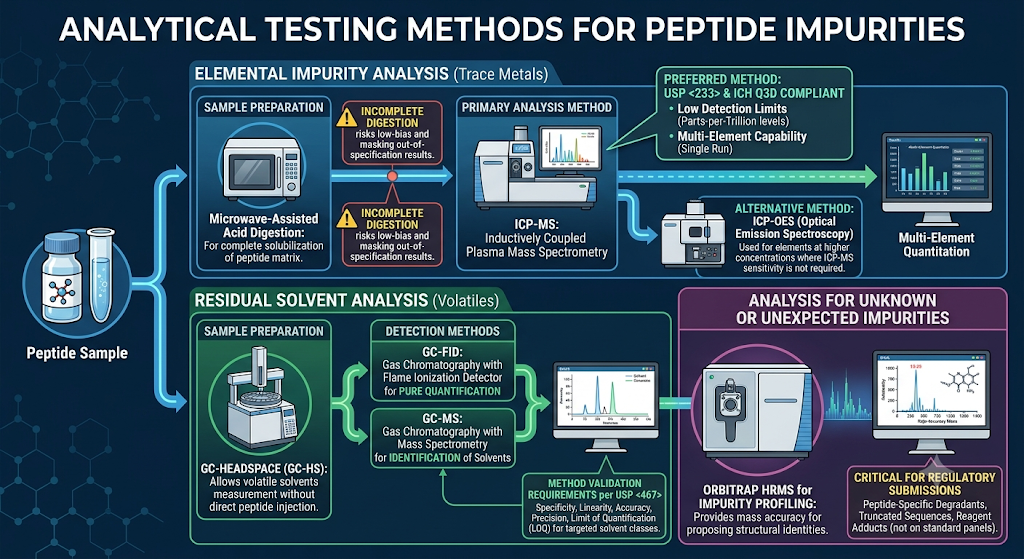
ICP-MS (Inductively Coupled Plasma Mass Spectrometry) is the primary method for elemental impurity testing because of its sensitivity down to parts-per-trillion levels, while GC with headspace sampling is the standard method for residual solvent quantification.
For elemental impurities:
- ICP-MS — the preferred method per USP <233> and ICH Q3D for its low detection limits and multi-element capability in a single run
- ICP-OES (Optical Emission Spectroscopy) — used for elements present at higher concentrations where ICP-MS sensitivity isn’t required
- Sample preparation typically involves microwave-assisted acid digestion to fully solubilize the peptide matrix before analysis, since incomplete digestion can bias results low and mask a true out-of-specification result
For residual solvents:
- GC-Headspace (GC-HS) — the standard approach per USP <467>, allowing volatile solvents to be measured without direct injection of the peptide sample
- GC-FID or GC-MS detection, depending on whether identification or pure quantification is the goal
- Method validation must address specificity, linearity, accuracy, precision, and limit of quantification for each targeted solvent class
For unknown or unexpected impurities: When a peptide batch shows an impurity peak that does not match any known elemental or solvent reference, high-resolution mass spectrometry becomes essential. Orbitrap HRMS for impurity profiling provides the mass accuracy needed to propose structural identities for these unknowns, which is often the difference between a stalled regulatory submission and a well-supported justification of an impurity’s origin and safety margin. This becomes especially important for peptide-specific degradants, truncated sequences, or reagent adducts that would never appear on a standard ICP-MS or GC-headspace panel.
5: What Does a Risk-Based Control Strategy Look Like?
A risk-based control strategy under ICH Q3D means not every batch is tested for every possible element — instead, testing is focused on elements with a realistic probability of occurring based on the specific synthesis route, equipment, and reagents used.
Building this strategy typically involves:
- Mapping every raw material, reagent, catalyst, and piece of process equipment against the ICH Q3D element list
- Assessing the probability of carryover into the final API based on process chemistry and purification steps
- Comparing worst-case exposure estimates against PDE limits for the intended route of administration
- Setting a routine testing panel that reflects genuine risk rather than a blanket “test everything” approach
- Building a defined escalation path for any unknown peak or unexpected result, so it can move directly into structural identification rather than sitting unresolved
- Periodically re-evaluating the risk assessment when raw material sources, equipment, or synthesis routes change
This approach is not just a cost-saving measure — regulators expect to see a documented, scientifically justified rationale behind which elements and solvents are tested routinely versus qualified once and monitored periodically. Sponsors that have gone through an unknown impurity identification ANDA case study understand firsthand how a well-built risk assessment, paired with a fast identification pathway, can prevent a single unresolved peak from delaying an entire filing timeline.
6: How Does This Testing Support Regulatory Submissions?
Elemental impurity and residual solvent data form a required part of the Quality module in ANDA, NDA, and IND submissions, and gaps in this data are a recurring source of regulatory deficiency letters for peptide API sponsors. Reviewers expect to see method validation data, a risk assessment aligned with ICH Q3D principles, and specification limits tied back to PDE values for the intended route of administration — oral, parenteral, or inhalation routes each carry different PDE thresholds for the same element.
For parenteral peptide products in particular, PDE limits are considerably tighter, which makes accurate quantification and a well-justified control strategy even more important at the specification-setting stage. This data does not exist in isolation — it forms one piece of a broader characterization package alongside identity, purity, and degradation data, and sponsors benefit from working with a partner offering comprehensive impurity characterization services that can connect elemental, solvent, and structural impurity findings into a single coherent regulatory narrative rather than a set of disconnected data tables.
Conclusion:
Elemental Impurities and Residual Solvents Testing for Synthetic Peptide APIs is not a checkbox exercise — it requires a genuine understanding of where contamination enters the SPPS and purification workflow, paired with sensitive analytical methods like ICP-MS, GC-headspace, and Orbitrap HRMS, and a risk-based strategy that regulators can trust. As peptide therapeutics continue to expand into more complex modalities and administration routes, sponsors that build this testing into their development program early, rather than retrofitting it before submission, tend to face far fewer delays during regulatory review.
Frequently Asked Questions:
Elemental impurities can originate from metal catalysts, raw materials, stainless steel manufacturing equipment, water systems, purification columns, and processing containers. Multi-step peptide synthesis increases the possibility of trace metal contamination throughout production. If not adequately controlled, these impurities may impact product quality and patient safety. A thorough risk assessment and routine testing help identify and control potential contamination sources in compliance with ICH Q3D.
Residual solvents are regulated under ICH Q3C, which classifies solvents based on their toxicity and establishes acceptable concentration limits. The guideline helps manufacturers assess solvent-related risks and determine suitable analytical testing strategies. Compliance with ICH Q3C ensures that residual solvents remaining after manufacturing do not pose safety concerns. It is a key requirement for global regulatory submissions.
ICP-MS is the preferred analytical technique because it offers extremely low detection limits, excellent sensitivity, and simultaneous analysis of multiple elements. It can accurately detect trace metals at parts-per-billion or even parts-per-trillion levels. The technique is highly reproducible and suitable for complex pharmaceutical matrices, making it widely accepted by regulatory authorities for ICH Q3D compliance.
Yes. Residual solvents can influence the chemical and physical stability of peptide APIs by affecting degradation pathways, crystallinity, moisture content, and polymorphic forms. Excess solvent residues may also alter product performance during storage. Routine residual solvent testing helps ensure product stability, quality, and compliance with ICH Q3C throughout the product lifecycle.
Testing frequency depends on the manufacturer’s risk assessment, process understanding, and regulatory requirements. During development and process validation, testing is generally performed more frequently to establish process capability. For commercial manufacturing, routine testing may be reduced if consistent process control has been demonstrated. Any significant process change should trigger a reassessment of the testing strategy.
The most commonly monitored metals include lead, cadmium, arsenic, mercury, palladium, platinum, nickel, cobalt, chromium, copper, vanadium, rhodium, ruthenium, iridium, and selenium. The specific elements tested depend on the manufacturing process, catalysts used, and raw material risk assessment. Manufacturers select relevant elements based on scientific justification rather than testing every metal routinely.
Reference
- Swietlow A, Lower A. A Holistic Quality Control Strategy for Peptide Active Pharmaceutical Ingredients (APIs).https://books.rsc.org/books/edited-volume/801/chapter/541861
- Li W, Chen Y, Zhang Z, Gao X, Guo X. Research progress on the impurities identification and determination in pharmaceuticals.https://www.authorea.com/doi/full/10.22541/au.168897593.33201685
- Janvier S, Cheyns K, Canfyn M, Goscinny S, De Spiegeleer B, Vanhee C, Deconinck E. Impurity profiling of the most frequently encountered falsified polypeptide drugs on the Belgian market. Talanta. 2018 Oct 1;188:795-807.https://www.sciencedirect.com/science/article/pii/S0039914018306283
- Ramamoorthy S. Impurity Characterization Across Drug Development Stages: Analytical Methodologies and Regulatory Perspectives. Pharmaceutical Research. 2026 Mar 3:1-22.https://link.springer.com/article/10.1007/s11095-026-04054-y
- Finotti Cordeiro C, Lopardi Franco L, Teixeira Carvalho D, Bonfilio R. Impurities in active pharmaceutical ingredients and drug products: A critical review. Critical Reviews in Analytical Chemistry. 2026 Jan 2;56(1):55-75.https://www.tandfonline.com/doi/abs/10.1080/10408347.2024.2384046
About the Author


