
Introduction
The adoption of the EMA Reflection Paper on a Tailored Clinical Approach introduces a modern regulatory strategy designed to reduce unnecessary clinical testing by prioritizing advanced bioanalytical characterization and clinical pharmacology. By shifting the primary focus of biosimilarity evaluation away from routine comparative Phase III clinical trials toward advanced analytical, functional, and pharmacokinetic (PK) assessments, the European Medicines Agency (EMA) provides biopharmaceutical developers with a more efficient pathway for demonstrating therapeutic equivalence. This tailored approach reflects decades of accumulated regulatory science and evidence, demonstrating that analytical characterization methods can detect structural and functional variations with substantially greater sensitivity than broad clinical efficacy endpoints.
Discover how comprehensive biosimilar characterization supports evidence-based assessments of structural and functional similarity.
Historically, biosimilar authorization followed a rigid, stepwise confirmation process that typically culminated in expensive Phase III Comparative Efficacy Studies (CES) involving hundreds of patients. However, decades of post-marketing surveillance and extensive clinical trial data indicate that comparative Phase III trials rarely reveal structural, functional, or clinical differences that have not already been identified through early analytical characterization. The EMA Reflection Paper on a Tailored Clinical Approach formalizes a science-based framework under which comparative clinical efficacy studies may routinely be waived, provided that sponsors establish analytical similarity, an identical primary structure, and equivalent clinical pharmacokinetics. This regulatory evolution enables biopharmaceutical sponsors to redirect resources toward comprehensive, high-resolution bioanalytical characterization at earlier development stages while substantially reducing overall development timelines and research and development (R&D) expenditure.
Review the role of biosimilar comparability studies in building a scientifically justified case for biosimilarity.
Share via:
Quick Summary:
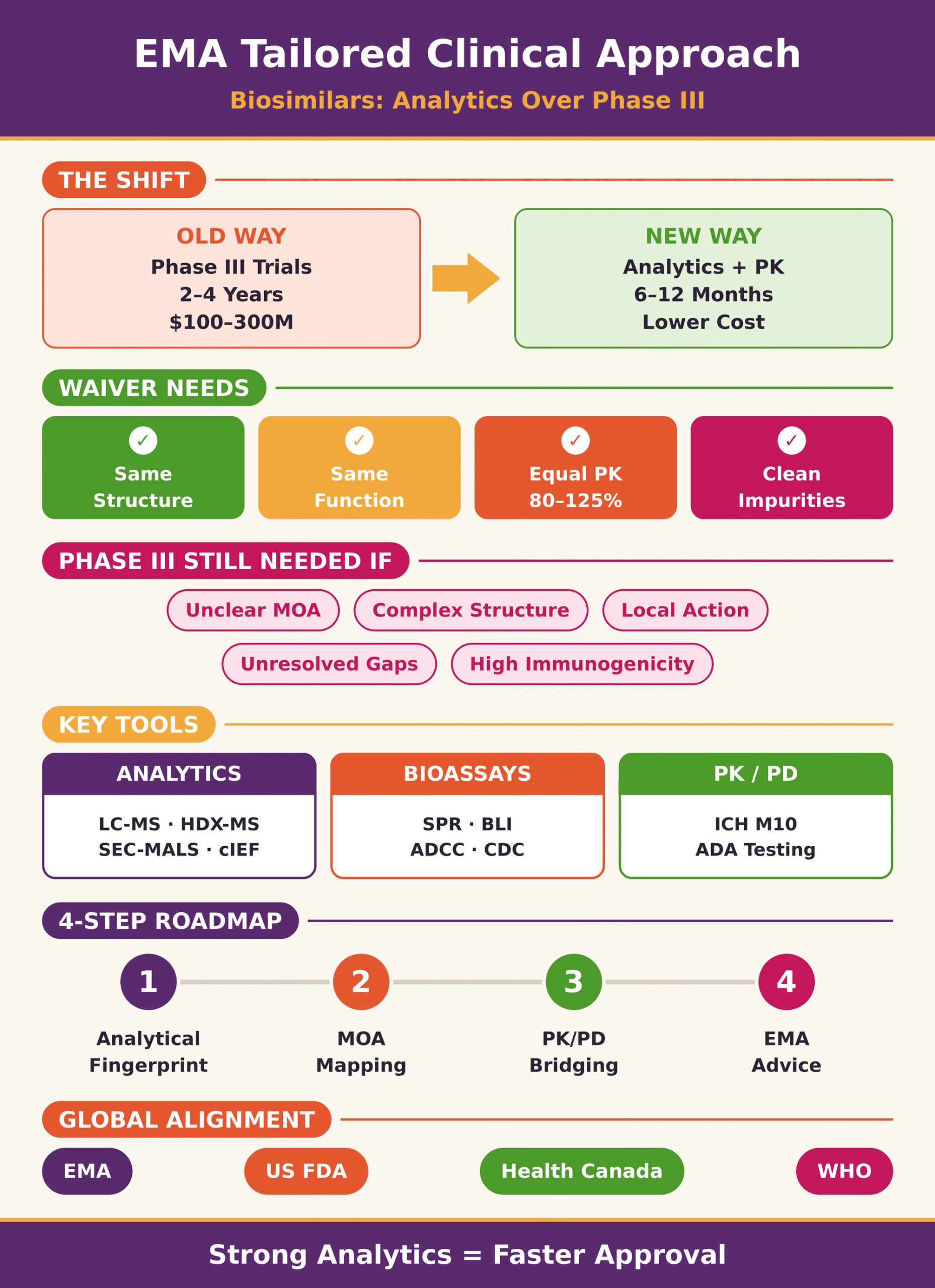
- Shift in approach: The EMA Reflection Paper (EMA/CHMP/BMWP/60916/2025) moves biosimilar evaluation away from routine Phase III comparative efficacy trials. The new basis is analytical characterization, functional assays and clinical pharmacokinetics, because these detect differences more sensitively than clinical endpoints.
- Major efficiency gains: Under the tailored pathway, clinical timelines can shrink from 2–4 years to about 6–12 months. Development costs (traditionally around $100–300 million) also drop substantially as resources move to early analytical work.
- Waiver prerequisites: To skip efficacy trials, sponsors must show four things. These are an identical primary structure and comparable higher-order structure, matching biological function across all mechanisms of action, PK bioequivalence within the 80–125% confidence range, and comparable impurity profiles.
- When Phase III is still required: Efficacy studies remain necessary if the mechanism of action is unclear or the product is highly heterogeneous. The same applies to locally acting products, unresolved quality differences, or high immunogenicity risk.
- Essential bioanalytical toolkit: Success depends on several complementary method types:
- orthogonal analytics such as LC-MS, HDX-MS, SEC-MALS and cIEF
- functional assays such as SPR, BLI, ADCC and CDC
- ICH M10-validated PK/PD assays with anti-drug antibody testing
- Four-stage roadmap: Developers should first do analytical fingerprinting, then map biological function and mechanism of action. Next comes clinical PK/PD and immunogenicity bridging, and finally alignment with the EMA through scientific advice before filing the marketing application.
- Global convergence: The FDA, Health Canada and WHO are moving in the same direction, so one integrated data package may support several markets. Sponsors should still confirm requirements specific to each jurisdiction.
Core Principles of the EMA Reflection Paper on a Tailored Clinical Approach
The fundamental principles of the EMA Reflection Paper on a Tailored Clinical Approach establish that high-resolution bioanalytical technologies and functional in vitro bioassays offer a more sensitive foundation for evaluating biosimilarity than traditional comparative clinical efficacy trials. Developed by the Committee for Medicinal Products for Human Use (CHMP) and the Biosimilar Medicinal Products Working Party (BMWP) under document reference EMA/CHMP/BMWP/60916/2025, this framework defines the scientific criteria for tailoring clinical development programs according to structural and functional comparability.
Comparative Phase III efficacy studies often rely on broad statistical equivalence margins and may be influenced by physiological variables, including differences in patient disease characteristics, background immunosuppressive therapies, and non-linear dose-response relationships. In contrast, physicochemical analytical platforms can accurately characterize primary sequence integrity, higher-order structures, post-translational modifications, and target-binding kinetics with exceptional precision. Consequently, the tailored framework shifts regulatory assessment away from empirical clinical observations toward a risk-based evaluation of Critical Quality Attributes (CQAs).
| Evaluation Parameter | Traditional Biosimilar Regulatory Pathway | Tailored Biosimilar Regulatory Pathway |
|---|---|---|
| Primary Basis of Similarity | Stepwise development culminating in Phase III clinical confirmation | Comprehensive analytical, functional, and clinical PK/PD profiling |
| Comparative Efficacy Studies (CES) | Generally required for complex biological therapeutics | Generally waived when comprehensive analytical and PK similarity is established |
| Clinical Timeline Duration | 2 to 4 years for multicenter, global Phase III trials | 6 to 12 months for single-dose or multiple-dose comparative PK/PD studies |
| Bioanalytical Focus | Standard characterization supporting progression into clinical development | Front-loaded, high-resolution, orthogonal analytical characterization |
| Development R&D Expense | High capital expenditure, approximately 100 million to 300 million, largely driven by clinical trials | Substantially reduced clinical expenditure, with resources redirected toward early analytical resolution |
| Regulatory Risk Evaluation | Residual uncertainty regarding clinical equivalence in patient populations | Critical Quality Attribute (CQA) matching and functional mechanism-based assessments |
When the physical, chemical, and functional characteristics of a biosimilar candidate fall within narrowly defined, prespecified similarity ranges established against the Reference Medicinal Product (RMP), residual clinical uncertainty can be minimized. Under these circumstances, comparative human pharmacokinetic (PK) studies, supplemented by relevant pharmacodynamic (PD) markers when available, provide the principal clinical evidence supporting biosimilarity.
Explore the importance of Critical Quality Attributes in biosimilars when defining analytical similarity criteria.
Prerequisites for Clinical Efficacy Waivers Under the Tailored Approach
To qualify for a waiver of comparative clinical efficacy studies, biosimilar candidates must demonstrate extensive analytical similarity, an identical primary amino acid sequence, comparable higher-order structures, well-characterized mechanisms of action, and equivalent clinical pharmacokinetic profiles. When these stringent scientific requirements are fulfilled, the available evidence may support reliable predictions of clinical efficacy and safety without the need for lengthy Phase III equivalence trials.
To justify omitting dedicated comparative clinical efficacy studies, biosimilar developers must prepare a comprehensive comparability dossier addressing several essential scientific domains:
Physicochemical Critical Quality Attributes (CQAs): The proposed biosimilar must demonstrate an identical primary amino acid sequence and comparable higher-order secondary, tertiary, and quaternary structures. Post-translational modification profiles, including N-glycosylation patterns (afucosylation, galactosylation, and high-mannose structures), C-terminal lysine truncation, charge variants (acidic and basic species), and size-exclusion aggregation profiles, must remain within narrow tolerance intervals established through the analysis of multiple reference product batches.
Learn how glycosylation analysis of biosimilars helps evaluate glycan profiles and their potential effects on biological activity.
Functional Bioassays and Mechanism of Action (MOA): Developers must establish biological similarity across all known primary and secondary mechanisms of action associated with the relevant therapeutic indications. For monoclonal antibodies (mAbs), this assessment requires characterization of target Fab binding kinetics, Fc receptor interactions (FcγR I, FcγR IIa, FcγR IIIa, FcRn, and C1q), and cell-based bioactivity assays, including Antibody-Dependent Cellular Cytotoxicity (ADCC), Complement-Dependent Cytotoxicity (CDC), and programmed cell death induction.
Comparative Pharmacokinetics (PK) and Pharmacodynamics (PD): A clinical PK study in a sensitive population, typically healthy adult volunteers or an appropriate stable patient population, is required. Key pharmacokinetic parameters, including the area under the concentration-time curve (AUC0-inf and AUC0-t) and maximum serum concentration (Cmax), must demonstrate bioequivalence within the standard 90% confidence interval range of 80.00% to 125.00%. Where suitable pharmacodynamic biomarkers are available, such as absolute neutrophil count for filgrastim, PD bioequivalence must also be demonstrated.
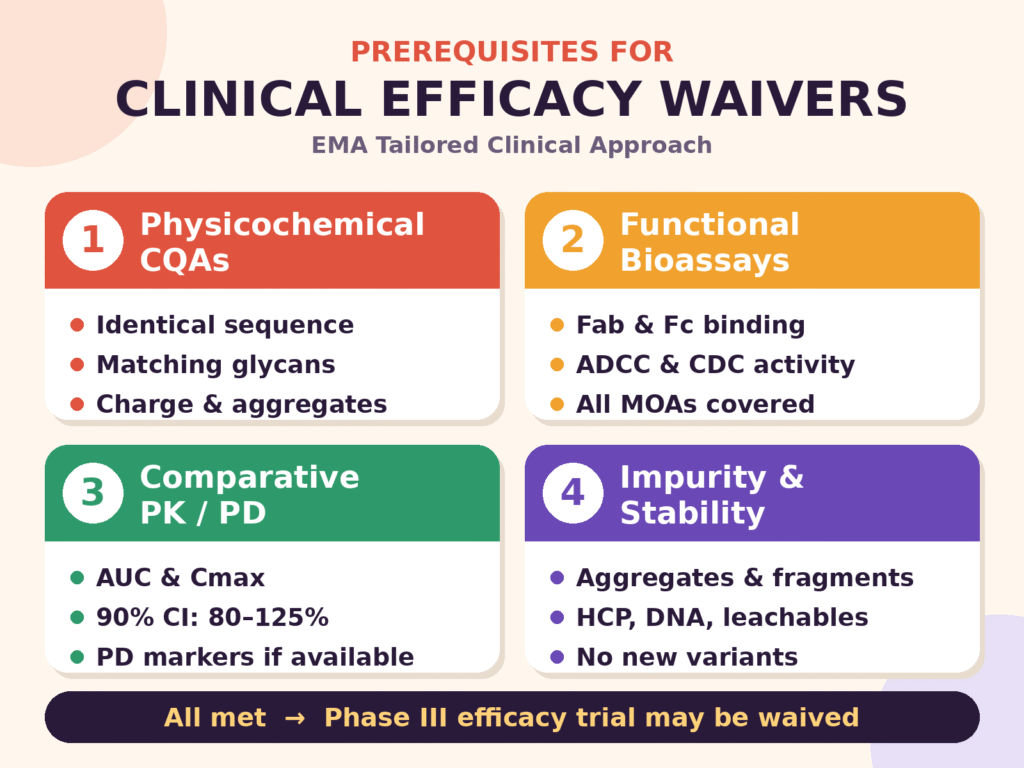
Impurity and Stability Profiles: Comprehensive quantification of product-related impurities, including aggregates and fragments, and process-related impurities, such as host cell proteins, host cell DNA, and leachables, is necessary. Manufacturing process changes that introduce previously unidentified impurity species or structural variants may prevent an upfront clinical waiver until the resulting differences have been adequately characterized and resolved through analytical investigations.
Examine approaches to impurity profiling of biosimilars to strengthen impurity identification and comparative quality assessments.
Scenarios Where Comparative Clinical Efficacy Studies Remain Mandatory
Comparative clinical efficacy studies may remain necessary when a biosimilar candidate has an incompletely understood mechanism of action, substantial intrinsic structural heterogeneity, a local route of administration that prevents meaningful systemic PK evaluation, or unresolved analytical differences. In these circumstances, clinical endpoints may be required to determine whether the observed quality differences affect safety or therapeutic performance.
Although the tailored framework is relevant to many recombinant proteins and monoclonal antibodies, certain biological drug classes and manufacturing outcomes present analytical or physiological limitations that prevent regulators from relying exclusively on laboratory characterization.
| Disqualifying Scenario Category | Specific Clinical or Bioanalytical Condition | Scientific Rationale for Mandatory Efficacy Studies |
|---|---|---|
| Uncertain Mechanism of Action | Complex biologics, novel multispecific formats, or poorly understood primary or secondary MOAs | In vitro functional assays may not fully predict complex in vivo signaling pathways across multiple indications. |
| High Structural Heterogeneity | Heavily glycosylated proteins, complex natural extracts, or polydisperse macromolecules | Existing analytical technologies may not completely resolve or quantify every clinically relevant microheterogeneity. |
| Local Site of Action | Locally administered biologics, such as intraocular, intrathecal, or topical products | Systemic PK measurements may not adequately represent local tissue concentrations, target engagement, or localized immunogenicity. |
| Unresolved Quality Variances | Differences in critical quality attributes or novel process-related impurity profiles | Structural discrepancies may introduce risks related to safety, neutralizing immunogenicity, or biological potency that cannot yet be quantified adequately. |
| High Immunogenicity Impact | Products in which anti-drug antibodies (ADAs) cause substantial clinical neutralization or cross-reactive toxicity | Single-dose PK studies may not adequately characterize chronic immunogenicity patterns and their associated safety consequences. |
When analytical or functional differences are identified between a proposed biosimilar and its reference product, sponsors cannot rely exclusively on the historical clinical experience associated with the reference medicine. If high-throughput bioassays and other appropriate analytical methods cannot scientifically establish that a discrepancy is clinically irrelevant, a targeted clinical study may be necessary to address the specific remaining uncertainty. The design of such a study should correspond directly to the nature and potential clinical consequences of the identified difference.
Understand how forced degradation studies for biosimilars can help investigate degradation-related changes and their implications for product quality.
Strategic Bioanalytical Imperatives Under the EMA Reflection Paper on a Tailored Clinical Approach
Implementing the EMA Reflection Paper on a Tailored Clinical Approach successfully requires an integrated bioanalytical strategy that prioritizes high-resolution structural characterization, comprehensive functional assay panels, and validated PK/PD bioanalysis early in development. Biosimilar developers must assemble a coherent body of evidence using complementary analytical techniques to justify requests for waivers of comparative clinical trials to regulatory authorities.
Orthogonal Analytical Characterization
Orthogonal characterization involves applying complementary analytical methods to independently evaluate critical quality attributes, including higher-order structures and microheterogeneity. Depending on a single analytical technique is insufficient to establish a comprehensive similarity profile or support a clinical waiver. Instead, sponsors should implement a broad and scientifically justified analytical testing program covering the following areas:
Primary and Secondary Structure: Intact and subunit mass spectrometry (LC-MS), peptide mapping using tandem mass spectrometry (LC-MS/MS), hydrogen-deuterium exchange mass spectrometry (HDX-MS), and circular dichroism (CD) should be used to characterize the molecular structure and identify potential differences between the biosimilar candidate and the reference product.
See how intact mass analysis for biosimilars supports molecular mass confirmation and the investigation of structural differences.
Glycosylation Profiling: Hydrophilic interaction liquid chromatography with fluorescence detection (HILIC-FLD-MS) can support released glycan analysis, sialic acid quantification, and core fucosylation mapping. These assessments help establish whether glycosylation patterns are comparable and whether any differences could affect biological activity, pharmacokinetics, or immunogenicity.
Aggregation and Size Heterogeneity: Analytical ultracentrifugation using sedimentation velocity (AUC-SV), size-exclusion chromatography coupled with multi-angle light scattering (SEC-MALS), and asymmetric flow field-flow fractionation (AF4) provide complementary information about molecular size distributions, aggregation, and other forms of size heterogeneity.
Review methods for aggregation analysis in biosimilars to understand how size-related variants can be assessed during comparability testing.
Charge Heterogeneity: High-performance cation exchange chromatography (CEX-HPLC) and capillary isoelectric focusing (cIEF) can be used to characterize acidic and basic variants and assess charge heterogeneity. These techniques help identify differences arising from post-translational modifications, degradation, or manufacturing-related variations.
xplore charge variant analysis using mass spectrometry to investigate molecular heterogeneity and its potential relevance to product comparability.
Functional and Kinetic Affinity Bioassays
Functional bioassays are essential for evaluating biological activity and target-engagement kinetics across all relevant primary and secondary mechanisms of action. These assays should quantitatively assess target affinity and biological potency using techniques such as surface plasmon resonance (SPR), bio-layer interferometry (BLI), kinetic exclusion assays, and cell-based reporter-gene assays.
Binding kinetic parameters (kon, koff, and KD) for target antigens and Fc receptors, including FcγRIIIa and FcRn, should demonstrate close comparability with the reference standard across multiple manufacturing lots. Evaluating these parameters helps establish whether molecular interactions and functional responses remain consistent between the biosimilar candidate and the reference product. Where relevant, additional mechanism-specific assays should be incorporated to ensure that all clinically meaningful biological activities are adequately assessed.
Integrated Clinical PK/PD and Bioanalytical Validation
Clinical pharmacokinetic and pharmacodynamic assays must be validated in accordance with ICH M10 guidelines to support reliable measurements of systemic exposure and appropriate immunogenicity monitoring. Ligand Binding Assays (LBA) and LC-MS/MS bioanalytical methods should demonstrate adequate sensitivity, precision, selectivity, minimal matrix effects, and appropriate performance in the presence of potential target interference.
Comparative clinical PK studies should also incorporate a suitable anti-drug antibody (ADA) assessment strategy, including screening assays, confirmatory testing, and neutralizing antibody (NAb) assays when appropriate. These assessments help determine whether treatment-emergent immunogenicity could influence PK clearance profiles or complicate the interpretation of comparative pharmacokinetic results.
Consider an end-to-end biosimilar analytical package for regulatory submissions to coordinate analytical characterization and supporting evidence into a comprehensive dossier.
Step-by-Step Risk Assessment for Developers
Biosimilar developers should implement a structured, four-stage, risk-based framework to assess analytical similarity, clarify mechanisms of action, and establish PK/PD comparability before requesting regulatory waivers. Applying a systematic risk-assessment process allows sponsors to identify, investigate, and resolve analytical differences early in development, reducing the likelihood of unexpected regulatory concerns during later stages.
Stage 1: Analytical Fingerprinting: Perform comprehensive physicochemical characterization using multiple batches of both the proposed biosimilar and the reference product. Assess structural differences against predefined analytical similarity acceptance criteria and determine whether any observed variations require further investigation.
Stage 2: Biological Function and MOA Mapping: Evaluate biological activity across all relevant clinical indications and map the known primary and secondary mechanisms of action. If the relevant target mechanisms are sufficiently understood and can be reliably measured through appropriate in vitro assays, proceed toward designing the comparative clinical PK study.
Stage 3: Clinical PK/PD and Immunogenicity Bridging: Conduct an appropriate comparative PK study in healthy subjects or patients, depending on the product and study requirements. Incorporate sensitive pharmacodynamic markers where available and implement robust ADA bioanalysis to assess potential immunogenicity-related effects on pharmacokinetics and study interpretation.
Stage 4: EMA Scientific Advice Alignment: Submit the analytical, functional, and PK bridging evidence to the EMA through the scientific advice procedure. Seek regulatory feedback on the proposed clinical development strategy, including the scientific justification for omitting comparative Phase III efficacy studies, before filing the Marketing Authorization Application (MAA).
Global Alignment and Strategic Outlook for Developers
Increasing regulatory alignment among the EMA, US FDA, Health Canada, and the World Health Organization (WHO) is helping establish a more consistent international approach to clinical efficacy waivers. This convergence allows biopharmaceutical developers to plan integrated analytical and clinical PK packages that may support submissions across multiple jurisdictions while reducing unnecessary duplication of studies.
Historically, differences in regulatory expectations required biosimilar developers to conduct additional Phase III trials to satisfy the requirements of individual national authorities. The growing adoption of tailored clinical development frameworks is helping harmonize these expectations and promote more efficient evidence-generation strategies.
Health Canada: Health Canada’s evolving biosimilar regulatory framework reduces reliance on routine comparative clinical efficacy trials when the available evidence supports such an approach. This direction is consistent with the broader regulatory shift toward analytical comparability and clinical pharmacology as the foundation of biosimilarity assessment.
US Food and Drug Administration (FDA): The FDA has increasingly emphasized the importance of analytical similarity and comparative clinical pharmacology, including pharmacokinetic and pharmacodynamic (PK/PD) assessments, when determining the need for comparative clinical efficacy studies. The extent of clinical evidence required depends on the product-specific scientific justification and the remaining uncertainties.
World Health Organization (WHO): Updated WHO guidance on biosimilar evaluation supports a more scientifically justified approach to nonclinical and clinical requirements. When sufficient analytical comparability has been established, routine animal studies and certain comparative clinical investigations may be unnecessary, depending on the product and the applicable guidance.
This growing international alignment can reduce development barriers, accelerate market entry, lower R&D expenditure, and improve patient access to advanced biotherapeutics. For developers, the strategic priority is to establish a robust analytical foundation early, demonstrate functional comparability, and generate clinical pharmacology evidence that directly addresses any remaining uncertainty. Nevertheless, sponsors must account for jurisdiction-specific requirements and obtain appropriate regulatory feedback before assuming that a clinical study waiver will be accepted across all markets.
Conclusion
The EMA Reflection Paper on a Tailored Clinical Approach represents a significant evolution in biosimilar development by placing greater emphasis on high-resolution analytical characterization and clinical pharmacology rather than routinely requiring Phase III clinical trials. By prioritizing advanced physicochemical testing, comprehensive functional bioassays, and validated PK/PD bioanalysis, this framework enables developers to build a stronger scientific case for biosimilarity, potentially shorten development timelines, and reduce R&D expenditure. The need for comparative clinical efficacy studies can then be determined according to the specific characteristics of the product and the level of residual scientific uncertainty.
Strengthen your biosimilar development strategy with specialized biosimilar characterization services that support comprehensive analytical assessment and comparability investigations.
Successfully navigating this streamlined regulatory pathway requires substantial bioanalytical expertise, access to orthogonal testing technologies, and compliance with applicable standards, including ICH M10. Biopharmaceutical organizations seeking to optimize biosimilar development programs through advanced bioanalytical characterization and regulatory strategy can connect with experienced specialists through the contact page to discuss their analytical testing and development requirements.
Frequently Asked Questions
The tailored approach moves away from routinely requiring Phase III comparative efficacy studies for every biosimilar candidate. Instead, regulators assess whether comprehensive analytical characterization, functional testing, and comparative clinical pharmacology provide sufficient evidence to establish biosimilarity, with additional clinical studies considered when uncertainties remain.
Developers need complementary analytical technologies, including high-resolution mass spectrometry (LC-MS/MS and HDX-MS), size-exclusion chromatography with light scattering (SEC-MALS), capillary isoelectric focusing (cIEF), surface plasmon resonance (SPR), and cell-based bioassays. Validated bioanalytical methods compliant with ICH M10 are also essential for reliable clinical PK measurements and immunogenicity assessments.
Immunogenicity is assessed using appropriate anti-drug antibody (ADA) screening and confirmatory methods, together with neutralizing antibody (NAb) assays when relevant. These assessments help determine whether immune responses could influence pharmacokinetics, treatment safety, or biological activity, supporting a scientifically justified decision about the need for further clinical investigations.
Yes, a waiver may be possible for complex monoclonal antibodies when comprehensive evidence establishes similarity across all relevant primary and secondary mechanisms of action. This includes Fab binding, \(Fc\gamma R\) engagement, Antibody-Dependent Cellular Cytotoxicity (ADCC), and Complement-Dependent Cytotoxicity (CDC), supported by suitable analytical and functional comparisons.
Pharmacodynamic markers provide additional evidence of biological activity when they reliably reflect the mechanism of action of the medicine. Demonstrating comparable PD responses alongside pharmacokinetic similarity can strengthen the justification for waiving comparative clinical efficacy studies, provided that the selected biomarkers are sufficiently sensitive and relevant to the product.
The EMA framework reflects a broader regulatory shift toward analytical characterization and comparative clinical pharmacology as central components of biosimilar evaluation. Health Canada and the US FDA have also adopted approaches that support reducing unnecessary comparative efficacy testing when scientifically justified, although specific requirements may differ between jurisdictions.
Developers should consider seeking EMA Scientific Advice once they have generated substantial analytical comparability data, completed relevant functional assessments, and established a proposed clinical PK/PD strategy. Early regulatory consultation can help identify evidence gaps and clarify whether the proposed justification for omitting comparative efficacy studies is appropriate before the Marketing Authorization Application (MAA) is submitted.
A waiver may be difficult to justify when the mechanism of action is poorly understood, structural heterogeneity cannot be adequately characterized, or the local site of action prevents meaningful systemic PK assessment. Unresolved differences in Critical Quality Attributes (CQAs), potentially significant impurity variations, or remaining safety concerns may also require additional targeted clinical investigations.
Indication extrapolation allows a biosimilar to be authorized for additional indications of the reference product without conducting separate clinical efficacy trials in every patient population. This decision requires a comprehensive assessment of analytical similarity, relevant mechanisms of action, functional activity, safety, and immunogenicity, together with scientific justification that any differences do not affect the proposed indications.
Reference:
- European Medicines Agency. (2026, March 16). Reflection paper on a tailored clinical approach in biosimilar development. https://www.ema.europa.eu/en/scientific-guidelines/reflection-paper-tailored-clinical-approach-biosimilar-development
- European Medicines Agency. (2026, March 16). Reflection paper on a tailored clinical approach in biosimilar development (EMA/CHMP/BMWP/60916/2025). https://www.ema.europa.eu/en/documents/other/reflection-paper-tailored-clinical-approach-biosimilar-development_en.pdf-0
- Schiestl, M., Ranganna, G., Watson, K., Jung, B., Roth, K., Capsius, B., Trieb, M., Bias, P., & Maréchal-Jamil, J. (2020). The path towards a tailored clinical biosimilar development. BioDrugs, 34(3), 297–306. https://doi.org/10.1007/s40259-020-00422-1
- Guillen, E., Barry, S., Jost, N., Ekman, N., Knippel, V., Kuhlmann-Gottke, J., Maier, J., Weise, M., Laslop, A., Anour, R., van Zandbergen, G., & Kirsch-Stefan, N. (2025). The tailored biosimilar approach: Expectations and requirements. Drugs, 85(5), 601–608. https://doi.org/10.1007/s40265-025-02168-y
Get In Touch With Us
About The Author