

Introduction to Encapsulating Hydrophilic vs Hydrophobic APIs in PLGA
The development of clinically successful long-acting parenteral formulations depends on aligning the solubility characteristics of the therapeutic payload with the thermodynamic behavior of the polymer matrix. Encapsulating hydrophilic vs hydrophobic APIs in PLGA requires fundamentally different emulsion structures, solvent systems, and stabilization approaches to minimize premature drug release while preserving therapeutic activity. Poly(lactic-co-glycolic acid) (PLGA) is a clinically approved and highly adaptable biodegradable copolymer composed of lactic acid and glycolic acid monomers.
Because PLGA undergoes in vivo degradation through the hydrolytic cleavage of ester bonds, producing non-toxic and metabolizable lactic acid and glycolic acid monomers that are subsequently eliminated through the Krebs cycle, it has become the gold-standard carrier system for sustained drug delivery applications.
Despite its widespread use, successful formulation requires careful consideration of the significant physicochemical differences between water-soluble (hydrophilic) and water-insoluble (hydrophobic) active pharmaceutical ingredients (APIs). Hydrophobic compounds exhibit an inherent thermodynamic compatibility with PLGA, whereas hydrophilic peptides, proteins, and small-molecule salts present substantial challenges for stable incorporation within the lipophilic polymer matrix. Formulation programs characterized at ResolveMass Laboratories Inc. demonstrate that achieving prolonged and predictable sustained release requires systematic optimization of polymer physicochemistry, interfacial behavior, and solvent extraction dynamics.
To learn more about standard and customized analytical frameworks for long-acting drug products, visit PLGA Long-Acting Injectable Formulation.
Article Summary:
- PLGA is widely used for long-acting drug delivery, but formulation strategies differ significantly depending on whether the API is hydrophilic or hydrophobic.
- Hydrophobic APIs are easier to encapsulate because they are more compatible with the PLGA matrix, resulting in higher drug loading, better retention, and lower burst release.
- Hydrophilic APIs present greater formulation challenges, as they tend to diffuse into the aqueous phase during processing, reducing encapsulation efficiency and increasing early drug leakage.
- Solvent selection and PLGA properties such as molecular weight, lactide:glycolide ratio, and end-group chemistry strongly influence particle structure, degradation rate, and release behavior.
- Encapsulation methods must be matched to API solubility, with single-emulsion techniques preferred for hydrophobic drugs and double-emulsion or coacervation methods commonly used for hydrophilic molecules.
- Drug release profiles differ substantially, with hydrophobic compounds typically showing controlled diffusion-driven release, while hydrophilic compounds often exhibit faster release and higher burst effects.
- Process optimization and stabilization strategies, including microfluidics, pH modifiers, and anti-acylation additives, are critical for improving the performance and stability of peptide and protein formulations.
Thermodynamic Barriers and Phase Separation when Encapsulating Hydrophilic vs Hydrophobic APIs in PLGA
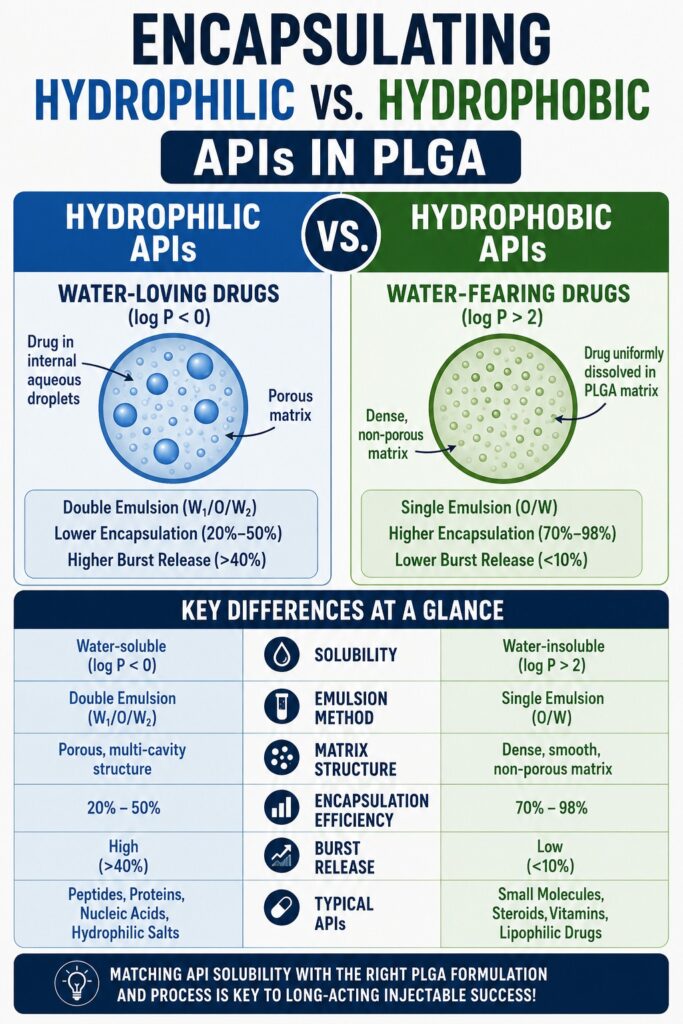
The fundamental thermodynamic distinction between these two categories of drugs arises from their partition coefficients (log P), which determine whether a molecule remains localized within the organic polymer droplet or migrates into the surrounding aqueous phase. Successfully encapsulating hydrophilic vs hydrophobic APIs in PLGA requires overcoming these partitioning tendencies to achieve high drug loading and homogeneous matrix entrapment.
The free energy of mixing governs the structural uniformity of the final formulation. Hydrophobic drugs, which typically exhibit partition coefficients (log P > 2), readily dissolve alongside PLGA in commonly used water-immiscible organic solvents such as dichloromethane (DCM). This creates a homogeneous organic phase in which drug molecules and polymer chains remain highly miscible and physically intertwined.
In contrast, hydrophilic compounds with negative or very low partition coefficients (log P < 0) are thermodynamically incompatible with the organic polymer phase. When introduced through a primary water-in-oil (W₁/O) emulsion, these molecules remain confined within internal aqueous droplets dispersed throughout the organic phase. After this primary emulsion is transferred into an external continuous aqueous phase (W₂), a strong chemical potential gradient drives the water-soluble drug molecules outward.
This outward diffusion occurs rapidly across the oil-water interface before complete polymer solidification can occur, leading to reduced encapsulation efficiency and accumulation of drug at the microparticle surface.
Solvation Kinetics and Interfacial Partitioning of Encapsulating Hydrophilic vs Hydrophobic APIs in PLGA
Interfacial partitioning is governed by both the rate of solvent extraction into the continuous phase and the relative affinity of the drug for aqueous versus organic environments. When encapsulating hydrophilic vs hydrophobic APIs in PLGA, hydrophobic compounds (log P > 2) generally remain stably dissolved during gradual polymer precipitation, whereas hydrophilic compounds (log P < 0) rapidly diffuse into the aqueous boundary layer.
The choice of organic solvent strongly influences these interfacial processes. Commonly used formulation solvents and their characteristics include:
Dichloromethane (DCM)
A highly volatile and water-immiscible solvent with very low water solubility (1.3% w/v). DCM exits the organic phase gradually, enabling controlled and uniform PLGA precipitation that is highly favorable for retaining hydrophobic APIs.
Ethyl Acetate (EA)
Ethyl acetate possesses significantly greater water solubility (8.7% w/v), promoting rapid solvent extraction into the aqueous phase. Although this rapid exchange often produces smaller nanoparticles, it may also accelerate migration of water-soluble drugs toward the interface if polymer hardening is not sufficiently fast.
Acetone and Acetonitrile
These water-miscible solvents are frequently employed in nanoprecipitation processes. Upon introduction into an aqueous environment, they diffuse almost instantaneously, causing rapid polymer desolvation. When hydrophilic APIs are present, this rapid solvent exchange frequently results in drug loss to the aqueous bulk phase, producing extremely low encapsulation efficiencies.
For a detailed analysis of solvent extraction, interface stability, and processing bottlenecks, view Challenges in PLGA Microsphere Development.
Critical Polymer Attributes and Their Effects on Encapsulating Hydrophilic vs Hydrophobic APIs in PLGA
Polymer characteristics such as lactide-to-glycolide (LA) ratio, molecular weight, and sequence distribution directly influence hydration behavior and matrix stability. Selecting the appropriate PLGA grade allows formulators to regulate water penetration and tailor release mechanisms according to the solubility profile of the encapsulated drug.
PLGA’s physical and mechanical behavior is determined by both chemical composition and stereochemistry. Poly(lactic acid) (PLA) contains a methyl side group that sterically restricts water penetration, making it highly hydrophobic. Poly(glycolic acid) (PGA), on the other hand, lacks this methyl group and therefore exhibits greater crystallinity and hydrophilicity. Copolymerization of these monomers allows precise control over degradation kinetics.
Amorphous Nature
PLGA copolymers containing less than 70% polyglycolide are generally amorphous and exhibit glass transition temperatures (Tg) between 45°C and 55°C. Since these values exceed physiological temperature (37°C), the polymer remains in a rigid glassy state that effectively restricts premature drug diffusion.
Erosion Kinetics
A 50:50 LA ratio degrades most rapidly because it maximizes water uptake within amorphous regions, typically degrading within 3 to 4 weeks. Increasing the lactide content to ratios such as 75:25 or 85:15 decreases water penetration and extends drug release over several months.
To evaluate the structural differences, hydration properties, and degradation profiles of common polyesters, see PLA vs PLGA vs PCL.
Sequence Distribution and Molecular Weight Distribution (MWD)
Beyond monomer composition alone, sequence distribution and polydispersity index (PDI) significantly affect performance. Analytical studies conducted at ResolveMass Laboratories Inc. indicate that generic PLGA grades often display broader molecular weight distributions (for example, PDI ≈ 1.8) compared with Reference Listed Drug (RLD) polymers (for example, PDI ≈ 1.4).
A greater proportion of low-molecular-weight chains (<5 kDa) accelerates water ingress, promotes autocatalytic ester hydrolysis, and contributes to premature matrix degradation.
Learn how molecular weight distribution impacts drug delivery performance at PLGA PDI Pharmaceutical.
Polymer End-Group Chemistry and Charge Interactions in Encapsulating Hydrophilic vs Hydrophobic APIs in PLGA
Polymer end-group chemistry plays a critical role in determining matrix hydrophilicity, swelling behavior, and charge interactions. Acid-terminated grades accelerate water uptake, whereas ester-capped grades provide enhanced resistance to hydration and swelling.
When encapsulating hydrophilic vs hydrophobic APIs in PLGA, acid-terminated copolymers can electrostatically attract positively charged peptides, thereby enhancing loading efficiency. However, these same polymers also accelerate hydrolytic degradation. Ester-capped polymers, by contrast, reduce early water ingress and provide greater resistance to burst release.
Acid-Terminated PLGA
Acid-terminated PLGA contains free hydrophilic carboxylic acid groups (-COOH). These polar functionalities promote water uptake and lower local pH during the initial hydration stage, which may trigger pronounced burst release of encapsulated hydrophilic compounds.
At the same time, ionized carboxyl groups carry a negative charge and can establish strong electrostatic interactions with positively charged peptides such as octreotide. These interactions help retain peptides within the organic phase and significantly improve encapsulation efficiency.
Ester-Terminated PLGA
Ester-capped PLGA contains alkyl ester end groups, commonly ethyl esters (-COOC₂H₅), which make the polymer more hydrophobic and less susceptible to swelling and premature hydration.
In a naltrexone microsphere development program characterized at ResolveMass Laboratories Inc., replacing an acid-capped polymer with an ester-capped polymer of identical composition (50:50 ratio, 25 kDa) reduced 24-hour burst release from 21.3% to 13.8%. Increasing the molecular weight further to 45 kDa reduced burst release to 9.1%.
Primary Processing Methodologies for Encapsulating Hydrophilic vs Hydrophobic APIs in PLGA
The optimal microencapsulation method is largely determined by API solubility. Hydrophobic compounds are generally formulated using single-emulsion oil-in-water (O/W) systems, while hydrophilic molecules often require double-emulsion (W/O/W), solid-in-oil-in-water (S/O/W), or coacervation-based techniques.
The selected manufacturing route determines the spatial distribution of the drug, matrix porosity, and final encapsulation efficiency.
Comparative Process Overview
Single Emulsion (O/W) Method
- API Compatibility: Hydrophobic drugs (log P > 2)
- Organic Solvents: DCM, Chloroform
- Stabilizers: PVA (0.5%–2.0% w/v), TPGS
- Encapsulation Efficiency: 70%–98%
- Morphology: Dense, smooth, non-porous matrix
- Common Failures: Solvent residues, particle aggregation
Double Emulsion (W₁/O/W₂) Method
- API Compatibility: Hydrophilic drugs, peptides, proteins
- Organic Solvents: DCM, Ethyl Acetate
- Stabilizers: PVA, BSA (1%–3% w/v)
- Encapsulation Efficiency: 20%–50%
- Morphology: Highly porous, multi-cavity structures
- Common Failures: Burst release and drug leakage
Solid-in-Oil-in-Water (S/O/W) Method
- API Compatibility: Highly hydrophilic salts (e.g., Amoxicillin)
- Organic Solvents: DCM, Acetonitrile
- Stabilizers: Surfactant-coated API dispersions
- Encapsulation Efficiency: 60%–85%
- Morphology: Moderately dense, micro-channeled structures
- Common Failures: Micronization limitations and surfactant toxicity
For insights into selecting processing stabilizers and surfactants to control droplet size, read Surfactants and Emulsifiers in PLGA Microsphere Fabrication.
Coacervation / Phase Separation
- API Compatibility: Peptides, proteins, vaccines
- Organic Solvents: DCM, Acetonitrile
- Stabilizers: Light mineral oil, lecithin (0.25%)
- Encapsulation Efficiency: 70%–95%
- Morphology: Smooth shell with variable internal voids
- Common Failures: Alkane residue toxicity and agglomeration
To review formulation design principles and process controls for phase-separated systems, read PLGA Depot Formulation.
Nanoprecipitation / Solvent Displacement
- API Compatibility: Primarily hydrophobic compounds
- Organic Solvents: Acetone, DMSO, DMF
- Stabilizers: PVA, Poloxamer 188 (2%)
- Encapsulation Efficiency: Low for hydrophilic compounds and moderate for hydrophobic compounds
- Morphology: Small submicron particles with low porosity
- Common Failures: Low yield and excessive API loss
Emulsion and Phase Solidification Kinetics of Encapsulating Hydrophilic vs Hydrophobic APIs in PLGA
Polymer shell formation is controlled by solvent extraction and evaporation rates, which ultimately determine matrix density and surface morphology. When encapsulating hydrophilic vs hydrophobic APIs in PLGA, slow solvent extraction promotes the formation of dense, non-porous matrices, while rapid solvent removal can trap water-soluble molecules near the particle surface, creating porous channels and structural defects.
The coacervation process follows three primary stages:
1. Phase Separation of the Coating Polymer
Controlled addition of an incompatible non-solvent such as silicone oil (200, 500, or 1000 mPas viscosity) to the PLGA-drug solution reduces polymer solubility and induces phase separation. Desolvation studies involving PLGA 50:50 have identified four distinct stages, with stage 3 representing the optimal stability window for controlled coacervate formation.
2. Adsorption of the Coacervate Around the Drug Phase
The desolvated PLGA droplets adsorb onto suspended drug particles and uniformly coat their surfaces.
3. Solidification and Quenching
The soft microparticles are transferred into a hardening bath containing heptane or hexane. These solvents efficiently extract DCM and silicone oil while promoting particle hardening. The extraction process must be carefully balanced to prevent structural collapse or retention of residual alkane solvents.
Coacervation Process Flow
[ Polymer + API in DCM ]
↓ Add Silicone Oil (Non-solvent)
[ Phase Separation ]
↓ Adsorption
[ Coacervate Coating of API Particles ]
↓ Transfer to Heptane Bath
[ Solidification ]
By comparison, spray drying relies on atomized droplets exposed to heated air. During solvent evaporation, hydrophilic compounds migrate toward the particle surface due to thermodynamic driving forces. This results in surface enrichment of hydrophilic APIs, increased pore formation, and elevated burst release following administration.
Mass Transport and Drug Release Profiles of Encapsulating Hydrophilic vs Hydrophobic APIs in PLGA
Drug transport from PLGA systems follows distinct release mechanisms depending on drug solubility and matrix structure. Hydrophobic compounds are generally released through gradual diffusion and polymer erosion, whereas hydrophilic compounds migrate through interconnected water-filled pores.
Phase 1: Hydration and Initial Release (Burst Phase)
Hydrophobic APIs
Release is governed by slow surface dissolution, resulting in minimal burst release (<10%) due to limited surface accumulation.
Hydrophilic APIs
Rapid dissolution of surface-localized drug and immediate water penetration often produces burst release exceeding 40%.
Phase 2: Hydration Lag Period
Hydrophobic APIs
The dense, glassy polymer matrix (Tg > 37°C) remains intact, resulting in negligible release.
Hydrophilic APIs
Diffusion continues through water-filled microcavities, with release rates governed by pore tortuosity.
Phase 3: Bulk Erosion and Accelerated Release
Hydrophobic APIs
Bulk ester hydrolysis lowers polymer molecular weight, increasing matrix permeability and accelerating diffusion.
Hydrophilic APIs
Accumulation of acidic oligomers generates osmotic pressure, causing matrix swelling. Once interconnected pore networks form, rapid release of the remaining drug cargo can occur.
The degradation kinetics may be represented as:
Hydrolytic Cleavage Rate:
-d(MW)/dt = k[H₂O][H⁺]
As molecular weight declines, chain entanglement decreases and mechanical integrity is progressively lost. Simultaneously, formation of hydrophilic oligomers containing -COOH and -OH groups increases osmotic pressure and promotes further water uptake.
Once a critical molecular weight threshold is reached, microparticle swelling accelerates drug mobility. In vivo, surrounding tissues and hydrogel environments may physically restrict swelling, resulting in slower release than that observed during in vitro testing.
For an in-depth breakdown of how matrix geometry transitions during degradation, consult Bulk Erosion vs Surface Erosion in PLGA.
Mitigating Chemical Degradation and Peptide Acylation in Encapsulating Hydrophilic vs Hydrophobic APIs in PLGA
Peptide acylation and matrix instability can be minimized through the use of basic metal hydroxides and divalent cationic stabilizers. These excipients neutralize the acidic microenvironment generated during PLGA degradation and reduce peptide-polymer interactions that lead to chemical modification.
Water-soluble biologics including octreotide, salmon calcitonin (sCT), human parathyroid hormone (hPTH), and exenatide are particularly susceptible to acylation within degrading PLGA matrices.
Acylation Substitution Pathway
O
║
[PLGA Chain]-C-O-[Chain] + H₂N-[Peptide] → [PLGA Chain]-C-NH-[Peptide] + HO-[Chain]
(Electrophilic Ester) (Nucleophilic Amine) (Acylated Peptide Impurity)
Primary amine groups present at the N-terminus or on lysine side chains attack electrophilic carbonyl carbons within the polyester backbone. This reaction forms covalently bound acylated peptide impurities that may reduce efficacy, increase immunogenicity, and compromise product quality.
Inorganic Divalent Cations
Water-soluble calcium (Ca²⁺) and manganese (Mn²⁺) salts significantly inhibit acylation. These ions compete with peptides for negatively charged PLGA binding sites and reduce peptide adsorption to degrading polymer surfaces.
Basic Additives
Compounds such as magnesium hydroxide (Mg(OH)₂) and magnesium carbonate (MgCO₃) neutralize acidic degradation products and stabilize the local microenvironment. Without these additives, local pH values may decrease below 3, accelerating protein degradation.
Polyelectrolyte Complexes
Combining inorganic cations with carboxymethyl chitosan (CMCS), or utilizing reversible self-immolative protecting groups, can effectively shield reactive amine groups and maintain controlled peptide release for periods extending up to 50 days.
Learn about analytical approaches to stabilize and characterize large-molecule parenterals at Characterization of Long-Acting Biologics.
Process Parameter Optimization and Scale-Up Strategies
Achieving high encapsulation efficiency, reproducible particle morphology, and strong manufacturing yields requires optimization of emulsification parameters, solvent removal kinetics, and stabilizer concentrations using structured Design of Experiments (DoE) methodologies.
Microfluidic-assisted synthesis offers enhanced control over droplet formation, size distribution, and shell thickness while significantly reducing batch-to-batch variability.
Homogenization Speed
Operating between 6,000 and 12,000 rpm is generally optimal. Although increased shear reduces droplet size and can improve encapsulation of hydrophilic compounds, excessive shear may damage plasmid DNA (pDNA) or denature sensitive proteins.
PVA Concentration
Typical concentrations range from 0.5% to 2.0% w/v. Concentrations exceeding 1.5% may lead to significant residual PVA adsorption on particle surfaces, increasing hydrophilicity and accelerating water uptake.
Surfactant Competition
Nonionic surfactants can substantially alter encapsulation efficiency. For example, increasing Poloxamer 407 concentration may reduce vitamin E loading from 98% at 0.05% Poloxamer to 41% at elevated surfactant concentrations because surfactant molecules compete for interfacial adsorption sites.
Traditional Batch Emulsification
Broad droplet size distributions (1–100 µm) frequently produce inconsistent release profiles and elevated polydispersity.
Traditional Batch Emulsification → Broad Droplet Size Distribution (1–100 µm) → Inconsistent Burst Release
Microfluidic Synthesis
Microfluidic systems employ continuous coaxial flow junctions to generate highly monodisperse droplets with precise structural dimensions, typically ranging from 1–100 µm.
[ Coaxial Fluid Flow ] → Monodisperse Droplets (Monolayer Precision) → Highly Reproducible Release
This continuous manufacturing approach simplifies scale-up because production capacity can be increased through longer operating times rather than larger processing vessels. The result is highly reproducible encapsulation and predictable release performance.
Review regulatory requirements for establishing polymeric bioequivalence in abbreviated applications at PLGA Polymer Sameness for ANDA.
Conclusion: Key Insights for Encapsulating Hydrophilic vs Hydrophobic APIs in PLGA
The successful development of long-acting injectable formulations requires a comprehensive understanding of how drug solubility interacts with the thermodynamic, physical, and chemical properties of the polymer carrier. Effectively encapsulating hydrophilic vs hydrophobic APIs in PLGA requires careful alignment of polymer attributes, processing strategies, and stabilization approaches with the unique requirements of the therapeutic payload.
While hydrophobic small molecules can often be formulated using relatively straightforward single-emulsion techniques, hydrophilic proteins, peptides, and nucleic acids require advanced structural engineering and chemical stabilization strategies to overcome their limited compatibility with polyester matrices.
Addressing polymer quality variability, minimizing peptide acylation, and controlling burst release demands extensive expertise in physicochemical characterization and formulation reverse-engineering. To address complex parenteral formulation challenges and access custom microstructural characterization services, developers are encouraged to connect with the scientific team at https://resolvemass.ca/contact/.
Frequently Asked Questions (FAQs)
Encapsulation efficiency (%EE) measures the proportion of the initial drug amount that is successfully incorporated into PLGA particles during formulation. It can be determined using either direct or indirect analytical approaches. In the direct method, purified nanoparticles are dissolved in a suitable organic solvent, the polymer is precipitated, and the released drug is quantified using techniques such as UV-Vis spectroscopy, LC-MS/MS, or BCA assays. The indirect method estimates encapsulation efficiency by measuring the amount of unentrapped drug remaining in the supernatant and calculating the difference from the total drug initially added.
Burst release refers to the rapid release of a significant portion of the encapsulated drug, often occurring within the first 24 to 72 hours after administration. This phenomenon is commonly caused by drug molecules accumulating near the particle surface during solvent evaporation and solidification. Strategies to reduce burst release include selecting higher-molecular-weight ester-terminated PLGA grades, optimizing solvent removal conditions to promote uniform particle hardening, and maintaining moderate drug loading levels to avoid the formation of interconnected diffusion pathways.
The organic solvent plays a critical role in determining nanoparticle size because it controls the rate of solvent diffusion into the surrounding aqueous phase. Solvents with higher water miscibility, such as ethyl acetate, are extracted more rapidly, leading to faster polymer precipitation and the formation of smaller particles. In contrast, less water-soluble solvents like dichloromethane diffuse more slowly and generally produce larger particles. While rapid solvent extraction can reduce particle size, it may also decrease encapsulation efficiency for hydrophilic drugs.
Peptide acylation is one of the most significant chemical degradation pathways observed in PLGA-based delivery systems. It occurs when nucleophilic amine groups present on peptides react with ester bonds in the PLGA polymer or its degradation products. This reaction generates acylated peptide impurities that can alter the molecular structure of the therapeutic agent. As a result, drug potency may decline, release behavior can become unpredictable, and the risk of unwanted immune responses may increase.
The single emulsion (O/W) technique is primarily used for hydrophobic drugs and involves dissolving both the API and PLGA in an organic phase before dispersing the mixture into an aqueous stabilizer solution. In contrast, the double emulsion (W₁/O/W₂) process is designed for hydrophilic compounds. In this method, the drug is first dissolved in an internal aqueous phase, which is then emulsified into the polymer-containing organic phase and subsequently dispersed into a second external aqueous phase. The additional emulsion step enables the encapsulation of water-soluble molecules within the polymer matrix.
PLGA degrades in the body through hydrolytic cleavage of its ester bonds in the presence of water. As degradation progresses, the polymer chains gradually break into smaller fragments until they are converted into lactic acid and glycolic acid monomers. Lactic acid enters normal metabolic pathways and is processed through the Krebs cycle, ultimately forming carbon dioxide and water. Glycolic acid may either be excreted by the kidneys or further metabolized before elimination.
During PLGA degradation, acidic degradation products accumulate inside the microparticles and accelerate further hydrolysis through an autocatalytic mechanism. Basic additives such as magnesium hydroxide (Mg(OH)₂) and magnesium carbonate (MgCO₃) act as internal buffering agents that neutralize these acidic species. By maintaining a more stable internal pH environment, they reduce the rate of ester bond cleavage and slow overall polymer erosion. This stabilization can also improve the integrity and performance of encapsulated biomolecules.
The W₁/O/W₂ approach encapsulates hydrophilic drugs in a dissolved aqueous state, making them susceptible to diffusion into the external water phase during processing. This often leads to reduced encapsulation efficiency. In contrast, the S/O/W method disperses the drug as solid micronized particles within the polymer solution before emulsification. Because the drug remains in a solid form rather than a dissolved state, its movement across the oil-water interface is greatly restricted, resulting in improved retention and higher encapsulation efficiency.
Reference:
- Wang, H., Zhang, G., Sui, H., Liu, Y., Park, K., & Wang, W. (2015). Comparative studies on the properties of glycyrrhetinic acid-loaded PLGA microparticles prepared by emulsion and template methods. International Journal of Pharmaceutics, 496(2), 723–731. https://doi.org/10.1016/j.ijpharm.2015.11.018
- Makadia, H. K., & Siegel, S. J. (2011). Poly lactic-co-glycolic acid (PLGA) as biodegradable controlled drug delivery carrier. Polymers, 3(3), 1377–1397. https://doi.org/10.3390/polym3031377
- Rastogi, V., Yadav, P., Gupta, A., & Sharma, N. (2025). Recent advances in PLGA-based drug delivery systems: Formulation strategies, characterization, and therapeutic applications. Pharmaceutics, 17(8), Article 1123. https://doi.org/10.3390/pharmaceutics17081123
- Berg, A. M., Hall, E. A., & Witzmann, F. A. (2022). Poly(lactic-co-glycolic acid) (PLGA) nanoparticle formulations for encapsulation, delivery, and release of hydrophilic active ingredients: A review. Pharmaceutics, 14(9), 1868. https://doi.org/10.3390/pharmaceutics14091868
- Lee, P. W., & Pokorski, J. K. (2018). PLGA devices: Production and applications for sustained protein delivery. Wiley Interdisciplinary Reviews: Nanomedicine and Nanobiotechnology, 10(5), e1516. https://doi.org/10.1002/wnan.1516
- Arshad, M. S., Ahmad, P., Akhtar, S., Qaisar, M. N., Murtaza, G., Khan, H. M. S., Asghar, S., Hussain, Z., Abbas, N., Hussain, I., & Bukhari, N. I. (2021). Poly(lactic-co-glycolic acid)-based nanoparticles for sustained and targeted drug delivery. Polymers, 13(20), 3504. https://doi.org/10.3390/polym13203504
- Zhang, Y., & Schwendeman, S. P. (2012). Minimizing acylation of peptides in PLGA microspheres. Journal of Controlled Release, 162(1), 119–126. https://doi.org/10.1016/j.jconrel.2012.04.022
Get In Touch With Us
About The Author


