Introduction:
Encapsulation Efficiency of Cyclodextrin-Based Dendrimers is one of the most important parameters in modern nanomedicine and advanced drug delivery research. It directly influences how effectively therapeutic compounds can be incorporated into dendrimer nanocarriers and delivered to targeted tissues with enhanced stability and controlled release.
Cyclodextrin-based dendrimers have emerged as highly promising nanostructures because they combine the unique molecular inclusion properties of cyclodextrins with the highly branched architecture of dendrimers. This hybrid design enables superior drug-loading capability, improved solubility, and enhanced pharmacokinetic behavior.
In pharmaceutical development, achieving high encapsulation efficiency is essential because it impacts:
- Drug loading capacity
- Therapeutic effectiveness
- Dose reduction potential
- Stability during storage
- Release kinetics
- Safety profiles
As nanotechnology-based therapeutics continue advancing toward clinical applications, understanding and optimizing encapsulation efficiency has become increasingly critical for pharmaceutical researchers and biotechnology companies.
Summary:
- Encapsulation Efficiency of Cyclodextrin-Based Dendrimers determines how effectively drug molecules are loaded into nanocarriers for targeted delivery.
- Cyclodextrin-based dendrimers combine the host-guest inclusion ability of cyclodextrins with the branched architecture of dendrimers, enabling high drug-loading capacity.
- High encapsulation efficiency improves:
- Drug stability
- Controlled release
- Bioavailability
- Target specificity
- Reduced toxicity
- Factors affecting encapsulation efficiency include:
- Dendrimer generation
- Cyclodextrin type
- Drug polarity
- Solvent system
- Surface functionalization
- Analytical characterization techniques such as:
- NMR
- FTIR
- DLS
- HPLC
- LC-MS/MS
are essential for evaluating dendrimer-drug complexes.
- Cyclodextrin-based dendrimers are increasingly used in:
- Oncology
- Neurological drug delivery
- Gene delivery
- Controlled-release therapeutics
- Advanced analytical support from ResolveMass Laboratories Inc. helps ensure reliable characterization and optimization of dendrimer formulations.
1: What Is Encapsulation Efficiency?
Encapsulation efficiency refers to the percentage of drug molecules successfully entrapped or incorporated into a carrier system relative to the total amount initially used during formulation.
The basic formula is:
Encapsulation Efficiency (%)=Amount of Encapsulated DrugTotal Drug Added×100Encapsulation\ Efficiency\ (\%) = \frac{Amount\ of\ Encapsulated\ Drug}{Total\ Drug\ Added} \times 100Encapsulation Efficiency (%)=Total Drug AddedAmount of Encapsulated Drug×100
Higher encapsulation efficiency means more drug is successfully loaded into the dendrimer system, minimizing wastage and improving therapeutic performance.
Why Encapsulation Efficiency Matters
High encapsulation efficiency offers several pharmaceutical advantages:
| Benefit | Impact |
|---|---|
| Improved bioavailability | Enhances absorption of poorly soluble drugs |
| Reduced systemic toxicity | Minimizes off-target exposure |
| Controlled drug release | Enables sustained therapeutic action |
| Lower dosage requirements | Reduces side effects |
| Enhanced stability | Protects sensitive drugs from degradation |
| Cost efficiency | Minimizes expensive drug loss |
For high-value therapeutics such as anticancer agents and biologics, achieving efficient encapsulation is especially important.
2: Understanding Cyclodextrin-Based Dendrimers
Cyclodextrin-based dendrimers are nanoscale branched polymers that incorporate cyclodextrin units into dendritic structures.
What Are Cyclodextrins?
Cyclodextrins are cyclic oligosaccharides capable of forming inclusion complexes with hydrophobic molecules. Their structure contains:
- Hydrophilic outer surface
- Hydrophobic internal cavity
This enables cyclodextrins to encapsulate poorly water-soluble drugs effectively.
What Are Dendrimers?
Dendrimers are highly branched synthetic macromolecules with:
- Controlled architecture
- Multiple surface functional groups
- High molecular uniformity
- Internal cavities for drug loading
Their nanoscale size and tunable chemistry make them excellent drug delivery vehicles.
Why Combine Cyclodextrins with Dendrimers?
The hybrid structure provides synergistic advantages:
- Enhanced encapsulation capability
- Increased aqueous solubility
- Multiple drug-binding sites
- Improved targeting potential
- Better biocompatibility
- Reduced toxicity compared to traditional dendrimers
3: Mechanisms of Drug Encapsulation
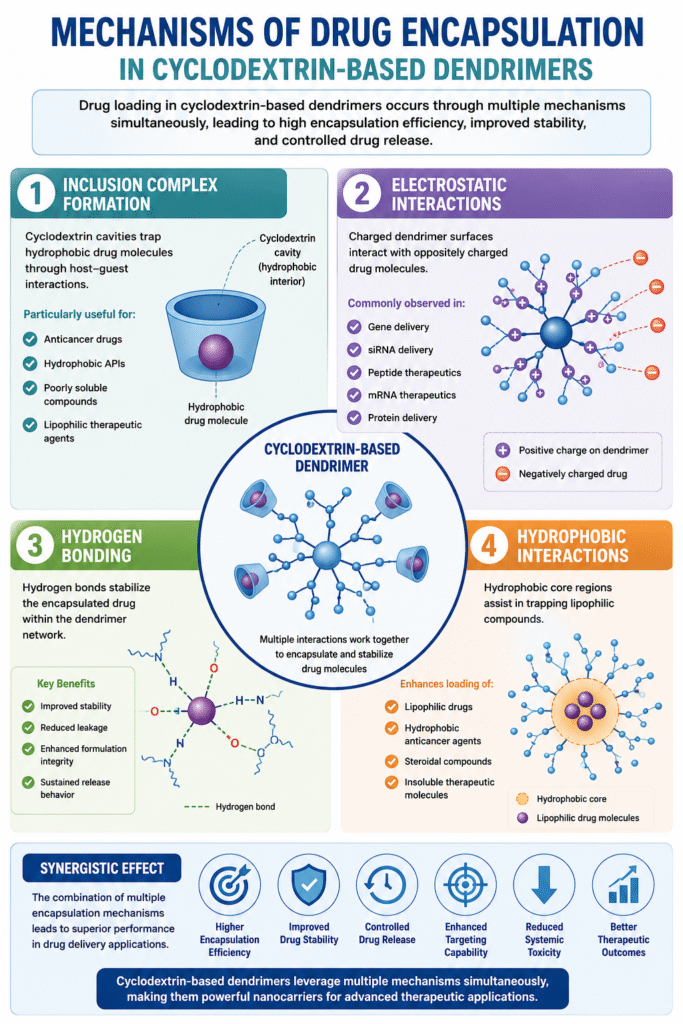
Drug loading in cyclodextrin-based dendrimers occurs through multiple intermolecular interactions working together simultaneously. These mechanisms enable efficient drug entrapment, improved stability, and controlled release of therapeutic compounds. The unique hybrid structure of cyclodextrin-based dendrimers allows them to accommodate a broad range of drug molecules with varying physicochemical properties.
1. Inclusion Complex Formation
Inclusion complex formation is one of the primary mechanisms responsible for drug encapsulation in cyclodextrin-based dendrimers. Cyclodextrins possess a hydrophobic internal cavity and a hydrophilic outer surface, allowing them to host hydrophobic drug molecules within their cavity through host-guest interactions.
This mechanism significantly improves the aqueous solubility and stability of poorly soluble drugs. The encapsulated drug is physically protected from degradation caused by environmental factors such as oxidation, light, or hydrolysis.
This mechanism is particularly effective for:
- Anticancer drugs
- Hydrophobic active pharmaceutical ingredients (APIs)
- Poorly water-soluble compounds
- Lipophilic therapeutic agents
Common examples include the encapsulation of doxorubicin, paclitaxel, and curcumin for enhanced drug delivery performance.
2. Electrostatic Interactions
Electrostatic interactions occur when charged functional groups present on the dendrimer surface attract oppositely charged drug molecules or biomolecules. Many dendrimers contain positively charged amino groups that can strongly interact with negatively charged therapeutic agents.
This mechanism is especially important in nucleic acid and biomolecule delivery systems because DNA, RNA, and certain peptides carry negative charges.
Electrostatic encapsulation is commonly used in:
- Gene delivery systems
- siRNA delivery
- mRNA therapeutics
- Peptide-based drugs
- Protein delivery applications
These ionic interactions improve loading efficiency while also supporting targeted cellular uptake and intracellular delivery.
3. Hydrogen Bonding
Hydrogen bonding contributes significantly to the stabilization of drug molecules within the dendrimer network. Functional groups such as hydroxyl, amino, carbonyl, and ether groups present in both cyclodextrins and dendrimers participate in hydrogen bond formation with therapeutic compounds.
These interactions help:
- Improve structural stability
- Reduce premature drug leakage
- Enhance formulation integrity
- Support sustained-release behavior
Hydrogen bonding is particularly useful for drugs containing polar functional groups and contributes to long-term formulation stability during storage and circulation.
4. Hydrophobic Interactions
Hydrophobic interactions occur when lipophilic drug molecules associate with hydrophobic regions inside the dendrimer architecture. The internal hydrophobic domains of cyclodextrin-based dendrimers create favorable environments for trapping nonpolar compounds.
This mechanism enhances the loading of:
- Lipophilic drugs
- Hydrophobic anticancer agents
- Steroidal compounds
- Insoluble therapeutic molecules
Hydrophobic interactions are critical for improving the bioavailability of poorly soluble drugs and are often combined with inclusion complex formation for enhanced encapsulation performance.
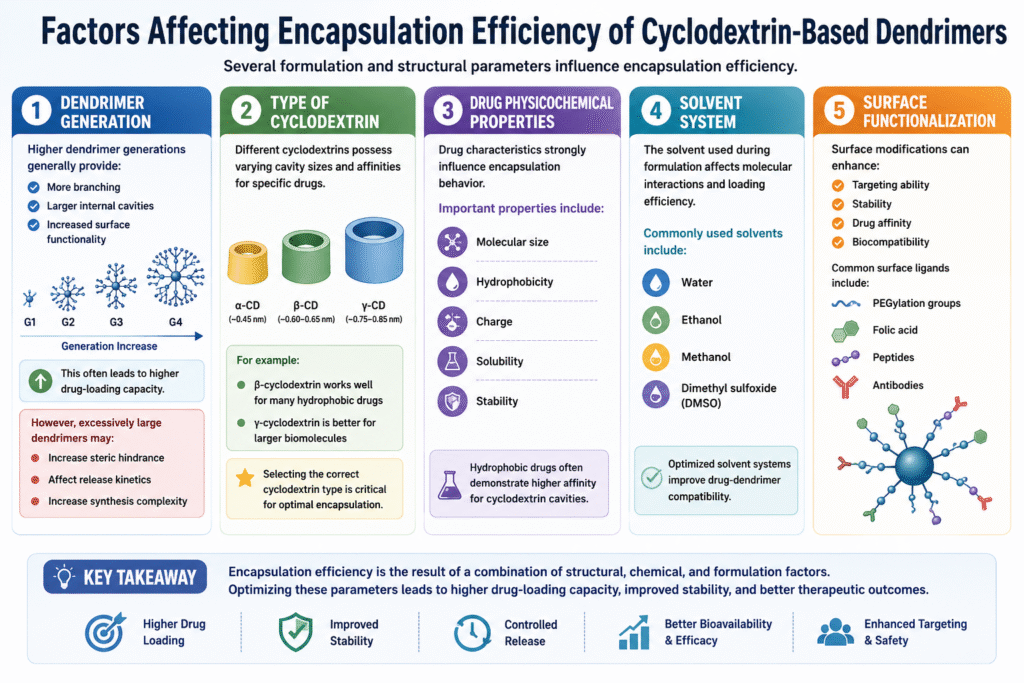
4: Factors Affecting Encapsulation Efficiency of Cyclodextrin-Based Dendrimers
Several formulation and structural parameters influence encapsulation efficiency.
1. Dendrimer Generation
Higher dendrimer generations generally provide:
- More branching
- Larger internal cavities
- Increased surface functionality
This often leads to higher drug-loading capacity.
However, excessively large dendrimers may:
- Increase steric hindrance
- Affect release kinetics
- Increase synthesis complexity
2. Type of Cyclodextrin
Different cyclodextrins possess varying cavity sizes and affinities for specific drugs.
For example:
- β-cyclodextrin works well for many hydrophobic drugs
- γ-cyclodextrin is better for larger biomolecules
Selecting the correct cyclodextrin type is critical for optimal encapsulation.
3. Drug Physicochemical Properties
Drug characteristics strongly influence encapsulation behavior.
Important properties include:
- Molecular size
- Hydrophobicity
- Charge
- Solubility
- Stability
Hydrophobic drugs often demonstrate higher affinity for cyclodextrin cavities.
4. Solvent System
The solvent used during formulation affects molecular interactions and loading efficiency.
Commonly used solvents include:
- Water
- Ethanol
- Methanol
- Dimethyl sulfoxide (DMSO)
Optimized solvent systems improve drug-dendrimer compatibility.
5. Surface Functionalization
Surface modifications can enhance:
- Targeting ability
- Stability
- Drug affinity
- Biocompatibility
Common surface ligands include:
- PEGylation groups
- Folic acid
- Peptides
- Antibodies
5: Methods Used to Measure Encapsulation Efficiency
Accurate analytical characterization is essential for evaluating cyclodextrin-based dendrimer formulations.
1. High-Performance Liquid Chromatography (HPLC)
HPLC is widely used for quantifying encapsulated versus free drug concentrations.
Advantages include:
- High sensitivity
- Excellent reproducibility
- Quantitative accuracy
2. LC-MS/MS
LC-MS/MS provides highly sensitive analysis for trace-level drug quantification.
This technique is particularly valuable for:
- Complex formulations
- Bioanalytical studies
- Pharmacokinetic analysis
3. Nuclear Magnetic Resonance (NMR)
NMR helps confirm:
- Inclusion complex formation
- Molecular interactions
- Structural integrity
4. Dynamic Light Scattering (DLS)
DLS measures:
- Particle size
- Polydispersity index
- Nanoparticle stability
5. Fourier Transform Infrared Spectroscopy (FTIR)
FTIR identifies functional group interactions between dendrimers and drug molecules.
6: Applications of Cyclodextrin-Based Dendrimers
1. Cancer Drug Delivery
Cyclodextrin-based dendrimers are extensively studied for targeted chemotherapy.
Benefits include:
- Enhanced tumor targeting
- Reduced systemic toxicity
- Improved drug solubility
- Controlled release behavior
Drugs commonly investigated include:
- Doxorubicin
- Paclitaxel
- Cisplatin
2. Neurological Drug Delivery
Crossing the blood-brain barrier remains a major pharmaceutical challenge.
Cyclodextrin-based dendrimers improve CNS drug delivery by:
- Enhancing permeability
- Increasing drug stability
- Enabling controlled release
3. Gene and RNA Delivery
Functionalized dendrimers can effectively deliver:
- DNA
- siRNA
- mRNA
- CRISPR systems
Their tunable surface chemistry supports advanced gene therapy research.
4. Antimicrobial Applications
Dendrimer systems are also explored for:
- Antibiotic delivery
- Antifungal therapeutics
- Antiviral formulations
7: Challenges in Achieving High Encapsulation Efficiency
Despite their advantages, several challenges remain.
1. Manufacturing Complexity
Large-scale production requires:
- Precise synthesis control
- Batch reproducibility
- Advanced purification methods
2. Drug Leakage
Some formulations may experience premature drug release during storage or circulation.
3. Stability Concerns
Environmental conditions such as:
- pH
- Temperature
- Ionic strength
can affect encapsulation performance.
4. Regulatory Considerations
Nanomedicine formulations require extensive analytical validation and safety assessment before commercialization.
Strategies to Improve Encapsulation Efficiency
Researchers continue developing innovative optimization techniques.
1. Surface Engineering
Surface modifications improve drug affinity and stability.
2. Optimized Formulation Parameters
Careful optimization of:
- Drug-to-dendrimer ratio
- pH conditions
- Solvent composition
- Temperature
can significantly enhance loading efficiency.
3. Stimuli-Responsive Systems
Advanced dendrimers can respond to:
- pH changes
- Temperature
- Enzymes
- Light
to enable site-specific drug release.
4. Computational Modeling
AI-driven molecular modeling increasingly helps predict:
- Drug compatibility
- Binding interactions
- Optimal dendrimer structures
8: Role of Advanced Analytical Support
Reliable analytical characterization is essential for successful dendrimer formulation development.
ResolveMass Laboratories Inc. supports pharmaceutical and biotechnology organizations with advanced analytical services including:
- LC-MS/MS analysis
- Structural characterization
- Impurity profiling
- Stability studies
- Bioanalytical testing
- Method development and validation
Comprehensive analytical support helps researchers optimize Encapsulation Efficiency of Cyclodextrin-Based Dendrimers while ensuring formulation quality, reproducibility, and regulatory readiness.
9: Future Outlook
Cyclodextrin-based dendrimers are expected to play an increasingly important role in next-generation therapeutics.
Future developments may include:
- Personalized nanomedicine
- Smart drug delivery systems
- AI-assisted formulation optimization
- Precision oncology applications
- Advanced gene therapies
As pharmaceutical innovation accelerates, improved encapsulation efficiency will remain central to maximizing therapeutic success.
Conclusion:
Encapsulation Efficiency of Cyclodextrin-Based Dendrimers is a critical factor in determining the success of advanced drug delivery systems. High encapsulation efficiency improves therapeutic effectiveness, stability, controlled release, and overall pharmaceutical performance.
By combining the molecular inclusion capabilities of cyclodextrins with the structural advantages of dendrimers, these hybrid nanocarriers offer exceptional potential across oncology, neurology, gene delivery, and precision medicine applications.
Continued advances in analytical characterization, formulation science, and nanotechnology are expected to further enhance the performance of cyclodextrin-based dendrimer systems in the coming years.
For pharmaceutical companies and researchers, partnering with experienced analytical laboratories such as ResolveMass Laboratories Inc. can provide the specialized support necessary to optimize formulation development and accelerate innovation.
Frequently Asked Questions:
Cyclodextrin-based dendrimers are widely used because they combine the inclusion capability of cyclodextrins with the highly branched structure of dendrimers. This hybrid architecture improves drug solubility, loading capacity, and targeting potential. They can encapsulate both hydrophobic and charged therapeutic compounds efficiently. These nanocarriers also help reduce systemic toxicity and improve controlled drug release. Their multifunctional properties make them highly valuable in advanced pharmaceutical and nanomedicine applications.
Cyclodextrins improve drug solubility by forming inclusion complexes with hydrophobic drug molecules inside their internal cavities. The outer hydrophilic surface allows the resulting complex to dissolve more easily in aqueous environments. This process enhances the absorption and bioavailability of poorly soluble drugs. Cyclodextrins also protect sensitive drugs from degradation caused by light, oxidation, or hydrolysis. As a result, they are commonly used in pharmaceutical formulations to improve therapeutic effectiveness.
Several formulation and structural parameters influence encapsulation efficiency in cyclodextrin-based dendrimers. These include dendrimer generation, cyclodextrin type, drug molecular size, hydrophobicity, solvent system, and surface functionalization. Higher dendrimer generations often provide greater drug-loading capacity due to increased branching and cavity volume. The compatibility between the drug and dendrimer structure also plays an important role. Optimizing these variables helps improve formulation stability and overall drug delivery performan
High encapsulation efficiency offers multiple pharmaceutical benefits by ensuring more drug molecules are successfully loaded into the carrier system. This improves therapeutic effectiveness while reducing the required dosage and minimizing side effects. It also enhances drug stability and supports controlled or sustained drug release. Higher efficiency reduces manufacturing losses, making formulation development more cost-effective. Overall, it contributes to better patient outcomes and more reliable drug delivery systems.
Cyclodextrin-based dendrimers are highly promising for gene and RNA delivery because their charged surfaces can interact with negatively charged nucleic acids. They are commonly used for delivering DNA, siRNA, mRNA, and CRISPR-related therapeutics. These dendrimers protect genetic material from degradation during circulation. They also improve cellular uptake and intracellular delivery efficiency. Their tunable surface chemistry makes them attractive candidates for advanced gene therapy applications.
The future of cyclodextrin-based dendrimers in nanomedicine is highly promising due to ongoing advances in targeted drug delivery and precision therapeutics. Researchers are developing smart dendrimer systems capable of responding to pH, temperature, or enzymatic triggers. These nanocarriers are expected to play major roles in personalized medicine, gene therapy, and advanced oncology treatments. Improved analytical techniques and AI-driven formulation optimization will further enhance their performance. Continued innovation may accelerate their transition from research laboratories to clinical applications.
Reference
- Namazi H, Heydari A. Synthesis of β‐cyclodextrin‐based dendrimer as a novel encapsulation agent. Polymer international. 2014 Aug;63(8):1447-55.https://scijournals.onlinelibrary.wiley.com/doi/abs/10.1002/pi.4637
- Topuz F, Uyar T. Recent advances in cyclodextrin‐based nanoscale drug delivery systems. Wiley Interdisciplinary Reviews: Nanomedicine and Nanobiotechnology. 2024 Nov;16(6):e1995.https://wires.onlinelibrary.wiley.com/doi/abs/10.1002/wnan.1995
- Yousef T, Hassan N. Supramolecular encapsulation of doxorubicin with β-cyclodextrin dendrimer: in vitro evaluation of controlled release and cytotoxicity. Journal of Inclusion Phenomena and Macrocyclic Chemistry. 2017 Feb;87(1):105-15.https://link.springer.com/article/10.1007/s10847-016-0682-4
- Nafee N, Hirosue M, Loretz B, Wenz G, Lehr CM. Cyclodextrin-based star polymers as a versatile platform for nanochemotherapeutics: enhanced entrapment and uptake of idarubicin. Colloids and Surfaces B: Biointerfaces. 2015 May 1;129:30-8.https://www.sciencedirect.com/science/article/pii/S0927776515001484
- Chaturvedi K, Ganguly K, Kulkarni AR, Kulkarni VH, Nadagouda MN, Rudzinski WE, Aminabhavi TM. Cyclodextrin-based siRNA delivery nanocarriers: a state-of-the-art review. Expert opinion on drug delivery. 2011 Nov 1;8(11):1455-68.https://www.tandfonline.com/doi/abs/10.1517/17425247.2011.610790