

Introduction
End-to-End ANDA Analytical Package Development for a complex generic suspension requires an integrated analytical framework that connects qualitative (Q1) and quantitative (Q2) excipient deformulation with advanced physicochemical (Q3) microstructural characterization and biopredictive performance testing. Developing a scientifically rigorous End-to-End ANDA Analytical Package Development workflow helps ensure that candidate drug formulations meet U.S. Food and Drug Administration (FDA) Abbreviated New Drug Application (ANDA) regulatory requirements while potentially avoiding the need for costly clinical endpoint bioequivalence trials.
Learn how to build an audit-ready analytical package for your generic filings:🔗 Discover One-Stop CDMO Analytical Services for ANDA
Complex generic suspensions, including ophthalmic, otic, topical, and long-acting parenteral delivery systems, create distinct analytical development challenges because of their non-Newtonian rheological behavior, multiphase physical instability, and sensitive drug crystal habits. Even small differences in excipient polymer grade, particle size distribution (D10, D50, D90), or active pharmaceutical ingredient (API) polymorphic state can influence suspended-phase behavior, modify localized dissolution kinetics, and contribute to in vivo bioequivalence failure.
Streamline your complex generic ophthalmic formulations with end-to-end development services:🔗 Explore CDMO Services for Generic Ophthalmic Drug Products
This case study examines the analytical methodology implemented for a target complex generic suspension. Through the application of orthogonal analytical instrumentation, biopredictive in vitro release models, and ICH Q2(R2)-compliant method validation protocols, ResolveMass Laboratories Inc. established comprehensive pharmaceutical and physicochemical equivalence relative to the Reference Listed Drug (RLD).
Share via:
Quick Summary:
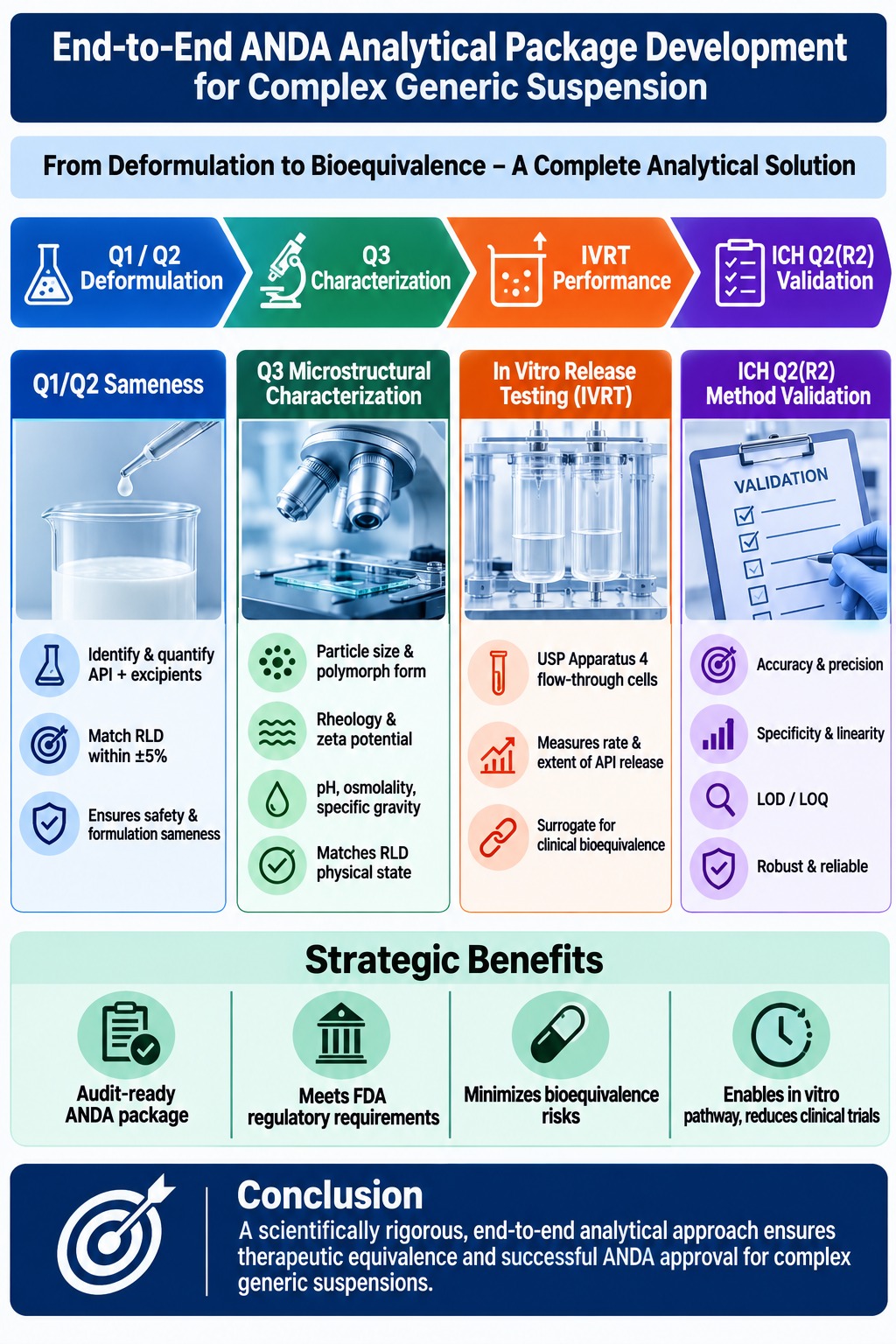
- End-to-end ANDA analytical development integrates Q1/Q2 deformulation, Q3 characterization, IVRT, method validation, and stability studies for complex generic suspensions.
- Q1/Q2 sameness confirms the identity and concentration of API and excipients, with key excipient concentrations targeted within ±5% of the Reference Listed Drug (RLD).
- Q3 characterization evaluates critical physical properties such as particle size (D10/D50/D90), polymorphism, rheology, viscosity, yield stress, zeta potential, pH, osmolality, and specific gravity to establish microstructural similarity.
- IVRT (In Vitro Release Testing) uses biorelevant conditions, including USP Apparatus 4, to measure drug-release rate and distinguish meaningful formulation or manufacturing differences.
- ICH Q2(R2) method validation establishes analytical reliability through specificity, linearity, accuracy, precision, LOD/LOQ, robustness, and system suitability.
- Strategic execution and stability testing connects CMAs, CPPs, and CQAs while monitoring changes such as crystal growth, polymorphism, polymer degradation, and pH during storage.
- Overall goal: Generate an audit-ready, scientifically defensible ANDA analytical package that strengthens regulatory confidence, reduces bioequivalence risk, and can support in-vitro bioequivalence approaches while potentially reducing the need for clinical endpoint studies.
Deformulation and Q1/Q2 Sameness Verification in End-to-End ANDA Analytical Package Development
Deformulation is used to establish qualitative (Q1) identity and quantitative (Q2) excipient concentrations within a strict ±5% target tolerance relative to the Reference Listed Drug (RLD). This stage involves isolating and quantifying the active pharmaceutical ingredient (API) together with suspended viscolyzers, surfactants, tonicity agents, preservatives, and other relevant formulation components.
Accelerate your Q1/Q2 deformulation timeline with comprehensive reference standard analytics:🔗 Read about RLD Sourcing and Reverse Engineering
Quantitative sameness (Q2) is particularly important for complex suspensions because changes in excipient concentration can influence vehicle viscosity, API saturation solubility, and physical suspension re-dispersibility. Establishing accurate Q1/Q2 sameness helps address potential safety concerns, including local tissue irritation, while reducing structural differences that could influence drug release rates. Characterization of multiple RLD lots also helps account for normal batch-to-batch variability associated with commercially manufactured innovator products.
Reverse Engineering Excipient Matrices for End-to-End ANDA Analytical Package Development
Reverse engineering of excipient matrices within End-to-End ANDA Analytical Package Development involves the use of spectroscopic, chromatographic, and thermoanalytical approaches to separate and characterize polymeric stabilizers, tonicity adjusters, surfactants, and other formulation components. Determining the specific excipient chemistry and molecular weight distributions is important for preventing downstream microstructural differences during commercial formulation development and scale-up.
Analytical isolation begins with phase separation using high-speed centrifugal filtration to separate dissolved vehicle excipients from suspended drug particles. Dissolved polymers, such as carboxymethylcellulose, polyvinyl alcohol, or carbomers, are evaluated for molecular weight distribution and intrinsic viscosity using Gel Permeation Chromatography with Refractive Index Detection (GPC-RI). Surfactants and preservatives are isolated and characterized using reversed-phase High-Performance Liquid Chromatography coupled with Mass Spectrometry (LC-MS/MS) and Gas Chromatography-Mass Spectrometry (GC-MS). Inorganic salts and buffering ions are quantified using Inductively Coupled Plasma Mass Spectrometry (ICP-MS) and ion chromatography.
| Excipient Class / Component | Primary Analytical Technique | Secondary / Orthogonal Technique | Acceptance Criteria / Target |
|---|---|---|---|
| Active Pharmaceutical Ingredient (API) | HPLC-UV / LC-MS/MS | Solid-State PXRD / DSC | Assay: 98.0%–102.0%; Identical Polymorph |
| Polymeric Viscolyzers (e.g., CMC, Carbomer) | Gel Permeation Chromatography (GPC-RI) | Rotational Rheometry / Intrinsic Viscosity | Q2 concentration within ±5%; matching MW profile |
| Non-ionic Surfactants (e.g., Polysorbates) | LC-MS/MS (Evaporative Light Scattering) | FTIR / Nuclear Magnetic Resonance (NMR) | Q2 concentration within ±5%; identical grade |
| Preservatives & Small Molecules | Reversed-Phase HPLC-UV | GC-MS volatile profiling | Q2 concentration within ±5% of RLD target |
| Inorganic Buffers & Tonicity Salts | Inductively Coupled Plasma Mass Spectrometry (ICP-MS) | Ion Chromatography (IC) | Quantitative match (±5%) to RLD target |
Plan your analytical and regulatory strategies for complex suspension generics:🔗 Learn about Generic Ophthalmic Suspension ANDA Development
Physicochemical (Q3) Characterization and Microstructural Profiling
Physicochemical (Q3) characterization assesses the structural organization of the formulation and its physical state to determine whether the generic product demonstrates microstructural similarity to the RLD. Important Q3 testing parameters include particle size distribution, crystal polymorphism, rheological flow dynamics, zeta potential, phase state, pH, osmolality, and specific gravity.
Demonstrating Q3 structural equivalence provides evidence that the internal spatial organization of suspended particles and the dynamics of the liquid vehicle behave similarly during stress, storage, and administration. When Q1, Q2, and Q3 characteristics are appropriately matched, the generic suspension can more closely reproduce the local bioavailability and clinical safety profile associated with the innovator product.
Solid-State Polymorphism and Particle Size Distribution
Solid-state characterization using Powder X-Ray Diffraction (PXRD) and laser diffraction determines whether the suspended API exhibits crystal morphology and particle size characteristics comparable to those of the innovator product, including D10, D50, and D90 measurements. Differences in crystal habit or polymorphic phase transitions can modify API dissolution rates and consequently influence local tissue absorption.
Polymorphic identity is evaluated directly within the intact liquid suspension matrix using low-angle Transmission PXRD in combination with Differential Scanning Calorimetry (DSC) and Thermal Gravimetric Analysis (TGA). This approach minimizes isolation-related artifacts that could potentially cause phase transformations during sample preparation. Particle size distribution is measured using validated wet-dispersion Laser Diffraction, such as Malvern Mastersizer, together with automated Static Automated Imaging (Morphologi) to evaluate particle aspect ratio and elongation.
Understand key differences in analytical and formulation approaches across active modalities:🔗 Compare Peptide and Small Molecule Drug Differences
Rheological Dynamics and Phase State Assessment
Rheological characterization measures shear-dependent flow behavior, zero-shear viscosity, yield stress, and thixotropic recovery to support consistent suspension re-dispersibility and dosing. Comparable yield stress is important for maintaining physical stability and limiting particle sedimentation during shelf storage.
Rotational rheometers equipped with cone-and-plate geometries are used to perform controlled shear rate sweeps and generate comprehensive flow curves. The Herschel-Bulkley and Casson mathematical models are applied to non-Newtonian flow data to determine yield stress values (τ0) and flow behavior indices (n). Oscillatory amplitude and frequency sweeps are used to assess the elastic (G’) and viscous (G”) moduli, helping confirm that sol-gel transitions and structural recovery kinetics remain within the target RLD range.
| Physicochemical Parameter (CQA) | Analytical Instrumentation | Method Rationale | Target Equivalence Benchmark |
|---|---|---|---|
| Particle Size Distribution (D10, D50, D90) | Laser Diffraction & Automated Image Analysis | Governs dissolution kinetics and sedimentation velocity | Overlapping population curves; D50 ±10% of RLD |
| API Polymorphic Form | Transmission PXRD & Thermal Analysis (DSC/TGA) | Prevents polymorphic shifts and solubility changes | Identical diffraction pattern and melting endotherm |
| Rheological Flow & Viscosity Profile | Rotational Rheometer (Cone-and-Plate) | Determines pourability, syringeability, and local retention | Superimposable shear rate vs. viscosity curves |
| Yield Stress (τ0) & Thixotropy | Oscillatory Rheometry / Stress Ramps | Prevents phase separation and particle settling | Yield stress values within RLD inter-batch range |
| Zeta Potential & Surface Charge | Dynamic Light Scattering (Electrophoretic Mobility) | Evaluates electrostatic repulsion and flocculation risk | Equivalent surface potential (±5 mV) |
| pH, Osmolality & Specific Gravity | Compendial Micro-pH / Freezing Point Osmometer | Ensures ocular/parenteral physiological compatibility | Identical parameters to RLD specification limits |
Learn how robust bioequivalence study designs support non-clinical submission pathways:🔗 Explore Bioequivalence Study Design for Complex Generics
Biorelevant Performance via In Vitro Release Testing (IVRT)
In Vitro Release Testing (IVRT) functions as a surrogate for clinical bioequivalence by determining the rate and extent of API release under controlled and discriminating hydrodynamic conditions. A scientifically well-designed IVRT method can distinguish formulation differences, manufacturing process changes, and polymorphic instability that may affect drug release behavior.
Developing an IVRT method for complex suspensions requires careful selection of receptor media, diffusion cell architectures, and synthetic membrane barriers that do not become the rate-limiting step for API transport. Sink conditions should be maintained throughout the study period to better represent physiological clearance mechanisms and ensure that drug release is appropriately characterized.
Expand your understanding of injectable formulation strategies and lyophilization kinetics: 🔗 Guide to Formulating Lyophilized Peptide Injectables
Hydrodynamic Optimization Using USP Apparatus 4 Flow-Through Cells
USP Apparatus 4 (Flow-Through Cell) technology enables continuous media exchange and maintenance of sink conditions for evaluating complex suspensions with slow-dissolving APIs. Both open-loop and closed-loop configurations, together with specialized dispersed-system adapters, can accommodate particulate formulations while minimizing membrane-clogging artifacts.
The flow-through cell apparatus delivers biorelevant media at controlled flow rates, such as 4 to 16 mL/min, through a vertical column containing glass beads that help establish consistent flow dynamics. Synthetic membranes, including Tuffryn, PTFE, or Polycarbonate, separate the formulation from the receptor phase while allowing API flux into the receptor stream. Release profiles can be mathematically evaluated through linear regression of cumulative drug release per unit area (mg/cm²) against the square root of time (√t), allowing steady-state release rates to be determined from the slope in accordance with appropriate FDA non-parametric statistical metrics.
The discriminatory capability of the method is demonstrated by testing intentionally modified formulations, including non-Q1/Q2 variants, formulations with altered particle size distributions, and heat-stressed polymorphic forms. The optimized IVRT protocol should be sufficiently sensitive to identify meaningful performance changes arising from these formulation or process modifications.
Method Validation Under ICH Q2(R2) Guidelines
Method validation under the updated ICH Q2(R2) guideline establishes that analytical procedures included in the ANDA package are suitable for their intended purpose and demonstrate appropriate accuracy, precision, specificity, and robustness for commercial batch release and stability testing. Regulatory submission packages require validation protocols that address the relevant performance characteristics of stability-indicating assays, impurity profiling procedures, and Q3/IVRT methods.
Align your impurity identification and quantification strategies with ICH standards:🔗 Read our guide on Impurity Control Strategies Under ICH Q3A
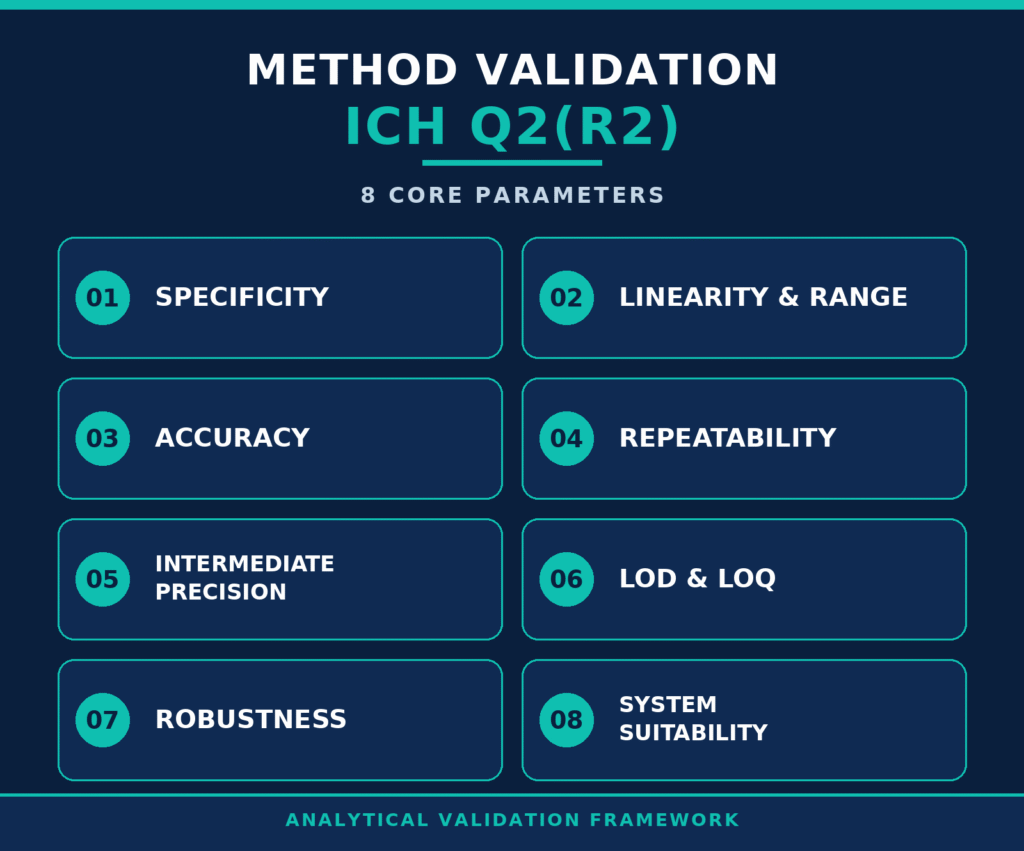
Full analytical validation requires assessment of eight ICH Q2(R2) performance categories:
- Specificity: Complete chromatographic separation of the API from degradation products, excipients, and synthesis intermediates, demonstrating the absence of relevant spectral interference.
- Linearity and Range: High correlation coefficients (r² ≥ 0.999) established across 50% to 150% of target assay concentrations and 0.05% to 1.5% for degradation impurities.
- Accuracy: Mean recoveries within 98.0% to 102.0% for API assay across low, medium, and high spike concentration levels.
- Repeatability: Precision assessed using six replicate preparations, with a Relative Standard Deviation (RSD) ≤ 1.0% for assay.
- Intermediate Precision: Inter-day, inter-analyst, and inter-instrument reproducibility demonstrated with RSD ≤ 1.5%.
- Limit of Detection (LOD) and Quantitation (LOQ): Signal-to-noise thresholds established at ≥3:1 for LOD and ≥10:1 for LOQ, supporting sensitive monitoring of trace degradation products.
- Robustness: Deliberate variations in flow rate (±0.2 mL/min), column temperature (±2°C), and mobile phase pH (±0.2 units) demonstrating no meaningful loss of chromatographic resolution.
- System Suitability: Continuous assessment of column efficiency (N > 2000), tailing factors (T ≤ 1.5), and injection repeatability.
Ensure seamless ANDA filing with complete CMC documentation packages:🔗 Overview of CMC Documentation at a CDMO for ANDA
Strategic Execution of End-to-End ANDA Analytical Package Development
Implementing End-to-End ANDA Analytical Package Development can streamline regulatory submission activities by integrating Quality by Design (QbD) principles across deformulation, microstructural characterization, performance testing, and stability assessment. ResolveMass Laboratories Inc. compiles audit-ready analytical data packages designed to address potential FDA Information Requests (IRs) and reduce the risk of Refuse-to-Receive (RTR) actions.
Linking Critical Material Attributes (CMAs) and Critical Process Parameters (CPPs) directly to Critical Quality Attributes (CQAs) establishes a predictive framework for understanding and controlling long-term product performance. Accelerated and long-term ICH stability testing programs (40°C/75% RH and 25°C/60% RH) are used to monitor potential crystal growth, polymorphic transformations, viscolyzer depolymerization, pH changes, and other physicochemical alterations over time.
Evaluate domestic vs. international outsourcing options for your specialized analytical and manufacturing needs:🔗 Comparing Canadian vs. US Peptide CDMOs
By generating comprehensive orthogonal characterization data at an early stage, generic drug sponsors can use Controlled Correspondence or Pre-ANDA meeting pathways to support scientifically justified in vitro bioequivalence approaches and potentially reduce the need for extensive clinical trial programs.
Discover specialized scale-up and CDMO solutions tailored for complex actives and APIs:🔗 Explore Peptide CDMO Scale-Up Services
Conclusion
A rigorous End-to-End ANDA Analytical Package Development program is essential for supporting regulatory approval of complex suspensions under contemporary FDA standards. Integrating accurate Q1/Q2 deformulation, comprehensive Q3 microstructural characterization, discriminatory IVRT release kinetics, and ICH Q2(R2)-compliant method validation enables CROs and generic drug sponsors to identify and mitigate bioequivalence risks while generating evidence to support therapeutic equivalence.
For specialized contract research, analytical deformulation, and bioequivalence package development for complex generic pipelines, scientific experts can be contacted directly through the ResolveMass Laboratories Inc. Contact Page.
Frequently Asked Questions
Particle size distribution is a key Critical Quality Attribute because it affects the surface area available for drug dissolution and can therefore influence release behavior, tissue permeation, and biological disposition. It also contributes substantially to suspension stability because particle dimensions affect settling behavior. Larger particles generally sediment more rapidly, making particle size control important for maintaining uniformity and consistent dosing.
USP Apparatus 4 (Flow-Through Cell) continuously supplies fresh dissolution medium through the test cell, helping maintain sink conditions for poorly soluble or slowly dissolving APIs. Its controlled flow environment can provide more suitable hydrodynamic conditions for complex suspension formulations than conventional systems. Specialized cell configurations can also accommodate particulate formulations while supporting consistent assessment of API release.
Polymorphic stability is important because changes in the crystalline form of the API can modify its physicochemical and dissolution characteristics. Conversion from one polymorphic state to another during manufacturing, processing, or storage may affect thermodynamic solubility and drug release. Such changes can ultimately influence bioavailability and create a potential risk to bioequivalence.
Excipient deformulation typically combines multiple orthogonal analytical techniques to identify and quantify formulation components. HPLC-UV and LC-MS/MS can be used for surfactants and preservatives, while GPC-RI provides information about polymer molecular weight profiles. ICP-MS supports inorganic salt analysis, and NMR or FTIR can help characterize excipient chemistry and grade. Centrifugal phase separation may be used beforehand to separate suspended API particles from the liquid vehicle.
ICH Q2(R2) provides a harmonized framework for demonstrating that analytical procedures are suitable for their intended purpose. The guideline addresses key validation characteristics such as specificity, accuracy, precision, linearity, range, LOD, LOQ, and robustness. It also accommodates the validation of a broader range of analytical procedures, including modern instrumental and spectroscopic approaches, when scientifically justified.
Rheological yield stress represents the stress that must be exceeded before a material begins to flow, making it an important parameter for suspension stability. Appropriate yield stress can help limit particle settling during storage while still allowing the formulation to redisperse when subjected to appropriate handling. For ophthalmic and parenteral products, controlling this property can support dose uniformity, administration performance, and suitable local retention.
A commonly applied target for Q2 sameness assessment is maintaining inactive ingredient concentrations within ±5% of the corresponding concentrations in the Reference Listed Drug. This comparison is used to evaluate whether the generic formulation is quantitatively aligned with the RLD. Any deviation outside the intended target range should be scientifically assessed and may require additional regulatory justification or supporting information, depending on the product and FDA expectations.
A discriminating IVRT method should be capable of detecting meaningful differences in drug release when deliberate formulation or manufacturing changes are introduced. This can be demonstrated by evaluating intentionally modified batches with differences in particle size, excipient concentrations, or processing conditions such as homogenization. If the method produces measurable and consistent changes in release behavior, it provides evidence that the procedure can distinguish relevant formulation and process-related variations.
Generic drug developers can use mechanisms such as Controlled Correspondence and Pre-ANDA meetings to obtain FDA feedback during development of complex generic products. These interactions provide opportunities to discuss proposed Q1/Q2/Q3 characterization strategies, IVRT approaches, and alternative methods for establishing bioequivalence. Early regulatory engagement can help sponsors align their analytical strategy with FDA expectations before submitting the ANDA.
Reference:
- U.S. Food and Drug Administration. (2023, September 13). Characterization-based bioequivalence approaches for topical products: Part 1: Q3 guidance [Presentation]. FDA (fda.gov)
- Chang, R.-K., Raw, A., Lionberger, R., & Yu, L. (2015). Erratum to: Generic development of topical dermatologic products: Formulation development, process development, and testing of topical dermatologic products. The AAPS Journal, 17(6), 1522. https://doi.org/10.1208/s12248-015-9823-8
- Miranda, M., Veloso, C., Brown, M., Pais, A. A. C. C., Cardoso, C., & Vitorino, C. (2022). Topical bioequivalence: Experimental and regulatory considerations following formulation complexity. International Journal of Pharmaceutics, 620, 121705. https://doi.org/10.1016/j.ijpharm.2022.121705 (pubmed.ncbi.nlm.nih.gov)
- Bal, G., Lakshmi, K., Rajkumar, M., & Mohanta, B. C. (2023). Characterization and reverse engineering of pharmaceuticals: Role of thermoanalytical techniques. Research Journal of Pharmacy and Technology, 16(10), 4973–4980. https://doi.org/10.52711/0974-360X.2023.00805
- Reddy, P. (2024, May 20–21). USP complex generics—Research needs based upon industry feedback [Presentation]. U.S. Food and Drug Administration. FDA document
- European Medicines Agency. (2024). ICH Q2(R2) guideline on validation of analytical procedures—Step 5—Revision 2 (EMA/CHMP/ICH/82072/2006). https://www.ema.europa.eu/en/ich-q2r2-validation-analytical-procedures-scientific-guideline
Get In Touch With Us
About The Author


