

Introduction:
The Environmental Impact of Cyclodextrin-Based Dendrimers has become an important topic in pharmaceutical research, nanotechnology, and sustainable material science. As industries increasingly adopt nanomaterials for drug delivery, diagnostics, agriculture, and environmental applications, understanding their ecological footprint is critical.
Cyclodextrin-based dendrimers combine the unique molecular architecture of dendrimers with the biodegradable and biocompatible properties of cyclodextrins. These hybrid nanostructures are being explored as safer alternatives to traditional synthetic polymers because they can potentially reduce toxicity, improve biodegradability, and support greener chemistry practices.
However, while cyclodextrin dendrimers offer several sustainability advantages, their environmental impact depends on multiple factors including manufacturing processes, solvent selection, degradation pathways, bioaccumulation, and waste management practices.
This article explores the environmental implications of cyclodextrin-based dendrimers, their benefits, challenges, and the future of sustainable dendrimer technologies.
Summary:
- Cyclodextrin-based dendrimers are emerging as promising nanomaterials with potential environmental advantages over conventional synthetic polymers.
- Their biodegradable carbohydrate structure may reduce long-term ecological accumulation compared to traditional nanocarriers.
- Environmental impact depends on synthesis methods, solvent usage, raw materials, toxicity, biodegradability, and disposal practices.
- Green chemistry approaches are improving the sustainability profile of cyclodextrin dendrimer production.
- These materials show potential in environmental remediation, drug delivery, wastewater treatment, and sustainable nanotechnology.
- Regulatory evaluation and lifecycle assessment remain essential before large-scale commercialization.
- ResolveMass Laboratories Inc. supports advanced analytical characterization for nanomaterials, polymers, and dendrimer systems to help organizations evaluate safety, quality, and environmental compliance.
1: What Are Cyclodextrin-Based Dendrimers?
Cyclodextrin-based dendrimers are highly branched nanostructures that incorporate cyclodextrin molecules either at the core or on the surface of the dendrimer architecture. Cyclodextrins are cyclic oligosaccharides derived from natural starch and are widely known for their excellent biocompatibility, low toxicity, and molecular encapsulation properties.
These materials are gaining significant attention in pharmaceutical, biomedical, and environmental research because they combine the advantages of cyclodextrins with the highly controlled architecture of dendrimers.
Key Properties of Cyclodextrins
Cyclodextrins are valued for several important characteristics:
- Biocompatibility
- Low toxicity
- Ability to improve water solubility
- Molecular encapsulation capability
- Chemical versatility
- Controlled host-guest interactions
Dendrimers, meanwhile, are synthetic nanoscale polymers with a highly branched three-dimensional structure. Their surface chemistry can be precisely modified, making them useful for targeted delivery and multifunctional applications.
When cyclodextrins and dendrimers are combined, they form multifunctional nanomaterials capable of encapsulating drugs, transporting biomolecules, capturing pollutants, and supporting advanced therapeutic systems.
Major Applications of Cyclodextrin-Based Dendrimers
| Application Area | Potential Use |
|---|---|
| Drug Delivery | Controlled and targeted drug release |
| Gene Therapy | Nucleic acid and gene transport |
| Environmental Science | Pollutant capture and remediation |
| Agriculture | Controlled pesticide delivery |
| Diagnostics | Imaging and biosensing applications |
| Wastewater Treatment | Heavy metal adsorption and contaminant removal |
These multifunctional properties make cyclodextrin-based dendrimers promising candidates for sustainable nanotechnology and next-generation biomedical applications.
2: Why Is the Environmental Impact of Cyclodextrin-Based Dendrimers Important?
The Environmental Impact of Cyclodextrin-Based Dendrimers is important because nanomaterials often behave differently from conventional chemicals once released into the environment. Due to their nanoscale size, high surface area, and unique physicochemical properties, these materials can interact with ecosystems in complex ways that may affect environmental safety and sustainability.
As cyclodextrin-based dendrimers become increasingly used in pharmaceuticals, biotechnology, environmental remediation, and agriculture, understanding their ecological footprint is essential for responsible development and regulatory compliance.
Key Environmental Factors Influenced by Nanomaterials
Cyclodextrin-based dendrimers may influence several environmental processes, including:
- Aquatic toxicity – Potential interactions with aquatic organisms such as algae, fish, and microorganisms.
- Soil behavior – Changes in soil mobility, nutrient interactions, and nanoparticle transport.
- Bioaccumulation – Possibility of accumulation within living organisms and food chains.
- Microbial activity – Effects on beneficial microbial communities involved in biodegradation and nutrient cycling.
- Plant interactions – Uptake and transport within agricultural crops or natural vegetation.
- Wastewater treatment efficiency – Influence on filtration systems, adsorption processes, and treatment microorganisms.
Why Researchers Are Interested
The Environmental Impact of Cyclodextrin-Based Dendrimers is receiving growing scientific attention because these materials may provide a safer alternative to many traditional synthetic nanomaterials. Cyclodextrins are naturally derived from starch and are generally recognized for their low toxicity and biocompatibility, which may help reduce long-term ecological risks.
However, despite these advantages, comprehensive environmental risk assessment is still necessary to evaluate:
| Environmental Concern | Importance |
|---|---|
| Biodegradability | Determines environmental persistence |
| Toxicity | Assesses ecological safety |
| Nanoparticle stability | Impacts long-term environmental behavior |
| Degradation products | Evaluates secondary environmental effects |
| Regulatory compliance | Ensures safe commercialization |
Understanding these factors helps researchers and manufacturers design more sustainable nanomaterials while minimizing potential environmental harm.
3: Environmental Benefits of Cyclodextrin-Based Dendrimers
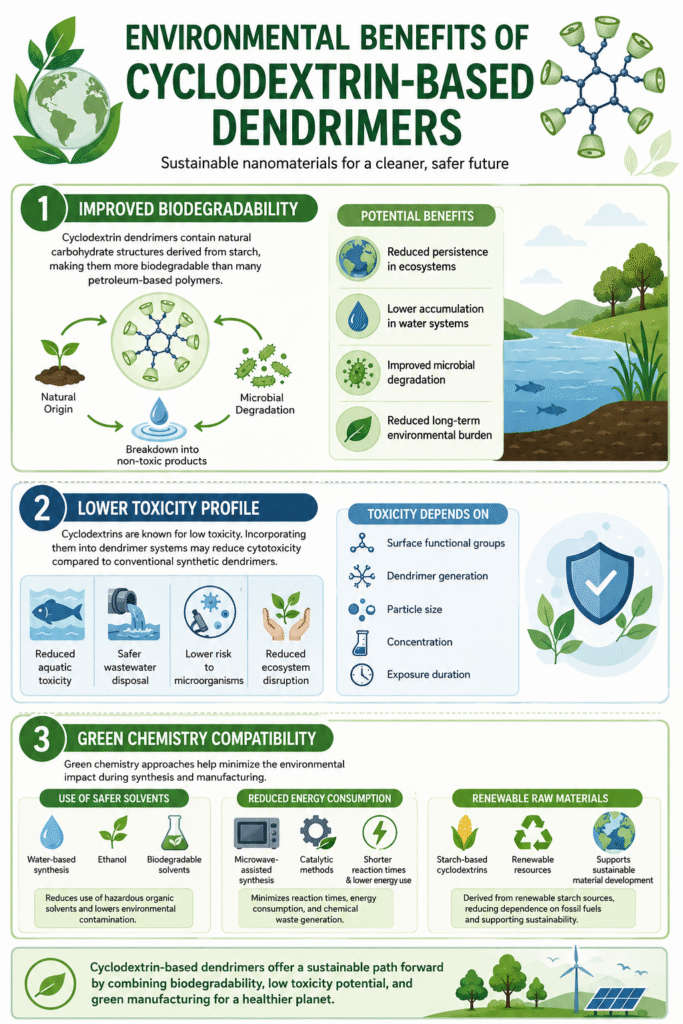
Cyclodextrin-based dendrimers are attracting attention in sustainable nanotechnology because they may offer several environmental advantages compared to traditional synthetic nanomaterials. Their biodegradable carbohydrate components, lower toxicity potential, and compatibility with green chemistry approaches make them promising candidates for environmentally responsible applications.
1. Improved Biodegradability
One of the primary environmental advantages of cyclodextrin dendrimers is their potential biodegradability. Since cyclodextrins originate from natural starch sources, they are more environmentally friendly than many petroleum-derived polymers.
Potential benefits include:
- Reduced persistence in ecosystems
- Lower accumulation in water systems
- Improved microbial degradation
- Reduced long-term environmental burden
Biodegradable nanomaterials are increasingly preferred in pharmaceutical and industrial applications because they reduce concerns regarding nanoparticle accumulation.
2. Lower Toxicity Profile
Cyclodextrins are generally recognized for their low toxicity and broad pharmaceutical acceptance. Incorporating cyclodextrins into dendrimer systems may help reduce cytotoxicity commonly associated with synthetic dendrimers such as PAMAM dendrimers.
Lower toxicity may provide environmental advantages including:
- Reduced aquatic toxicity
- Safer wastewater disposal
- Lower risk to microorganisms
- Reduced ecosystem disruption
However, toxicity still depends on:
- Surface functional groups
- Dendrimer generation
- Particle size
- Concentration
- Exposure duration
3. Green Chemistry Compatibility
The Environmental Impact of Cyclodextrin-Based Dendrimers can be minimized through green chemistry approaches during synthesis.
Modern sustainable synthesis strategies include:
Use of Safer Solvents
Researchers increasingly use:
- Water-based synthesis
- Ethanol
- Biodegradable solvents
instead of hazardous organic solvents.
Reduced Energy Consumption
Microwave-assisted synthesis and catalytic methods can reduce:
- Reaction times
- Energy use
- Chemical waste generation
Renewable Raw Materials
Cyclodextrins are produced from renewable starch sources, supporting sustainable material development.
4: Environmental Challenges Associated with Cyclodextrin-Based Dendrimers
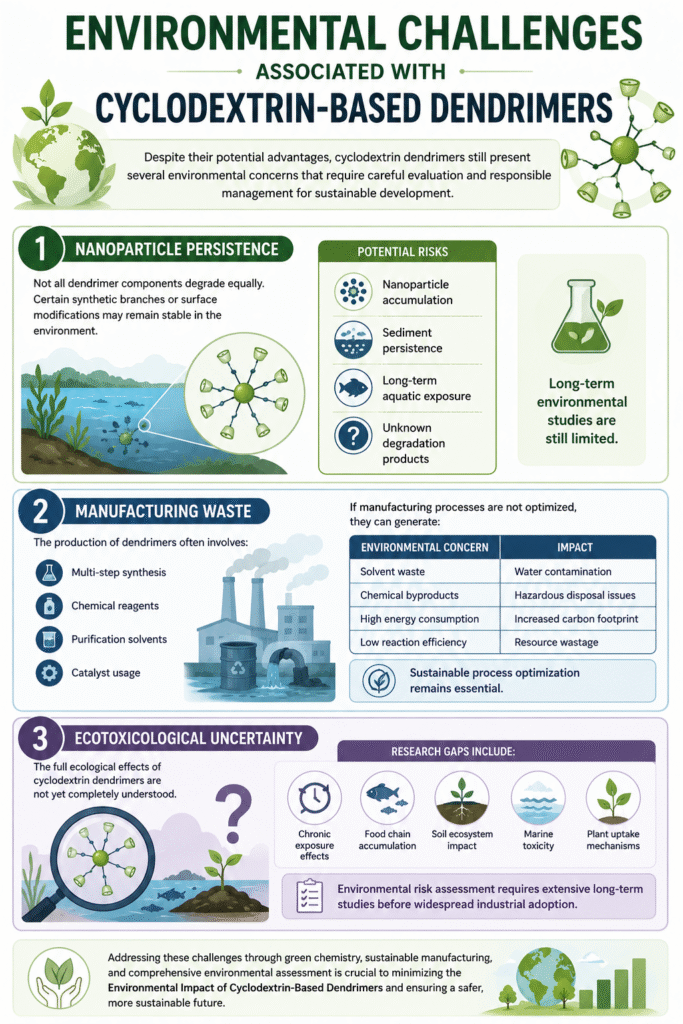
Although cyclodextrin-based dendrimers offer promising environmental and biomedical advantages, they still present several ecological and sustainability concerns. Understanding these limitations is essential for developing safer nanomaterials and ensuring responsible commercialization.
The Environmental Impact of Cyclodextrin-Based Dendrimers depends not only on their biodegradable components but also on their synthesis methods, structural modifications, environmental persistence, and long-term ecological behavior.
1. Nanoparticle Persistence
Not all dendrimer components degrade equally. Certain synthetic branches or surface modifications may remain stable in the environment.
Potential risks include:
- Nanoparticle accumulation
- Sediment persistence
- Long-term aquatic exposure
- Unknown degradation products
Long-term environmental studies are still limited.
2. Manufacturing Waste
The production of dendrimers often involves:
- Multi-step synthesis
- Chemical reagents
- Purification solvents
- Catalyst usage
If manufacturing processes are not optimized, they can generate:
| Environmental Concern | Impact |
|---|---|
| Solvent waste | Water contamination |
| Chemical byproducts | Hazardous disposal issues |
| High energy consumption | Increased carbon footprint |
| Low reaction efficiency | Resource wastage |
Sustainable process optimization remains essential.
3. Ecotoxicological Uncertainty
The full ecological effects of cyclodextrin dendrimers are not yet completely understood.
Research gaps include:
- Chronic exposure effects
- Food chain accumulation
- Soil ecosystem impact
- Marine toxicity
- Plant uptake mechanisms
Environmental risk assessment requires extensive long-term studies before widespread industrial adoption.
5: Lifecycle Assessment of Cyclodextrin-Based Dendrimers
Lifecycle assessment (LCA) evaluates the environmental impact of materials from production to disposal.
For cyclodextrin dendrimers, key lifecycle stages include:
Raw Material Sourcing
Advantages:
- Renewable carbohydrate feedstocks
Challenges:
- Agricultural resource consumption
- Water use during starch processing
Manufacturing
Advantages:
- Potential for green synthesis
Challenges:
- Complex multistep reactions
- Solvent-intensive purification
Product Use
Advantages:
- Lower toxicity potential
- Targeted delivery reducing chemical waste
Challenges:
- Environmental release during use
Disposal and Degradation
Advantages:
- Partial biodegradability
Challenges:
- Incomplete degradation pathways
- Unknown nanoparticle residues
Lifecycle analysis helps organizations identify opportunities to improve sustainability.
6: Applications Supporting Environmental Sustainability
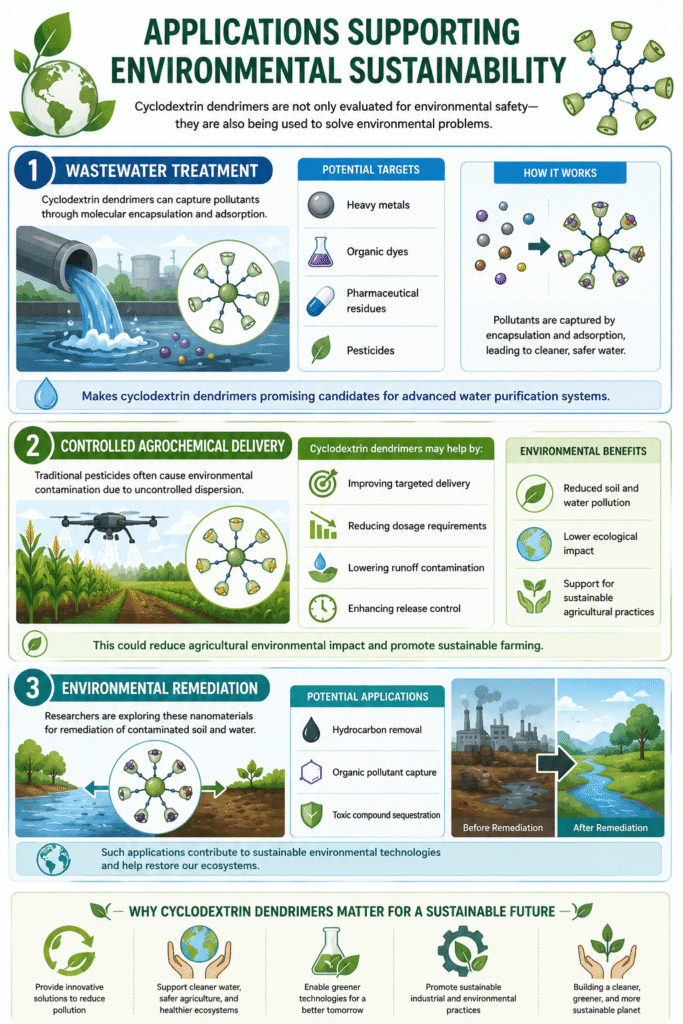
Cyclodextrin-based dendrimers are not only being studied for their environmental safety—they are also emerging as promising tools for solving environmental challenges. Their unique molecular structure, high surface functionality, and encapsulation capability make them useful in pollution control, water purification, sustainable agriculture, and environmental remediation.
The growing interest in the Environmental Impact of Cyclodextrin-Based Dendrimers is partly driven by their potential to support cleaner and more sustainable technologies.
1. Wastewater Treatment
Cyclodextrin dendrimers can capture pollutants through molecular encapsulation and adsorption.
Potential targets include:
- Heavy metals
- Organic dyes
- Pharmaceutical residues
- Pesticides
This makes them promising candidates for advanced water purification systems.
2. Controlled Agrochemical Delivery
Traditional pesticides often cause environmental contamination due to uncontrolled dispersion.
Cyclodextrin dendrimers may help by:
- Improving targeted delivery
- Reducing dosage requirements
- Lowering runoff contamination
- Enhancing release control
This could reduce agricultural environmental impact.
3. Environmental Remediation
Researchers are exploring these nanomaterials for remediation of contaminated soil and water.
Potential applications include:
- Hydrocarbon removal
- Organic pollutant capture
- Toxic compound sequestration
Such applications may contribute to sustainable environmental technologies.
7: Regulatory Considerations
Regulatory agencies worldwide are increasingly focusing on nanomaterial safety.
For cyclodextrin dendrimers, regulatory evaluation may include:
| Regulatory Focus | Importance |
|---|---|
| Toxicity testing | Human and environmental safety |
| Biodegradation studies | Persistence evaluation |
| Waste disposal assessment | Environmental protection |
| Manufacturing compliance | Sustainable production |
| Nanoparticle characterization | Quality consistency |
Organizations developing dendrimer-based products must provide robust analytical data supporting environmental safety.
8: Role of Advanced Analytical Testing
Comprehensive analytical characterization is essential for evaluating the Environmental Impact of Cyclodextrin-Based Dendrimers.
Key analytical techniques include:
- Mass spectrometry
- Dynamic light scattering (DLS)
- Zeta potential analysis
- GPC/SEC analysis
- NMR spectroscopy
- FTIR spectroscopy
- Thermal analysis
- Particle size characterization
These techniques help determine:
- Structural consistency
- Impurity profiles
- Stability
- Degradation behavior
- Environmental fate
Analytical laboratories play a critical role in ensuring nanomaterials meet environmental and regulatory standards.
Conclusion:
The Environmental Impact of Cyclodextrin-Based Dendrimers represents both a challenge and an opportunity for modern nanotechnology. These advanced materials offer promising environmental advantages including biodegradability, reduced toxicity potential, and compatibility with green chemistry approaches.
At the same time, important concerns remain regarding nanoparticle persistence, manufacturing waste, ecotoxicity, and long-term environmental fate. Continued research, lifecycle assessment, and regulatory oversight are essential to ensure safe and sustainable implementation.
As the field evolves, cyclodextrin-based dendrimers may become key contributors to environmentally responsible pharmaceutical, industrial, and environmental technologies. Organizations involved in dendrimer research and manufacturing must prioritize comprehensive analytical characterization and sustainable process development to support safer commercialization.
Frequently Asked Questions:
The Environmental Impact of Cyclodextrin-Based Dendrimers refers to how these nanomaterials affect ecosystems, water systems, soil, microorganisms, and living organisms. Researchers study their biodegradability, toxicity, environmental persistence, and manufacturing footprint to determine whether they are safer alternatives to conventional nanomaterials. Their environmental behavior depends on their structure, surface chemistry, and degradation profile. Understanding these impacts is essential for sustainable industrial and pharmaceutical applications.
Cyclodextrin-based dendrimers are considered more environmentally friendly than many traditional synthetic polymers because cyclodextrins are derived from renewable starch sources. They may offer improved biodegradability and lower toxicity profiles. Additionally, green chemistry synthesis methods can reduce manufacturing waste and solvent use. However, complete environmental safety still requires long-term ecological and toxicological studies. Sustainability depends on both material design and production practices.
Cyclodextrin dendrimers are important in sustainable nanotechnology because they combine biodegradable carbohydrate structures with multifunctional nanoscale properties. They can support cleaner drug delivery systems, wastewater treatment technologies, and environmental remediation applications. Their ability to reduce toxicity and improve targeted delivery makes them attractive for greener industrial processes. Researchers are also exploring renewable and energy-efficient synthesis methods. These features align with global sustainability goals.
Yes, cyclodextrin-based dendrimers are being studied for advanced wastewater treatment and pollutant removal applications. Their molecular encapsulation and adsorption capabilities allow them to capture contaminants such as heavy metals, pesticides, pharmaceutical residues, and organic dyes. This can improve water purification efficiency and reduce environmental contamination. Their multifunctional structure also supports selective pollutant binding. These properties make them promising materials for sustainable water treatment systems.
Many cyclodextrin dendrimers show potential biodegradability because cyclodextrins originate from natural starch-based materials. Their carbohydrate components may degrade more easily than petroleum-derived polymers. However, some synthetic dendrimer branches or surface modifications may remain stable in the environment. Biodegradability depends on molecular structure, environmental conditions, and formulation chemistry. Researchers continue developing fully biodegradable dendrimer systems for safer environmental applications.
Potential environmental risks include nanoparticle persistence, sediment accumulation, unknown degradation products, and ecotoxicological uncertainty. Since nanomaterials can interact differently with ecosystems than traditional chemicals, researchers are evaluating long-term exposure effects on aquatic organisms, soil systems, and food chains. Risks also depend on concentration, particle size, and surface chemistry. Comprehensive environmental risk assessment is essential before large-scale industrial use.
Cyclodextrin dendrimers are being explored for controlled agrochemical delivery systems in agriculture. They may improve pesticide and fertilizer efficiency by enabling targeted delivery and controlled release. This can reduce chemical overuse, runoff contamination, and environmental pollution. Controlled-release technologies may also lower the frequency of chemical application. Such applications support more sustainable agricultural practices and reduced ecological impact.
Reference
- Pandey A. Cyclodextrin-based nanoparticles for pharmaceutical applications: A review. Environmental Chemistry Letters. 2021 Dec;19(6):4297-310.https://link.springer.com/article/10.1007/s10311-021-01275-y
- Crini G, Fourmentin S, Fenyvesi É, Torri G, Fourmentin M, Morin-Crini N. Cyclodextrins, from molecules to applications. Environmental chemistry letters. 2018 Dec 15;16(4):1361-75.https://link.springer.com/article/10.1007/s10311-018-0763-2
- Packirisamy V, Rugmangathan J, Palani D, Ariyamuthu R. Systems based on cyclodextrin for environmental pollutant detection and monitoring: potential applications. International Journal of Environmental Analytical Chemistry. 2026 May 3;106(6):1428-42.https://www.tandfonline.com/doi/abs/10.1080/03067319.2025.2548941
- Topuz F, Uyar T. Recent advances in cyclodextrin‐based nanoscale drug delivery systems. Wiley Interdisciplinary Reviews: Nanomedicine and Nanobiotechnology. 2024 Nov;16(6):e1995.https://wires.onlinelibrary.wiley.com/doi/abs/10.1002/wnan.1995
- Mellet CO, Fernández JM, Benito JM. Cyclodextrin-based gene delivery systems. Chemical Society Reviews. 2011;40(3):1586-608.https://pubs.rsc.org/en/content/articlehtml/2011/cs/c0cs00019

