

Introduction
Achieving an efficient EU Generic Drug Dossier Development and EMA Submission through a Canadian Contract Development and Manufacturing Organization (CDMO) requires careful coordination between Health Canada manufacturing practices, European Medicines Agency (EMA) electronic Common Technical Document (eCTD) requirements, and applicable bioequivalence standards. This technical case study outlines how transatlantic drug development partnerships can utilize the Canada-EU Comprehensive Economic and Trade Agreement (CETA) Protocol to optimize regional Module 1 requirements, Module 3 Chemistry, Manufacturing, and Controls (CMC) documentation, and Qualified Person (QP) oversight.
For pharmaceutical sponsors planning commercialization within the European Union (EU), the regulatory route established under Article 10(1) of Directive 2001/83/EC offers a structured framework for generic drug authorization. Under this statutory pathway, applicants are not required to provide independent non-clinical safety studies or clinical efficacy trials when bioequivalence with an authorized European reference product has been conclusively demonstrated and Module 3 CMC documentation establishes appropriate and consistent quality standards. Nevertheless, non-EU sponsors and contract manufacturers commonly encounter several technical challenges, such as Active Substance Master File (ASMF) integration, European Pharmacopoeia (Ph. Eur.) compliance, EudraLex Volume 4 Annex 11 computer validation, and regional package leaflet readability requirements. Collaboration with an experienced Canadian CDMO that combines Health Canada Drug Establishment Licensing (DEL) requirements with European regulatory expectations can address these gaps and support more efficient dossier validation and regulatory clearance.
To streamline your North American CDMO partnerships, explore how to leverage a peptide CDMO in Canada for your regulatory submissions.
Share via:
Quick Summary:
- EU generic drug dossier development requires alignment between Health Canada GMP practices, EMA/eCTD requirements, EU bioequivalence standards, and Qualified Person (QP) oversight.
- Sponsors can choose the Centralised Procedure (CP), Decentralised Procedure (DCP), or Mutual Recognition Procedure (MRP) depending on their target EU markets and existing authorizations.
- The dossier combines EU Module 1 with ICH Modules 2–5, with strong focus on Module 3 CMC, ASMF integration, Ph. Eur. compliance, SmPC/PIL readability, and Environmental Risk Assessment.
- QP compliance is essential for non-EU manufacturing sites, including GMP systems, Annex 11 computer validation, data integrity, supply-chain traceability, audits, and Technical Quality Agreements.
- Bioequivalence generally requires AUC and Cmax 90% confidence intervals within 80–125%, with EEA-sourced reference products and bio-bridging when non-EEA references were used.
- The Canada-EU CETA GMP mutual-recognition framework can reduce duplicate inspections and regulatory effort while supporting GMP certificate recognition and EU market supply.
- Effective management of the 210-day EMA review and clock-stops—combined with an integrated Canadian CDMO pathway—can improve submission readiness and potentially shorten overall approval timelines from 14–18 months to 10–12 months.
Procedural Strategy for EU Generic Drug Dossier Development and EMA Submission
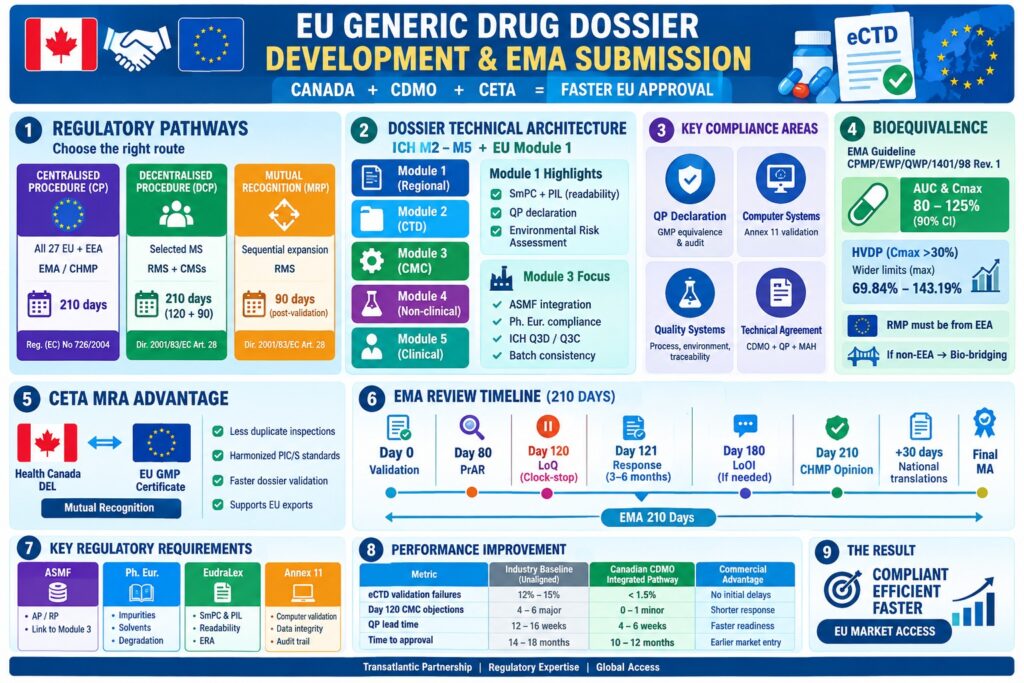
Determining the most appropriate regulatory pathway for an EU generic application depends largely on the intended geographic distribution of the product. Sponsors generally assess whether the Centralised Procedure (CP), which provides a single authorization covering the EU, or the Decentralised Procedure (DCP), which supports authorization across selected Member States, is more appropriate for their commercialization strategy. The choice of procedure and the designation of the Reference Member State (RMS) establish the regulatory assessment structure, review timelines, and national translation obligations under Directive 2001/83/EC.
If you are choosing between regions, evaluate the differences between Canadian vs US peptide CDMOs to optimize your regulatory pathway.
The Decentralised Procedure is widely used for generic drug products intended for authorization in several EU Member States at the same time when the product has not previously obtained authorization in an EU territory. During a DCP, the applicant nominates one national competent authority as the RMS. The RMS assumes responsibility for the scientific assessment, prepares the Preliminary Assessment Report (PrAR), and facilitates agreement among the Concerned Member States (CMSs). Selecting an appropriate RMS is strategically important because individual regulatory agencies may differ in their technical review capabilities, rapporteur availability, and regional expectations concerning analytical batch testing.
When managing cross-border drug filings, compare the advantages of United States vs overseas peptide CDMOs for dossier preparation.
The Centralised Procedure, by comparison, is mandatory for biotechnology-derived medicines and advanced therapies. It may also be used as an optional pathway for generic medicines when they demonstrate substantial technical or scientific innovation or when authorization is considered to provide a wider public health benefit throughout the EU. Under the Centralised Procedure, the application is submitted directly to the EMA in Amsterdam, where the Committee for Medicinal Products for Human Use (CHMP) performs a consolidated scientific assessment. A successful application results in a single legally binding Community Marketing Authorisation issued by the European Commission, which applies throughout the EU Member States and European Economic Area (EEA) countries.
| Regulatory Procedure | Target Market Scope | Evaluating Body & Leadership | Evaluation Timetable | Primary Legal Framework |
|---|---|---|---|---|
| Centralised Procedure (CP) | All 27 EU Member States + EEA | EMA / CHMP (Rapporteur & Co-Rapporteur) | 210 Active Evaluation Days | Regulation (EC) No 726/2004 |
| Decentralised Procedure (DCP) | Selected EU Member States | Reference Member State (RMS) + CMSs | 210 Days (Step I: 120d, Step II: 90d) | Directive 2001/83/EC Art. 28 |
| Mutual Recognition (MRP) | Sequential EU expansion | RMS (based on existing national MA) | 90 Days post-validation | Directive 2001/83/EC Art. 28 |
Technical Architecture of EU Generic Drug Dossier Development and EMA Submission
Developing the technical framework for an EU generic drug dossier involves compiling the standard International Council for Harmonisation (ICH) Modules 2 through 5 together with the specialized European Module 1, which contains regional administrative information and Product Information. A successful dossier requires close alignment between Module 3 CMC validation data and the claims presented in national Summary of Product Characteristics (SmPC) documents, outer labeling, and Patient Information Leaflets (PIL).
The regional requirements outlined in EudraLex Volume 2B establish the framework for compiling Module 1. In addition to the standard administrative documentation, this module requires a complete draft of the SmPC, which functions as the legal and clinical foundation for prescribing information throughout Europe. The package leaflet must also undergo formal User Consultation, commonly referred to as readability testing. During this process, representative target patient panels assess whether essential safety information, dosage directions, and side effect warnings are sufficiently clear, readable, understandable, and usable. Module 1 also requires documentation demonstrating Qualified Person (QP) oversight, together with an Environmental Risk Assessment (ERA) addressing possible eco-toxicity risks related to drug disposal and patient excretion.
Module 3 CMC and Active Substance Master File Integration
The integration of Active Substance Master Files (ASMF) into Module 3 requires precise coordination between the confidential synthesis information held by the API manufacturer and the finished product control strategy implemented by the CDMO. Canadian CDMOs must verify that analytical specifications covering elemental impurities (ICH Q3D), residual solvents (ICH Q3C), and degradation products are appropriately aligned with European Pharmacopoeia (Ph. Eur.) standards and EudraLex Volume 4 requirements.
If your generic pipeline involves peptide therapeutics, learn about outsource peptide manufacturing to CDMO for expert synthesis and regulatory assistance.
The ASMF procedure, which is also referred to as the European Drug Master File (EDMF) system, divides active substance information into an Applicant’s Part (AP) and a Restricted Part (RP). The Applicant’s Part is accessible to the marketing authorization applicant and CDMO and contains important technical information concerning API physical properties, specifications, stability data, and routine analytical testing procedures. The Restricted Part contains confidential proprietary information related to manufacturing operations, detailed reaction conditions, and catalyst controls, which is supplied by the API manufacturer directly to the relevant regulatory authorities. The contract manufacturer must ensure that Module 3, Section 3.2.S, of the finished product dossier corresponds accurately with the AP content. This consistency is essential for maintaining traceability of batch-to-batch consistency and critical quality attributes (CQAs) throughout regulatory submissions.
To ensure strict compliance for complex drug structures, review our GLP-1 peptide analytical characterization methodologies.
Qualified Person Declaration and Site Compliance
A Qualified Person (QP) Declaration provides confirmation that manufacturing facilities located outside the EU comply with Good Manufacturing Practice (GMP) standards equivalent to those established in EudraLex Volume 4, as required by Article 46(f) of Directive 2001/83/EC. Non-EU CDMOs therefore need comprehensive quality management systems, computer system validation consistent with Annex 11, and appropriate supply chain traceability to withstand QP audit evaluation.
- Verification of API supply chain integrity through routine on-site QP audits or established and recognized audit-sharing frameworks.
- Maintenance of validated manufacturing process documentation, environmental monitoring systems, and cleanroom controls that meet EudraLex Volume 4 Annex 1 requirements.
- Qualification and verification of analytical instruments together with computerized data integrity systems operating in accordance with EudraLex Volume 4 Annex 11.
- Implementation of formal Technical Quality Agreements that clearly define responsibilities among the non-EU manufacturing site, the QP, and the Marketing Authorization Holder (MAH).
When selecting a partner capable of passing QP audits, learn how to choose a peptide CDMO in the US with robust quality management systems.
Bioequivalence Alignment under EMA Guideline CPMP/EWP/QWP/1401/98 Rev. 1
Bioequivalence in an EMA generic drug submission is demonstrated by establishing that the candidate formulation provides an equivalent rate and extent of systemic exposure relative to an EEA-sourced reference product. The standard acceptance criterion requires 90% confidence intervals within 80.00-125.00% for AUC and Cmax. Clinical pharmacology programs must be designed in accordance with EMA guideline CPMP/EWP/QWP/1401/98 Rev. 1, including provisions that allow specific widened acceptance criteria for highly variable drug products.
For guidance on establishing bioequivalence for non-standard dosage forms, explore our bioequivalence study design for complex generic drug products.
European regulatory requirements specify that the Reference Medicinal Product (RMP) used in bioequivalence studies must be obtained from a country within the European Economic Area (EEA). When preliminary formulation screening or clinical development has been performed using a non-EEA reference product, the applicant must provide a comprehensive bio-bridging package. Such a package involves comparative analytical characterization, including multi-media in vitro dissolution testing under physiological pH conditions at pH 1.2, 4.5, and 6.8, characterization of physical form, and quantitative comparison of impurities. These studies are intended to establish that the non-EEA product is equivalent to the EEA-sourced reference medicine.
For complex generic formulations such as injectables, discover key insights on formulating a lyophilized peptide injectable to ensure batch-to-batch bioequivalence.
For Highly Variable Drug Products (HVDP), defined as drug substances with intra-individual variability of Cmax greater than 30%, the EMA guideline allows a widened acceptance interval for peak exposure. The expanded Cmax acceptance limits are determined using a scaled average bioequivalence approach based on the intra-subject standard deviation of the reference product (σWR):
[U, L]=exp(∓k⋅σWR)[ U,\ L ] = \exp\left( \mp k \cdot \sigma_{WR} \right)
where k has a fixed value of 0.760. The maximum permitted expansion of the Cmax confidence interval is limited to 69.84% – 143.19%.
Leveraging the Canada-EU MRA for EU Generic Drug Dossier Development and EMA Submission
The Canada-EU Comprehensive Economic and Trade Agreement (CETA) Protocol on Good Manufacturing Practice (GMP) provides an important regulatory mechanism through which Canadian drug manufacturers can utilize Health Canada Drug Establishment Licenses (DEL) as recognized evidence of regulatory compliance in European submissions. By supporting mutual recognition of GMP-related activities, this framework can reduce the need for duplicative inspections by European competent authorities and consequently decrease regulatory preparation requirements and associated overhead.
Within the operational scope of CETA, Health Canada and EU national competent authorities recognize GMP compliance inspection outcomes for human pharmaceutical manufacturing facilities located within their respective jurisdictions. The mutual recognition framework also covers certain extra-jurisdictional inspection outcomes and facilitates the exchange of GMP Certificates. Canadian CDMOs operating under Health Canada’s Drug Establishment License framework can therefore support the export of finished drug products to EU Member States with a reduced likelihood of additional inspection, while benefiting from harmonized Pharmaceutical Inspection Co-operation Scheme (PIC/S) standards.
To understand the difference between integrated development and pure contract manufacturing, read our guide on peptide CDMO vs CMO.
| Regulatory Domain | Health Canada Framework | EudraLex / EMA Framework | CETA MRA Operational Impact |
|---|---|---|---|
| GMP Standard Guidance | Health Canada GUI-0001 | EudraLex Volume 4 (Parts I, II, III) | Mutual recognition of equivalent GMP standards |
| Facility Certification | Drug Establishment License (DEL) | EU GMP Certificate | Direct acceptance of Health Canada inspection results |
| Computer Systems Compliance | Health Canada Annex 11 equivalents | EudraLex Volume 4, Annex 11 | Alignment via harmonized PIC/S PE 009-17 guidelines |
| Batch Release & Testing | Mandatory C.02.019 testing | EudraLex Vol 4 Annex 16 QP Release | Waives redundant full re-testing upon EU importation |
Timeline and Clock-Stop Dynamics in EMA Submissions
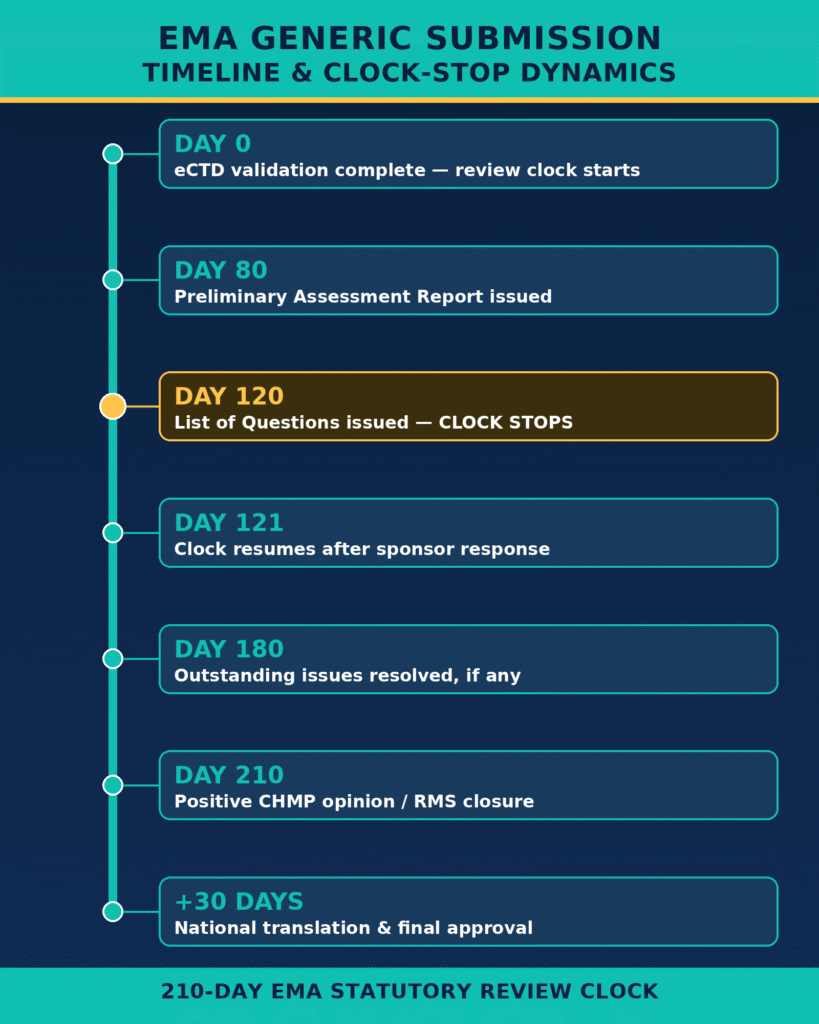
Effective management of the statutory 210-day EMA review process requires advance preparation for scheduled clock-stops, particularly around Day 120 and Day 180, when applicants may need to respond to regulatory questions. Contract manufacturers have a critical role during these clock-stops because they may be required to generate additional analytical, stability, or validation data within strict response periods ranging from three to six months.
The formal evaluation process begins at Day 0 after successful completion of eCTD administrative and technical validation. At approximately Day 80, the RMS or Rapporteur completes the Preliminary Assessment Report (PrAR) and distributes the assessment comments to the co-evaluating authorities. By Day 120, the agency consolidates regulatory comments into a List of Questions (LoQ), which may address CMC, clinical bioequivalence, and administrative matters. The review clock then stops at Day 120, providing the applicant with a three-month period to prepare and submit a comprehensive response. This period may be extended to as much as six months where applicable.
Following submission of the response documentation, the assessment clock resumes at Day 121. If limited scientific disagreements remain at Day 180, a List of Outstanding Issues (LoOI) may be generated. Resolution of these matters can potentially involve an oral hearing before the CHMP or CMDh. Once the outstanding issues have been satisfactorily addressed, a positive CHMP opinion or RMS closure report can be issued at Day 210. This is followed by the 30-day national translation phase for product labeling and the subsequent issuance of the final marketing authorization.
To ensure your process scale-up avoids Day 120 clock-stop delays, explore our expert peptide CDMO scale up services.
| Operational Metric | Industry Baseline (Unaligned) | Canadian CDMO Integrated Pathway | Commercial Advantage |
|---|---|---|---|
| eCTD Technical Validation Failures | 12% – 15% | < 1.5% | Prevents initial submission processing delays. |
| Day 120 CMC Objections | Average 4–6 major questions | 0–1 minor question | Shortens clock-stop response duration. |
| QP Declaration Processing Lead Time | 12–16 weeks | 4–6 weeks | Accelerates Module 1 readiness. |
| Overall Time-to-Approval | 14–18 months | 10–12 months | Delivers faster generic market entry across EU states. |
Conclusion
Successfully executing EU Generic Drug Dossier Development and EMA Submission depends on effectively combining North American contract manufacturing capabilities with European technical, administrative, and clinical expectations. By taking advantage of transatlantic regulatory frameworks such as the Canada-EU CETA MRA, pharmaceutical sponsors can improve the efficiency of Module 3 CMC development, facilitate Qualified Person site compliance, and approach EMA bioequivalence assessments with greater regulatory precision. Working with an experienced Canadian CDMO provides generic drug developers with the technical expertise, quality systems, and regulatory infrastructure required to pursue efficient approval and commercialization across European markets.
To discuss your EU dossier preparation, regulatory submission strategy, or contract manufacturing requirements, connect with our technical regulatory team at ResolveMass Contact Us.
Frequently Asked Questions
The Canada-EU CETA Protocol on GMP facilitates mutual recognition of relevant pharmaceutical manufacturing inspection outcomes between Health Canada and European authorities. This framework can reduce duplication in GMP inspection activities for eligible manufacturing sites and support more efficient regulatory preparation. Canadian CDMOs can therefore use established Health Canada compliance documentation to facilitate European regulatory activities.
A bioequivalence study conducted in North America may support an EMA generic application when its design, conduct, and bioanalytical methodology satisfy applicable European requirements. The Reference Medicinal Product should be sourced from the European Economic Area (EEA) for direct applicability. When a non-EEA reference product is used, appropriate bio-bridging evidence may be required to establish comparability with the EEA reference.
EU eCTD Module 1 contains region-specific administrative information required for European regulatory assessment. Key components include the application form, draft Summary of Product Characteristics (SmPC), labeling materials, and Patient Information Leaflets (PIL). It may also include User Consultation documentation, Qualified Person (QP) information, and an Environmental Risk Assessment (ERA), as applicable.
An Active Substance Master File (ASMF) enables API manufacturers to provide regulators with critical quality information while protecting confidential manufacturing knowledge. It is divided into an Applicant’s Part (AP) and a Restricted Part (RP). The AP provides information available to the applicant and CDMO, whereas the RP contains proprietary manufacturing details submitted directly by the API manufacturer to the relevant regulatory authority.
A Qualified Person (QP) Declaration supports confirmation that manufacturing activities performed at a non-EU site meet applicable European GMP expectations. Under Article 46(f) of Directive 2001/83/EC, appropriate oversight is required for medicinal products manufactured outside the EU and imported into the EEA. The QP evaluates relevant quality systems, manufacturing documentation, computer validation, and GMP controls against EudraLex Volume 4 requirements.
The Centralised Procedure involves a coordinated scientific assessment through the EMA and can result in a single Community Marketing Authorisation covering the applicable EU/EEA markets. The Decentralised Procedure is generally used when the product has not yet been authorized in an EU Member State and authorization is sought simultaneously in multiple selected states. Under the DCP, a designated Reference Member State (RMS) leads the assessment with input from Concerned Member States (CMSs).
Under EMA guideline CPMP/EWP/QWP/1401/98 Rev. 1, Highly Variable Drug Products (HVDP) with intra-subject Cmax variability above 30% may qualify for a scaled average bioequivalence approach. This approach can allow a wider acceptance range for Cmax than the conventional 80.00-125.00% interval. The permitted expansion is determined from the intra-subject variability of the reference product and can reach 69.84-143.19%.
A major review clock-stop commonly occurs around Day 120 when the applicant receives the List of Questions (LoQ). The applicant is generally provided approximately three months to prepare responses, with an extension of up to six months possible where justified. Additional issues identified later in the assessment may result in a List of Outstanding Issues (LoOI) and further regulatory interaction.
After a positive CHMP opinion or completion of the applicable decentralized assessment, the applicant enters the post-procedural translation phase. SmPC, labeling, and package leaflet content must be translated into the official languages required by the relevant Member States. The translated materials are reviewed and submitted to the national competent authorities before the final marketing authorization process is completed.
Reference:
- European Medicines Agency. (2026, September 2). Pre-authorisation guidance. European Medicines Agency
- Government of Canada. (2026, June 1). Mutual Recognition Agreement between Canada and the European Union (EU). Canada.ca
- European Medicines Agency. (n.d.). European Medicines Agency procedural advice for users of the centralised procedure for similar biological medicinal product applications. European Medicines Agency. EMA document
- Health Canada. (2024, January). Evaluation of the Pharmaceutical Drugs Program. Government of Canada. https://www.canada.ca/en/health-canada/corporate/transparency/corporate-management-reporting/evaluation/pharmaceutical-drugs-program.html
- European Medicines Agency. (2024, November 7). Authorisation of medicines. European Medicines Agency. https://www.ema.europa.eu/en/about-us/what-we-do/authorisation-medicines
- European Medicines Agency. (2026, July 14). Clinical pharmacology and pharmacokinetics: Questions and answers. European Medicines Agency. EMA webpage
Get In Touch With Us
About The Author


