

Introduction
Achieving Extractables and Leachables (E&L) Compliance for a Dry Powder Inhaler intended for European Medicines Agency (EMA) approval demands extensive chemical characterization and toxicological assessment to ensure that packaging materials and device components do not introduce harmful substances into the pulmonary system. This case study examines the comprehensive analytical and regulatory approach required to establish the safety and quality of a novel Dry Powder Inhaler (DPI) undergoing Marketing Authorization Application (MAA) review within the European Union.
Orally Inhaled and Nasal Drug Products (OINDPs), particularly DPIs, are considered high-risk drug delivery systems because they come into direct contact with pulmonary mucosal tissues and can enable systemic absorption without undergoing hepatic first-pass metabolism. Although dry powder formulations do not involve the continuous liquid-device interaction observed in pressurized metered-dose inhalers (pMDIs) or nebulized liquid formulations, DPIs present distinct challenges related to chemical migration. Potential leachables may arise from powder reservoirs, blister packaging laminates, thermal bonding adhesives, elastomeric sealing materials, and integrated desiccant components. The application of advanced chromatographic and spectroscopic techniques is therefore critical for identifying, quantifying, and toxicologically evaluating potential migrating compounds at concentrations below stringent regulatory thresholds.
For dedicated analytical solutions tailored to complex inhalation and nasal delivery systems, visit E&L Testing for Inhalation and Nasal Drug Products.
Article Summary:
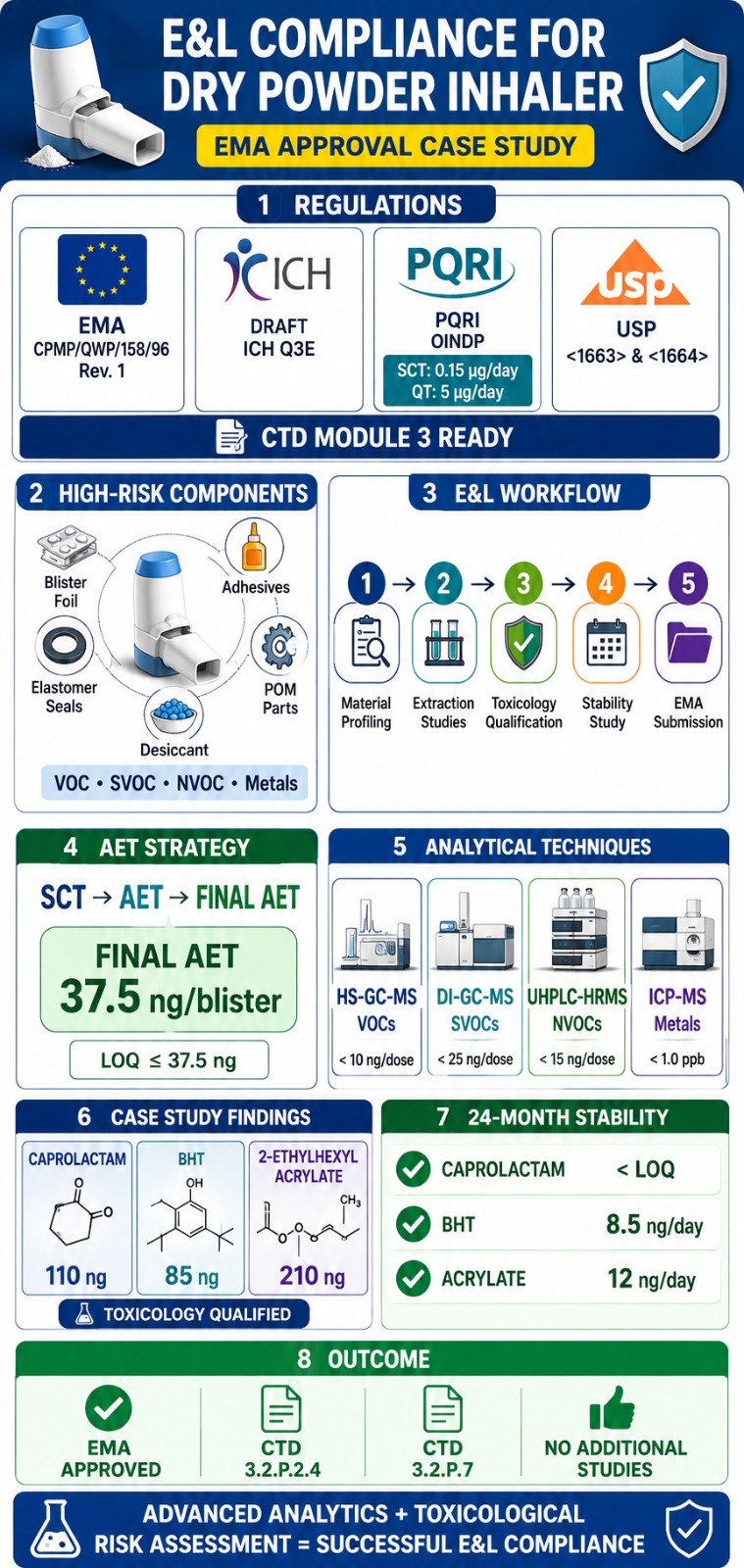
- E&L compliance is essential for EMA approval of Dry Powder Inhalers (DPIs), ensuring that packaging materials and device components do not release harmful compounds that could affect patient safety.
- EMA expectations are guided by EMA CPMP/QWP/158/96 Rev. 1, Draft ICH Q3E, PQRI OINDP recommendations, and USP <1663>/<1664>, requiring risk-based extractables and leachables assessment and CTD Module 3 documentation.
- A structured E&L workflow includes material risk assessment, controlled extraction studies, toxicological qualification, Analytical Evaluation Threshold (AET) determination, and long-term leachables monitoring throughout product shelf life.
- Advanced analytical techniques such as HS-GC-MS, DI-GC-MS, UHPLC-Orbitrap-HRMS/MS, and ICP-MS provide comprehensive detection of volatile, semi-volatile, non-volatile, and elemental impurities at ultra-trace levels.
- The case study identified key extractables including caprolactam, BHT/BHT-quinone, and 2-ethylhexyl acrylate, all of which underwent detailed toxicological evaluation and were demonstrated to remain within acceptable safety limits.
- Validated analytical methods and 24-month stability studies confirmed excellent method performance, low limits of quantitation, and leachable concentrations consistently below established Safety Concern Thresholds (SCTs) and Final AET values.
- A comprehensive analytical and toxicological strategy enabled successful EMA marketing authorization without additional information requests, demonstrating that robust E&L programs improve regulatory compliance, product quality, and patient safety.
Regulatory Framework for Extractables and Leachables (E&L) Compliance for a Dry Powder Inhaler
The EMA regulatory landscape requires comprehensive safety qualification of DPI container closure systems through CPMP/QWP/158/96 Rev. 1 and the draft ICH Q3E guideline, supported by PQRI-established safety thresholds. Regulatory compliance involves defining and justifying Safety Concern Thresholds (SCTs), Qualification Thresholds (QTs), and Analytical Evaluation Thresholds (AETs), all of which must be incorporated into CTD Module 3 documentation.
Among all pharmaceutical dosage forms, OINDPs are subject to some of the most rigorous regulatory expectations. EMA assessment typically requires compliance with several key standards:
EMA Guideline CPMP/QWP/158/96 (Revision 1)
This guideline outlines specific pharmaceutical quality requirements for inhalation products and requires comprehensive characterization of container closure systems along with compatibility assessments of device materials and drug product components.
Draft ICH Q3E Guideline
The draft ICH Q3E framework establishes a globally harmonized approach for evaluating and controlling extractable and leachable impurities. It integrates material characterization with quality risk management principles described in ICH Q9 and supports lifecycle management of E&L risks.
PQRI OINDP Recommendations
The Product Quality Research Institute (PQRI) recommendations define industry-recognized thresholds for inhaled products, including a Safety Concern Threshold (SCT) of 0.15 µg/day (150 ng/day) and a Qualification Threshold (QT) of 5 µg/day for individual organic leachables.
USP General Chapters <1663> and <1664>
These chapters provide standardized scientific frameworks for conducting controlled extraction studies and evaluating drug product leachables. They are widely used to support the design, execution, and interpretation of E&L investigations.
Learn more about USP methodology standards by reviewing USP Extractables and Leachables Guidance.
| Regulatory Framework / Guideline | Primary Scope & Focus Area | Key Threshold / Metric | EMA Compliance Requirement |
|---|---|---|---|
| EMA CPMP/QWP/158/96 Rev. 1 | Quality requirements for inhalation and nasal medicinal products | Specification limits for leachables throughout shelf life | Requires material characterization and leachables evaluation of device components |
| Draft ICH Q3E | Harmonized lifecycle management of E&L risk | Risk-based control strategy aligned with PDE and TTC concepts | Expected integration into CTD Module 3 sections 3.2.P.2.4 and 3.2.P.7 |
| PQRI OINDP Recommendations | Thresholds and scientific best practices for inhalation products | SCT: 0.15 µg/day (150 ng/day); QT: 5 µg/day | Widely accepted by EMA for AET calculation and toxicological qualification |
| USP <1663> / USP <1664> | Technical design of extraction and leachables studies | Analytical Evaluation Threshold (AET) determination | Provides standardized methodology for chemical characterization and risk assessment |
Risk Assessment and Component Profiling in Inhalation Systems
Risk assessment for dry powder inhalers involves a structured evaluation of both direct and indirect contact materials according to their extraction potential, chemical composition, and likelihood of contributing extractable compounds. Particular attention is given to primary drug-contact materials and components that may influence headspace equilibrium within the inhalation system. High-risk regions commonly include foil blister heat-seal coatings, polyurethane-based adhesives, polyoxymethylene mechanical components, and elastomeric sealing materials.
Dry Powder Inhalers generally fall into two principal design categories:
Pre-metered Systems
These systems contain pre-filled doses supplied in unit-dose formats such as aluminum blister strips or gelatin/HPMC capsules. Materials with direct product contact include foil laminates, heat-seal coatings, adhesive layers, and capsule shell pigments or colorants.
Device-metered Systems
These inhalers contain a bulk powder reservoir from which individual doses are mechanically dispensed. Relevant contact materials include reservoir surfaces, metering mechanisms, elastomeric gaskets, desiccant cartridges, spring assemblies, and other internal device components.
Although dry powder formulations generally demonstrate lower extraction rates than liquid-based products, volatile organic compounds (VOCs) and semi-volatile organic compounds (SVOCs) can migrate through gaseous-phase interactions within packaging headspace environments. Furthermore, micronized active pharmaceutical ingredients (APIs) and excipients such as lactose monohydrate possess extensive surface areas that may adsorb airborne organic contaminants originating from packaging materials, printing inks, engineering polymers such as polyoxymethylene and polypropylene, or even manufacturing and storage environments.
Read more about addressing packaging migration risks and nitrosamines at Packaging Leachables and Nitrosamine E&L.
Workflow Strategy for Extractables and Leachables (E&L) Compliance for a Dry Powder Inhaler
The E&L compliance process follows a structured progression beginning with USP <1663> controlled extraction studies conducted under exaggerated laboratory conditions and extending through toxicological assessment and long-term USP <1664> leachables monitoring. This stepwise strategy identifies potential extractables, establishes toxicological safety thresholds, and verifies product stability under actual storage conditions.
| Phase / Step | Operational Focus | Key Methodology | Core Regulatory Deliverable |
|---|---|---|---|
| Phase 1: Material Profiling | Risk ranking of polymers, foils, adhesives, pigments, and colorants | Material-contact mapping and headspace exposure modeling | Risk Assessment Report (CTD 3.2.P.2.4) |
| Phase 2: Controlled Extractions | Exaggerated extraction studies performed according to USP <1663> | HS-GC-MS, DI-GC-MS, UHPLC-HRMS, and ICP-MS screening | Comprehensive Extractables Profile and Relative Response Factor (RRF) Database |
| Phase 3: Toxicological Qualification | Determination of final AET values and establishment of acceptable safety margins | PDE calculations and ICH M7 mutagenic TTC evaluations | Toxicological Risk Assessment Report |
| Phase 4: Leachables Stability Assessment | Real-time and accelerated shelf-life monitoring according to USP <1664> | Targeted method validation and testing across T = 0–24 months | Final Leachables Control Strategy incorporated into CTD 3.2.P.7 |
Discover how analytical methodologies are evolving by checking out Future of Extractables and Leachables Testing.
Deriving the Analytical Evaluation Threshold (AET) for DPI Systems
The Analytical Evaluation Threshold (AET) translates the 0.15 µg/day Safety Concern Threshold (SCT) into a product-specific concentration limit while accounting for analytical uncertainty associated with detector response variability. Establishing an appropriate AET ensures that trace-level organic leachables with the potential to exceed toxicological safety limits are consistently detected, quantified, and assessed during the E&L program.
The PQRI approach for estimating the AET in an OINDP system is expressed as:
Estimated AET = (SCT / MDD) × (Formulation Dose Units / Packaging Unit Mass or Volume)
Where:
- SCT = Safety Concern Threshold (0.15 µg/day for OINDPs)
- MDD = Maximum Daily Dose (number of actuations or doses administered per day)
Case Calculation Example: Pre-Metered DPI Blister Pack
Consider a pre-metered DPI formulation containing a combination drug product packaged within a unit-dose aluminum-aluminum blister system, where:
- Maximum Daily Dose (MDD) = 2 actuations per day
- Packaging configuration = 1 dose per blister
- Weight of the primary-contact blister laminate per dose = 50 mg (0.05 g)
Calculate the Estimated AET per Blister Dose
Estimated AETdose = 0.15 µg/day ÷ 2 doses/day = 0.075 µg/blister = 75 ng/blister
Convert the Estimated AET into a Component Concentration
Estimated AETconcentration = 0.075 µg/blister 0.05 g blister material = 1.5 µg/g (1.5 ppm)
This corresponds to a concentration of 1.5 ppm within the blister laminate material.
Incorporating an Analytical Uncertainty Factor (UF)
Analytical detectors such as GC-MS and LC-MS frequently demonstrate different Relative Response Factors (RRFs) for unknown compounds. To reduce the possibility of false-negative results and ensure conservative impurity detection, an analytical uncertainty factor is applied during AET determination.
A default Uncertainty Factor (UF) of 50% (0.50) is commonly used, although a laboratory may derive a more specific value based on the variability observed within its RRF database.
The adjusted AET is calculated as follows:
Final AET = Estimated AET × (1 − UF)
Final AETdose = 75 ng/blister × (1 − 0.50) = 37.5 ng/blister
Based on this calculation, all analytical screening methods should demonstrate a Limit of Quantitation (LOQ) that is equal to or lower than 37.5 ng/blister to ensure adequate sensitivity for regulatory compliance.
Plan your project scope and budget effectively with Cost of Extractables and Leachables Testing.
Advanced Analytical Techniques and Method Validation
Comprehensive E&L investigations depend on a coordinated set of high-resolution analytical technologies capable of detecting volatile, semi-volatile, non-volatile, and elemental contaminants. Validation of these methods under cGMP and GLP requirements is essential to demonstrate acceptable recovery, precision, accuracy, and quantitation performance below the established Final AET, even in the presence of complex formulation matrices.
Because no single analytical platform can characterize every potential chemical species, a robust E&L program relies on multiple complementary analytical techniques that collectively provide broad chemical coverage.
Headspace Gas Chromatography-Mass Spectrometry (HS-GC-MS)
HS-GC-MS is primarily used to identify and quantify volatile organic compounds, including residual solvents, low-molecular-weight monomers, and volatile degradation products that may migrate from packaging or device materials into the inhalation system.
Direct Injection Gas Chromatography-Mass Spectrometry (DI-GC-MS)
DI-GC-MS is particularly effective for the analysis of semi-volatile organic compounds. Typical targets include plasticizers such as phthalates, processing lubricants including fatty acid amides, and antioxidant additives such as BHT and Irganox compounds.
Ultra-High Performance Liquid Chromatography Coupled with High-Resolution Tandem Mass Spectrometry (UHPLC-Orbitrap-HRMS/MS)
UHPLC-Orbitrap-HRMS/MS provides highly sensitive characterization of non-volatile organic compounds, including polymer oligomers, photoinitiators, thermal stabilizers, degradation products, and other complex extractable or leachable species that may not be amenable to gas chromatography.
Inductively Coupled Plasma Mass Spectrometry (ICP-MS)
ICP-MS is used to evaluate elemental impurities in accordance with ICH Q3D requirements. This technique enables ultra-trace quantification of metals that may originate from catalysts, pigments, packaging materials, manufacturing equipment, or device components. Common analytes include nickel, lead, cadmium, arsenic, zinc, and aluminum.
| Analytical Technique | Primary Target Analyte Class | Representative Compounds | Target Sensitivity / LOQ Threshold |
|---|---|---|---|
| HS-GC-MS | Volatile Organic Compounds (VOCs) | Residual solvents, low-molecular-weight monomers, alkanes | < 10 ng/dose |
| Direct Injection GC-MS | Semi-Volatile Organic Compounds (SVOCs) | BHT, palmitic acid, phthalates, slip agents | < 25 ng/dose |
| UHPLC-Orbitrap-HRMS | Non-Volatile Organic Compounds (NVOCs) | Irganox 1010, Irgafos 168, polymer oligomers | < 15 ng/dose |
| ICP-MS | Elemental Impurities (ICH Q3D) | Lead, cadmium, arsenic, nickel, aluminum | < 1.0 ppb |
Review comprehensive testing programs across pharmaceutical categories at Extractables and Leachables in Pharmaceutical Products.
Case Study Implementation: Technical Findings and EMA Dossier Approval
This case study illustrates how a combination corticosteroid/bronchodilator DPI successfully obtained EMA marketing authorization through the identification of critical extractable compounds and the establishment of scientifically justified toxicological safety margins. The resulting analytical and toxicological dataset fulfilled the requirements of CTD Module 3 and supported regulatory approval without the need for additional information requests or supplementary studies.
Packaging and Device Configuration
The evaluated drug product consisted of a fixed-dose combination of micronized fluticasone propionate and salmeterol xinafoate, formulated with coarse lactose monohydrate as the carrier excipient. The formulation was pre-metered into 60 individual aluminum-aluminum foil blister cavities arranged in a strip and incorporated into a multi-dose inhalation device.
The primary packaging system included a cold-form foil laminate composed of Polyvinyl Chloride (PVC), Aluminum, and Polyamide, sealed using a heat-seal lacquer. Secondary device materials included a polyoxymethylene (POM) ratchet mechanism, an acrylonitrile butadiene styrene (ABS) housing, a polypropylene (PP) mouthpiece, and a stainless steel spring assembly. Each material was assessed as part of the overall E&L risk evaluation to determine its potential contribution to extractable and leachable compounds.
Controlled Extraction Results and Structural Elucidation
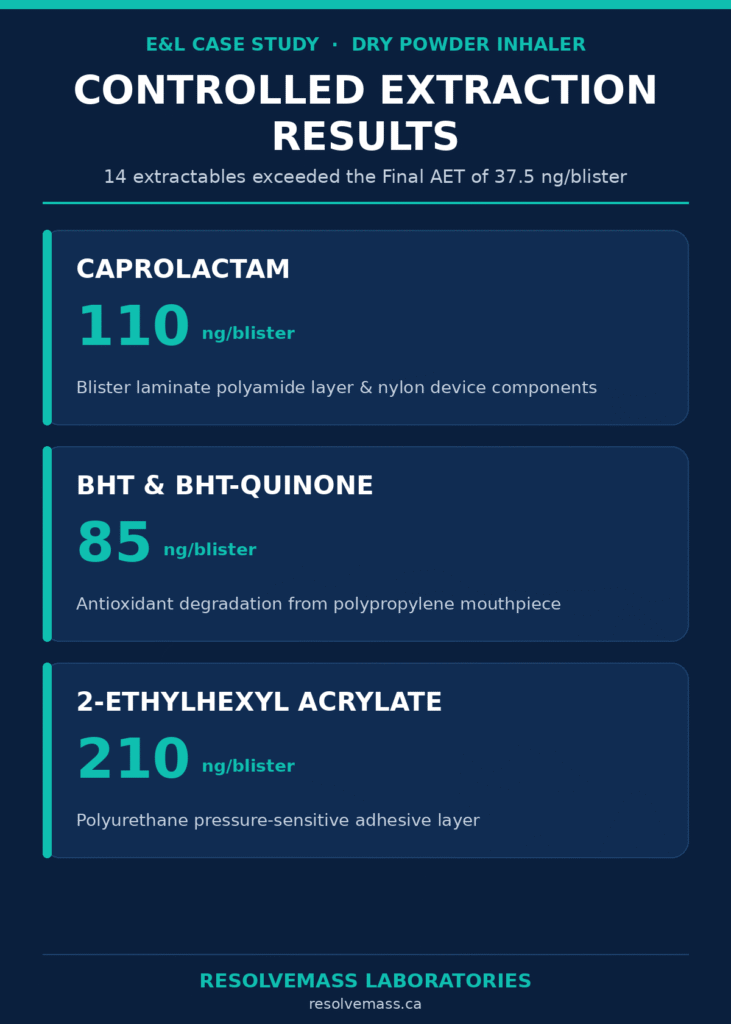
Controlled extraction studies performed according to USP <1663> conditions identified 14 unique chemical entities at concentrations exceeding the calculated Final AET of 37.5 ng/blister.
Structural characterization using high-resolution Orbitrap mass spectrometry combined with GC-MS spectral library matching revealed three extractable groups of particular regulatory significance:
Caprolactam (110 ng/blister)
Caprolactam was traced to mechanical wear associated with the polyamide layer of the blister laminate as well as nylon-based structural components within the device assembly. The compound was consistently detected during controlled extraction studies and therefore required toxicological qualification.
2,6-Di-tert-butyl-4-methylphenol (BHT) and BHT-Quinone (85 ng/blister)
These compounds were identified as antioxidant-related degradation products originating from the polypropylene mouthpiece material. Their presence reflected the use of polymer stabilization additives commonly incorporated into polypropylene formulations during manufacturing.
2-Ethylhexyl Acrylate (210 ng/blister)
This volatile monomer was linked to the polyurethane-based pressure-sensitive adhesive layer used within the multilayer foil laminate structure. Because acrylate-containing compounds may present toxicological concerns, this extractable became a primary focus of the qualification strategy.
See how real-world data handles complex scenarios at FDA Extractables and Leachables Case Studies.
Toxicological Qualification Strategy
The identified compounds underwent a comprehensive toxicological assessment using established European and international risk evaluation principles.
Caprolactam was assessed against its established Permissible Daily Exposure (PDE) of 100 µg/day. Estimated patient exposure at the maximum daily dose was approximately 0.22 µg/day, resulting in a Margin of Exposure (MoE) exceeding 450. This substantial safety margin indicated that caprolactam did not represent a meaningful toxicological risk under intended conditions of use.
2-Ethylhexyl Acrylate received additional scrutiny because the acrylate functional group can trigger genotoxicity concerns under ICH M7 guidelines. A structure-activity relationship (SAR) assessment was conducted to evaluate mutagenic potential. Although the compound warranted ongoing monitoring within the control strategy, the maximum estimated patient exposure of 0.42 µg/day remained well below the established Threshold of Toxicological Concern (TTC) for mutagenic impurities, which is 1.5 µg/day for chronic administration. Consequently, the observed exposure level was considered toxicologically acceptable.
The toxicological review concluded that all identified extractables were adequately controlled and did not pose a significant risk to patient safety when administered according to the approved dosing regimen.
Learn how carcinogenic and mutagenic risks are evaluated at Extractables and Leachables Carcinogenicity Testing.
Formal Leachables Method Validation and Shelf-Life Confirmation
Targeted analytical methods were subsequently developed and validated to monitor the compounds identified during the extraction phase.
A Headspace-GC-MS method was validated for the quantification of 2-ethylhexyl acrylate, while UHPLC-MS/MS methods were developed and validated for the determination of BHT and caprolactam in the presence of the formulated drug product.
Method validation demonstrated excellent analytical performance, including:
- Linearity with R² > 0.998
- Recovery values ranging from 92% to 108%
- Limits of Quantitation (LOQs) of 5.0 ng/blister
These performance characteristics confirmed that the methods possessed sufficient sensitivity and reliability to detect leachables at concentrations well below the established AET.
Long-term and accelerated stability studies were performed over a 24-month storage period under both:
- 25°C / 60% RH
- 40°C / 75% RH
Leachables monitoring generated the following findings:
Caprolactam
Caprolactam remained below the analytical limit of quantitation throughout the stability program. The absence of measurable migration was attributed to the lack of a liquid phase capable of facilitating extraction from the packaging materials into the dry powder formulation.
BHT
BHT migration reached a stable equilibrium concentration of approximately 8.5 ng/day, remaining substantially below its toxicologically acceptable exposure level and demonstrating no meaningful safety concern.
2-Ethylhexyl Acrylate
The compound migrated primarily into the package headspace and achieved a steady-state leachable concentration of approximately 12.0 ng/day. This value remained significantly below the 150 ng/day Safety Concern Threshold (SCT) established for OINDPs.
The comprehensive stability dataset confirmed that all monitored leachables remained within acceptable toxicological limits throughout the proposed shelf life.
As a result, the applicant was able to submit a complete E&L package within CTD Section 3.2.P.2.4 (Pharmaceutical Development) and CTD Section 3.2.P.7 (Container Closure System). The strength of the supporting analytical and toxicological evidence enabled successful EMA approval without requests for additional testing or supplemental regulatory clarification.
Conclusion
Achieving Extractables and Leachables (E&L) Compliance for a Dry Powder Inhaler requires a systematic and multidisciplinary approach that combines advanced analytical characterization with robust toxicological risk assessment. Through comprehensive material qualification, controlled extraction studies, threshold-based risk evaluation, and long-term leachables monitoring, pharmaceutical developers can establish the scientific evidence necessary to support both patient safety and regulatory compliance.
As demonstrated in this case study, the identification of potential migration pathways, coupled with analytical methods capable of detecting compounds below calculated AET limits, provides the objective data required to satisfy EMA expectations. A well-designed E&L strategy not only facilitates regulatory approval but also strengthens overall product quality throughout the development lifecycle.
Specialized Contract Research Organizations such as ResolveMass Laboratories Inc. offer advanced E&L testing programs, method development and validation services, extractables and leachables risk assessments, and toxicological evaluations specifically designed for complex inhalation and nasal drug products.
Partner with leading CRO specialists to streamline your regulatory journey through Extractables and Leachables Testing Laboratory Capabilities.
To explore customized analytical and regulatory strategies for inhalation and nasal drug delivery systems, connect with the experienced scientific team at ResolveMass Laboratories Inc. through their Contact Us channel.
Frequently Asked Questions (FAQs)
Dry Powder Inhalers deliver medication directly to the respiratory tract, allowing substances to reach the lungs without undergoing first-pass metabolism in the liver. Because inhaled compounds can be rapidly absorbed through pulmonary tissues, even trace levels of unwanted contaminants may pose local or systemic safety concerns. As a result, regulatory authorities apply particularly stringent E&L requirements to inhalation products.
For Orally Inhaled and Nasal Drug Products (OINDPs), regulatory assessments commonly reference a Safety Concern Threshold of 0.15 µg/day (150 ng/day) for individual unidentified organic leachables. Compounds present below this threshold are generally considered unlikely to present significant toxicological risk. However, additional evaluation may still be necessary if a compound contains structural features associated with genotoxicity or carcinogenicity.
Materials most frequently associated with E&L concerns include multilayer blister laminates, polyurethane-based adhesives, heat-seal coatings, printing inks, elastomeric sealing components, and integrated desiccant systems. These materials may contain additives, residual monomers, processing aids, or degradation products capable of migrating into the device environment over time. Consequently, they are often prioritized during risk assessments and extraction studies.
The draft ICH Q3E guideline promotes a harmonized global approach for managing extractables and leachables throughout a product’s lifecycle. It encourages comprehensive material characterization, science-based risk assessments, and clearly defined control strategies supported by analytical and toxicological data. For EMA submissions, the guideline strengthens expectations for documenting E&L risk management within CTD Module 3.
A robust E&L investigation typically combines several complementary analytical technologies to ensure broad chemical coverage. Headspace GC-MS is commonly used for volatile compounds, while Direct Injection GC-MS supports the analysis of semi-volatile substances. UHPLC coupled with high-resolution mass spectrometry is employed for non-volatile organic compounds, and ICP-MS is used to detect and quantify elemental impurities in accordance with ICH Q3D requirements.
Supplier-generated extractables data can provide valuable information during the early stages of risk assessment and material selection. However, such data cannot replace formal leachables studies performed on the finished drug product. Regulatory authorities expect manufacturers to evaluate the actual formulation under intended storage conditions to confirm whether identified extractables migrate into the product throughout its shelf life.
When toxicological information is limited or unavailable, a combination of analytical and computational approaches is used to assess risk. Structural activity relationship (SAR) modeling, high-resolution mass spectrometric characterization, and toxicological screening tools help predict potential hazards. These evaluations are typically supported by Threshold of Toxicological Concern (TTC) principles and ICH M7 guidance when mutagenic risk must be considered.
The overall timeline depends on product complexity, packaging configuration, and regulatory objectives. Initial risk assessments, controlled extraction studies, and analytical method development are often completed within several weeks. However, leachables studies generally run alongside formal stability programs and may continue for 6 to 24 months to generate the long-term data required for EMA registration and shelf-life justification.
Reference:
- European Medicines Agency. (2006). Guideline on the pharmaceutical quality of inhalation and nasal products (EMEA/CHMP/QWP/49313/2005 Corr.). European Medicines Agency. https://www.ema.europa.eu/en/documents/scientific-guideline/guideline-pharmaceutical-quality-inhalation-nasal-medicinal-products-revision-1_en.pdf
- European Medicines Agency. (2025). ICH Q3E extractables and leachables – Scientific guideline. European Medicines Agency. https://www.ema.europa.eu/en/ich-q3e-extractables-leachables-scientific-guideline
- European Medicines Agency. (2024). Draft guideline on the pharmaceutical quality of inhalation and nasal medicinal products (EMA/CHMP/20607/2024). European Medicines Agency. https://www.ema.europa.eu/en/documents/scientific-guideline/draft-guideline-pharmaceutical-quality-inhalation-nasal-medicinal-products-revision-1_en.pdf
- U.S. Food and Drug Administration. (2023). Container closure systems and component changes: Glass vials and stoppers; stability documentation for human drugs and biologics (Guidance for Industry). U.S. Department of Health and Human Services. https://www.fda.gov/media/168951/download
- European Medicines Agency. (2026). Overview of comments received on ICH Q3E guideline and supporting documentation for extractables and leachables (EMA/CHMP/ICH/236669/2025 and EMA/CHMP/ICH/236668/2025) (EMA/2613/2026 Rev. 1). European Medicines Agency. https://www.ema.europa.eu/en/documents/comments/overview-comments-received-ich-q3e-guideline-supporting-documentation-extractables-leachables-ema-chmp-ich-236669-2025-ema-chmp-ich-236668-2025_en.pdf
Get In Touch With Us
About The Author


