

Introduction:
Extractables and Leachables from Elastomeric Closures are a major focus area in pharmaceutical packaging and regulatory compliance because elastomeric components directly contact sensitive drug products. Rubber stoppers, syringe plungers, cartridge seals, and vial closures are widely used in injectable formulations, biologics, vaccines, ophthalmics, and combination products. These materials may release chemical compounds into the drug product during manufacturing, sterilization, storage, or administration.
Regulatory authorities now expect pharmaceutical companies to conduct detailed Extractables and Leachables (E&L) studies to demonstrate that packaging components do not compromise product safety, efficacy, purity, or stability. With the rapid growth of biologics and complex injectable therapies, regulatory scrutiny surrounding elastomeric closure systems has increased significantly.
A scientifically designed E&L program is now considered an essential part of pharmaceutical product development and regulatory submissions. Regulatory focus has also increased around Extractables and Leachables in Biologics and ATMPs and evolving ICH Q3E Guideline for Extractables and Leachables expectations.
Manufacturers developing injectable combination products should also consider specialized studies such as E&L Testing for Pre-Filled Syringes and Extractables and Leachables Testing for Autoinjectors to support packaging compatibility and patient safety.
Summary:
- Extractables and Leachables (E&L) from elastomeric closures are critical for ensuring pharmaceutical product safety and regulatory compliance.
- Regulatory agencies such as the FDA, EMA, USP, and PQRI expect risk-based E&L assessments for injectable and biologic drug products.
- Elastomeric closures including vial stoppers, syringe plungers, and cartridge seals can release organic, inorganic, and volatile compounds into drug formulations.
- Advanced analytical techniques such as LC-MS, GC-MS, ICP-MS, and headspace analysis are essential for comprehensive E&L characterization.
- Proper study design, toxicological assessment, and analytical validation are necessary to meet global regulatory expectations.
- Early-stage E&L risk assessments help reduce regulatory delays, improve product quality, and enhance patient safety.
- Growing global focus on ICH Q3E Extractables and Leachables Study Requirements is increasing the need for robust regulatory strategies.
1: What Are Extractables and Leachables from Elastomeric Closures?
Extractables are chemical substances that can be released from packaging materials under aggressive laboratory extraction conditions. Leachables are compounds that migrate into the drug product under actual storage and usage conditions.
Elastomeric closures are commonly manufactured using materials such as:
- Butyl rubber
- Bromobutyl rubber
- Chlorobutyl rubber
- Silicone-treated elastomers
- Thermoplastic elastomers
These materials often contain additives and manufacturing aids including:
- Antioxidants
- Accelerators
- Plasticizers
- Vulcanizing agents
- Lubricants
- Fillers
- Pigments
Some of these substances can migrate into pharmaceutical products over time and become potential leachables.
Companies performing extraction studies frequently evaluate optimized Solvents for Extractables Studies to maximize compound recovery and improve analytical coverage.
2: Why Regulatory Agencies Focus on Elastomeric Closure E&L Studies
Regulatory agencies place strong emphasis on Extractables and Leachables (E&L) from elastomeric closures because even trace amounts of migrated chemicals can compromise patient safety, drug stability, and product efficacy. Elastomeric components such as vial stoppers, syringe plungers, and cartridge seals remain in direct contact with pharmaceutical formulations throughout storage and administration, increasing the possibility of chemical interaction.
As modern pharmaceutical products become more complex—especially biologics, vaccines, biosimilars, and injectable therapies—the risk associated with packaging-related contaminants has grown significantly. Regulatory bodies including the FDA, EMA, USP, and PQRI therefore require comprehensive E&L assessments to ensure container closure systems are safe and compatible with the drug product.
Manufacturers preparing global submissions often review differences between E&L Testing USA vs Europe and evolving Extractables and Leachables E&L Requirements for U.S. Market Authorization expectations.
Potential Risks Associated with Elastomeric Closure Leachables
| Risk Category | Potential Impact |
|---|---|
| Toxicity | Harmful chemical exposure to patients |
| Drug instability | Reduced potency, efficacy, and shelf life |
| Protein aggregation | Critical issue for biologics and monoclonal antibodies |
| Immunogenicity | Increased immune response caused by contaminants |
| Oxidation | Degradation of active pharmaceutical ingredients |
| Particulate formation | Safety concerns in injectable formulations |
| Regulatory non-compliance | Delayed approvals, warning letters, or product recalls |
For injectable, ophthalmic, and inhalation drug products, acceptable contaminant thresholds are extremely low because these administration routes bypass many of the body’s natural defense mechanisms. Even low-level leachables may create serious safety concerns, particularly for chronic therapies or sensitive patient populations.
Regulatory agencies therefore expect pharmaceutical manufacturers to implement scientifically justified E&L programs supported by advanced analytical characterization, toxicological assessment, and long-term stability studies.
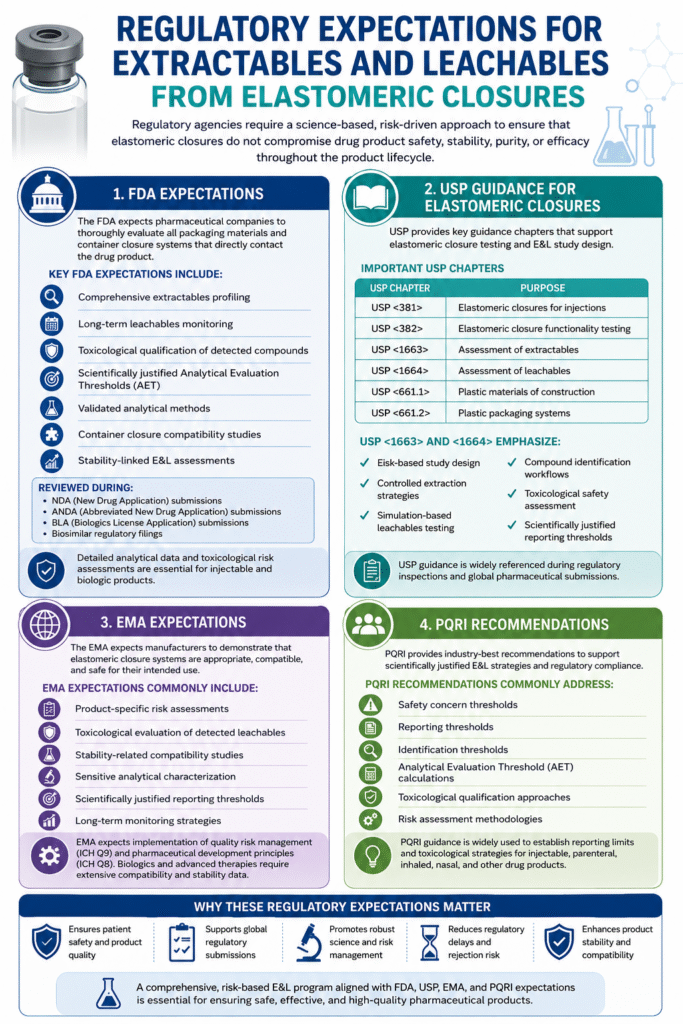
3: Regulatory Expectations for Extractables and Leachables from Elastomeric Closures
Regulatory agencies worldwide expect pharmaceutical manufacturers to implement a science-based and risk-driven strategy for evaluating Extractables and Leachables from Elastomeric Closures throughout the entire product lifecycle. Since elastomeric components directly contact sensitive drug formulations, regulators require evidence that these packaging systems do not compromise product safety, stability, purity, or efficacy.
Modern regulatory expectations extend beyond basic material testing and now include comprehensive extractables profiling, toxicological assessment, analytical method validation, and long-term leachables monitoring.Companies often develop risk-based strategies aligned with ICH Q3E Extractables Leachables Risk Assessment guidance and evolving global E&L regulations.
1. FDA Expectations
The U.S. Food and Drug Administration (FDA) expects pharmaceutical companies to thoroughly evaluate all packaging materials and container closure systems that directly contact the drug product. Elastomeric closures are considered high-risk components because they can potentially release organic, inorganic, and volatile compounds into the formulation during storage and use.
Key FDA Expectations Include:
- Comprehensive extractables profiling
- Long-term leachables monitoring
- Toxicological qualification of detected compounds
- Scientifically justified Analytical Evaluation Thresholds (AET)
- Validated analytical methods
- Container closure compatibility studies
- Stability-linked E&L assessments
The FDA commonly reviews E&L data during:
- NDA (New Drug Application) submissions
- ANDA (Abbreviated New Drug Application) submissions
- BLA (Biologics License Application) submissions
- Biosimilar regulatory filings
Companies preparing regulatory submissions frequently evaluate Extractables and Leachables E&L Testing in the United States and review FDA Extractables and Leachables Case Studies to better understand agency expectations.
For NDA and ANDA support, manufacturers often perform Extractables and Leachables E&L Testing for Drug Safety for NDA ANDA Submissions to ensure regulatory readiness.
For injectable and biologic products, FDA reviewers frequently request detailed analytical characterization data along with toxicological risk assessments to ensure patient safety.
2. USP Guidance for Elastomeric Closures
The United States Pharmacopeia (USP) provides important guidance documents that support elastomeric closure testing and E&L study design. These chapters help manufacturers establish scientifically sound analytical strategies and material qualification programs.
Important USP Chapters
| USP Chapter | Purpose |
|---|---|
| USP <381> | Elastomeric closures for injections |
| USP <382> | Elastomeric closure functionality testing |
| USP <1663> | Assessment of extractables |
| USP <1664> | Assessment of leachables |
| USP <661.1> | Plastic materials of construction |
| USP <661.2> | Plastic packaging systems |
Among these, USP <1663> and USP <1664> are widely recognized as foundational guidance chapters for modern E&L programs. These chapters emphasize:
- Risk-based study design
- Controlled extraction strategies
- Simulation-based leachables testing
- Compound identification workflows
- Toxicological safety assessment
- Scientifically justified reporting thresholds
USP guidance is frequently referenced during regulatory inspections and global pharmaceutical submissions.
3. EMA Expectations
The European Medicines Agency (EMA) expects pharmaceutical manufacturers to demonstrate that elastomeric closure systems are appropriate and safe for their intended use. EMA reviewers place strong emphasis on packaging compatibility, especially for biologics and sterile injectable products.
EMA Expectations Commonly Include:
- Product-specific risk assessments
- Toxicological evaluation of detected leachables
- Stability-related compatibility studies
- Sensitive analytical characterization
- Scientifically justified reporting thresholds
- Long-term monitoring strategies
For biologics, biosimilars, gene therapies, and advanced therapeutic products, EMA reviewers often require highly detailed compatibility and stability data because these formulations are particularly sensitive to trace-level contaminants.
EMA also expects companies to apply quality risk management principles aligned with ICH Q9 and pharmaceutical development principles outlined in ICH Q8.
4. PQRI Recommendations
The Product Quality Research Institute (PQRI) provides widely accepted industry recommendations that support regulatory compliance strategies for E&L studies. Although PQRI guidance is not legally binding, it is extensively referenced across the pharmaceutical industry and frequently used to justify analytical and toxicological approaches.
PQRI Recommendations Commonly Address:
- Safety concern thresholds
- Reporting thresholds
- Identification thresholds
- Analytical Evaluation Threshold (AET) calculations
- Toxicological qualification approaches
- Risk assessment methodologies
PQRI recommendations are especially valuable when establishing scientifically justified reporting limits and toxicological qualification strategies for orally inhaled, nasal, injectable, and parenteral drug products.
Because regulatory expectations continue to evolve, many pharmaceutical companies use PQRI guidance alongside FDA, USP, EMA, and ICH recommendations to develop globally acceptable E&L programs.
4: Common Extractables and Leachables Found in Elastomeric Closures
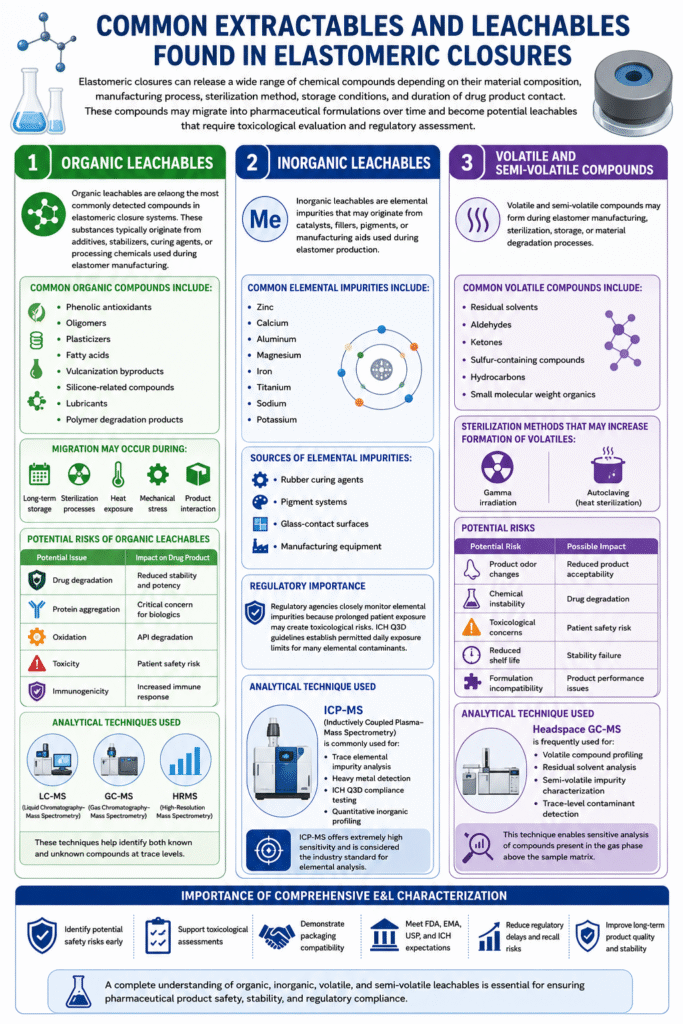
Elastomeric closures can release a wide range of chemical compounds depending on their material composition, manufacturing process, sterilization method, storage conditions, and duration of drug product contact. These compounds may migrate into pharmaceutical formulations over time and become potential leachables that require toxicological evaluation and regulatory assessment.
Because injectable and biologic drug products are highly sensitive to contamination, identifying and characterizing these compounds is a critical component of Extractables and Leachables (E&L) studies.
Regulatory concern has increased regarding Packaging Leachables Nitrosamine E&L Studies because certain packaging-related impurities may pose potential carcinogenic risks.
1. Organic Leachables
Organic leachables are among the most commonly detected compounds in elastomeric closure systems. These substances often originate from additives, stabilizers, curing agents, or processing chemicals used during elastomer manufacturing.
Common Organic Compounds Include:
- Phenolic antioxidants
- Oligomers
- Plasticizers
- Fatty acids
- Vulcanization byproducts
- Silicone-related compounds
- Lubricants
- Polymer degradation products
Advanced toxicological investigations including Extractables and Leachables Carcinogenicity Testing are increasingly important for compounds detected in sensitive pharmaceutical products.
These compounds may migrate into the drug product during:
- Long-term storage
- Sterilization processes
- Heat exposure
- Mechanical stress
- Product interaction with packaging materials
Potential Risks of Organic Leachables
Organic contaminants can contribute to:
| Potential Issue | Impact on Drug Product |
|---|---|
| Drug degradation | Reduced stability and potency |
| Protein aggregation | Critical concern for biologics |
| Oxidation | API degradation |
| Toxicity | Patient safety risk |
| Immunogenicity | Increased immune response |
Analytical Techniques Used
Organic extractables and leachables are typically analyzed using:
- LC-MS (Liquid Chromatography–Mass Spectrometry)
- GC-MS (Gas Chromatography–Mass Spectrometry)
- High-resolution mass spectrometry (HRMS)
These techniques help identify both known and unknown compounds at trace levels.
2. Inorganic Leachables
Inorganic leachables are elemental impurities that may originate from catalysts, fillers, pigments, or manufacturing aids used during elastomer production. Even low concentrations of elemental impurities can become a significant regulatory concern, particularly for injectable products.
Common Elemental Impurities Include:
- Zinc
- Calcium
- Aluminum
- Magnesium
- Iron
- Titanium
- Sodium
- Potassium
Certain metals may also originate from:
- Rubber curing agents
- Pigment systems
- Glass-contact surfaces
- Manufacturing equipment
Regulatory Importance
Regulatory agencies closely monitor elemental impurities because prolonged patient exposure may create toxicological risks. ICH Q3D guidelines establish permitted daily exposure limits for many elemental contaminants.
Analytical Technique Used
ICP-MS (Inductively Coupled Plasma–Mass Spectrometry) is commonly used for:
- Trace elemental impurity analysis
- Heavy metal detection
- ICH Q3D compliance testing
- Quantitative inorganic profiling
ICP-MS offers extremely high sensitivity and is considered the industry standard for elemental analysis.
3. Volatile and Semi-Volatile Compounds
Volatile and semi-volatile compounds may form during elastomer manufacturing, sterilization, storage, or material degradation. These compounds are especially important because some can migrate rapidly into pharmaceutical formulations under elevated temperature or storage conditions.
Common Volatile Compounds Include:
- Residual solvents
- Aldehydes
- Ketones
- Sulfur-containing compounds
- Hydrocarbons
- Small molecular weight organics
Sterilization methods such as gamma irradiation or autoclaving can sometimes accelerate the formation of volatile degradation products.
Potential Risks
Volatile contaminants may contribute to:
- Product odor changes
- Chemical instability
- Toxicological concerns
- Reduced shelf life
- Drug formulation incompatibility
Analytical Technique Used
Headspace GC-MS is frequently used for:
- Volatile compound profiling
- Residual solvent analysis
- Semi-volatile impurity characterization
- Trace-level contaminant detection
This technique enables sensitive analysis of compounds present in the gas phase above the sample matrix.
5: Key Study Design Considerations
Regulatory agencies expect Extractables and Leachables (E&L) studies to be scientifically justified, risk-based, and tailored to the specific pharmaceutical product and packaging system. A properly designed study helps identify potential contaminants, assess toxicological risks, and demonstrate that elastomeric closures are compatible with the intended drug formulation throughout its lifecycle.
Because injectable products, biologics, ophthalmics, and combination therapies are highly sensitive to contamination, study design plays a critical role in ensuring reliable analytical results and regulatory acceptance.
1. Extraction Study Parameters
Important extraction variables include:
| Parameter | Consideration |
|---|---|
| Solvent selection | Polar and non-polar systems |
| Temperature | Accelerated extraction conditions |
| Extraction time | Worst-case simulation |
| pH conditions | Product-relevant environments |
| Surface area | Maximum exposure assessment |
Aggressive extraction conditions help identify potential worst-case extractables profiles.
2. Simulation Leachables Studies
Leachables studies should simulate actual product conditions including:
- Drug formulation contact
- Real storage conditions
- Sterilization exposure
- Shipping stress
- Shelf-life duration
Simulation studies are especially important for biologics and injectable formulations.
3. Analytical Evaluation Threshold (AET)
The Analytical Evaluation Threshold determines which detected compounds require toxicological assessment.
AET calculations are typically based on:
- Maximum daily dose
- Route of administration
- Safety concern thresholds
- Toxicological risk assumptions
Regulators expect scientifically justified AET calculations during submissions.
6: Challenges in Elastomeric Closure E&L Testing
One of the biggest challenges is identifying unknown compounds detected during non-targeted screening.
Advanced analytical workflows and outsourcing support from specialized laboratories offering Outsourcing Extractables and Leachables E&L Testing Laboratory United States can help pharmaceutical companies improve analytical coverage and regulatory compliance.
Biologic drug products are highly sensitive to trace contaminants, making E&L testing especially critical for monoclonal antibodies, peptides, vaccines, biosimilars, and Extractables and Leachables E&L in Emerging Biologics and Advanced Therapies.
1. Unknown Compound Identification
One of the biggest challenges is identifying unknown compounds detected during non-targeted screening.
Common difficulties include:
- Low concentration levels
- Lack of reference standards
- Complex fragmentation patterns
- Co-eluting peaks
Advanced HRMS workflows are often necessary for structural elucidation.
2. Biologics Compatibility
Biologic drug products are highly sensitive to trace contaminants.
Potential compatibility concerns include:
- Protein aggregation
- Oxidation
- Structural destabilization
- Adsorption effects
This makes E&L testing especially critical for monoclonal antibodies, peptides, vaccines, and biosimilars.
3. Extremely Low Detection Requirements
Modern regulatory expectations require highly sensitive analytical detection.
Challenges include:
- Instrument sensitivity limitations
- Background contamination
- Method reproducibility
- Data interpretation complexity
Laboratories must maintain highly controlled analytical environments to generate reliable data.
7: Future Trends in Elastomeric Closure E&L Testing
The pharmaceutical industry is rapidly advancing toward more sophisticated E&L workflows.
Emerging trends include:
- High-resolution non-targeted screening
- AI-assisted compound identification
- Automated spectral interpretation
- Improved toxicological prediction software
- Increased biologics-focused guidance
- Enhanced combination product regulations
As advanced injectable therapies continue to grow, regulatory expectations for E&L characterization will likely become even more stringent.
The growing adoption of advanced analytical technologies is shaping the Future of Extractables and Leachables Testing across pharmaceutical and biologic product development.
Conclusion:
Extractables and Leachables from Elastomeric Closures are a critical component of pharmaceutical product safety, quality assurance, and regulatory compliance. Regulatory agencies now expect comprehensive risk-based E&L programs that combine advanced analytical testing, toxicological assessment, and scientifically justified study design.
Pharmaceutical companies must proactively evaluate elastomeric closure systems to ensure compatibility with drug products throughout the product lifecycle. A robust E&L strategy helps reduce regulatory risk, improve product stability, and protect patient safety.
Organizations with deep analytical expertise, advanced instrumentation capabilities, and strong regulatory understanding are best positioned to successfully navigate the increasing complexity of global E&L expectations.
Frequently Asked Questions:
E&L studies are important because elastomeric closures remain in direct contact with sensitive pharmaceutical formulations. Even trace-level contaminants may cause toxicity, drug degradation, protein aggregation, oxidation, or immunogenic responses. Regulatory agencies therefore require detailed E&L evaluations to ensure patient safety and product quality.
Common elastomeric closure materials include:
-Butyl rubber
-Bromobutyl rubber
-Chlorobutyl rubber
-Silicone-treated elastomers
-Thermoplastic elastomers
These materials often contain additives such as antioxidants, plasticizers, accelerators, lubricants, fillers, and pigments that may become potential extractables or leachables.
Commonly detected compounds include:
-Phenolic antioxidants
-Plasticizers
-Oligomers
-Fatty acids
-Vulcanization byproducts
-Residual solvents
-Aldehydes
-Ketones
-Elemental impurities such as zinc, aluminum, and iron
These compounds may originate from manufacturing additives, degradation products, sterilization processes, or packaging interactions.
Biologic drug products such as monoclonal antibodies, peptides, vaccines, and gene therapies are highly sensitive to trace contaminants. Leachables may cause protein aggregation, oxidation, adsorption, structural destabilization, or immunogenicity. Because of this sensitivity, biologics often require extensive long-term compatibility and stability-linked E&L studies.
Sterilization methods such as gamma irradiation, autoclaving, and ethylene oxide treatment can alter packaging materials and generate degradation products. These processes may increase the formation of volatile or semi-volatile leachables, making post-sterilization E&L evaluation an important part of study design.
Reference
- Jahn M. Leachables and extractables: from regulatory expectations to laboratory assessment. InChallenges in protein product development 2018 Jun 21 (pp. 337-351). Cham: Springer International Publishing.https://link.springer.com/chapter/10.1007/978-3-319-90603-4_16
- Smith EJ, Paskiet DM, Tullo EJ. The management of extractables and leachables in pharmaceutical products. InParenteral Medications, Fourth Edition 2019 Jul 19 (pp. 535-573). CRC Press.https://www.taylorfrancis.com/chapters/edit/10.1201/9780429201400-29/management-extractables-leachables-pharmaceutical-products-edward-smith-diane-paskiet-erica-tullo
- Kushwaha P, Madan A, Kushwaha P, Madan AK. Extractables and leachables: an overview of emerging challenges. Pharmaceutical Technology. 2008 Aug 2;32(8):1-4.https://www.pharmtech.com/view/extractables-and-leachables-overview-emerging-challenges
- Ramamoorthy S, Chong NS, Hotha KK. Strengthening extractable & leachable study submissions: best practices to avoid regulatory deficiencies. American Journal of Analytical Chemistry. 2024;15(12):368-94.https://www.researchgate.net/profile/Subathra-Ramamoorthy-2/publication/387503864_Strengthening_Extractable_Leachable_Study_Submissions_Best_Practices_to_Avoid_Regulatory_Deficiencies/links/678dbc981ec9f9589f51a2bb/Strengthening-Extractable-Leachable-Study-Submissions-Best-Practices-to-Avoid-Regulatory-Deficiencies.pdf
About the Author


