

Introduction:
Extractables and leachables in dexamethasone injectables represent one of the most critical — yet often underestimated — challenges in the development and manufacture of parenteral pharmaceuticals. When a chemical migrates from a vial stopper, prefilled syringe barrel, or IV bag into a dexamethasone solution, it becomes a potential safety threat that regulators and patients cannot afford to ignore.
Dexamethasone is a potent corticosteroid widely used in intravenous (IV) and intramuscular (IM) formulations for conditions ranging from severe allergic reactions and inflammatory diseases to COVID-19 treatment protocols. Given its broad clinical use and direct injection into the bloodstream, even trace-level chemical contaminants from packaging materials can carry significant toxicological implications.
At ResolveMass Laboratories Inc., we have built a specialized practice around pharmaceutical extractables and leachables science, helping drug manufacturers navigate the complex regulatory landscape with precision, efficiency, and scientific rigor. This guide offers a deep dive into the E&L challenges specific to dexamethasone injectables and explains how a well-structured testing program can protect both patients and product portfolios.
Summary:
- Extractables and leachables (E&L) are chemical compounds that migrate from packaging or container-closure systems into drug products — and in injectables like dexamethasone, they pose serious patient safety and regulatory risks.
- Dexamethasone injectables are uniquely vulnerable due to their aqueous formulation, long shelf life, and contact with multiple polymer and elastomer components.
- Regulatory agencies including the FDA, EMA, and ICH have established strict guidelines (ICH Q3E, USP <1663>, USP <1664>) for E&L assessment in parenterals.
- A systematic E&L program includes extractables studies on packaging materials followed by leachables monitoring in the drug product itself.
- Key risk factors for dexamethasone E&L include pH, temperature, sterilization method, and the type of container-closure system used.
- ResolveMass Laboratories Inc. provides expert E&L testing, method development, and regulatory strategy for injectable drug manufacturers.
- Proactive E&L management protects patients, ensures regulatory approval, and prevents costly product recalls.
1: What Are Extractables and Leachables? Definitions and Key Differences
Extractables are compounds released from packaging materials under harsh laboratory conditions; leachables are compounds that actually migrate into the drug product under real-world storage conditions.
Understanding the distinction is foundational to any E&L program:
| Term | Definition | Testing Conditions | Regulatory Relevance |
|---|---|---|---|
| Extractables | Chemicals released from packaging/closure components under exaggerated conditions | Aggressive solvents, elevated temperature, extended time | Defines the “worst-case” chemical inventory |
| Leachables | Chemicals that actually migrate into the drug product during storage or use | Actual drug product, real-time or accelerated stability | Direct patient safety concern; must meet safety thresholds |
Key sources of extractables and leachables in injectable systems include:
- Elastomeric stoppers and plungers (rubber bungs containing vulcanization agents, antioxidants, plasticizers)
- Glass vials and ampoules (elemental leachables: boron, silicon, aluminium)
- Plastic IV bags and tubing (PVC, polyethylene, polypropylene additives)
- Prefilled syringe barrels (cyclic olefin copolymer or glass with silicone oil)
- Adhesives and coatings on packaging labels and seals
2: Why Dexamethasone Injectables Are at High Risk for E&L Issues
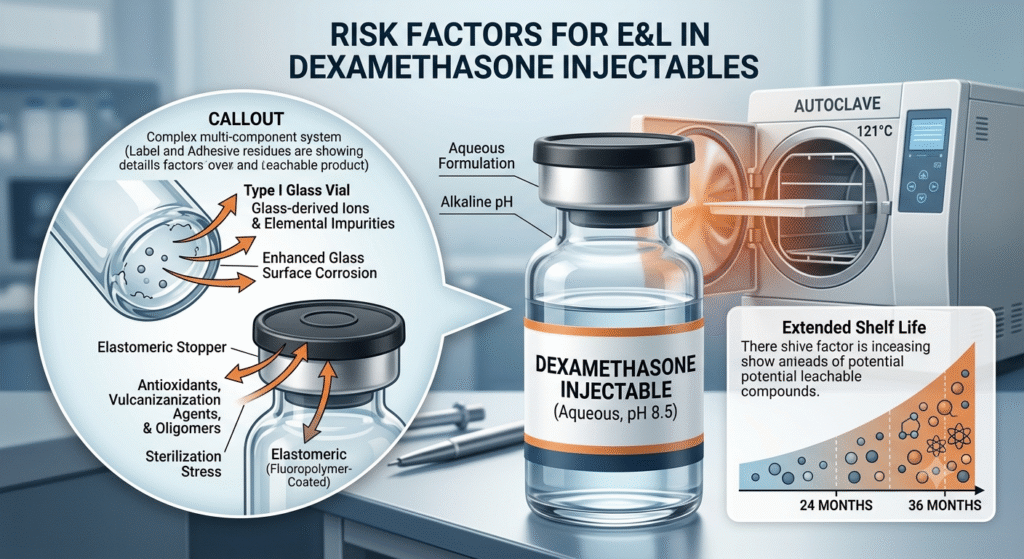
Dexamethasone injectable formulations have a specific chemical and physical profile that amplifies E&L risk compared to many other parenteral drugs.
1. Aqueous Formulation
Dexamethasone sodium phosphate, the most common injectable form, is dissolved in an aqueous medium. Water is a highly effective solvent for polar and ionic leachables — including many rubber additives and glass-derived ions — making aqueous injectables particularly susceptible.
2. Broad pH Range
Injectable dexamethasone formulations typically have a pH between 7.0 and 8.5. Alkaline pH can accelerate glass corrosion (leading to elemental leachables like boron and silicon) and enhance extraction of certain rubber-derived compounds.
3. Long Shelf Life
Dexamethasone injectables often carry a shelf life of 24 to 36 months. The longer the drug product contacts its container-closure system, the greater the cumulative leachable burden — which is why real-time leachables studies must parallel accelerated stability programs.
4. Sterilization Stress
Terminal steam sterilization (autoclave) at 121°C is commonly used for aqueous dexamethasone injectables. This elevated temperature dramatically increases the rate and extent of extractable migration from elastomeric stoppers and plastic components.
5. Multi-Component Systems
A typical dexamethasone vial contains:
- Type I borosilicate glass vial
- Fluoropolymer-coated elastomeric stopper
- Aluminium crimp seal
- Paper/polymer composite label
Each component is a potential E&L source, and interactions between components can produce unexpected degradation products.
3: Framework for E&L in Dexamethasone Injectables
The key regulatory guidelines governing extractables and leachables in parenteral products include ICH Q3E (draft), USP <1663>, USP <1664>, ISO 10993-18, and FDA’s 2016 guidance on container closure systems. Manufacturers must demonstrate safety compliance before regulatory approval.
ICH Q3E — Guideline on Extractables and Leachables
- Provides a harmonized framework across FDA, EMA, and PMDA for E&L assessment
- Introduces the concept of Analytical Evaluation Threshold (AET) — the minimum level at which a leachable must be identified and reported
- Applicable to drug products including parenterals in their final container-closure system
USP <1663> and <1664>
- USP <1663>: Assessment of Extractables Associated with Pharmaceutical Packaging/Delivery Systems — guidance on conducting extractables studies
- USP <1664>: Assessment of Drug Product Leachables Associated with Pharmaceutical Packaging/Delivery Systems — guidance on monitoring leachables in the drug product
FDA Guidance Documents
- Guidance for Industry: Container Closure Systems for Packaging Human Drugs and Biologics (1999) — still a cornerstone document
- Draft Guidance on Analytical Procedures for Extractables and Leachables (2023) — updated requirements for analytical method development and validation
ISO 10993-18
Governs biological evaluation of medical devices and packaging materials; frequently cross-referenced in E&L toxicological risk assessments for injectables.
4: Step-by-Step E&L Testing Program for Dexamethasone Injectables
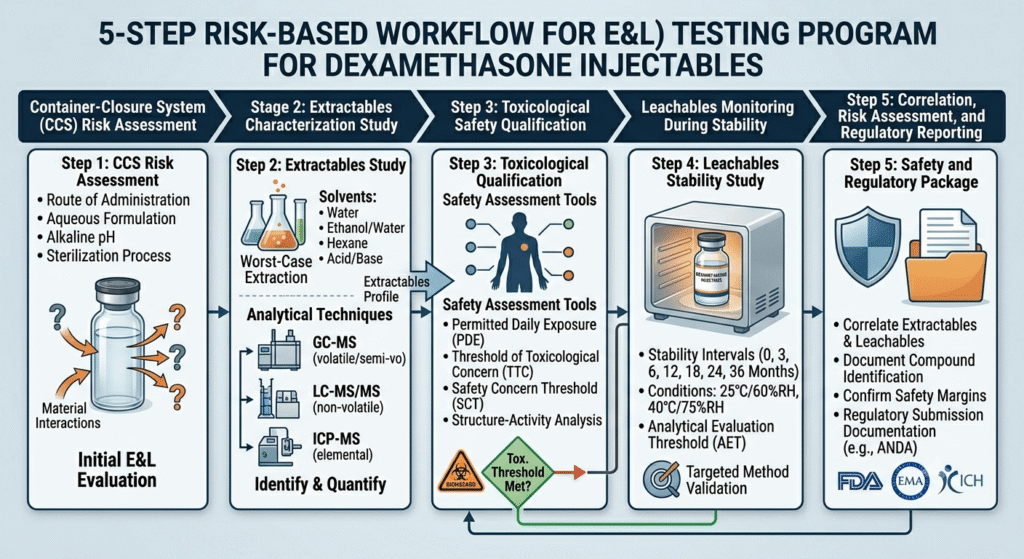
A compliant E&L program follows a sequential, risk-based approach: material characterization → extractables study → leachables monitoring → safety qualification.
Step 1: Container-Closure System (CCS) Risk Assessment
Before any laboratory work begins, conduct a documented risk assessment covering:
- Route of administration (intravenous/intramuscular — highest risk category)
- Drug product formulation (aqueous, pH, excipients)
- Material composition of all components in contact with the drug
- Sterilization method and processing conditions
- Intended shelf life and storage temperature
For dexamethasone IV products, this risk assessment will almost universally classify the CCS as high interaction potential, triggering a comprehensive E&L program.
Step 2: Extractables Study (Controlled Extraction)
Extractables studies expose packaging components to aggressive solvents to build a complete chemical inventory (“extractables profile”):
Recommended extraction solvents for rubber stoppers and polymeric components:
- Purified water (simulates aqueous drug product)
- 50% ethanol/water (simulates semi-polar environment)
- Hexane or heptane (simulates non-polar extraction)
- Dilute acid and base solutions (simulates pH extremes)
Analytical methods applied:
- GC-MS — volatile and semi-volatile organic compounds
- LC-MS/MS — non-volatile organic compounds, rubber additives (e.g., 2-mercaptobenzothiazole, N-nitrosamines)
- ICP-MS — elemental analysis (metals from glass and stoppers)
- Headspace GC — residual solvents and volatile leachables
- TOC (Total Organic Carbon) — overall organic leachable burden
Step 3: Safety Qualification of Extractables
Each identified extractable is evaluated using:
- Toxicological Risk Assessment (TRA) against established safety thresholds
- Permitted Daily Exposure (PDE) limits from ICH Q3C/Q3D
- Threshold of Toxicological Concern (TTC) approach for unknowns
- Comparison with Safety Concern Threshold (SCT) of 1.5 µg/day for parenterals (per ICH Q3E draft)
Compounds identified above the SCT require full safety qualification. N-nitrosamines — potent carcinogens found in rubber vulcanization — require assessment at sub-microgram/day levels.
Step 4: Leachables Study (Drug Product Monitoring)
Leachables are measured directly in the filled dexamethasone injectable product under:
- Accelerated stability conditions: 40°C/75% RH for 3 and 6 months
- Real-time stability conditions: 25°C/60% RH across the full shelf-life period
- Stress conditions: freeze-thaw cycling, light exposure (photostability)
The analytical methods used must be fully validated (specificity, sensitivity, linearity, precision, accuracy) with AET established based on the SCT and formulation dose/volume.
Step 5: Correlation and Safety Report
The final step links the extractables profile to observed leachables, confirms that all leachables are accounted for, and demonstrates safety qualification. This report forms a key section of the CTD Module 3.2.P.2 (pharmaceutical development) and Module 3.2.P.7 (container closure system) of the regulatory submission.
5: Common Leachables Found in Dexamethasone Injectables
The following table summarizes commonly detected leachables in aqueous injectable products packaged in standard vial systems:
| Leachable Compound | Source | Detection Method | Key Concern |
|---|---|---|---|
| 2-Mercaptobenzothiazole (MBT) | Rubber stopper (accelerator) | LC-MS/MS | Genotoxicity potential |
| N-Nitrosamines (e.g., NDMA) | Rubber stopper vulcanization | GC-MS/LC-HRMS | Potent carcinogens |
| Benzothiazole | Rubber stopper degradation | LC-MS/MS | Skin sensitizer |
| Boric acid / boron | Borosilicate glass | ICP-MS | Reproductive toxicity at high levels |
| Silicon dioxide (silica) | Glass surface | ICP-MS | Generally low risk |
| Silicone oil | Prefilled syringe lubricant | GC, visual inspection | Particle formation risk |
| Antioxidants (e.g., Irganox 1010) | Plastic components | LC-MS/MS | Generally low risk at typical levels |
| Plasticizers (e.g., DEHP) | PVC bags/tubing | GC-MS | Endocrine disruption concern |
6: N-Nitrosamines: A Special Concern in Dexamethasone Injectables
N-nitrosamines are among the highest-priority leachables in rubber-stopppered injectables because they are classified as probable human carcinogens with no safe threshold.
Following the NDMA/NMBA contamination crisis in Zantac (ranitidine) and sartan drugs, regulators have intensified scrutiny of nitrosamine sources across all drug categories — including injectables. Rubber stoppers containing secondary amines can generate nitrosamines in the presence of nitrosating agents, and dexamethasone injectables are not exempt from this risk.
ResolveMass Laboratories Inc. recommends:
- Proactive nitrosamine risk assessment for all injectable products, even those not yet flagged by regulators
- Low-level N-nitrosamine testing using validated LC-HRMS methods capable of detection at the low nanogram-per-day level
- Working with stopper suppliers to obtain nitrosamine-specific extractables data and certificates of analysis
7: Analytical Evaluation Threshold (AET): How to Calculate It for Dexamethasone
The AET defines the minimum analytical sensitivity required to detect leachables at the Safety Concern Threshold — it tells your laboratory how sensitive their method must be.
For dexamethasone injectables, AET calculation follows this logic:
- Safety Concern Threshold (SCT): 1.5 µg/day for parenterals (ICH Q3E draft)
- Maximum daily dose (MDD): For dexamethasone, a high-dose IV protocol may deliver up to 40 mg/day; for typical anti-inflammatory use, doses may range from 4–20 mg/day
- Concentration in product: SCT (µg/day) ÷ MDD (mL/day) = AET (µg/mL)
Example:
- SCT = 1.5 µg/day
- MDD = 10 mL/day
- AET = 1.5 ÷ 10 = 0.15 µg/mL
This means any leachable present at or above 0.15 µg/mL in the dexamethasone product must be identified and safety-qualified. Your analytical method must have a limit of detection (LOD) at or below this AET — which demands high-sensitivity instrumentation such as triple quadrupole LC-MS/MS or HRMS platforms.
8: Key Challenges in E&L Testing for Dexamethasone Injectables
Conducting a robust E&L program for dexamethasone presents several specific technical challenges:
- Matrix interference: The dexamethasone molecule itself can interfere with LC-MS/MS analysis; method development must demonstrate separation of the drug from leachables of interest.
- Sterilization-induced changes: Autoclave sterilization can chemically alter both drug product and packaging — method development should use autoclaved samples.
- Low-level detection requirements: AET values for parenterals are often at or below 0.1 µg/mL, requiring highly sensitive and validated analytical platforms.
- Regulatory moving targets: The N-nitrosamine guidance, ICH Q3E development, and EMA’s evolving position on elemental impurities mean that programs initiated today may need to be supplemented tomorrow.
- Supplier data gaps: Many packaging suppliers provide only limited extractables data — pharmaceutical manufacturers must often conduct independent studies.
9: How ResolveMass Laboratories Inc. Supports Your E&L Program
At ResolveMass Laboratories Inc., our team of analytical chemists, toxicologists, and regulatory scientists brings deep expertise to every stage of the extractables and leachables lifecycle for dexamethasone and other parenteral products.
Our E&L Services Include:
- Extractables Study Design and Execution — controlled extraction of stoppers, vials, plungers, and IV bags using USP <1663>-aligned protocols
- Leachables Monitoring Programs — method development, validation, and testing across stability timepoints
- Toxicological Risk Assessment (TRA) — safety qualification of identified extractables and leachables using PDE, TTC, and SCT frameworks
- N-Nitrosamine Risk Assessment and Testing — proactive evaluation using LC-HRMS and GC-CI-MS/MS methods
- Analytical Method Development and Validation — GC-MS, LC-MS/MS, ICP-MS, headspace GC, TOC
- Regulatory Report Preparation — CTD-ready E&L sections for NDA, ANDA, MAA, and Health Canada submissions
- Container Closure System Qualification — full CCS qualification packages for new product launches and packaging changes
Why Choose ResolveMass Laboratories Inc.?
- Purpose-built analytical infrastructure for pharmaceutical E&L testing
- Regulatory expertise spanning FDA, EMA, Health Canada, and ICH guidelines
- Proven track record in parenteral drug product development and post-approval support
- Transparent, scientifically defensible study designs that withstand regulatory scrutiny
- Fast turnaround without sacrificing scientific integrity
Conclusion:
Extractables and leachables in dexamethasone injectables are not merely a regulatory checkbox — they are a patient safety imperative and a business-critical risk management priority. The combination of aqueous formulation, direct parenteral administration, long shelf life, and high-temperature sterilization makes dexamethasone one of the drug products most susceptible to meaningful leachable burdens from its container-closure system.
A scientifically rigorous, regulatory-aligned E&L program — built on the principles of ICH Q3E, USP <1663/1664>, and modern analytical science — is the only reliable path to product approval, patient protection, and long-term commercial success. Given the intensifying regulatory landscape around N-nitrosamines and elemental impurities, manufacturers who act proactively on extractables and leachables in dexamethasone injectables will be best positioned for approval timelines, label claims, and global market access.
ResolveMass Laboratories Inc. is ready to be your scientific partner at every stage of this journey — from early-phase risk assessment to post-approval lifecycle management.
Frequently Asked Questions:
Dexamethasone injections are administered intravenously or intramuscularly, which means any contaminants present can directly reach systemic circulation. E&L studies help identify packaging-related impurities before they become a patient safety concern. These studies also evaluate whether detected compounds exceed toxicological safety limits. Regulatory agencies expect manufacturers to demonstrate that packaging materials do not negatively impact the product. Proper E&L testing supports successful product approval and lifecycle management.
Most dexamethasone injectable products contain dexamethasone sodium phosphate in an aqueous solution. Water is highly effective at extracting polar and ionic compounds from packaging materials over time. This can increase the likelihood of leachable migration from rubber closures and glass containers. Extended contact during storage further amplifies the risk. As a result, aqueous injectables are generally considered high-priority products for E&L evaluation.
Several packaging components can contribute extractables and leachables, including elastomeric stoppers, glass vials, polymeric syringe parts, aluminum seals, and adhesive labels. Rubber stoppers may release antioxidants, curing agents, or processing additives. Glass containers can contribute elemental impurities such as boron or silicon. Polymeric materials may release oligomers or plasticizers. Each product-contact component should be evaluated as part of a comprehensive E&L program.
Each detected compound is assessed using established toxicological principles and regulatory thresholds. Scientists evaluate exposure levels using concepts such as Permitted Daily Exposure (PDE), Threshold of Toxicological Concern (TTC), and Safety Concern Threshold (SCT). The amount of the compound detected is compared against acceptable safety limits. Additional toxicological review may be required for compounds that exceed reporting thresholds. This process ensures that patient exposure remains within safe limits.
Nitrosamines are a class of compounds that have attracted significant regulatory attention because some are known or suspected carcinogens. They can potentially form from rubber materials, vulcanization agents, or manufacturing processes. Even extremely low levels may require investigation due to their toxicological significance. Advanced analytical techniques are often necessary to detect nitrosamines at trace concentrations. Regulatory agencies expect manufacturers to assess and control nitrosamine-related risks where applicable.
Many dexamethasone injectables undergo terminal steam sterilization at elevated temperatures. These conditions can increase the migration of chemicals from elastomeric and polymeric packaging materials. Heat may also accelerate degradation reactions that generate additional extractable compounds. As a result, sterilization effects are often incorporated into extractables study designs. Understanding the impact of sterilization helps manufacturers better predict long-term leachable behavior.
Reference
- Smith EJ, Paskiet DM, Tullo EJ. The management of extractables and leachables in pharmaceutical products. InParenteral Medications, Fourth Edition 2019 Jul 19 (pp. 535-573). CRC Press.https://www.taylorfrancis.com/chapters/edit/10.1201/9780429201400-29/management-extractables-leachables-pharmaceutical-products-edward-smith-diane-paskiet-erica-tullo
- Jahn M. Leachables and extractables: from regulatory expectations to laboratory assessment. InChallenges in protein product development 2018 Jun 21 (pp. 337-351). Cham: Springer International Publishing.https://link.springer.com/chapter/10.1007/978-3-319-90603-4_16
- Jenke D. Extractables and leachables: characterization of drug products, packaging, manufacturing and delivery systems, and medical devices. John Wiley & Sons; 2022 Aug 2.https://books.google.com/books?hl=en&lr=&id=A296EAAAQBAJ&oi=fnd&pg=PR12&dq=Extractables+and+Leachables+in+Dexamethasone+Injectables&ots=WCo2LEl73k&sig=rtOm0snkeXt4bkr-6lME9Yj5o0o
- Parker W, DeCou D. Extractables and Leachables in Drug Products: An Overview. Handbook of Validation in Pharmaceutical Processes, Fourth Edition. 2021 Oct 28:943-51.https://www.taylorfrancis.com/chapters/edit/10.1201/9781003163138-60/extractables-leachables-drug-products-william-parker-decou
About the Author


