

Introduction
Extractables and Leachables Testing for Peptide Injectables is an essential analytical prerequisite for assessing the chemical compatibility, physical stability, and biological safety of parenteral peptide formulations. Synthetic and recombinant peptides exhibit complex secondary and tertiary structures, amphiphilic surface characteristics, and reactive amino acid side chains, making them particularly susceptible to trace chemical migrants originating from primary packaging materials and bioprocessing equipment. These chemical migrants can range from organic rubber vulcanization residues and polymer additives to inorganic heavy metals, and may initiate significant drug degradation pathways, including direct oxidation, covalent adduct formation, charge neutralization, and interfacial aggregation.
As the biopharmaceutical industry increasingly adopts ready-to-use drug delivery formats, including prefilled syringes (PFS), autoinjectors, and cartridge systems, liquid formulations can remain in continuous direct contact with container surfaces throughout their multi-year shelf life. At the same time, contemporary biomanufacturing processes rely extensively on single-use systems (SUS), including bioprocess storage bags, silicone transfer tubing, and membrane filters, which can release distinct profiles of process-equipment extractables before final container filling. Under the emerging International Council for Harmonisation (ICH) Q3E guidance and established United States Pharmacopeia standards (USP , ), the implementation of robust orthogonal testing programs is critical for detecting, characterizing, and controlling these chemical migrants throughout the product lifecycle.
Learn more about custom peptide synthesis services when developing peptide candidates that require controlled material and process characterization.
Share via:
Quick Summary:
- E&L testing is essential for peptide injectables to evaluate chemical compatibility, physical stability, and biological safety throughout the product lifecycle.
- Peptides are highly vulnerable to chemical migrants, which can cause covalent adduct formation, oxidation, unfolding, and aggregation.
- Prefilled syringes require particular attention to silicone oil (PDMS) and tungsten polyanions, which may contribute to subvisible particles and peptide aggregation.
- Elastomeric stoppers and plungers can release vulcanization accelerators, nitrosamine precursors, antioxidants, and metals, creating risks of oxidation and chemical modification.
- Single-use systems (SUS) may contribute bNOX, siloxanes, polymer degradants, and filter extractables, potentially affecting peptide stability during manufacturing.
- A risk-based ICH Q3E approach combines controlled extractables studies, leachables studies, toxicological assessment, and Analytical Evaluation Threshold (AET) calculations.
- Orthogonal testing using GC-MS, LC-HRMS, ICP-MS, FlowCam, and RICM, together with suitable material controls and barrier technologies, helps identify, characterize, and control migrants for safer and more stable peptide injectables.
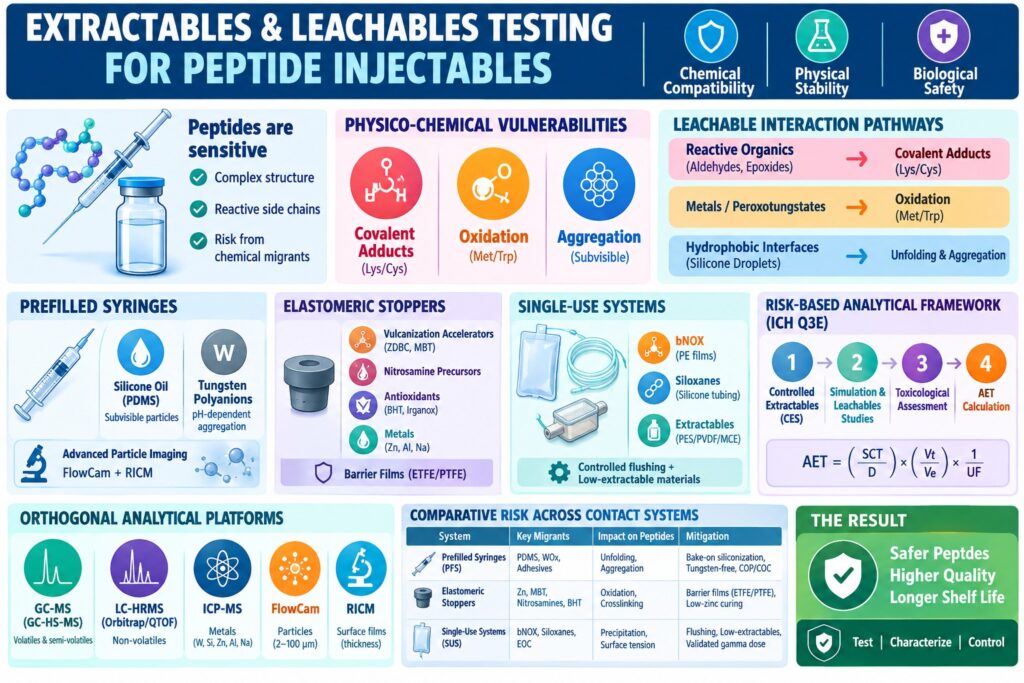
Physico-Chemical Vulnerabilities of Peptide Injectables to Chemical Migrants
Therapeutic peptides are inherently susceptible to chemical degradation and structural destabilization when exposed to trace levels of leachables because of their flexible amino acid chains and chemically reactive side-chain moieties. Direct interactions with organic leachables can result in covalent adduct formation, whereas trace metals and hydrophobic interfaces can initiate oxidation cascades and irreversible self-assembly, ultimately producing subvisible aggregates.
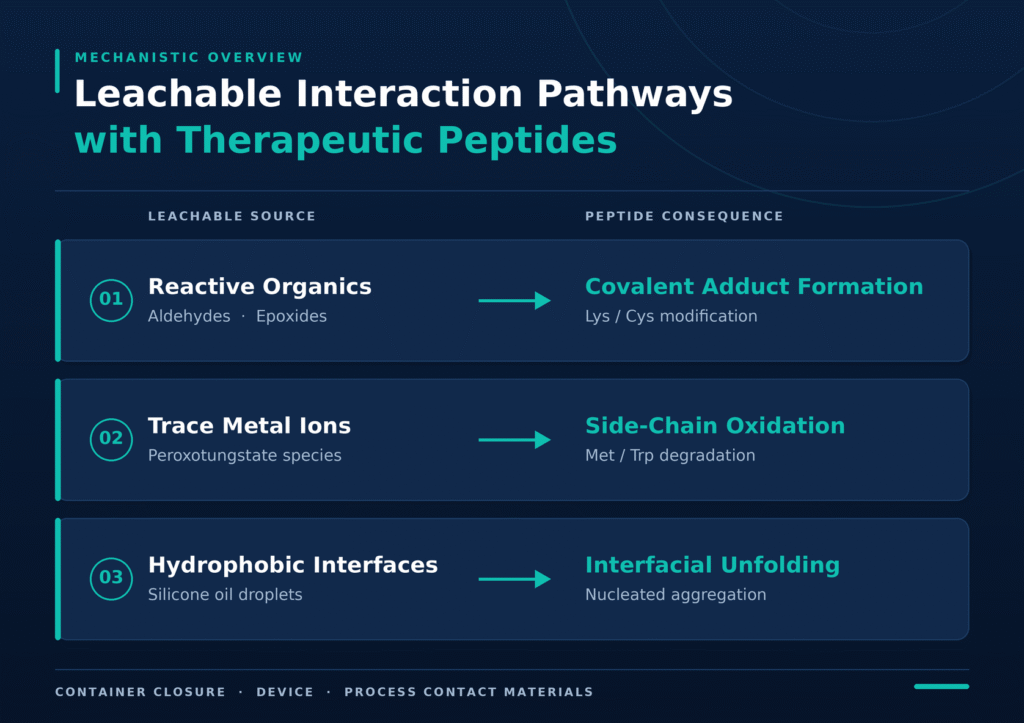
In contrast to small-molecule therapeutics, peptides have higher molecular weights and larger molecular surface areas, exposing reactive functional groups such as the thiol group of cysteine, the thioether of methionine, the imidazole ring of histidine, and the indole ring of tryptophan to potential interactions with chemical migrants. Leachable-induced peptide destabilization primarily occurs through three mechanisms:
- Covalent Adduct Formation: Low-molecular-weight organic leachables, including residual resin monomers, unreacted epoxides, and aldehyde degradants originating from plastics, can undergo nucleophilic substitution or addition reactions with amino acid side chains. Such reactions permanently modify the peptide’s primary structure and may decrease receptor binding affinity while generating neo-epitopes that could increase immunogenic risk.
- Oxidation Cascades: Trace inorganic metals, including tungsten or iron, together with residual peroxides released from manufacturing equipment or packaging components, can catalyze the oxidation of methionine to methionine sulfoxide. These species may also promote degradation of tryptophan and cysteine residues, contributing to chemical modification and structural instability.
- Interfacial Hydrophobic Unfolding and Aggregation: Migrated silicone oil droplets and polymeric leachables can establish hydrophobic liquid-liquid or solid-liquid interfaces within the formulation. Peptides may adsorb at these hydrophobic boundaries and undergo conformational unfolding, exposing previously buried hydrophobic regions. This process can promote irreversible self-association and the development of subvisible and visible particulate aggregates.
Understand how peptides differ from small-molecule drugs and why their analytical and formulation requirements can differ.
Extractables and Leachables Testing for Peptide Injectables in Prefilled Syringes: Silicone Oil and Tungsten Dynamics
Extractables and Leachables Testing for Peptide Injectables packaged in prefilled syringes primarily emphasizes the characterization and quantification of polydimethylsiloxane silicone oil droplets and inorganic tungsten polyanions. These two classes of migrants are particularly relevant because they can contribute to peptide aggregation and particulate formation within parenteral delivery systems.
Silicone Oil Migration and Subvisible Particle Formation
Silicone oil, specifically polydimethylsiloxane or PDMS, is applied to the internal barrel surfaces of glass and polymer prefilled syringes as a lubricant. Its primary purpose is to reduce plunger break-loose force and facilitate smooth plunger movement during drug administration. However, PDMS can detach or migrate from the glass surface into the aqueous formulation, generating subvisible silicone oil particles (SiOPs) that provide hydrophobic nucleation sites for peptide aggregation.
The siliconization process has a direct influence on the amount of free silicone oil available within the fluid path:
- Spray-on Siliconization: Application of liquid silicone oil produces a comparatively thick surface coating (>100 nm) containing mobile PDMS fractions. This can result in increased levels of subvisible particulate matter during prolonged storage.
- Bake-on Siliconization: Thermal treatment crosslinks the PDMS emulsion with the borosilicate glass substrate, substantially reducing the migration of free silicone oil and helping maintain lower particulate levels.
Because conventional light obscuration testing under USP cannot reliably differentiate benign silicone oil droplets from potentially immunogenic peptide aggregates, advanced particle-imaging approaches under USP <1788.3>, including FlowCam analysis, together with Reflective Interference Contrast Microscopy (RICM), are required for visual characterization of the particulate populations.
Explore peptide injectable formulation considerations for additional insight into formulation and product-contact considerations.
Tungsten Polyanions and pH-Dependent Aggregation Mechanisms
Residual tungsten pin deposits generated during glass syringe manufacturing can dissolve into aqueous formulations as soluble polyanions, including paratungstenate-A and paratungstenate-B. These species can electrostatically interact with positively charged peptides under acidic conditions and promote rapid aggregation. During syringe barrel formation, tungsten pins used to pierce the needle cavity are exposed to extremely high temperatures, resulting in tungsten oxide ($WO_x$) residues within the funnel area.
The tendency of tungsten to promote peptide precipitation depends on several formulation parameters, particularly solution pH, ionic strength, and the presence of oxidizing species:
- Acidic Formulations (pH 4.0 – 5.5): Soluble tungsten can form negatively charged polyanionic complexes that strongly associate with positively charged basic peptides. This interaction can promote rapid precipitation, physical turbidity, and aggregate formation.
- Neutral/Basic Formulations (pH 6.0 – 7.0): Increased electrostatic repulsion between the peptide and tungsten species can reduce their interaction, thereby lowering the potential for tungsten-induced aggregation.
- Peroxotungstate Degradation Pathways: When formulations contain trace hydrogen peroxide (H2O2) residues originating from sterilization processes, tungsten can react to generate peroxotungstate complexes. Peroxotungstates can function as aggressive oxidizing species, contributing to peptide fragmentation, methionine oxidation, and degradation of the primary peptide chain.
Review peptide CDMO scale-up services for considerations involved in transferring peptide manufacturing from development toward larger-scale production.
Elastomeric Stoppers and Primary Closure Extractables and Leachables Profiles
Elastomeric vial stoppers and syringe plungers can release complex mixtures of organic vulcanization accelerators, antioxidant degradants, plasticizers, and trace heavy metals into liquid peptide formulations. Assessment of these primary closure components therefore requires targeted characterization of chemical migrants that may react with amino acid side chains, promote crosslinking, or catalyze structural cleavage.
Halobutyl rubber formulations, including chlorobutyl and bromobutyl materials, contain base polymers, vulcanization agents, antioxidants, pigments, and processing aids. During steam sterilization, gamma irradiation, or prolonged contact with the drug product, low-molecular-weight additives may migrate into the peptide formulation. Important classes of elastomeric migrants include:
- Vulcanization Accelerators: Zinc dibutyldithiocarbamate (ZDBC), 2-mercaptobenzothiazole (MBT), and sulfur compounds can contribute to disulfide bond shuffling and covalent peptide crosslinking.
- Nitrosamine Precursors: Amine-based vulcanization agents can contribute to the formation of toxic $N$-nitrosamines, making ultra-trace quantitation an important component of extractables and leachables assessment.
- Antioxidant Degradants: Hindered phenols, including Irganox 1010 and BHT, can degrade into reactive quinones that directly oxidize electron-rich amino acid side chains.
- Elemental Impurities: Leached zinc (Zn), aluminum (Al), and sodium (Na) ions can modify formulation ionic strength and may catalyze enzymatic or chemical degradation processes.
To minimize these migration pathways, modern primary closure systems may incorporate fluoropolymer barrier films, including ethylene tetrafluoroethylene or ETFE, over product-contact surfaces. These barrier layers can substantially reduce the concentrations of organic and inorganic leachables reaching the peptide formulation.
Learn about peptide impurity-control strategies relevant to controlling degradation products and chemical impurities throughout peptide development.
Single-Use Systems in Peptide Biomanufacturing
Single-use systems used during peptide biomanufacturing can release polymer degradation products, photoinitiators, and siloxanes into bulk peptide intermediates, potentially influencing formulation stability before the final container-filling stage. Single-use bioprocessing assemblies, including bioprocess storage bags, transfer tubing, depth filters, and membrane filtration capsules, are commonly exposed to gamma sterilization. This treatment can cause polymer backbone degradation and generate volatile and semi-volatile extractables.
Critical single-use migrants include:
- bNOX / bis(2,4-di-tert-butylphenyl)phosphate: This compound is a toxic degradant of the tris(2,4-di-tert-butylphenyl)phosphite antioxidant (Irgafos 168) and can be generated during gamma irradiation of polyethylene bioprocess films. bNOX can inhibit cellular growth and may interact directly with hydrophobic peptide domains, potentially promoting localized precipitation.
- Silicone Tubing Siloxanes: Platinum-cured or peroxide-cured silicone tubing can release low-molecular-weight linear and cyclic siloxanes during high-shear fluid transfer operations.
- Membrane Filter Extractables: Cellulosic and polymeric filters, including PES, PVDF, and MCE materials, can release trace surfactants and organic carbon. These migrants may modify solution surface tension and potentially accelerate peptide aggregation during sterile filtration.
Explore GMP peptide API manufacturing services for manufacturing environments where material qualification and process controls are integral to peptide API production.
Risk-Based Analytical Framework for Extractables and Leachables Testing for Peptide Injectables Under ICH Q3E
Developing a compliant Extractables and Leachables Testing for Peptide Injectables program under the emerging ICH Q3E guideline requires a tiered workflow that combines aggressive extraction profiling to establish an Analytical Target List (ATL) with real-time migration studies evaluated against a calculated Analytical Evaluation Threshold (AET).
The ICH Q3E framework organizes E&L assessments around systematic risk evaluation, chemical characterization, and toxicological qualification. For parenteral peptide injectables, which represent high-risk delivery routes because they involve direct systemic administration, the testing workflow includes:
- Controlled Extractables Studies (CES): Packaging components and single-use materials are subjected to exaggerated solvent conditions, including polar, semi-polar, and non-polar solvents, under thermal stress. The objective is to identify potential chemical migrants and establish the Analytical Target List (ATL).
- Simulation & Leachables Studies: Actual chemical migration is quantified using formulation-simulating solvents or the actual peptide drug product under real-time ($25^\circ\text{C} / 60% \text{ RH}$) and accelerated ($40^\circ\text{C} / 75% \text{ RH}$) stability conditions.
- Toxicological Safety Assessment: Identified leachable concentrations are assessed against established Permitted Daily Exposure (PDE) levels, Safety Concern Thresholds (SCT), and Threshold of Toxicological Concern (TTC) values.
Compare peptide CDMO and CMO models when assessing how external development and manufacturing support can be structured across the product lifecycle.
Analytical Evaluation Threshold (AET) Calculation
The Analytical Evaluation Threshold defines the concentration limit above which an unknown extractable or leachable peak must undergo structural identification and toxicological risk evaluation. For parenteral peptide injectables, the AET is calculated using the following equation:
AET=(SCTD)×(VtVe)×(1UF)AET = \left( \frac{SCT}{D} \right) \times \left( \frac{V_t}{V_e} \right) \times \left( \frac{1}{UF} \right)
Where:
- $SCT$ is the Safety Concern Threshold ($1.5,\mu\text{g/day}$ for parenteral products based on PQRI recommendations).
- $D$ is the maximum daily dose of the peptide drug product ($\text{mL/day}$ or $\text{doses/day}$).
- $V_t$ is the total nominal volume of the container closure system.
- $V_e$ is the volume of the extraction solvent used during analytical testing.
- $UF$ is the Analytical Uncertainty Factor, which is applied to account for analytical response variability among non-target compounds and is typically within the range of $1.3$ to $2.0$.
Orthogonal Analytical Platforms
Comprehensive characterization of chemical migrants requires the use of orthogonal, high-resolution analytical techniques that provide coverage across both organic and inorganic chemical domains.
| Analytical Platform | Target Chemical Class | Specific Application in Peptide E&L Programs |
|---|---|---|
| GC-MS / GC-HS-MS | Volatile and semi-volatile organic compounds | Plasticizers, residual solvents, monomer fragments, cyclic siloxanes. |
| LC-HRMS (Orbitrap / QTOF) | Non-volatile organic compounds, surfactants, polymer degradants | Antioxidant degradants (Irganox, bNOX), vulcanization accelerators, peptide-leachable adducts. |
| ICP-MS (Sector Field / Triple Quad) | Elemental impurities and trace heavy metals | Quantitative detection of $W, Si, Zn, Al, Na, As$ down to sub-ppb levels. |
| Flow Imaging Microscopy (FlowCam) | Subvisible particulate matter ($2 – 100,\mu\text{m}$) | Morphological classification separating subvisible silicone oil droplets from peptide aggregates. |
| RICM / Interferometry | Surface film morphology | Quantitative spatial profiling of silicone oil coating thickness and uniformity in syringe barrels. |
Comparative Risk Assessment Across Primary Packaging and Bioprocessing Formats
Evaluation of extractable and leachable risks requires consideration of the physical contact conditions, principal chemical migrants, and potential degradation pathways associated with prefilled syringes, elastomeric stoppers, and single-use systems.
| Contact System | Primary Contact Materials | Key Potential Extractables & Leachables | Primary Degradation Impact on Peptides | Primary Risk Mitigation Strategy |
|---|---|---|---|---|
| Prefilled Syringes (PFS) | Type I Borosilicate Glass, PDMS Silicone Oil, Staked Needle Adhesives | Mobile PDMS silicone droplets, $WO_x$ / Tungsten polyanions, Adhesive monomers | Interfacial unfolding, subvisible particulate nucleation, tungstate-induced aggregation | Bake-on siliconization, tungsten-free pin manufacturing, COP/COC polymer syringe barrels |
| Elastomeric Stoppers | Halobutyl Rubber (Chlorobutyl/Bromobutyl), Curing Compounds | Zinc ions ($Zn^{2+}$), MBT, Nitrosamine precursors, BHT/Irganox quinones | Side-chain oxidation, covalent adduct formation, disulfide bond shuffling | Lamination with fluoropolymer barrier films (ETFE/PTFE), low-zinc peroxide curing |
| Single-Use Systems (SUS) | Polyethylene (PE), Polypropylene (PP), Silicone Tubing, PES Filters | bNOX degradants, alkylphenols, siloxanes, extractable organic carbon (EOC) | Upstream peptide precipitation, surface tension alteration during sterile filtration | Controlled pre-use flushing, low-extractable film selection, validated gamma dosing |
Compare peptide CDMO options in Canada and the United States when evaluating manufacturing locations and technical support for peptide development programs.
Conclusion
Standardized Extractables and Leachables Testing for Peptide Injectables is indispensable for addressing complex regulatory expectations, preventing the formation of potentially immunogenic aggregates, and supporting the long-term safety of peptide drug products. The delicate physico-chemical stability of synthetic and recombinant peptide therapeutics requires a proactive chemical safety assessment covering all manufacturing and packaging contact surfaces.
Chemical migrants, including silicone oil droplets, tungsten polyanions, rubber vulcanization accelerators, and bioprocess film degradants, can create significant risks of peptide oxidation, covalent adduct formation, and particulate aggregation. By applying an integrated suite of orthogonal analytical techniques, including LC-HRMS, GC-MS, ICP-MS, and Flow Imaging Microscopy, in alignment with ICH Q3E and USP standards, drug developers can establish comprehensive chemical and toxicological profiles while supporting the preservation of product quality and clinical performance. Continuous lifecycle monitoring and rigorous material qualification can further help ensure that potential leachable risks are identified, characterized, and controlled well before commercial release.
Explore peptide CDMO options in the United States for additional considerations when planning peptide development, manufacturing, and analytical support.
For expert extractables and leachables characterization, regulatory risk assessment, and analytical method validation tailored for parenteral drug development, contact ResolveMass Laboratories Inc. at:
Reference:
- Nashed-Samuel, Y., Liu, D., Fujimori, K., Perez, L., & Lee, H. (2011). Extractable and leachable implications on biological products in prefilled syringes. American Pharmaceutical Review, 14(1), 74–80. https://www.researchgate.net/publication/289454414_Extractable_and_leachable_implications_on_biological_products_in_prefilled_syringes
- Jiang, Y., Nashed-Samuel, Y., Li, C., Liu, W., Pollastrini, J., Mallard, D., Wen, Z.-Q., Fujimori, K., Pallitto, M., Donahue, L., Chu, G., Torraca, G., Vance, A., Mire-Sluis, T., Freund, E., Davis, J., & Narhi, L. (2009). Tungsten-induced protein aggregation: Solution behavior. Journal of Pharmaceutical Sciences, 98(12), 4695–4710. https://doi.org/10.1002/jps.21778
- Murphy, M. I., Leissa, J. A., Plata, S. B., Chamberlain, A. L., & Patel, S. M. (2023). Effect of various silicone oil and tungsten levels on the stability of a monoclonal antibody in nine commercially available prefilled syringes. Journal of Pharmaceutical Sciences, 112(6), 1586–1594. https://doi.org/10.1016/j.xphs.2023.03.009.
- Badkar, A., Wolf, A., Bohack, L., & Kolhe, P. (2011). Development of biotechnology products in pre-filled syringes: Technical considerations and approaches. AAPS PharmSciTech, 12(2), 564–572. https://doi.org/10.1208/s12249-011-9617-y
Get In Touch With Us
About The Author


