

Introduction:
Sponsors developing a drug for the North American market almost always end up filing in both the United States and Canada, and the analytical testing strategy behind those two submissions is often where timelines quietly fall apart. Need expert support for Elemental Impurities and Residual Solvents Testing for Synthetic Peptide APIs? ResolveMass Laboratories Inc. provides ICH Q3D and ICH Q3C compliant analytical testing, method development, validation, and regulatory support for pharmaceutical and biotechnology companies, and this is precisely the kind of work that becomes far simpler when one lab, not two, generates the data for both FDA and Health Canada review. This article explains why a single cross-border testing partner matters, how FDA and Health Canada requirements actually align, and what a sponsor should look for in a lab capable of supporting both dossiers from one dataset.
Selecting one experienced analytical testing laboratory for both FDA and Health Canada submissions creates consistency throughout product development. Instead of generating multiple datasets from different laboratories, sponsors can rely on harmonized analytical methods, standardized documentation, validated procedures, and scientifically defensible reports that satisfy both regulatory authorities.
This article explains why a unified analytical strategy improves submission quality, reduces project risks, and accelerates regulatory approvals.
Summary:
- Sponsors filing in both the US and Canada can use a single CRO to generate one analytical dataset that satisfies FDA and Health Canada requirements simultaneously, cutting cost, timeline, and regulatory risk.
- FDA (21 CFR, USP) and Health Canada (Food and Drug Regulations, Ph. Eur./USP-aligned monographs) accept ICH-harmonized methods, so a single ICH Q2(R2)-validated method package can support both dossiers.
- A cross-border-experienced lab prevents the most common failure mode: two labs generating divergent results for the same attribute, forcing a sponsor to explain discrepancies to both agencies.
- Elemental impurities (ICH Q3D) and residual solvents (ICH Q3C) testing is a clear example of a single method framework that works for both jurisdictions when done correctly.
- ResolveMass Laboratories Inc. runs FDA- and Health Canada-aligned testing programs from one Canadian facility, with one point of contact, one validated method set, and one data package for both submissions.
1: Why Split Testing Between Two Labs Creates Regulatory Risk
Splitting testing between a US-based lab and a Canada-based lab seems logical on paper, but it routinely produces two data packages that don’t agree with each other, and reviewers on both sides notice.
- Different labs validate methods against slightly different acceptance criteria, even when both claim ICH compliance.
- Instrument-to-instrument and analyst-to-analyst variability compounds when two organizations run the same test independently.
- Sponsors end up writing deviation justifications explaining why FDA’s elemental impurities result and Health Canada’s result for the same batch don’t match exactly.
- Two separate technology transfers double the risk of method transfer failure before either submission is even filed.
None of this reflects poorly on either lab individually. It’s a structural problem: two independent testing programs for one molecule almost never stay perfectly aligned over a multi-year development timeline.
2: Benefits of Using One Testing Laboratory for FDA and Health Canada Submissions
Using one experienced laboratory minimizes variability while improving regulatory confidence.
| Benefit | Business Impact |
|---|---|
| Single analytical strategy | Eliminates duplicate method development |
| Consistent analytical reports | Easier regulatory review |
| Uniform validation protocols | Better reproducibility |
| Standardized documentation | Simplifies CTD preparation |
| Reduced project management | Lower operational costs |
| Faster communication | Quicker issue resolution |
| Centralized data management | Improved data integrity |
| Lower regulatory risk | Fewer review questions |
3: Do FDA and Health Canada Actually Accept the Same Analytical Data?
Yes — for the vast majority of pharmaceutical analytical testing, FDA and Health Canada both work from the same ICH harmonized guidelines, so one validated method package can support both submissions without duplication.
Both agencies participate in the International Council for Harmonisation (ICH), and both reference ICH Q2(R2) for analytical method validation, ICH Q3D for elemental impurities, and ICH Q3C for residual solvents in their respective guidance documents. The practical differences are administrative, not scientific:
| Element | FDA (US) | Health Canada |
|---|---|---|
| Governing framework | 21 CFR, USP monographs | Food and Drug Regulations, Ph. Eur./USP-aligned monographs |
| Elemental impurities standard | ICH Q3D (adopted via USP <232>/<233>) | ICH Q3D (adopted directly) |
| Residual solvents standard | ICH Q3C (USP <467>) | ICH Q3C |
| Method validation reference | ICH Q2(R2) | ICH Q2(R2) |
| Submission format | eCTD via FDA ESG | eCTD via Health Canada CESG |
Because the underlying science and acceptance criteria are ICH-based in both jurisdictions, a method validated once — correctly, to ICH Q2(R2) — generates data that is directly usable in both an NDA/ANDA to FDA and a New Drug Submission (NDS) to Health Canada.
4: What Changes When the API Is a Synthetic Peptide
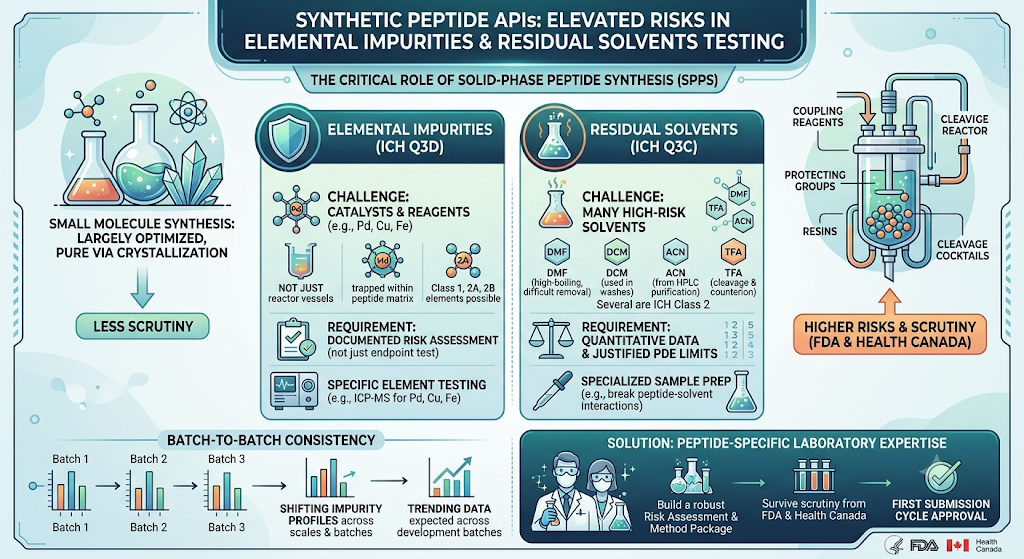
Synthetic peptide APIs raise the stakes on elemental impurities and residual solvents testing specifically because of how they’re manufactured, and both FDA and Health Canada scrutinize this data closely during review.
Solid-phase peptide synthesis (SPPS) relies on coupling reagents, protecting groups, resins, and cleavage cocktails that introduce a distinct impurity profile compared to small-molecule synthesis:
- Elemental impurities (ICH Q3D): catalysts and reagents used in coupling and deprotection steps can introduce Class 1, 2A, and 2B elements that require a documented risk assessment, not just an endpoint test.
- Residual solvents (ICH Q3C): SPPS and purification typically involve DMF, DCM, TFA-related solvents, and acetonitrile from HPLC purification — several of which fall into ICH Class 2, meaning permitted daily exposure limits apply and must be justified with quantitative data.
- Batch-to-batch consistency: peptide APIs synthesized at different scales can show shifting impurity profiles, so both agencies expect trending data across development batches, not a single-batch snapshot.
A lab that understands peptide chemistry specifically — not just generic small-molecule elemental impurities testing — is positioned to build a risk assessment and method package that survives scrutiny from both FDA and Health Canada reviewers on the first submission cycle.
5: How FDA and Health Canada Expectations Align
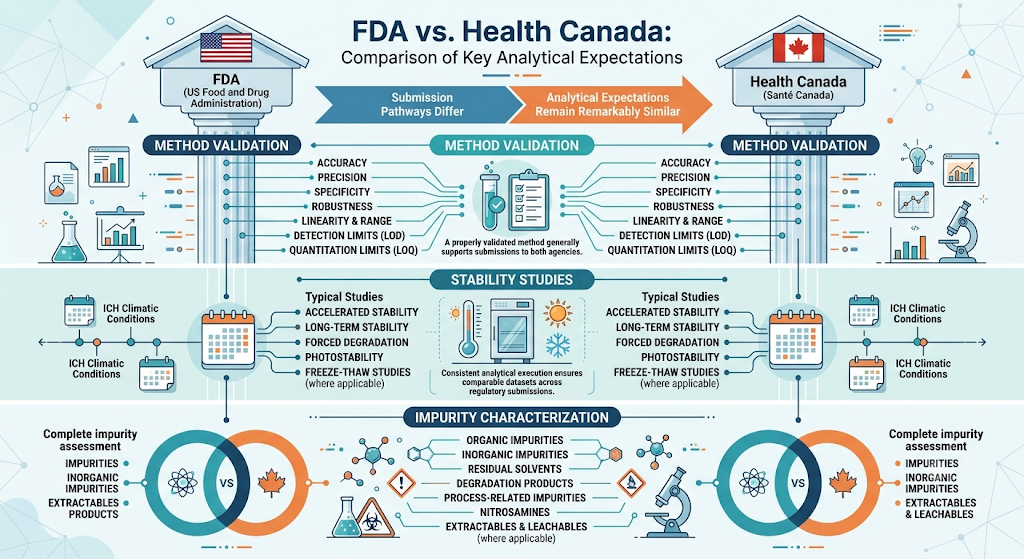
Although submission pathways differ, analytical expectations remain remarkably similar.
Method Validation
Both agencies expect validated analytical methods demonstrating:
- Accuracy
- Precision
- Specificity
- Robustness
- Linearity
- Range
- Detection limits
- Quantitation limits
A properly validated method generally supports submissions to both agencies.
Stability Studies
Regulators expect stability data generated under ICH climatic conditions.
Typical studies include:
- Accelerated stability
- Long-term stability
- Forced degradation
- Photostability
- Freeze-thaw studies (where applicable)
Consistent analytical execution ensures comparable datasets across regulatory submissions.
Impurity Characterization
Both agencies require complete impurity assessment, including:
- Organic impurities
- Inorganic impurities
- Residual solvents
- Degradation products
- Process-related impurities
- Nitrosamines
- Extractables & Leachables (where applicable)
6: How a Single Cross-Border Lab Streamlines the Submission Process
Using one CRO for both FDA and Health Canada testing removes duplicate validation work, keeps the data package internally consistent, and gives regulatory affairs teams one technical point of contact for questions from either agency.
The practical benefits compound across a development program:
- One method validation cycle instead of two, since ICH Q2(R2)-compliant validation is accepted by both agencies.
- One certificate of analysis format that regulatory affairs can adapt for both eCTD submissions without reconciling conflicting numbers.
- One technology transfer if testing later moves in-house or to a commercial-scale facility.
- One team answering agency questions, so a Health Canada information request and an FDA information request are both answered with full knowledge of the complete dataset — not a partial view.
- Faster amendment cycles, since updating a specification or re-testing a batch only has to happen once, not in parallel at two labs.
For elemental impurities and residual solvents testing specifically, this matters because both are risk-assessment-driven disciplines under ICH Q3D and ICH Q3C. A risk assessment built once, by a team that understands the synthesis route, is more defensible than two independently constructed assessments that happen to reach similar conclusions.
7: What to Look for in a Cross-Border Testing Partner
A lab capable of supporting both FDA and Health Canada submissions from one program should be evaluated against a few concrete criteria, not general reputation alone.
- Regulatory familiarity with both frameworks — not just ICH guidelines in the abstract, but practical experience preparing data packages that have gone through both FDA and Health Canada review cycles.
- ICH Q3D and ICH Q3C method capability for the specific modality (small molecule, peptide, biologic), including risk assessment documentation, not just raw test results.
- Analytical technology matched to the impurity profile — ICP-MS/ICP-OES for elemental impurities, GC-headspace for residual solvents, with validated limits of quantitation below permitted daily exposure thresholds.
- A single quality system governing all testing, so audit trail, data integrity, and documentation standards are identical regardless of which submission the data supports.
- Direct scientist access, so regulatory affairs and CMC teams can get technical questions answered by the analyst or study director, not routed through account management layers.
Conclusion:
Cross-border drug development doesn’t have to mean cross-border testing complexity. When one lab generates ICH Q2(R2)-validated data that satisfies both FDA and Health Canada requirements, sponsors avoid duplicated validation work, conflicting datasets, and the credibility questions that come from two labs producing two different answers to the same question. Need expert support for Elemental Impurities and Residual Solvents Testing for Synthetic Peptide APIs? ResolveMass Laboratories Inc. provides ICH Q3D and ICH Q3C compliant analytical testing, method development, validation, and regulatory support for pharmaceutical and biotechnology companies pursuing both FDA and Health Canada submissions from a single, coordinated data package.
Frequently Asked Questions:
Using one analytical laboratory ensures consistent testing methods, validation protocols, and reporting across your entire development program. It eliminates unnecessary duplicate studies and reduces variability between datasets. A single laboratory also improves communication, simplifies project management, and helps generate regulatory-ready documentation that can support submissions to both the FDA and Health Canada. This approach often saves both time and development costs.
While the FDA and Health Canada have different regulatory review processes, both largely follow harmonized ICH guidelines such as ICH Q2(R2), Q3C, Q3D, M7, and M10. This means analytical methods developed according to these standards are generally suitable for both agencies. Sponsors can therefore build one robust analytical strategy instead of separate testing programs for each market.
Typical analytical studies include:
-Method development and validation
-Assay and related substances testing
-Elemental impurities (ICH Q3D)
-Residual solvents (ICH Q3C)
-Stability studies
-Forced degradation studies
-Nitrosamine testing
-Extractables & Leachables (E&L)
-Dissolution testing
-Impurity identification using LC-MS/MS or HRMS
A single CRO follows standardized procedures throughout the project, ensuring consistent sample preparation, validated methods, and uniform reporting. This minimizes discrepancies that can occur when multiple laboratories are involved. Regulatory reviewers are more likely to accept well-documented, consistent datasets, reducing the likelihood of additional questions or requests for repeat testing.
Yes, in many cases. If an analytical method is developed and validated according to current ICH guidelines and meets the intended purpose, it can often support submissions to both regulatory agencies. Proper validation demonstrates the method’s accuracy, precision, specificity, robustness, and reliability. This helps avoid duplicate method development and simplifies global regulatory submissions.
CTD-ready documentation organizes analytical data in a format recognized by multiple regulatory authorities. It includes validated methods, study reports, certificates of analysis, chromatograms, and supporting scientific information. Well-prepared documentation improves submission quality, reduces review time, and makes it easier to respond to regulatory questions during product approval.
Reference
- Knowles L, Luth W, Bubela T. Paving the road to personalized medicine: recommendations on regulatory, intellectual property and reimbursement challenges. Journal of Law and the Biosciences. 2017 Dec;4(3):453-506.https://academic.oup.com/jlb/article-pdf/doi/10.1093/jlb/lsx030/23732194/lsx030.pdf
- Krishnan A, Mody R, Malhotra H. Global regulatory landscape of biosimilars: emerging and established market perspectives. Biosimilars. 2015 Feb 17:19-32.https://www.tandfonline.com/doi/abs/10.2147/BS.S44052
- Dalpé G, Joly Y. Towards precision medicine: The legal and ethical challenges of pharmacogenomics. InRoutledge handbook of medical law and ethics 2014 Sep 19 (pp. 339-366). Routledge.https://api.taylorfrancis.com/content/chapters/edit/download?identifierName=doi&identifierValue=10.4324/9780203796184-23&type=chapterpdf
- Diamantopoulos MA, Boti MA, Sarri T, Tounias G, Psychogyiou DD, Scorilas A. Regulation of biomarker analysis: what can be translated in the clinic?. Expert Review of Molecular Diagnostics. 2025 Oct 3;25(10):647-64.https://www.tandfonline.com/doi/abs/10.1080/14737159.2025.2534962
- DuBois W. New drug research, the extraterritorial application of FDA regulations, and the need for international cooperation. Vand. J. Transnat’l L.. 2003;36:161.https://heinonline.org/hol-cgi-bin/get_pdf.cgi?handle=hein.journals/vantl36§ion=19
- Cekola J. Outsourcing drug investigations to India: a comment on US, Indian, and international regulation of clinical trials in cross-border pharmaceutical research. Nw. J. Int’l L. & Bus.. 2007;28:125.https://heinonline.org/hol-cgi-bin/get_pdf.cgi?handle=hein.journals/nwjilb28§ion=7
About the Author


