

Introduction:
FDA and Health Canada Inspection Readiness for Testing Laboratories means maintaining a laboratory in a state where analytical activities, personnel, instruments, methods, records, and data can withstand regulatory scrutiny at any time. For pharmaceutical companies, the testing laboratory is often one of the most important sources of objective evidence demonstrating that a product meets its established quality requirements.
An FDA or Health Canada inspector may not simply ask whether a laboratory obtained a passing result. The deeper questions are whether the method was scientifically appropriate, whether the instrument was qualified and calibrated, whether analysts were trained, whether all generated data were retained, and whether the laboratory’s records accurately represent what actually happened.
FDA CGMP requirements establish expectations for laboratory controls, scientifically sound testing procedures, calibration, and complete laboratory records. Health Canada similarly inspects drug establishments against GMP requirements and specifically evaluates data integrity, record keeping, qualification and validation, equipment, training, procedures, testing, stability, and sample retention.
For this reason, inspection readiness should be built into everyday laboratory operations — not assembled in the weeks before an inspection is announced.
Summary:
- FDA and Health Canada Inspection Readiness for Testing Laboratories depends on having reliable data, controlled analytical methods, qualified equipment, trained personnel, and complete documentation at all times.
- A testing laboratory must be able to demonstrate not only what result was generated, but also how, when, by whom, and under which approved procedure it was generated.
- FDA laboratory expectations include scientifically sound specifications, sampling plans, test procedures, calibration, complete records, and appropriate review of laboratory data.
- Health Canada inspections evaluate data integrity, record keeping, qualification and validation, equipment, training, written procedures, product testing, stability, and sample retention.
- Inspection readiness should be treated as an ongoing quality activity, not a preparation exercise that begins only after receiving an inspection notice.
- A well-organized laboratory can make an inspection more efficient by quickly retrieving approved methods, raw data, chromatograms, audit trails, calculations, instrument records, deviations, OOS investigations, and training records.
- ResolveMass Laboratories combines advanced analytical capabilities with a quality-focused laboratory environment to support pharmaceutical and biopharmaceutical testing and regulatory programs.
1: What Does FDA and Health Canada Inspection Readiness Mean for a Testing Laboratory?
FDA and Health Canada Inspection Readiness for Testing Laboratories means being able to demonstrate, with documented evidence, that laboratory testing is scientifically justified, controlled, traceable, reproducible, and compliant with applicable GMP requirements.
A laboratory should be prepared to demonstrate control over the following areas:
| Inspection-Readiness Area | What the Laboratory Should Demonstrate |
|---|---|
| Analytical methods | Approved, scientifically justified and appropriately validated/verified methods |
| Raw data | Complete, attributable and retrievable analytical records |
| Instruments | Qualification, calibration, maintenance and appropriate use |
| Analysts | Training, competency and authorization |
| Standards and reagents | Identity, lot information, preparation, storage and expiry/use period |
| Sample management | Traceability from receipt through testing and disposition |
| Data integrity | Complete and reliable electronic and paper records |
| Deviations/OOS | Documented investigation and scientifically justified conclusions |
| Audit trails | Appropriate review and retention of relevant electronic activity |
| Reports | Accurate, traceable and consistent final results |
| Quality system | SOPs, change control, CAPA and periodic review |
The objective is not to create documents specifically for an inspector. The objective is to have a laboratory system in which the documentation naturally demonstrates control.
2: Why Is the Testing Laboratory So Important During an FDA or Health Canada Inspection?
The testing laboratory provides direct evidence about the identity, strength, quality, purity, safety, and consistency of pharmaceutical materials and products, which is why laboratory records can become a major component of an inspection.
FDA’s CGMP laboratory requirements call for scientifically sound specifications, standards, sampling plans and test procedures, together with appropriate controls for laboratory activities. FDA also emphasizes that laboratory records must include relevant data — including passing, failing, suspect, and apparently erroneous data — rather than selectively retaining only favorable results.
Health Canada similarly identifies product testing and stability among the areas assessed during GMP inspections, alongside data integrity and record keeping.
This means an inspection can move quickly from a high-level quality-system discussion to highly technical questions such as:
- Which method was used for this batch?
- Was the method approved before testing began?
- Who performed the analysis, and was the analyst trained on that procedure?
- What instrument was used, and was it within calibration?
- What happened to the original chromatographic data — were any injections repeated or results excluded?
- How was any OOS result investigated?
- Which reference standard lot was used?
- Can the laboratory reproduce the reported result from the original records?
A laboratory should be prepared to answer these questions using evidence rather than explanations alone.
3: How Should a Laboratory Prepare Its Analytical Methods?
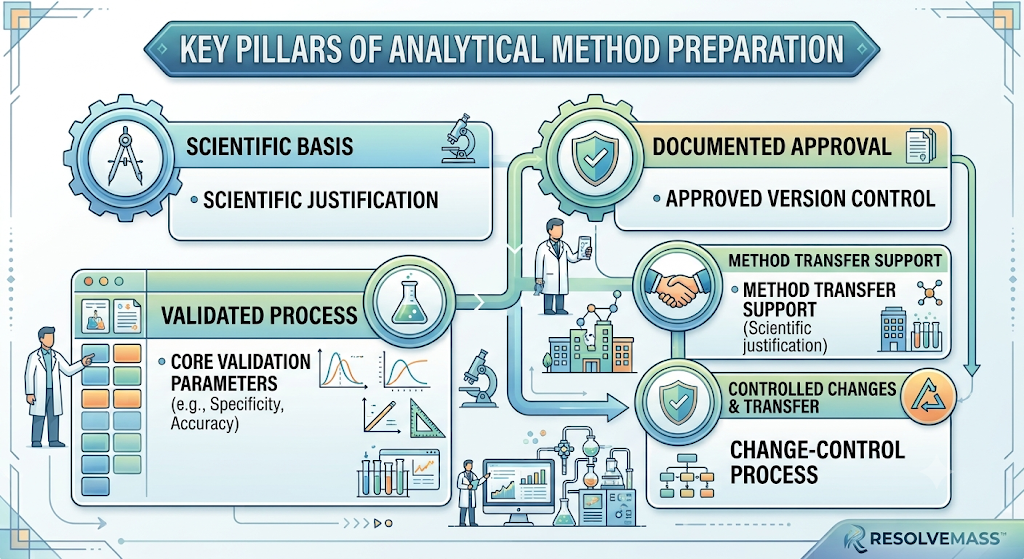
Analytical methods should be scientifically justified, controlled, appropriately validated or verified for their intended use, and supported by complete documentation. Method readiness matters because an inspector may directly evaluate whether the method is capable of producing reliable results for its intended purpose.
Method approval and version control. Every GMP method should have a clearly identifiable version and approval status. Analysts should use the currently approved procedure rather than uncontrolled copies or outdated versions.
Method validation or verification. Depending on the intended use, the laboratory should maintain appropriate evidence for parameters such as:
- Specificity/selectivity
- Accuracy and precision
- Linearity and range
- Detection and quantitation limits, where applicable
- Robustness and system suitability
- Solution stability and recovery
- Stability-indicating capability, where relevant
Method transfer. Where methods originate from a sponsor or another laboratory, the transfer or verification process should be documented and scientifically justified.
Changes to methods. Changes should follow an appropriate change-control process. The laboratory should be able to explain what changed, why it changed, who approved it, what impact was assessed, and when the revised method became effective.
ResolveMass supports analytical method development and validation for pharmaceutical and biopharmaceutical applications, including HPLC/UHPLC and LC-MS-based methods, impurity profiling, stability-indicating methods, forced degradation studies, and method verification/transfer support.
4: How Does Data Integrity Affect FDA and Health Canada Inspection Readiness?
Data integrity is one of the most critical elements of FDA and Health Canada inspection readiness for testing laboratories because regulators need confidence that laboratory records accurately represent the work performed.
A strong laboratory data-integrity framework should ensure that data are attributable, legible, contemporaneous, original or appropriately true copies, accurate, complete, consistent, enduring, and available. FDA specifically states that CGMP laboratory records should be complete and subject to appropriate review.
Laboratories should pay particular attention to:
- Original electronic data, chromatograms, and spectra
- Instrument sequence information and integration parameters
- Audit trails and electronic signatures
- Sample preparation records and calculation worksheets
- System suitability results
- Failed injections and repeated analyses
- Deleted or modified records
- OOS and atypical results
- Access permissions
A common inspection weakness is treating the final Certificate of Analysis or analytical report as the complete record. It is not — the supporting raw data and metadata are essential to establishing how the reported result was generated.
5: What Instrument and Equipment Records Should Be Inspection-Ready?
Every instrument used for regulated testing should have documented evidence that it is suitable for use and maintained in an appropriate state of control. Important records include:
- Installation/qualification documentation, where applicable
- Calibration records and preventive maintenance
- Repairs and service records
- Instrument usage logs and software/version information
- Computerized-system controls and performance checks
- Qualification status
- Deviations associated with instrument failures
FDA laboratory expectations include calibration of instruments, apparatus, gauges, and recording devices at suitable intervals using written procedures.
For example, if an HPLC result is questioned during an inspection, the laboratory should be able to connect the full chain of traceability:
Sample → Method → Sequence → Instrument → Standard → Analyst → Raw Data → Calculation → Reported Result.
That chain of traceability is fundamental to inspection readiness.
6: How Should Analysts and Laboratory Personnel Be Prepared?
Personnel should be trained, qualified, and demonstrably competent for the laboratory activities they perform. Training records should clearly establish that an analyst was trained on:
- Relevant SOPs and analytical methods
- Instrument operation
- Data-integrity requirements
- Safety procedures and sample handling
- Documentation practices
- OOS/deviation procedures, where applicable
Training should not be limited to attendance records — where appropriate, laboratories should maintain evidence of practical competency. An inspector may ask an analyst to explain how a test is performed, and the analyst should be able to describe the process consistently with the approved procedure. Health Canada specifically identifies staff training and qualifications as areas evaluated during GMP inspections.
7: What Should a Laboratory Check for OOS, Deviations, and Unexpected Results?
OOS, atypical, and unexpected results should be investigated through controlled, scientifically sound procedures rather than simply repeated until a passing result is obtained.
The laboratory should review whether:
- The initial test was performed correctly and the instrument was functioning appropriately
- Standards and reagents were suitable
- Calculations were correct
- Sample preparation was performed according to the method
- Analyst error is supported by evidence
- Additional laboratory testing is scientifically justified
- A broader manufacturing or product investigation is required
FDA has specifically highlighted concerns around unofficial “trial injections” and emphasizes that data generated during analysis must be retained and reviewed. Laboratories should therefore avoid practices that create undocumented or selectively discarded analytical results.
8: What Documentation Should Be Ready Before an Inspection?
The laboratory should maintain an organized, retrievable documentation package covering methods, personnel, equipment, samples, standards, raw data, investigations, and quality-system activities.
Laboratory quality documents: quality manual, relevant SOPs, quality policies, change controls, CAPA records, deviations, internal audit records.
Analytical documentation: approved analytical methods, validation/verification protocols and reports, method transfer records, system suitability requirements, specifications, sampling procedures, analytical worksheets.
Equipment documentation: equipment inventory, qualification records, calibration certificates, maintenance records, service reports, equipment logbooks.
Data and records: raw analytical data, chromatograms, spectra, audit trails, electronic records, calculations, laboratory reports, Certificates of Analysis.
Personnel records: training records, competency assessments, analyst authorization records, job responsibilities.
Materials and standards: reference-standard certificates, reagent records, preparation records, expiry/use-by assessments, storage records.
Health Canada expects drug establishments to maintain detailed records supporting GMP compliance, and its inspection process includes review of procedures and records.
9: FDA vs. Health Canada: What Should Testing Laboratories Know?
Both FDA and Health Canada expect strong laboratory controls and reliable data, although the applicable regulatory framework and inspection process differ.
| Area | FDA | Health Canada |
|---|---|---|
| Laboratory controls | Scientifically sound specifications, sampling and testing controls | GMP controls under Canada’s Food and Drug Regulations |
| Data integrity | Complete and reliable CGMP records | Data integrity and record keeping specifically assessed |
| Equipment | Calibration and appropriate controls | Qualification, calibration and maintenance evaluated |
| Personnel | Appropriate procedures, review and oversight | Training and qualifications evaluated |
| Testing | Testing and release controls | Product testing and stability assessed |
| Inspection readiness | Continuous CGMP compliance | Establishments are expected to remain inspection-ready |
| Corrective action | Deficiencies addressed through appropriate quality systems | CAPA and corrective action expected following observations |
Health Canada states that establishments within the scope of its inspection policy must comply with the Food and Drugs Act and Food and Drug Regulations. Its inspection strategy evaluates compliance with GMP requirements and uses risk-based observations. Health Canada also notes that establishments holding or applying for a Drug Establishment Licence are responsible for being ready for inspection, and advance notice is not guaranteed in every circumstance.
10: How Can a Testing Laboratory Conduct an Inspection-Readiness Mock Audit?
A mock inspection is one of the most practical ways to identify weaknesses before a regulator identifies them. Instead of only checking whether SOPs exist, the laboratory should simulate an actual inspection by selecting a recently tested batch and asking:
- Show me the approved method used, and its validation or verification evidence.
- Show me who performed the analysis and their training record.
- Show me the instrument used, and its calibration and maintenance status.
- Show me the original raw data and the audit trail.
- Show me the calculations and the reference standard information.
- Show me any deviations or OOS investigations.
- Show me how the final result was reviewed and approved.
The goal is to retrieve evidence quickly and demonstrate that the complete analytical story is internally consistent.
11: How Can ResolveMass Laboratories Support Inspection-Ready Analytical Programs?
ResolveMass Laboratories supports pharmaceutical and biopharmaceutical organizations with analytical development, characterization, and testing capabilities designed around scientific rigor, documentation, and regulatory expectations. ResolveMass identifies itself as a Health Canada GMP-compliant, Drug Establishment Licence holder, FDA-registered laboratory, and ISO 9001:2015-certified organization.
Its analytical capabilities include:
- HPLC and UHPLC analysis
- LC-MS/MS and high-resolution mass spectrometry
- Impurity profiling and nitrosamine testing
- Peptide characterization and sequencing
- NMR characterization
- Polymer characterization and GPC
- Extractables and leachables testing
- Bioanalytical testing
- Analytical method development and validation
For organizations preparing regulatory submissions, audits, or inspections, the value of an analytical partner is not simply access to instrumentation. The laboratory must be able to generate scientifically defensible data and maintain documentation that allows results to be reconstructed and understood. ResolveMass’s analytical method development and validation services emphasize scientifically sound methods, validation, regulatory-oriented documentation, and support for IND, NDA, ANDA, and marketing-authorization programs.
12: FDA and Health Canada Inspection Readiness Checklist for Testing Laboratories
A laboratory can use the following high-level checklist as part of its ongoing quality review:
- Current approved analytical methods are available.
- Validation/verification documentation is complete.
- Analysts are trained and authorized.
- Instruments are qualified/calibrated as applicable.
- Preventive maintenance is current.
- Reference standards and reagents are controlled.
- Sample traceability is maintained.
- Raw data are complete and retrievable.
- Audit trails are appropriately controlled and reviewed.
- Calculations can be reconstructed.
- OOS and deviation investigations are documented.
- Changes are managed through change control.
- CAPA actions are tracked to completion.
- Laboratory SOPs reflect actual practices.
- Records are protected from unauthorized alteration or deletion.
- Inspection-critical records can be retrieved promptly.
- Mock inspection exercises have been performed.
13: What Are the Most Common Laboratory Inspection-Readiness Weaknesses?
The most significant weaknesses are usually not the absence of sophisticated analytical instruments, but gaps in documentation, data integrity, method control, training, equipment records, and investigation practices. Common warning signs include:
- Using uncontrolled copies of analytical procedures
- Incomplete instrument logs
- Expired or poorly controlled reagents
- Missing training evidence
- Unexplained reinjections
- Inadequately documented calculations
- Incomplete raw-data packages
- Poor audit-trail review
- Unresolved deviations and weak OOS investigations
- Inconsistent practices between SOPs and actual laboratory operations
- Difficulty retrieving historical records
These weaknesses can undermine confidence in otherwise technically sound analytical results.
14: Why Should Inspection Readiness Be a Continuous Laboratory Practice?
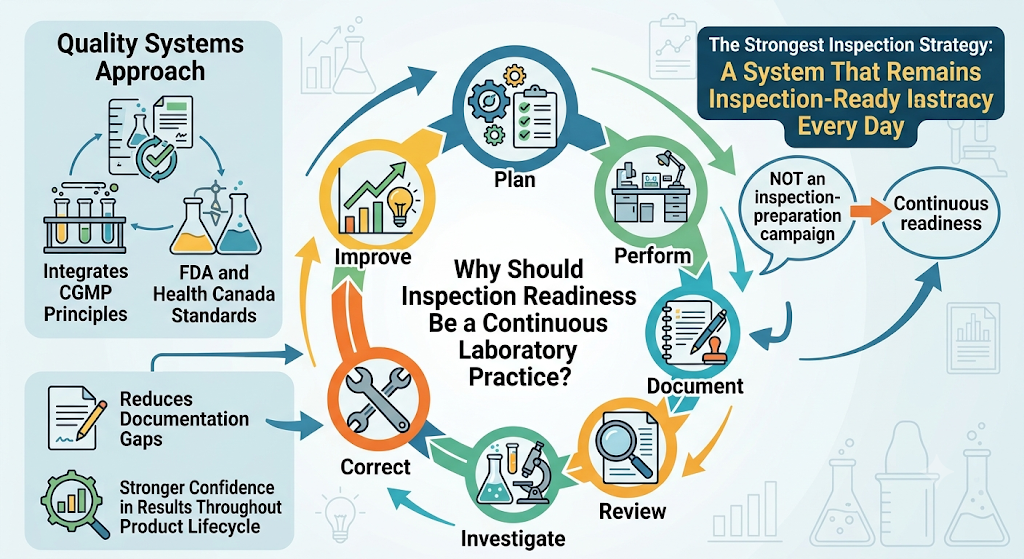
The strongest inspection strategy is not an inspection-preparation campaign; it is a laboratory quality system that remains inspection-ready every day. FDA’s quality-systems approach emphasizes integrating quality-system principles with CGMP requirements rather than treating compliance as a separate activity. Similarly, Health Canada’s inspection policy states that establishments must comply with applicable GMP requirements and maintain readiness for inspection.
A continuous-readiness model follows this cycle:
Plan → Perform → Document → Review → Investigate → Correct → Improve
This approach reduces the risk of discovering documentation gaps immediately before an inspection and creates stronger confidence in analytical results throughout the product lifecycle.
Conclusion:
FDA and Health Canada Inspection Readiness for Testing Laboratories begins with reliable science and ends with reliable evidence. A laboratory must be able to demonstrate that its methods are appropriate, instruments are controlled, analysts are competent, samples are traceable, data are complete, investigations are scientifically justified, and records accurately represent the work performed.
For pharmaceutical and biopharmaceutical organizations, selecting an analytical partner should therefore involve more than evaluating instrumentation or turnaround time — the laboratory’s quality system, scientific expertise, data-integrity practices, and ability to produce inspection-ready documentation are equally important.
ResolveMass Laboratories brings together advanced analytical capabilities, pharmaceutical testing expertise, and a quality-focused operating environment to support complex analytical programs across R&D and GMP applications. Its Health Canada Drug Establishment Licence, FDA registration, and ISO 9001:2015 certification provide additional evidence of its commitment to controlled, reliable laboratory operations.
Frequently Asked Questions:
The FDA may review analytical methods, specifications, laboratory procedures, raw data, and test results.
Inspectors can examine instrument calibration, equipment maintenance, reference standards, and analyst training.
They may also review OOS investigations, deviations, audit trails, calculations, and electronic records.
The laboratory must demonstrate that reported results are supported by complete and reliable data.
Consistency between written procedures and actual laboratory practices is also important.
Health Canada evaluates whether the laboratory operates according to applicable GMP requirements.
Inspection areas can include laboratory testing, data integrity, record keeping, equipment, and personnel training.
Inspectors may also review written procedures, product testing, stability activities, and sample retention.
Laboratories should maintain complete documentation supporting their analytical activities.
The overall objective is to demonstrate that testing processes consistently produce reliable and trustworthy results.
A laboratory should regularly review its SOPs, analytical methods, equipment records, and training documentation.
Raw data and audit trails should be checked for completeness and data-integrity issues.
OOS results, deviations, CAPAs, and change controls should be appropriately investigated and documented.
Mock inspections can help identify weaknesses before an FDA inspector identifies them.
All critical records should also be organized and readily retrievable.
Data integrity demonstrates that laboratory records accurately represent the work that was actually performed.
Regulators need confidence that analytical results have not been improperly changed, deleted, or selectively reported.
Complete raw data, audit trails, calculations, and metadata help establish this confidence.
Laboratories should retain relevant data, including failed or unexpected results where applicable.
Strong data-integrity controls therefore form a fundamental part of inspection readiness.
Reference
- Carey RB, Bhattacharyya S, Kehl SC, Matukas LM, Pentella MA, Salfinger M, Schuetz AN. Practical guidance for clinical microbiology laboratories: implementing a quality management system in the medical microbiology laboratory. Clinical microbiology reviews. 2018 Jul;31(3):10-128.https://journals.asm.org/doi/abs/10.1128/cmr.00062-17
- Roy S, Mandal B, Das BK. Quality assurance in laboratory practices and equipment maintenance: Ensuring precision, reliability, and compliance. InLaboratory Techniques for Fish Disease Diagnosis 2025 May 1 (pp. 79-103). Singapore: Springer Nature Singapore.https://link.springer.com/chapter/10.1007/978-981-96-4620-3_5
- Holloway K, Miller FA, Rousseau F, Gutierrez A, Hogarth S. Health Canada needs to act on laboratory-developed diagnostics. Canadian Medical Association Journal. 2019 Sep 30;191(39):E1067-9.https://www.cmaj.ca/content/191/39/E1067.short
- Carpenter RE. Navigating the new norm: The FDA’s final rule on laboratory developed tests (LDTs) and its impact on clinical laboratory operations. Clinical Microbiology Newsletter. 2024 Sep 1;48:1-8.https://www.sciencedirect.com/science/article/pii/S0196439924000308
- Viswanathan S, Bubela T. Current practices and reform proposals for the regulation of advanced medicinal products in Canada. Regenerative medicine. 2015 Aug 1;10(5):647-63.https://www.tandfonline.com/doi/abs/10.2217/RME.15.28
About the Author


