

FDA Registered vs. Health Canada Licensed: What CROs and CDMOs Need in a Testing Partner
 By Anusha Sinha
•
July 27, 2026
By Anusha Sinha
•
July 27, 2026
Introduction
Evaluating an FDA Registered vs. Health Canada Licensed analytical testing partner requires Contract Research Organizations (CROs) and Contract Development and Manufacturing Organizations (CDMOs) to assess fundamental differences in regulatory oversight, quality system requirements, and licensing structures across North American jurisdictions. Although both the United States Food and Drug Administration (FDA) and Health Canada enforce stringent scientific standards based on International Council for Harmonisation (ICH) guidelines, their operational frameworks, site authorization mechanisms, and regulatory submission expectations differ in several critical respects. Selecting an analytical testing facility that meets compliance requirements in both jurisdictions is essential for biopharmaceutical sponsors, CROs, and CDMOs involved in cross-border drug development, release testing, and stability programs.
Within an increasingly integrated global supply chain, active pharmaceutical ingredients (APIs), finished dosage forms (FDFs), and advanced biopharmaceutical products frequently move across regulatory borders between the United States and Canada. A contract analytical testing laboratory therefore functions as a critical safeguard for product quality, patient safety, and regulatory compliance. Misunderstanding the distinction between an FDA Registered facility and a Health Canada Licensed testing laboratory can create significant operational challenges, including import holds, Complete Response Letters (CRLs), Notices of Deficiency (NODs), and potential regulatory enforcement actions. This report presents a comprehensive, expert-level technical analysis of the FDA Registered vs. Health Canada Licensed regulatory environments and establishes the key evaluation criteria that CROs and CDMOs should consider when selecting dependable analytical testing partners.
Streamline your North American manufacturing and testing operations by working with a specialized Pharmaceutical CDMO in the US and Canada.
Looking for a testing partner that meets both U.S. FDA and Canadian regulatory expectations?
Partner with a laboratory that understands the difference between FDA registration and Health Canada licensing—and can deliver accurate, compliant, audit-ready testing to support your pharmaceutical development and manufacturing needs. Contact us
Article Summary: Key Takeaways
- FDA registration and Health Canada licensing are not the same. While the FDA relies on facility registration followed by risk-based inspections, Health Canada requires a Drug Establishment Licence (DEL) with explicit authorization for testing activities before operations begin.
- Cross-border pharmaceutical programs demand dual regulatory readiness. CROs and CDMOs benefit from testing partners that understand both US and Canadian compliance requirements, helping reduce approval delays and regulatory risks.
- Analytical quality is a critical selection factor. Laboratories should demonstrate validated methods, compliance with ICH Q2 guidelines, strong quality agreements, and expertise in USP and international pharmacopeial standards.
- Advanced testing capabilities strengthen regulatory submissions. Essential services include stability studies, release testing, trace impurity analysis, extractables and leachables (E&L) testing, high-resolution mass spectrometry, ICP-MS, and robust electronic data integrity systems.
- Submission requirements differ between the two authorities. Although technical data are largely harmonized through the eCTD format, FDA and Health Canada require different Module 1 documents, review processes, and site authorization evidence.
- Regulatory enforcement can directly affect product timelines. Poor laboratory controls, inadequate data integrity, or non-compliance may result in FDA Complete Response Letters (CRLs), Warning Letters, or Health Canada Notices of Deficiency (NODs), Non-Compliant ratings, and import restrictions.
- Choosing a qualified analytical partner improves long-term success. A testing laboratory that satisfies both FDA and Health Canada expectations supports smoother regulatory submissions, reliable product quality, efficient market access, and stronger lifecycle compliance.
Statutory Frameworks: Comparing FDA Registered vs. Health Canada Licensed Testing Facilities
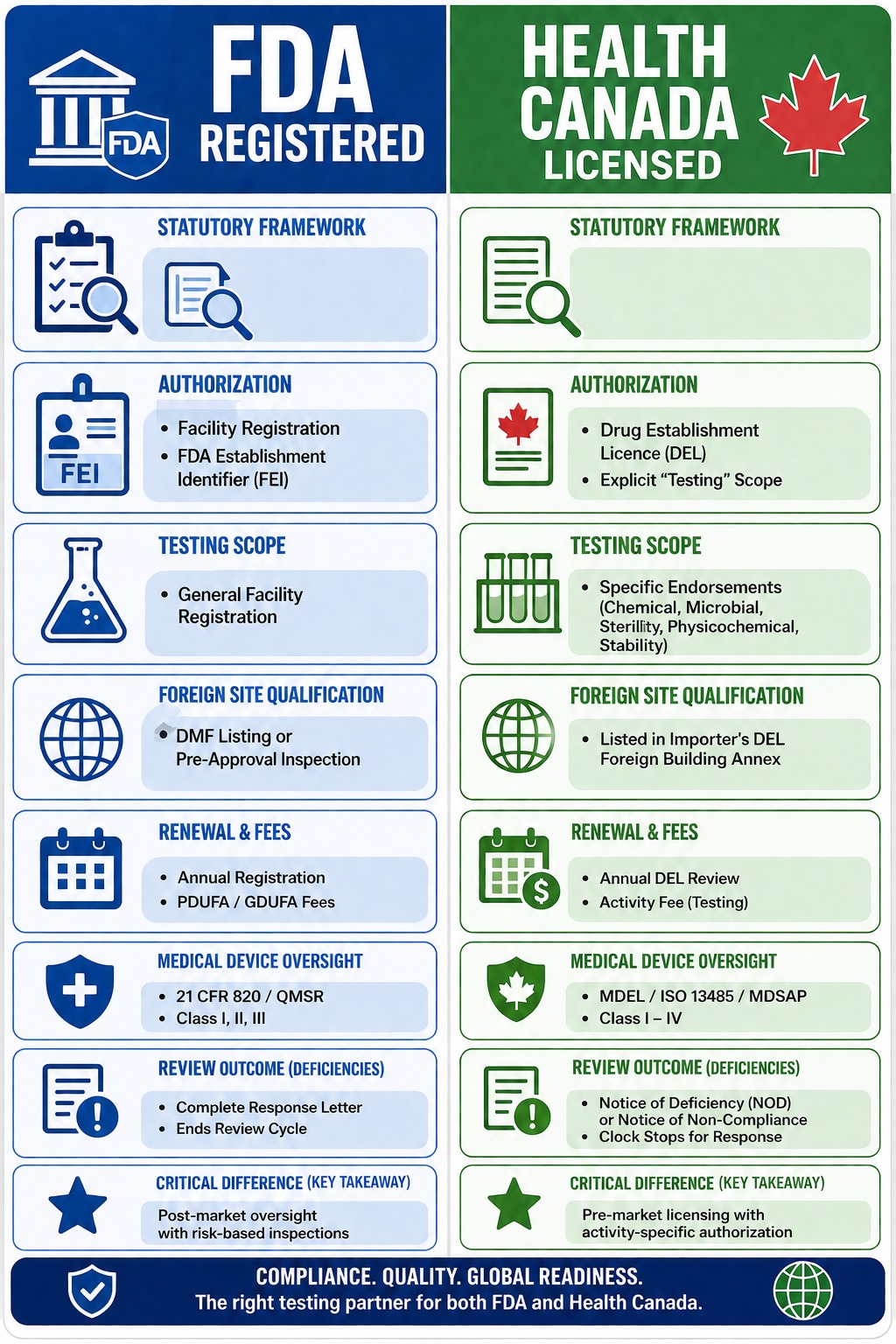
The primary statutory distinction between an FDA Registered vs. Health Canada Licensed testing facility concerns the mechanism used to authorize compliance. In the United States, the US FDA primarily relies on facility registration combined with post-market, risk-based cGMP inspections under 21 CFR Parts 210 and 211. In contrast, Health Canada requires pre-market site licensing through a Drug Establishment Licence (DEL), which explicitly identifies “Testing” as an authorized activity under Part C, Division 1A of the Food and Drug Regulations.
In the United States, analytical testing laboratories register with the FDA in accordance with Section 510 of the Federal Food, Drug, and Cosmetic Act (FD&C Act) and 21 CFR Part 207. Once registered, the facility receives an FDA Establishment Identifier (FEI). FDA registration is a self-identification requirement that places the facility within the FDA’s inspection and oversight framework. The FDA assesses facility compliance through risk-based Current Good Manufacturing Practice (cGMP) surveillance inspections, with laboratory controls evaluated under 21 CFR 211.160 (General Requirements), 21 CFR 211.165 (Testing and Release for Distribution), and 21 CFR 211.194 (Laboratory Records). Under US law, contract testing laboratories are regarded as direct extensions of the drug manufacturer’s quality unit and therefore play an important role in maintaining the integrity of the overall pharmaceutical quality system.
In Canada, Health Canada applies a direct and activity-specific licensing framework governed by the Food and Drugs Act and Part C, Division 1A of the Food and Drug Regulations (FDR). Any domestic laboratory that performs analytical testing on drugs, including raw materials, packaging components, finished dosage forms, or stability samples, must hold a valid Drug Establishment Licence (DEL) that specifically authorizes the activity of Testing. Health Canada further divides testing activities into specific sub-types identified through the licence endorsement, including Chemical, Microbiological, Sterility, Physicochemical, and Stability testing. Foreign testing facilities that provide analytical data to Canadian importers must undergo formal review and be listed in the Foreign Building Annex of the importer’s DEL. This listing must be supported by appropriate Good Manufacturing Practices (GMP) evidence assessed in accordance with Health Canada guidance GUI-0080.
Navigate complex cross-border compliance with tailored Regulatory Support for Generic Drugs US and Canada CDMO services.
| Regulatory Dimension | US FDA Registered Facility | Health Canada Licensed Facility (DEL) |
|---|---|---|
| Primary Legislation & Governing Rules | Federal Food, Drug, and Cosmetic Act; 21 CFR Parts 210, 211, 820 | Food and Drugs Act; Food and Drug Regulations (Part C, Division 1A & 2) |
| Authorization Instrument | FDA Facility Registration & FEI Identifier | Drug Establishment Licence (DEL) with explicit “Testing” scope |
| Pre-Operational Evaluation | Post-market risk-based surveillance inspection program | Pre-licensing GMP inspection or formal GUI-0080 evidence review |
| Testing Scope Categorization | General facility registration tied to registered drug listings | Granular endorsement (Chemical, Microbial, Sterility, Physicochemical, Stability) |
| Foreign Site Qualification | Drug Master File (DMF) listing or Pre-Approval Inspection (PAI) inclusion | Mandatory listing on Canadian Importer’s DEL Foreign Building Annex |
| Renewal & Fee Structure | Annual facility registration renewal and PDUFA/GDUFA user fees | Annual DEL review (ADLR) with activity-specific fees (6,014 for testing) |
| Medical Device Oversight | 21 CFR 820 Quality System Regulation / QMSR (Class I, II, III) | Medical Device Establishment Licence (MDEL) / ISO 13485 / MDSAP (Class I–IV) |
Swipe horizontally to view the full table on smaller screens.
Key Technical Criteria for CROs and CDMOs Evaluating an FDA Registered vs. Health Canada Licensed Partner
When assessing an FDA Registered vs. Health Canada Licensed testing laboratory, CROs and CDMOs should place particular emphasis on analytical method validation under ICH Q2 guidelines, compendial alignment across USP and Ph. Eur./BP monographs, formal Quality Agreements, and confirmation of the appropriate DEL sub-type endorsements.
One of the most important operational considerations for CROs and CDMOs is verifying that the contract testing laboratory can perform method validation, method verification, and method transfer across multiple compendial frameworks. Analytical procedures must meet the applicable requirements of ICH Q2(R1)/Q2(R2), including specificity, linearity, range, accuracy, precision (repeatability and intermediate precision), detection limit, quantitation limit, and robustness. Under 21 CFR 211.165(e) and USP Verification of Compendial Procedures, testing laboratories must confirm that compendial methods perform accurately and reliably within the specific formulation matrix being evaluated.
Ensure assay accuracy and compliance with robust Analytical Development for Generic Drugs in Canada.
Quality Agreements constitute a mandatory regulatory expectation under both 21 CFR 211.22 and Health Canada FDR C.02.015 / GUI-0001. These legally binding quality contracts must clearly establish the division of responsibilities between the CRO/CDMO sponsor and the contract analytical testing laboratory. The agreement should define procedures for Out-of-Specification (OOS) investigations, management of unexpected analytical results, change control notifications, raw data retention requirements, and rights of access for audits.
Understand the operational differences when evaluating a CDMO vs CRO for Generic Drug Development.
Contract testing facilities supporting distribution across both markets must maintain a broad range of technical capabilities, including:
- ICH Q1A–F Stability Testing Infrastructure: Fully validated, climate-controlled environmental chambers equipped with continuous 24/7 temperature and humidity monitoring, redundant backup power systems, and automated alarm systems capable of supporting real-time, accelerated, intermediate, and stress testing conditions.
- Release Testing Programs: Comprehensive microbiological and chemical testing capabilities compliant with USP (Microbial Enumeration Tests), USP (Tests for Specified Microorganisms), USP (Sterility Tests), and USP (Particulate Matter in Injections).
- Trace Impurity and Extractables/Leachables Characterization: High-resolution mass spectrometry platforms, including LC-MS/MS and GC-MS/MS, together with ICP-MS systems validated for elemental impurity profiling under USP and organic volatile impurity detection.
- Data Integrity and Computerized Systems Validation: Full compliance with 21 CFR Part 11 and Health Canada electronic records guidance, supported by restricted administrative access, automated audit trails, contemporaneous electronic signatures, and secure off-site data redundancy.
Verify complex impurity profiles with dedicated Peptide Analytical Characterization Services.
Impact on eCTD Module 1 Submissions and Review Mechanics: FDA Registered vs. Health Canada Licensed Data
The use of data generated by an FDA Registered vs. Health Canada Licensed analytical partner can directly influence regional Module 1 eCTD submissions and responses to review deficiencies, even though Modules 2 through 5 are broadly harmonized internationally under ICH standards.
The Electronic Common Technical Document (eCTD) format organizes global regulatory submissions into five distinct modules. Modules 2 through 5 contain scientific and technical information that can generally be reused across multiple regulatory jurisdictions. Module 3 (Quality / Chemistry, Manufacturing, and Controls) contains analytical information generated by the contract testing laboratory, including batch analyses, certificate of analysis (CoA) issuance, analytical method validation reports, container-closure integrity data, and stability testing summaries.
Discover how an experienced partner can Accelerate Generic Drug Development in the US and Canada.
The primary regional differences arise within eCTD Module 1. For US FDA submissions, including New Drug Applications [NDAs], Abbreviated New Drug Applications [ANDAs], and Biologics License Applications [BLAs], Module 1 requires Form FDA 356h, US Prescribing Information (USPI), establishment registration information, and environmental assessment evaluations under 21 CFR Part 25. For Canadian submissions, including New Drug Submissions [NDS] and Abbreviated New Drug Submissions [ANDS], Module 1 requires Form HC/SC 3011, Canadian Product Monographs, and explicit evidence of Drug Establishment Licensing. This includes foreign building listings in the importer’s DEL Annex where applicable.
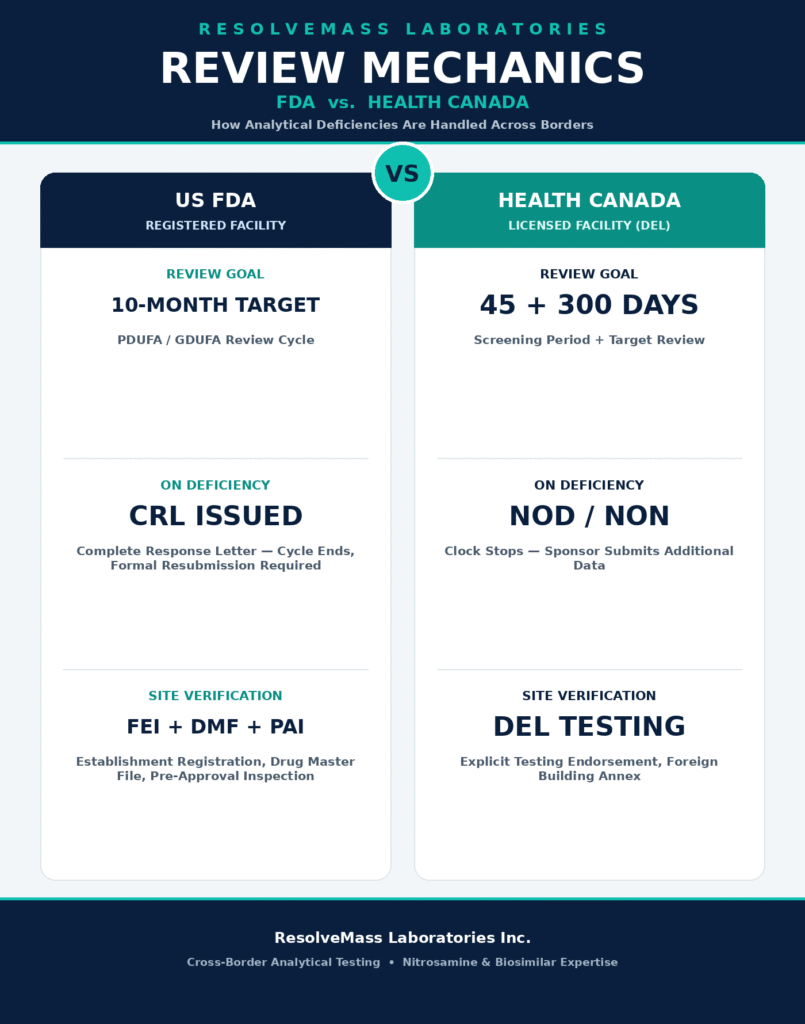
Review procedures and regulatory communications also differ considerably between the two regulatory authorities. Health Canada operates a “clock-stop” review mechanism. When Health Canada reviewers identify analytical deficiencies or missing validation parameters during the standard 300-day review target, the agency may issue a Notice of Deficiency (NOD) or Notice of Non-Compliance (NON). The review clock then stops, providing the sponsor with a defined period to submit supplemental laboratory data without losing the current submission cycle.
In contrast, the US FDA operates according to Prescription Drug User Fee Act (PDUFA) or Generic Drug User Fee Amendments (GDUFA) target review goals. If the FDA determines that analytical controls or testing methodologies are inadequately validated or fail to meet the requirements of 21 CFR 211.160(b), the agency may issue a Complete Response Letter (CRL) at the end of the review cycle. This concludes the current review and requires the sponsor to address the deficiencies through a formal resubmission.
Mitigate regulatory risks when Outsourcing Generic Drug Development in Canada.
Regulatory Review Mechanics Comparison
United States FDA Review Mechanics
- Module 1 Requirements: Form FDA 356h, USPI, 21 CFR 25 Environmental Exclusions, and Establishment FEI Numbers.
- Review Goal: A standard 10-month PDUFA/GDUFA target review period for original filings.
- Deficiency Process: A Complete Response Letter (CRL) is issued at the conclusion of the review cycle when significant deficiencies remain. The CRL terminates the current review cycle and requires the applicant to address the identified deficiencies before submitting a formal resubmission.
- Site Authorization Verification: Site authorization and regulatory status are verified through FDA Establishment Registration, Drug Master File (DMF) reviews, and Pre-Approval Inspections (PAIs), where applicable.
Health Canada Review Mechanics
- Module 1 Requirements: Form HC/SC 3011, Canadian Product Monograph, Drug Establishment Licence (DEL) evidence, and Foreign Building Annex documentation.
- Review Goal: A 45-day screening period followed by a 300-day target review period.
- Deficiency Process: Health Canada may issue a Notice of Deficiency (NOD) or Notice of Non-Compliance (NON) when deficiencies are identified. These mechanisms stop the review clock and provide the sponsor with an opportunity to generate and submit additional supporting data.
- Site Authorization Verification: Site authorization requires a valid Drug Establishment Licence (DEL) with an explicit Testing endorsement or, for foreign facilities, an appropriate listing in the Foreign Building Annex.
Risk Management and Enforcement: FDA Registered vs. Health Canada Licensed Compliance Standards
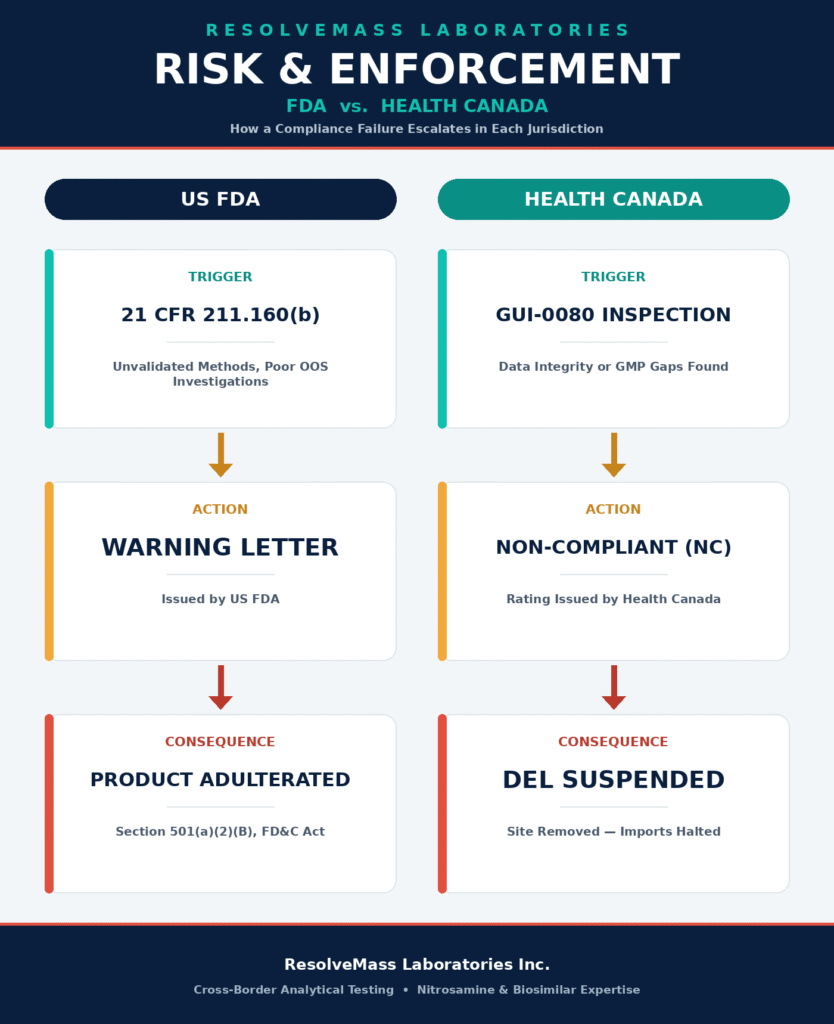
Risk management within an FDA Registered vs. Health Canada Licensed regulatory environment requires strict and consistently implemented laboratory controls to minimize the risk of FDA Warning Letters issued under 21 CFR 211.160(b) or Health Canada Non-Compliant (NC) ratings that may result in significant regulatory consequences, including the interruption of product imports.
Regulatory enforcement actions involving contract analytical laboratories frequently identify deficiencies in fundamental laboratory controls, data integrity systems, and quality unit oversight. The US FDA may issue Warning Letters citing 21 CFR 211.160(b) when a facility fails to establish scientifically sound specifications, standards, sampling plans, or analytical test procedures. Under Section 501(a)(2)(B) of the FD&C Act, drug products that are tested or released using laboratory controls that do not comply with applicable cGMP requirements may be considered legally adulterated. Common FDA observations include inadequate investigations of Out-of-Specification (OOS) results, use of unvalidated assay procedures, inappropriate integration of chromatographic peaks, and failure to preserve complete and accurate original raw data.
Health Canada maintains regulatory oversight through routine domestic GMP inspections and foreign building compliance assessments conducted under GUI-0080. These inspections result in one of two primary compliance ratings: “Compliant” (C) or “Non-Compliant” (NC). When a domestic testing facility receives a Non-Compliant rating, the outcome may include immediate suspension or cancellation of the facility’s DEL under FDR C.01A.016/C.01A.017. If a foreign testing facility receives an NC rating, Health Canada may remove the site from the Foreign Building Annexes of Canadian importers’ DELs. This action can immediately prevent the importation of products that depend on that laboratory for release testing or stability testing.
Align with a fully compliant Generic Pharmaceutical CDMO in Canada to safeguard your market entry.
For this reason, CROs and CDMOs must implement rigorous initial qualification and ongoing vendor audit programs for their analytical testing partners. These audits should evaluate instrument logbooks, analytical software audit trails, CAPA systems, data integrity controls, laboratory procedures, and analyst training files. A comprehensive vendor oversight program helps identify potential compliance weaknesses before they develop into regulatory findings that could compromise product supply, submission timelines, or market access.
Reduce operational risk when you Outsource Peptide Manufacturing to a CDMO.
Conclusion: Strategic Value of Selecting an FDA Registered vs. Health Canada Licensed Testing Partner
Partnering with a testing facility capable of bridging the FDA Registered vs. Health Canada Licensed regulatory frameworks can provide CROs and CDMOs with improved cross-border submission readiness, reduced regulatory review friction, and greater confidence in the integrity and reliability of analytical data.
Accelerate your complex molecules with specialized Peptide CDMO Services.
Navigating the complexities of North American biopharmaceutical regulation requires analytical testing partners that provide complete transparency across their quality management systems. By confirming that an analytical laboratory maintains FDA registration and holds the appropriate Health Canada Drug Establishment Licence endorsements for all relevant testing sub-types, CROs and CDMOs can better protect drug development programs from avoidable delays, unexpected cost increases, and regulatory enforcement risks. Establishing a robust analytical foundation supports more efficient regulatory submissions, strengthens quality assurance throughout the product lifecycle, and ultimately contributes to the protection of public health. Organizations seeking expert contract analytical testing, biopharmaceutical method validation, or cross-border release testing services can consult regulatory specialists directly through the ResolveMass Contact Page.
Frequently Asked Questions
What is the core difference between an FDA Registered facility and a Health Canada Licensed testing laboratory?
An FDA Registered facility has completed the required establishment registration process with the US FDA under 21 CFR Part 207, which primarily serves as a mechanism for identifying the facility for regulatory oversight. A Health Canada Licensed testing laboratory, in contrast, must hold a Drug Establishment Licence (DEL) that specifically authorizes the activity of “Testing.” This Canadian licensing process involves activity-specific regulatory oversight and GMP compliance requirements that are distinct from the US FDA registration model.
Can a US CRO or CDMO use a Health Canada Licensed testing laboratory for US FDA drug submissions?
Yes, analytical data generated by a Health Canada Licensed laboratory may be used to support US FDA drug submissions. However, the foreign testing facility must demonstrate compliance with applicable 21 CFR Parts 210 and 211 cGMP requirements and remain subject to FDA regulatory oversight where applicable. Depending on the regulatory circumstances, the FDA may evaluate the facility through Pre-Approval Inspections (PAIs), surveillance inspections, or other regulatory mechanisms.
Does an FDA Registered laboratory automatically qualify to test drugs imported into Canada?
No. FDA registration alone does not automatically authorize a laboratory to conduct testing for products intended for the Canadian market. The foreign facility must undergo the applicable assessment process under GUI-0080 and be formally listed on the Foreign Building Annex of the Canadian importer’s Drug Establishment Licence (DEL). Without the required Canadian authorization and listing, the laboratory may not satisfy Health Canada’s requirements for supporting imported drug products.
What specific testing sub-types must appear on a Canadian Drug Establishment Licence (DEL)?
A Canadian Drug Establishment Licence (DEL) identifies the specific testing activities that a facility is authorized to perform. Depending on the laboratory’s capabilities and approved scope, these endorsements may include Chemical, Microbiological, Sterility, Physicochemical, and Stability testing. The relevant testing categories must accurately correspond to the analytical activities performed for active pharmaceutical ingredients and finished dosage forms.
How do FDA and Health Canada handle Out-of-Specification (OOS) analytical test results?
Both the FDA and Health Canada require laboratories to conduct scientifically justified, thoroughly documented investigations when an Out-of-Specification (OOS) result is obtained. The FDA applies requirements under 21 CFR 211.192 and relevant OOS guidance, while Health Canada requires appropriate investigation practices under FDR C.02.015 and GUI-0001 (Chapter 4). Investigations must assess laboratory error, analytical procedures, equipment, data, and potential manufacturing-related causes before a scientifically supported conclusion is reached.
What are the fee differences between maintaining an FDA Registration and a Health Canada Testing DEL?
The financial obligations associated with these regulatory systems follow different structures. FDA-related fees are linked to applicable user fee programmes, including PDUFA, GDUFA, and MDUFA, depending on the regulated activity. Health Canada applies direct annual Drug Establishment Licence fees for authorized testing activities, including 6,014 CAD for testing as of April 2026, together with applicable foreign building assessment fees of 1,107 CAD per site.
How do regulatory inspection outcomes differ between the FDA and Health Canada?
The FDA generally documents inspection findings through Form FDA 483 observations and subsequent Establishment Inspection Reports (EIR), with outcomes commonly categorized as NAI, VAI, or OAI. Health Canada uses a different compliance classification system based primarily on a binary inspection outcome. Following an inspection or assessment, the facility may receive a “Compliant” (C) or “Non-Compliant” (NC) rating, depending on the significance and extent of identified deficiencies.
What quality management standards apply to medical device testing in the US versus Canada?
In the United States, medical device manufacturers and applicable testing operations are regulated under 21 CFR Part 820, the Quality System Regulation, with the transition to the Quality Management System Regulation (QMSR) incorporating ISO 13485 requirements. In Canada, medical device quality management oversight is closely associated with ISO 13485 requirements and the Medical Device Single Audit Program (MDSAP). The applicable requirements depend on the specific device classification and regulated activity.
Why are contract testing laboratories considered “extensions of the manufacturer” by regulatory bodies?
Contract testing laboratories perform critical quality control activities on behalf of drug manufacturers, sponsors, CROs, and CDMOs. Because analytical results can directly determine product release, stability conclusions, and regulatory decisions, regulators expect the contracting organization to maintain effective oversight of the laboratory. As outsourced quality control functions, these facilities must operate according to applicable cGMP requirements, with clearly defined responsibilities, documented quality agreements, and appropriate sponsor oversight.
What is a “NERBY” date on a Health Canada Drug Establishment Licence Foreign Building Annex?
A “New Evidence Required By” (NERBY) date identifies the deadline by which a Canadian importer must provide updated GMP evidence to maintain the active listing of a foreign testing facility on its Drug Establishment Licence. Supporting evidence may include a current inspection report, an applicable MRA certificate, or other acceptable GMP documentation. If the required evidence is not submitted by the specified date, the foreign site’s listing may be placed at risk and could affect the importation of products associated with that facility.
Reference:
- Health Canada. (2024, December 4). Glossary and definitions: Applications and service standards for drug establishment licences (GUI-0127). Government of Canada. https://www.canada.ca/en/health-canada/services/drugs-health-products/compliance-enforcement/establishment-licences/directives-guidance-documents-policies/management-applications-performance-drug-establishment-licences-0127/glossary-definitions.html
- Health Canada. (2017, February 10). Notice: Submission filing requirements—Good Manufacturing Practices (GMP)/Drug Establishment Licences (DEL). Government of Canada. Health Canada guidance document
- U.S. Food and Drug Administration. (2026, June 2). Laboratorios Dr. Collado S.A. MARCS-CMS 723285—Warning letter 320-26-87. FDA Warning Letter
- U.S. Food and Drug Administration. (2026, February 6). Cosmetic Manufacturers Pty Ltd. MARCS-CMS 719225—Warning letter 320-26-43. FDA Warning Letter
- U.S. Food and Drug Administration. (2022, April 14). Froggy’s Fog LLC MARCS-CMS 623283—Warning letter 320-22-30. FDA Warning Letter
Looking for a testing partner that meets both U.S. FDA and Canadian regulatory expectations?
Partner with a laboratory that understands the difference between FDA registration and Health Canada licensing—and can deliver accurate, compliant, audit-ready testing to support your pharmaceutical development and manufacturing needs.
Contact usAbout The Author
Anusha Sinha
Anusha Sinha, B.Pharm, is an experienced pharma professional with a strong background in Analytical Chemistry and Polymer Chemistry. With a passion for translating complex scientific data into clear, accessible content, she plays a vital role in communicating ResolveMass Laboratories Inc.’s advanced testing capabilities. In addition to her scientific expertise, Anusha leads Business Development initiatives, helping clients across pharmaceutical, biotechnology, and materials science sectors find tailored analytical solutions. Her combined experience in science and strategy positions her at the forefront of client engagement and technical communication.

