

Introduction:
The FDA Regulatory Pathway for Peptide-Oligonucleotide Conjugates is not determined simply by identifying a product as either a peptide or an oligonucleotide. Instead, FDA’s regulatory approach depends on the product’s legal classification, molecular design, mechanism of action, manufacturing process, intended therapeutic use, existing regulatory precedent, and the evidence required to establish quality, safety, and effectiveness.
Peptide-oligonucleotide conjugates are emerging therapeutic molecules that combine a peptide component with an oligonucleotide through a chemical linker. The peptide may provide targeting or cellular delivery properties, while the oligonucleotide may provide the primary pharmacological activity, such as modulation of gene expression. Sponsors evaluating this modality often start by comparing it to a related, more established class — see our antisense oligonucleotide vs. peptide-oligonucleotide conjugate comparison for how the two differ in structure and regulatory precedent.
Because the conjugate combines characteristics of two complex molecular modalities, developers may encounter additional questions involving molecular characterization, impurities, bioanalysis, pharmacokinetics, tissue distribution, metabolism, immunogenicity, and biological activity. FDA’s guidance on clinical pharmacology considerations for oligonucleotide therapeutics specifically recognizes that characteristics such as chemical modification and conjugation can influence the behavior of oligonucleotide products.
The key regulatory question for developers is therefore: what FDA pathway should be used for a peptide-oligonucleotide conjugate — 505(b)(1), 505(b)(2), 505(j), or another applicable pathway? The answer depends primarily on whether the product is novel and whether the sponsor can legally rely on existing information or an approved reference product.
Summary:
- The FDA Regulatory Pathway for Peptide-Oligonucleotide Conjugates is not determined simply by labeling a product a peptide or an oligonucleotide — it depends on regulatory classification, molecular structure, mechanism of action, intended use, existing FDA precedent, and available reference-product information.
- A novel peptide-oligonucleotide conjugate (POC) regulated as a drug will generally require an IND followed by an NDA under Section 505 of the FD&C Act.
- A 505(b)(1) NDA applies when the sponsor must generate complete reports of investigations establishing safety and effectiveness; a 505(b)(2) NDA may be appropriate when legally permissible existing information can support part of the application.
- An ANDA under Section 505(j) is generally difficult for a novel POC, since demonstrating the required sameness to a reference listed drug is scientifically challenging for a multi-component conjugate.
- CMC development must characterize the peptide, the oligonucleotide, the linker, the conjugation chemistry, impurities, degradation products, and the final conjugated molecule — not just the individual building blocks.
- FDA’s clinical pharmacology guidance on oligonucleotide therapeutics is directly relevant, since conjugation can change distribution, pharmacokinetics, pharmacodynamics, metabolism, and immunogenicity.
- Early FDA interaction — through pre-IND and subsequent meetings — helps sponsors clarify classification, development requirements, CMC expectations, and the appropriate marketing application before committing significant resources.
1: What Is a Peptide-Oligonucleotide Conjugate?
A peptide-oligonucleotide conjugate is a therapeutic molecule in which a peptide is chemically linked to an oligonucleotide to create a single molecular entity. The peptide component is typically designed to improve cellular uptake, tissue targeting, receptor-mediated delivery, intracellular penetration, and pharmacokinetic distribution to specific tissues — including specialized applications such as POCs in CNS drug delivery, where the peptide domain helps the conjugate cross biological barriers that oligonucleotides alone cannot penetrate.
The oligonucleotide component may include:
- Antisense oligonucleotides (ASOs)
- Small interfering RNA (siRNA)
- Other RNA-based therapeutic sequences
- Gene-expression-modulating oligonucleotides
- Sequence-specific therapeutic agents
The linker and conjugation chemistry can also be critical to the performance of the final therapeutic. Changing the conjugation site or linker may alter stability, cellular uptake, distribution, metabolism, release of the active oligonucleotide, pharmacological activity, and safety profile. Understanding exactly how peptide-oligonucleotide conjugates enter cells — via receptor-mediated endocytosis, direct membrane translocation, or another uptake mechanism — is often central to both the mechanism-of-action narrative and the nonclinical justification FDA will expect.
Therefore, analytical characterization should focus not only on the peptide and oligonucleotide individually but also on the final conjugated molecule.
2: What Is the FDA Regulatory Pathway for Peptide-Oligonucleotide Conjugates?
For a novel peptide-oligonucleotide conjugate regulated as a drug, the principal U.S. marketing pathway will generally be an NDA under Section 505 of the Federal Food, Drug, and Cosmetic Act. Depending on the product and the information available to the sponsor, the NDA strategy may involve either a 505(b)(1) or 505(b)(2) application.
| FDA Pathway | General Purpose | Potential Relevance to POCs |
|---|---|---|
| 505(b)(1) NDA | Full NDA supported by complete reports of safety and effectiveness investigations | Highly relevant to novel conjugates requiring an independent development program |
| 505(b)(2) NDA | NDA that relies partly on existing information the applicant did not generate or obtain a right of reference to | Potentially relevant when statutory requirements are satisfied |
| 505(j) ANDA | Generic drug application demonstrating required equivalence to a reference listed drug | Potentially relevant only when generic-drug requirements can be met |
| BLA | Marketing application for qualifying biological products | Not automatically applicable simply because the molecule contains a peptide or oligonucleotide |
| IND | Application permitting clinical investigation of an investigational drug | Generally required for clinical development of novel products |
The appropriate pathway should be determined through a product-specific regulatory assessment rather than by assuming that all peptide-oligonucleotide products follow the same route.
3: When Would a 505(b)(1) NDA Apply?
A 505(b)(1) NDA is generally appropriate when the peptide-oligonucleotide conjugate represents a novel therapeutic product and the sponsor needs to establish safety and effectiveness through its own development program. This situation may occur when the product has a novel peptide sequence, a novel oligonucleotide sequence, a novel linker, novel chemical modifications, a new conjugation strategy, a new therapeutic target, a new mechanism of action, or no suitable approved reference product.
A 505(b)(1) development program may require comprehensive evidence covering:
- CMC
- Nonclinical pharmacology
- Toxicology
- Pharmacokinetics
- Pharmacodynamics
- Bioanalytical methods
- Clinical safety
- Clinical efficacy
- Immunogenicity, where applicable
FDA has approved several oligonucleotide therapeutics through the NDA framework, demonstrating that oligonucleotide therapeutics can be regulated as drugs under Section 505. For a novel peptide-oligonucleotide conjugate, the sponsor should be prepared to demonstrate how the molecular structure relates to its pharmacological activity, safety, and clinical performance.
4: Could a Peptide-Oligonucleotide Conjugate Use the 505(b)(2) Pathway?
Potentially, yes — but eligibility for 505(b)(2) must be assessed based on the specific product and the information on which the sponsor intends to rely. The 505(b)(2) pathway can be used when at least some of the information required for approval comes from studies that were not conducted by or for the applicant and for which the applicant does not have a right of reference, subject to applicable statutory and regulatory requirements.
For a peptide-oligonucleotide conjugate, a 505(b)(2) strategy might be considered when there is relevant existing information concerning an established active ingredient, an existing approved product, previously characterized pharmacology, existing nonclinical information, established clinical knowledge, or certain formulation or route-of-administration information.
However, simply using a known peptide and a known oligonucleotide does not automatically qualify a new conjugate for 505(b)(2). The conjugation process may significantly change pharmacokinetics, tissue distribution, cellular uptake, metabolism, pharmacodynamics, toxicity, immunogenicity, and dose-response characteristics. Therefore, a sponsor should obtain regulatory advice before assuming that 505(b)(2) will substantially reduce development requirements.
5: Is an ANDA Appropriate for Peptide-Oligonucleotide Conjugates?
For a novel peptide-oligonucleotide conjugate, an ANDA is generally not the default regulatory pathway. An ANDA is intended for generic drug products that meet the applicable statutory requirements and demonstrate the required relationship to a reference listed drug. For complex peptide-oligonucleotide conjugates, demonstrating the necessary sameness or equivalence can be scientifically challenging.
Important characteristics for an ANDA sameness assessment may include:
- Peptide sequence
- Oligonucleotide sequence
- Chemical modifications
- Backbone chemistry
- Linker structure
- Conjugation site
- Molecular weight
- Purity
- Related substances
- Degradation products
- Biological activity
- Pharmacokinetics
- Immunogenicity-related considerations
If the proposed product differs substantially from the reference product in its molecular structure or conjugation chemistry, an ANDA may not be appropriate. Therefore, developers should conduct a detailed reference-product and regulatory-pathway assessment before committing to an ANDA strategy.
Why Is Generic Development Challenging for These Products?
Generic development of peptide-oligonucleotide conjugates can be more complicated than conventional small-molecule generic development because the molecular architecture contains several interacting components. Developers may need to establish equivalence across primary molecular structure, peptide sequence, oligonucleotide sequence, chemical modifications, conjugation site, linker structure, purity, impurity profile, molecular heterogeneity, biological activity, pharmacokinetic characteristics, and potential immunogenicity.
FDA’s ongoing scientific work regarding generic peptides and oligonucleotides demonstrates the increasing importance of analytical and biological approaches to evaluating complex products. For this reason, generic developers should not rely solely on conventional chromatographic purity testing when a more extensive molecular characterization strategy is scientifically necessary — orthogonal purification techniques for peptide-oligonucleotide conjugates are often needed to isolate and confirm the identity of closely related process impurities.
6: What Role Does the IND Play in the FDA Regulatory Pathway?
For a novel peptide-oligonucleotide conjugate, an IND is generally required before conducting clinical investigations in the United States. The IND package should provide sufficient information for FDA to assess whether the proposed clinical investigation can proceed safely.
The development package supporting an IND may include:
- Drug substance characterization
- Drug product information
- Manufacturing process
- Analytical methods
- Specifications
- Stability data
- Nonclinical pharmacology, toxicology, pharmacokinetics, and pharmacodynamics
- Bioanalytical strategy
- Clinical protocol and investigator information
- Risk assessment
For oligonucleotide therapeutics, FDA’s clinical pharmacology recommendations highlight considerations such as conjugation, chemical modifications, tissue distribution, immunogenicity, organ impairment, drug-drug interactions, and QTc considerations where applicable. For peptide-oligonucleotide conjugates, these considerations should be evaluated in the context of the complete molecular structure.
7: What CMC Data Are Important for Peptide-Oligonucleotide Conjugates?
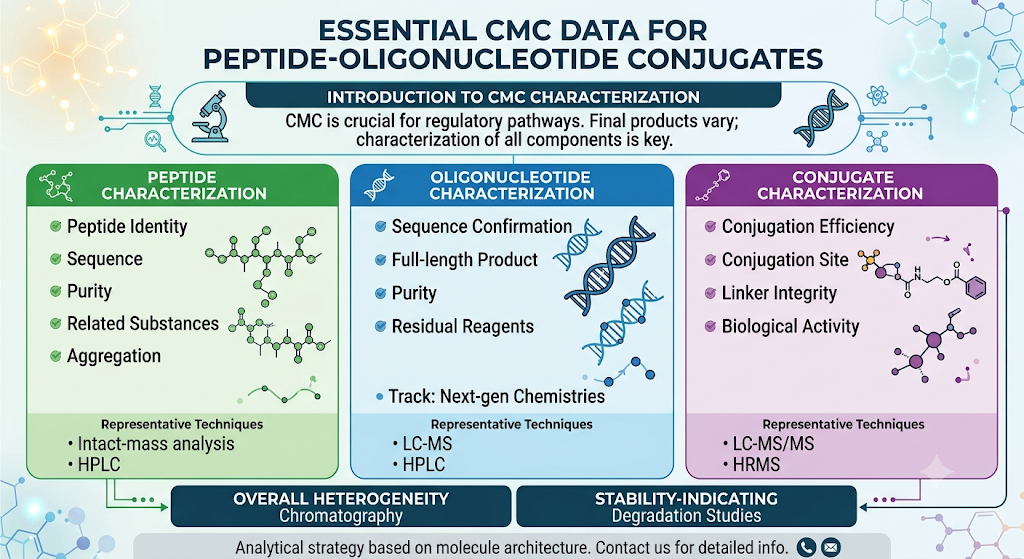
CMC characterization is one of the most important elements of the FDA Regulatory Pathway for Peptide-Oligonucleotide Conjugates because the final product can contain multiple sources of molecular variability. A strong analytical program should characterize both the individual components and the final conjugated drug substance — our analytical characterization services for peptide-oligonucleotide conjugates are built around exactly this multi-component demand.
Peptide characterization typically covers peptide identity, amino acid sequence, molecular mass, purity, related substances, oxidation, deamidation, truncation products, aggregation, and residual reagents/solvents.
Oligonucleotide characterization typically covers sequence confirmation, molecular weight, full-length product, shortmers, longmers, backbone modifications, end-group characterization, purity, related oligonucleotides, residual synthesis reagents, counterions, and degradation products. Sponsors working with modified backbones should also track how next-generation oligonucleotide chemistries — such as newer 2′-modifications or phosphorothioate alternatives — affect the analytical control strategy relative to first-generation designs.
Conjugate characterization — the piece unique to this modality — typically covers peptide-to-oligonucleotide conjugation efficiency, conjugation site, linker integrity, free peptide, free oligonucleotide, conjugated impurities, unconjugated impurities, molecular heterogeneity, aggregation, degradation pathways, and biological activity. Confirming the correct sequence and conjugation architecture up front relies on dedicated sequence confirmation strategies for peptide-oligonucleotide conjugates, since standard peptide mapping or oligonucleotide sequencing alone won’t verify the linkage itself.
| Component | Representative Analytical Techniques |
|---|---|
| Peptide domain | Peptide mapping, RP-HPLC, intact-mass analysis |
| Oligonucleotide domain | Ion-pair RP-HPLC, LC-MS, capillary gel electrophoresis |
| Conjugation site/linker | LC-MS/MS, high-resolution mass spectrometry |
| Overall heterogeneity | Ion-exchange chromatography, size-based chromatography |
| Stability-indicating | Forced degradation studies, stress testing |
The analytical strategy should be based on the molecule’s specific architecture and the regulatory questions that need to be answered. Manufacturing scale-up introduces its own analytical burden — see our overview of automation in peptide-oligonucleotide conjugate synthesis for how process control strategies evolve from bench to GMP scale. Drug product development, including buffer selection and delivery-device compatibility, is covered in our POC drug product formulation services overview, and long-term product quality depends on a well-designed storage, stability, and handling strategy established early in development.
8: How Does FDA Evaluate Oligonucleotide Clinical Pharmacology?
FDA’s guidance on clinical pharmacology considerations for oligonucleotide therapeutics addresses QTc prolongation and proarrhythmic potential, immunogenicity risk, hepatic impairment, renal impairment, and drug-drug interactions. For peptide-oligonucleotide conjugates, additional questions may arise because conjugation can change the disposition of the oligonucleotide.
Developers may need to investigate whether the peptide changes tissue distribution, whether conjugation improves cellular uptake, whether the conjugate remains stable in plasma, whether the linker is cleaved, whether the released oligonucleotide is the active species, whether conjugated metabolites are pharmacologically active, whether peptide and oligonucleotide components undergo different metabolic pathways, whether conjugation changes clearance, and whether conjugation changes immunogenicity.
A suitable bioanalytical strategy should be capable of measuring the relevant molecular species needed to understand exposure and pharmacological activity.
9: How Important Is Immunogenicity?
Immunogenicity can be an important consideration for peptide-oligonucleotide conjugates because both the peptide component and modified oligonucleotide may contribute to immune recognition or activation. The risk assessment may consider peptide sequence, peptide length, chemical modifications, oligonucleotide chemistry, backbone modifications, linker chemistry, conjugation site, aggregation, product-related impurities, innate immune activation, anti-drug antibodies where relevant, and other immune responses based on the specific molecule.
Immunogenicity assessment should be incorporated into development early rather than treated solely as a late-stage regulatory exercise.
10: Does a Peptide-Oligonucleotide Conjugate Require a BLA?
Not automatically. The presence of a peptide or oligonucleotide does not by itself mean that the product must be regulated through a biologics license application. Regulatory classification depends on the product’s characteristics and applicable statutory and regulatory framework, and FDA has significant experience regulating oligonucleotide therapeutics as drugs through CDER and the NDA framework.
Therefore, developers should perform an early regulatory classification assessment instead of assuming that a complex molecular structure automatically means the product is a biologic. For novel products, discussions with FDA can help clarify the appropriate regulatory jurisdiction and development pathway.
11: What FDA Guidance Should Developers Monitor?
There is no single FDA guidance document that completely defines the development pathway for every peptide-oligonucleotide conjugate. Instead, developers should consider multiple relevant FDA guidances and regulatory precedents.
| Regulatory Resource | Relevance |
|---|---|
| FDA Clinical Pharmacology Considerations for the Development of Oligonucleotide Therapeutics | PK/PD, immunogenicity, organ impairment, DDI, and other clinical pharmacology considerations |
| FDA Nonclinical Safety Assessment of Oligonucleotide-Based Therapeutics | Nonclinical safety considerations |
| FDA Clinical Pharmacology Considerations for Peptide Drug Products | Clinical pharmacology considerations for peptide products |
| FDA Synthetic Peptide Guidance and related current recommendations | Relevant considerations for certain generic peptide products |
| FDA ANDA vs. 505(b)(2) Guidance | Regulatory pathway selection |
| ICH M10 | Bioanalytical method validation |
| ICH Q6A/Q6B, as applicable | Specifications and characterization |
| ICH Q8 | Pharmaceutical development |
| ICH Q9 | Quality risk management |
| ICH Q10 | Pharmaceutical quality system |
Because FDA guidance and product-specific recommendations continue to evolve, sponsors should always verify the current version and regulatory status of relevant guidance before using it as the basis for a submission strategy. This is particularly important for peptide and oligonucleotide products because FDA’s scientific expectations continue to develop as more products enter clinical development and reach the market.
12: How Should Sponsors Build a Regulatory Strategy?
A practical strategy for developing a peptide-oligonucleotide conjugate can be organized into seven stages:
- Define the product — document peptide sequence, oligonucleotide sequence, chemical modifications, linker, conjugation site, mechanism of action, route of administration, and dosage form.
- Establish regulatory classification — determine whether the product is appropriately regulated as a drug and identify the relevant FDA center and review division.
- Evaluate existing FDA precedent — search for products with similarities in oligonucleotide modality, peptide component, conjugation chemistry, target, mechanism, route of administration, chemical modifications, and delivery strategy. A similar product does not necessarily establish the same regulatory pathway.
- Determine the marketing application — evaluate whether the product potentially fits 505(b)(1), 505(b)(2), or 505(j), based on both scientific and legal considerations.
- Develop the CMC package — build analytical methods capable of demonstrating identity, purity, structure, conjugation, impurities, stability, molecular consistency, and biological relevance.
- Establish the nonclinical and clinical strategy — connect exposure, tissue distribution, pharmacology, toxicology, biomarkers, PK/PD, and clinical endpoints to the molecular mechanism and intended therapeutic effect.
- Obtain FDA feedback — for a novel or scientifically complex conjugate, early FDA interaction can help clarify regulatory classification, IND expectations, CMC requirements, analytical characterization, nonclinical studies, clinical pharmacology, immunogenicity, bioanalytical methods, potential 505(b)(2) considerations, and the marketing application pathway.
13: How Can a Specialized CRO Support Development?
Peptide-oligonucleotide conjugates require analytical strategies that connect molecular structure with biological performance. A specialized analytical laboratory can support developers with peptide sequence confirmation, oligonucleotide characterization, intact-mass analysis, LC-MS/MS, high-resolution mass spectrometry, peptide mapping, RP-HPLC, ion-exchange chromatography, impurity profiling, degradation studies, stability-indicating method development, bioanalytical method development, structural characterization, method validation, and CMC analytical documentation.
ResolveMass Laboratories Inc. supports pharmaceutical and biotechnology developers with analytical characterization programs designed around complex molecules and regulatory requirements. The goal is not simply to generate analytical data but to produce scientifically interpretable and traceable evidence that helps demonstrate product quality and supports CMC development and regulatory decision-making.
Key Regulatory Takeaways
- There is no single FDA pathway automatically assigned to every peptide-oligonucleotide conjugate.
- A novel conjugate regulated as a drug will generally require an IND for clinical development and an NDA for marketing approval.
- A 505(b)(1) NDA is generally relevant when a sponsor must establish safety and effectiveness through a complete development program.
- A 505(b)(2) NDA may be appropriate when statutory requirements are satisfied and legally usable existing information can support part of the application.
- An ANDA should not be assumed simply because the peptide or oligonucleotide components are individually known.
- Conjugation can influence distribution, pharmacokinetics, pharmacodynamics, metabolism, and safety.
- CMC characterization should evaluate both individual components and the final conjugated molecular entity.
- Immunogenicity and biological activity should be considered during early development.
- Analytical methods should be capable of characterizing critical structural attributes and relevant impurities.
- Early regulatory interaction can reduce uncertainty regarding the appropriate FDA development pathway.
Conclusion:
The FDA Regulatory Pathway for Peptide-Oligonucleotide Conjugates depends on the specific characteristics of the product rather than simply its classification as a peptide or oligonucleotide. For many novel peptide-oligonucleotide conjugates regulated as drugs, development will generally involve an IND followed by an NDA. A 505(b)(1) pathway may be appropriate when the sponsor needs to generate a comprehensive independent evidence package, while a 505(b)(2) pathway may be considered when legally permissible reliance on existing information is possible. An ANDA should be considered only when the proposed product satisfies the requirements applicable to the generic-drug pathway and can demonstrate the necessary relationship to the reference listed drug.
Because peptide-oligonucleotide conjugates combine complex molecular architectures, their development requires careful attention to CMC characterization, impurity profiling, conjugation chemistry, molecular identity, stability, biological activity, pharmacokinetics, pharmacodynamics, and immunogenicity. For pharmaceutical and biotechnology developers, early regulatory planning combined with a robust analytical strategy can help identify development gaps before they become barriers to IND or NDA submission.
Frequently Asked Questions:
FDA’s guidance on Clinical Pharmacology Considerations for the Development of Oligonucleotide Therapeutics is an important resource. It addresses areas such as immunogenicity, hepatic and renal impairment, drug-drug interactions, and QTc considerations. Developers should also evaluate applicable FDA guidance concerning nonclinical safety, peptides, generic drug pathways, and product-specific recommendations.
HPLC can be an important component of the analytical strategy, but it may not be sufficient by itself for a complex conjugate. Chromatographic methods can provide information about purity and related substances, while mass spectrometry and complementary techniques can provide additional information about molecular identity, molecular mass, sequence, modifications, and conjugation.
Nonclinical requirements are product-specific but may include pharmacology, pharmacokinetics, biodistribution, toxicology, safety pharmacology where appropriate, and assessment of relevant off-target or immune-related effects. The design should consider the conjugate as a whole and identify which molecular species are responsible for pharmacological and toxicological effects.
Yes. Immunogenicity should be considered because both the peptide and oligonucleotide components, along with chemical modifications, aggregation, impurities, and conjugation chemistry, may influence immune responses. The appropriate immunogenicity assessment should be based on the product’s molecular characteristics and intended clinical use.
Conjugation can substantially influence an oligonucleotide’s absorption, distribution, cellular uptake, metabolism, and clearance. A peptide may alter tissue targeting or cellular penetration, while the linker can affect stability and release of the active species. Therefore, the pharmacokinetic behavior of the conjugate should be evaluated as a product-specific characteristic.
Reference
- Anwar S, Mir F, Yokota T. Enhancing the effectiveness of oligonucleotide therapeutics using cell-penetrating peptide conjugation, chemical modification, and carrier-based delivery strategies. Pharmaceutics. 2023 Apr 3;15(4):1130.https://www.mdpi.com/1999-4923/15/4/1130
- Holz E, Darwish M, Tesar DB, Shatz-Binder W. A review of protein-and peptide-based chemical conjugates: past, present, and future. Pharmaceutics. 2023 Feb 10;15(2):600.https://www.mdpi.com/1999-4923/15/2/600
- Bose S, Oliver PL. The chemistry and biology of oligonucleotide conjugation. Nucleic Acid Insights. 2024;1(3):127-38.https://www.researchgate.net/profile/Sritama-Bose-2/publication/380184816_The_chemistry_and_biology_of_oligonucleotide_conjugation/links/6630931a3524304153543973/The-chemistry-and-biology-of-oligonucleotide-conjugation.pdf
- Leckie J, Yokota T. Potential of cell-penetrating peptide-conjugated Antisense Oligonucleotides for the treatment of SMA. Molecules. 2024 Jun 4;29(11):2658.https://www.mdpi.com/1420-3049/29/11/2658
- Winkler J. Oligonucleotide conjugates for therapeutic applications. Therapeutic delivery. 2013 Jul 1;4(7):791-809.https://www.tandfonline.com/doi/abs/10.4155/tde.13.47
About the Author


