


Introduction
Navigating FDA vs EMA biosimilar regulatory pathways is one of the most strategically consequential decisions a biopharmaceutical developer makes at programme inception. Choose the wrong reference product, design studies to only one agency’s expectations, or misalign your analytical comparability package — and you face costly bridging studies, clinical holds, or outright rejection on both sides of the Atlantic. The good news: with the right scientific strategy and characterisation data, a developer can design a single, integrated programme that satisfies both regulators and brings a biosimilar to two of the world’s largest markets in parallel.
This guide breaks down the key structural differences between the two pathways, translates those differences into practical programme decisions, and explains where robust analytical support — from physicochemical characterisation through immunogenicity — becomes the linchpin of a successful dual-market strategy.
Summary
- The FDA (United States) and EMA (European Union) both provide well-established biosimilar regulatory pathways, but differ significantly in terminology, data requirements, extrapolation standards, and interchangeability/substitution rules.
- FDA biosimilar approval follows a 351(k) pathway under the Biologics Price Competition and Innovation Act (BPCIA); EMA follows Article 10(4) of Directive 2001/83/EC with dedicated biosimilar guidelines.
- The FDA requires a stepwise “totality of evidence” approach; the EMA uses a similar concept but applies a more prescriptive guideline structure with mandatory comparability exercises.
- Interchangeability is a distinct FDA designation not recognised by the EMA — in Europe, substitution is decided at the member-state level.
- Analytical characterisation, PK/PD studies, immunogenicity assessments, and clinical data requirements differ in scope and sequencing between the two agencies.
- Developers targeting both markets should design dual-compliant studies from the outset to avoid costly protocol amendments and duplicative data packages.
- ResolveMass Laboratories provides the analytical, bioanalytical, and CMC support needed to build a regulatory-ready biosimilar dossier for both FDA and EMA submissions.
1: What Is the Regulatory Basis for Biosimilar Approval in the US and EU?
The legal and scientific basis for biosimilar approval differs between the US and EU, though both rest on the principle that a biosimilar must demonstrate no clinically meaningful difference from an approved reference biological medicine.
FDA: The 351(k) Pathway Under BPCIA
In the United States, biosimilars are approved under Section 351(k) of the Public Health Service Act, as amended by the Biologics Price Competition and Innovation Act (BPCIA) of 2009. The FDA defines a biosimilar as a biological product that is “highly similar to the reference product notwithstanding minor differences in clinically inactive components,” with “no clinically meaningful differences” in safety, purity, or potency.
Key regulatory instruments include:
- FDA Guidance: Scientific Considerations in Demonstrating Biosimilarity to a Reference Product (2015, updated 2019)
- FDA Guidance: Quality Considerations in Demonstrating Biosimilarity of a Therapeutic Protein Product to a Reference Product
- Purple Book: FDA’s reference database for approved biological products and biosimilar designations
EMA: Article 10(4) and the Biosimilar Guideline Framework
In the European Union, biosimilars are approved under Article 10(4) of Directive 2001/83/EC, as interpreted through the EMA’s overarching guideline CHMP/437/04 and a suite of product-class-specific guidelines issued by the Committee for Medicinal Products for Human Use (CHMP).
Key regulatory instruments include:
- EMA Guideline on Similar Biological Medicinal Products (CHMP/437/04 Rev 1)
- EMA Guideline on Similar Biological Medicinal Products Containing Biotechnology-Derived Proteins as Active Substance: Non-clinical and Clinical Issues (EMEA/CHMP/BMWP/42832/2005 Rev 1)
- European Public Assessment Reports (EPARs): Publicly available scientific discussion documents for approved biosimilars
2: FDA vs EMA Biosimilar Regulatory Pathways: A Side-by-Side Comparison
The table below provides a direct comparison of the most clinically and operationally important differences between FDA and EMA biosimilar regulatory pathways.
| Parameter | FDA (United States) | EMA (European Union) |
|---|---|---|
| Legal Basis | Section 351(k) BPCIA / PHS Act | Article 10(4) Directive 2001/83/EC |
| Key Framework Term | “Biosimilar” | “Similar Biological Medicinal Product” |
| Reference Product (RP) Requirement | US-licensed RP mandatory | EU-authorised RP mandatory; foreign RP bridging accepted |
| Totality of Evidence | Yes — stepwise, risk-based | Yes — stepwise, guideline-prescriptive |
| Analytical Comparability | Foundational; finger-printing encouraged | Mandatory; EMA expects state-of-the-art characterisation |
| Non-Clinical Studies | May be waived with strong analytical data | Often waived; case-by-case per product class |
| PK/PD Studies | Required (comparative) | Required (comparative); single-dose crossover preferred |
| Clinical Efficacy Studies | May be waived if PK+immunogenicity sufficient | Confirmatory study often required for complex molecules |
| Immunogenicity | Comparative; pre- and post-marketing | Comparative; pre- and post-authorisation vigilance plan |
| Extrapolation | Permitted with scientific justification | Permitted; EMA requires explicit extrapolation rationale per indication |
| Interchangeability | Distinct FDA designation possible | Not defined at EU level; substitution is national policy |
| Naming Convention | 4-letter suffix appended to nonproprietary name | Uses the same INN as the reference product |
| Post-Marketing Pharmacovigilance | REMS may apply; standard safety reporting | Risk Management Plan (RMP) required |
| Label Carve-Outs | Permitted for certain indications | Permitted (skinny labelling) |
3: Reference Product Selection: A Critical Early Decision
Selecting the correct reference product is the first major regulatory decision — and it differs between the two jurisdictions. Developers must use a US-approved reference product for FDA submissions and an EU-approved reference product for EMA submissions.
This distinction has meaningful analytical implications:
- If your comparability studies are conducted against the EU reference product only, the FDA will require bridging data to the US reference product before accepting your analytical package.
- Conversely, a US-only analytical programme will not satisfy EMA without a corresponding bridging exercise.
- Best practice: Obtain both the US and EU reference product lots early, run side-by-side physicochemical and functional characterisation, and generate a three-arm comparability dataset (biosimilar candidate vs. US RP vs. EU RP) within a single, pre-planned analytical protocol.
This approach collapses what could be two sequential programmes into a single, more efficient study design, and directly addresses both agencies’ expectations in one data package.
4: Analytical Characterisation: Where Regulatory Convergence Is Highest
Both agencies converge most strongly on the expectation for deep, orthogonal analytical characterisation. This is also where a well-equipped CRO partner provides the most immediate value.
Both the FDA and EMA expect:
- Primary structure: Peptide mapping with LC-MS/MS; intact mass and subunit analysis by HRMS
- Higher-order structure (HOS): Circular dichroism (CD), differential scanning calorimetry (DSC), hydrogen-deuterium exchange MS (HDX-MS), or equivalent
- Post-translational modifications (PTMs): Glycoform profiling, oxidation, deamidation, glycosylation site occupancy
- Charge variant profiling: Cation exchange chromatography (CEX), capillary isoelectric focusing (cIEF)
- Size variants: SEC-HPLC, AUC-SEC, CE-SDS for aggregates and fragments
- Biological activity: Relevant functional assays (binding, cell-based potency, effector function as applicable)
- Forced degradation / stress testing: To establish stability comparability
Where the agencies diverge subtly is in the weight assigned to each tier of data when waiving non-clinical or clinical components. The FDA’s risk-based, “totality of evidence” framework gives developers somewhat more flexibility to argue for waiver of confirmatory clinical efficacy studies when the analytical fingerprint is exceptionally strong. The EMA, while accepting this principle, is often more explicit in its product-class-specific guidelines about which study types remain required regardless of analytical outcome.
5: Non-Clinical and Clinical Data Requirements: Key Differences
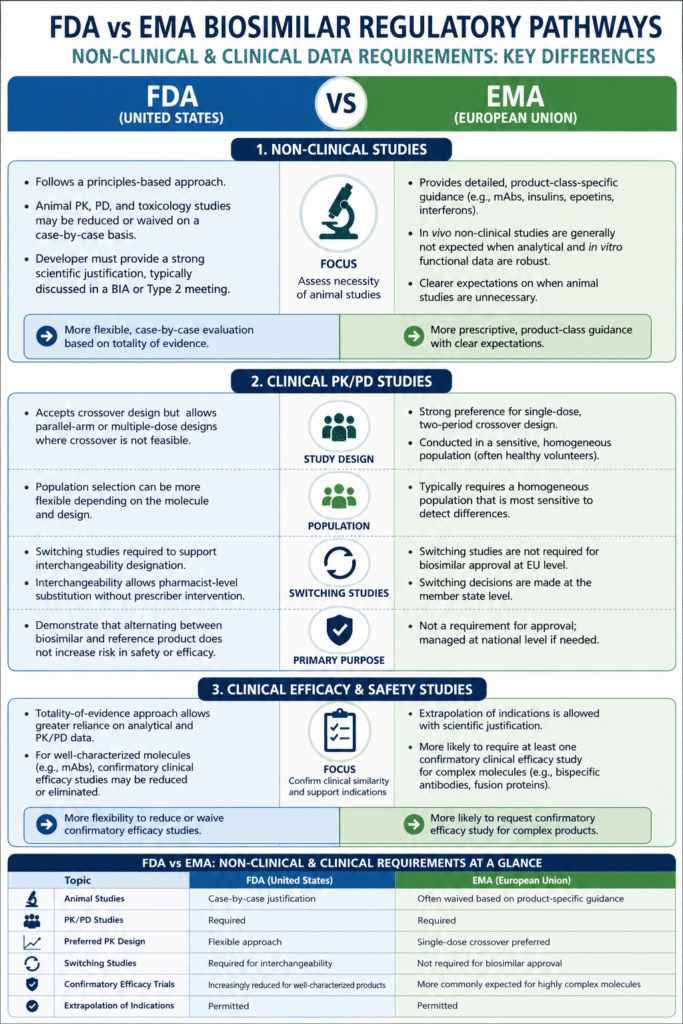
Non-Clinical Studies
Both the FDA and EMA accept the principle that non-clinical studies (animal PK, toxicology) can be reduced or waived when high-quality analytical characterisation and in vitro functional data are available. In practice, the EMA has published more detailed, product-class-specific guidance (e.g., for monoclonal antibodies, insulins, epoetins, interferons) that explicitly states when in vivo non-clinical studies are not expected.
The FDA guidance is more principles-based and requires the developer to construct the scientific argument for waiver on a case-by-case basis, typically in the context of a Biosimilar Initial Advisory (BIA) or Type 2 meeting.
Clinical PK/PD Studies
Both agencies require comparative PK/PD studies. Key practical differences include:
- Study design: The EMA strongly prefers a single-dose, two-period crossover design in a sensitive, homogeneous population (typically healthy volunteers for most molecules). The FDA permits this design but is more open to parallel-arm or multiple-dose designs where crossover is not feasible.
- Switching studies: The EMA does not require switching studies for biosimilar approval at the EU level (though some member states may request them nationally). The FDA, conversely, requires additional switching study data to support the separate interchangeability designation — a status that permits pharmacist-level substitution without prescriber intervention.
Clinical Efficacy and Safety Studies
Both agencies allow extrapolation of indications supported by scientific rationale. However:
- The EMA is generally more likely to require at least one confirmatory clinical efficacy study for complex molecules (e.g., bispecific antibodies, fusion proteins) even when PK data are robust.
- The FDA’s totality-of-evidence framework allows more weight to be placed on analytical and PK data, particularly for well-characterised molecules like mAbs, potentially reducing or eliminating the need for confirmatory clinical efficacy studies.
6: Extrapolation of Indications: A Shared Principle, Different Standards of Proof
Extrapolation — approving a biosimilar for indications held by the reference product without conducting clinical studies in each indication — is permitted by both agencies, but requires explicit scientific justification.
Both the FDA and EMA assess extrapolation based on:
- Mechanism of action in each indication
- Whether the same molecular target and effector functions are engaged
- Patient population differences and potential immunogenicity implications
- Available safety data across indications
The EMA requires a written extrapolation rationale as a discrete section of the clinical dossier, and CHMP can request indication-specific bridging data if the scientific rationale is deemed insufficient. The FDA evaluates extrapolation as part of the overall totality-of-evidence review but also expects a clearly articulated mechanistic justification, particularly for immunology indications where immune-mediated mechanisms may differ.
Practical implication: Developers should prepare indication-specific extrapolation rationale documents early — not as a post-submission afterthought — and ensure the analytical and functional data package proactively addresses each indication’s mechanism.
7: Immunogenicity: Both Agencies Require Comparative Assessment
Comparative immunogenicity is mandatory for both FDA and EMA biosimilar approval. The goal is to demonstrate that the biosimilar does not induce a meaningfully different immune response than the reference product.
Both agencies expect:
- Pre-defined, validated assays: Anti-drug antibody (ADA) detection, characterisation, and neutralising antibody (NAb) testing
- Comparative incidence and titres: Assessed against reference product in the same study population
- Clinical relevance assessment: Including impact on PK, safety, and efficacy
- Post-marketing immunogenicity monitoring: Ongoing pharmacovigilance
The EMA requires a formal Risk Management Plan (RMP) that includes a pharmacovigilance plan specifically addressing immunogenicity. The FDA may require a Risk Evaluation and Mitigation Strategy (REMS) for molecules with known serious safety risks, though this is assessed on a product-specific basis.
8: Interchangeability: The Most Distinctive US-Only Concept
The FDA’s interchangeability designation has no direct equivalent in the EU. An interchangeable biosimilar can be substituted for the reference product at the pharmacy level — without prescriber intervention — in US states that permit such substitution.
To obtain interchangeability, the FDA requires:
- Demonstration that the biosimilar produces the same clinical result as the reference product in any given patient
- For products administered more than once: evidence that switching between biosimilar and reference product does not produce greater risk than continuous use of the reference product alone
In Europe, substitution policy is determined at the member-state level. Some countries (notably France, Finland, and Poland) have established frameworks permitting automatic substitution of biosimilars; others do not. Developers targeting the EU market should map national substitution policies alongside the central EMA approval process.
9: Designing a Dual-Compliant Biosimilar Programme: Practical Recommendations
Running a parallel FDA/EMA programme does not require duplicating all studies — but it does require deliberate design choices from day one.
Key recommendations for dual-market biosimilar development:
- Use both reference products: Plan your analytical comparability exercise to include US RP, EU RP, and biosimilar candidate in a single protocol.
- Choose study designs that satisfy both agencies: Single-dose crossover PK studies in healthy volunteers typically satisfy both FDA and EMA expectations.
- Prepare parallel pre-submission interactions: Request FDA Type 2 Biosimilar Development meetings and EMA Scientific Advice simultaneously to align expectations early.
- Develop modular CTD dossiers: Use the Common Technical Document (CTD) format, which is accepted by both agencies, with jurisdiction-specific modules prepared in parallel.
- Build the extrapolation rationale early: Don’t treat indication extrapolation as a post-hoc argument — integrate it into your clinical development plan.
- Plan for interchangeability from the start: If US interchangeability is a commercial objective, the switching study design needs to be incorporated into clinical planning well before Phase 3.
- Engage a specialist CRO partner for analytical CMC work: The analytical comparability package is the load-bearing element of both submissions — investing in state-of-the-art characterisation early prevents expensive gaps later.
10: How ResolveMass Laboratories Supports Your Biosimilar Programme
ResolveMass Laboratories Inc. is a Canadian contract research and development organisation specialising in biopharmaceutical analytical services, with deep expertise in the characterisation data requirements that underpin both FDA and EMA biosimilar submissions.
Our capabilities directly aligned with biosimilar regulatory needs include:
- Physicochemical characterisation: Peptide mapping, glycan profiling, charge variant analysis, size exclusion, and intact/subunit mass analysis
- Higher-order structure (HOS) characterisation: DSC, CD, and advanced MS-based HOS methods
- Forced degradation and stability studies: Generating the stress-testing data required for analytical comparability packages
- Impurity profiling: Process-related and product-related impurity characterisation meeting ICH Q6B requirements
- Bioanalytical method development: ADA, NAb, and PK assay development and validation for immunogenicity programmes
- CMC dossier support: Technical writing and regulatory strategy support for Module 3 (quality) sections of CTD submissions
Our scientists have hands-on experience generating data packages to the standards expected by both the FDA and EMA — translating regulatory requirements into study protocols that produce submission-ready evidence.
Conclusion:
Understanding the FDA vs EMA biosimilar regulatory pathways — and designing your programme to satisfy both from the outset — is not just a regulatory exercise. It is a strategic commercial decision that directly determines your speed to market in the US and EU, your clinical programme costs, and your long-term competitive positioning in biosimilar markets worth hundreds of billions of dollars annually.
The agencies share a common scientific philosophy — analytical comparability first, clinical data to confirm when needed — but diverge in ways that matter: reference product requirements, interchangeability standards, non-clinical study expectations, and post-marketing obligations. Developers who understand these differences in advance, and who build their analytical and clinical programmes around them, consistently outperform those who attempt to retrofit a single-market programme for second-market submission.
ResolveMass Laboratories is ready to support your biosimilar programme at every analytical and CMC milestone — from initial reference product characterisation through full dossier preparation for FDA and EMA submission.
Frequently Asked Questions:
Not always. Both agencies are increasingly reducing clinical study requirements when strong analytical and functional similarity data are available. The FDA may place greater emphasis on analytical characterization and PK/PD studies, potentially eliminating the need for large efficacy trials in some cases. The EMA may still expect confirmatory efficacy studies for highly complex biologics. Requirements ultimately depend on the product and available evidence.
Interchangeability is a unique FDA designation that allows a biosimilar to be substituted for the reference product without prescriber approval, subject to state laws. To achieve this designation, manufacturers may need additional switching studies demonstrating no increased safety or efficacy risks. Interchangeability goes beyond standard biosimilar approval. It can provide commercial advantages by improving patient access and market uptake. The EMA does not offer an equivalent designation.
No, the EMA does not provide a formal interchangeability designation. Once a biosimilar is approved, decisions regarding switching and substitution are managed by individual EU member states. Many European countries have established their own policies based on clinical evidence and healthcare system requirements. The EMA’s primary focus is demonstrating biosimilarity rather than regulating substitution practices. This differs significantly from the FDA framework.
Animal studies are not always required for biosimilar approval. Both the FDA and EMA allow non-clinical animal studies to be reduced or waived when analytical and in vitro functional data sufficiently demonstrate similarity. The EMA provides detailed product-specific guidance outlining when animal studies may be unnecessary. The FDA evaluates such requests on a case-by-case basis. This trend helps reduce unnecessary animal testing and development costs.
Analytical characterization is considered the foundation of biosimilar development because it provides highly sensitive evidence of similarity between the biosimilar and reference product. Advanced techniques can detect structural, physicochemical, and functional differences that may not be visible in clinical studies. Regulators increasingly rely on analytical data to support biosimilarity assessments. Strong analytical evidence can also reduce the need for extensive clinical trials. As a result, analytical characterization is central to regulatory success.
Pharmacokinetic (PK) studies compare how the biosimilar and reference product are absorbed, distributed, metabolized, and eliminated in the body. Pharmacodynamic (PD) studies assess the biological effects produced by the products. These studies are among the most sensitive tools for detecting potential differences between products. Both the FDA and EMA generally require comparative PK/PD data. The results help support claims of biosimilarity and regulatory approval.
Yes, both the FDA and EMA allow extrapolation of indications when supported by scientific evidence. This means a biosimilar can receive approval for additional indications that were not directly studied in clinical trials. Regulators evaluate factors such as mechanism of action, receptor interactions, pharmacokinetics, and immunogenicity. Extrapolation reduces development costs and avoids unnecessary studies. It has become a well-established component of biosimilar regulation.
Reference
- Gherghescu I, Delgado-Charro MB. The biosimilar landscape: an overview of regulatory approvals by the EMA and FDA. Pharmaceutics. 2020 Dec 31;13(1):48.https://www.mdpi.com/1999-4923/13/1/48
- Wang J, Chow SC. On the regulatory approval pathway of biosimilar products. Pharmaceuticals. 2012 Mar 30;5(4):353-68.https://www.mdpi.com/1424-8247/5/4/353
- Knox RP, Desai V, Sarpatwari A. Biosimilar approval pathways: comparing the roles of five medicines regulators. Journal of Law and the Biosciences. 2024 Jul;11(2):lsae020.https://academic.oup.com/jlb/article-abstract/11/2/lsae020/7756460
- Amaral C, Rodrigues AR, Veiga F, Bell V. Biosimilar medicines: From development process to marketing authorization by the EMA and the FDA. Applied Sciences. 2024 Aug 26;14(17):7529.https://www.mdpi.com/2076-3417/14/17/7529
- Daller J. Biosimilars: A consideration of the regulations in the United States and European union. Regulatory Toxicology and Pharmacology. 2016 Apr 1;76:199-208.https://www.sciencedirect.com/science/article/pii/S0273230015301483
About the Author


