


Introduction
Forced Degradation and Photostability Studies for Generic Drug ANDA Submissions form the analytical cornerstone required to demonstrate that a testing method is stability-indicating and capable of detecting all degradation products throughout the commercial shelf life of a pharmaceutical product. These stress-testing investigations intentionally expose active pharmaceutical ingredients (APIs) and finished drug products to extreme environmental conditions in order to identify intrinsic degradation pathways, establish impurity profiles, and support chemistry, manufacturing, and controls (CMC) specifications.
For generic drug manufacturers pursuing approval through the Abbreviated New Drug Application (ANDA) 505(j) pathway, proving that an analytical method can clearly separate degradation products from the intact active drug substance is a fundamental regulatory expectation established by the United States Food and Drug Administration (FDA) and the International Council for Harmonisation (ICH). The purpose of stress testing is not to completely destroy the drug molecule; rather, it is to apply carefully controlled stress conditions that generate primary degradants—typically resulting in 10% to 20% degradation—without producing excessive secondary degradation artifacts that lack real-world relevance.
Discover the strategic differences in how to choose a peptide CDMO in the US to ensure compliant submission pathways.
Within the Quality by Design (QbD) framework, information generated from forced degradation and photostability studies directly supports formulation development, container-closure system selection, storage condition labeling, and the identification of critical quality attributes (CQAs). Poorly designed stress studies or inadequate analytical execution frequently lead to regulatory concerns, including uncharacterized co-eluting peaks, incomplete mass balance, and insufficient evidence of method specificity. Such deficiencies may ultimately result in Refuse-to-Receive (RTR) actions or Complete Response Letters (CRLs).
Learn more about the core structural and stability variances in our guide on the difference between a peptide and a small molecule drug.
Article Summary:
- Forced degradation and photostability studies demonstrate that analytical methods are truly stability-indicating, while identifying degradation pathways and impurity profiles for generic drug ANDA submissions.
- ICH Q1A(R2), Q1B, Q2(R1)/Q2(R2), and Q3A/Q3B provide the core regulatory framework covering stress testing, photostability, analytical validation, and degradation-product control.
- Stress studies evaluate acid/base hydrolysis, oxidation, thermal stress, humidity, and photolytic degradation, generally targeting controlled degradation rather than excessive breakdown.
- Photostability testing requires controlled visible and UV exposure, with dark controls and testing of the API, unpackaged drug product, and product in commercial packaging.
- Peak purity and mass balance are critical indicators of method performance. A mass balance of approximately 85–115% supports adequate recovery and detection of degradation products.
- Regulatory deficiencies can result from zero degradation, excessive degradation, unexplained mass imbalance, inadequate light controls, or unassessed API–excipient interactions. Scientifically justified stress conditions and appropriate analytical troubleshooting help mitigate these risks.
- Advanced stability-indicating methods should demonstrate specificity, adequate resolution (Rs ≥ 2.0), sensitivity, linearity, and structural characterization using techniques such as LC-MS/MS, HRMS, preparative HPLC, and NMR to support robust ANDA approval.
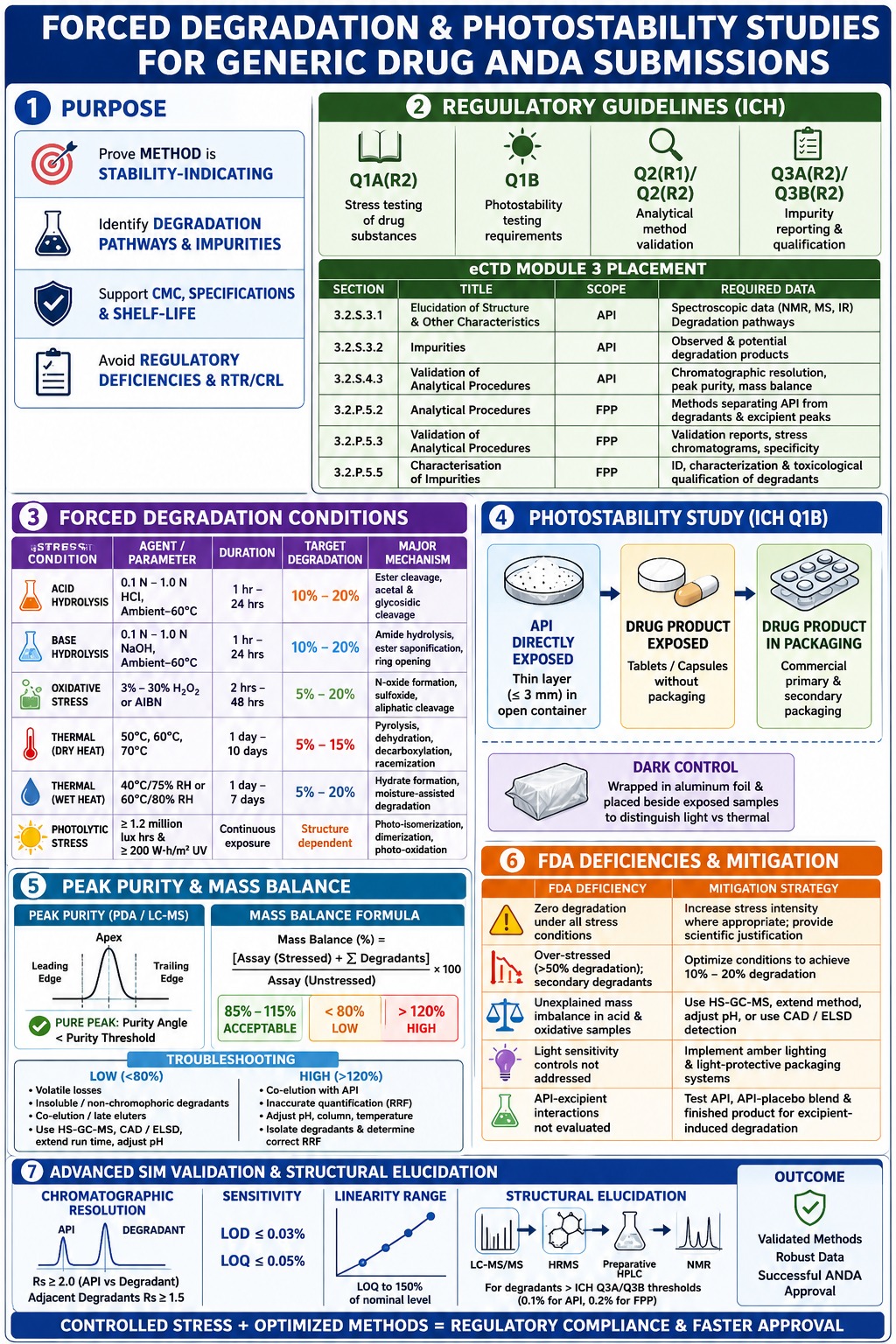
Regulatory Mandates and eCTD Module 3 Placement for Forced Degradation and Photostability Studies
Regulatory expectations established by the FDA and ICH require forced degradation and photostability data to be systematically incorporated into multiple sections of Module 3 of the Electronic Common Technical Document (eCTD). These data are essential for demonstrating complete CMC compliance and supporting the overall stability strategy of the product. The studies are primarily governed by ICH Q1A(R2), Q1B, Q2(R1)/Q2(R2), and Q3A/Q3B guidelines, which collectively define stress-testing requirements, photostability exposure criteria, analytical validation expectations, and impurity reporting thresholds.
The regulatory framework for stress testing is built upon four major ICH guidance documents:
ICH Q1A(R2)
Requires stress testing of drug substances to evaluate intrinsic stability characteristics and identify degradation pathways using acid hydrolysis, base hydrolysis, oxidative degradation, thermal exposure, and humidity stress.
ICH Q1B
Defines photostability testing requirements, including exposure to at least 1.2 million lux hours of visible light and a minimum of 200 watt-hours/m² of near-ultraviolet energy for both drug substances and drug products.
ICH Q2(R1)/Q2(R2)
Establishes analytical method validation requirements and requires evidence that analytical procedures can specifically separate the active ingredient from degradation products, process-related impurities, and excipient-related interferences.
ICH Q3A(R2) and Q3B(R2)
Provide guidance on reporting, identification, qualification, and control of degradation products and organic impurities in drug substances and finished pharmaceutical products.
Information generated during these studies must be incorporated into designated eCTD Module 3 sections to facilitate regulatory review and approval.
| eCTD Section | Section Title | Regulatory Scope | Required Stress Data and Documentation |
|---|---|---|---|
| 3.2.S.3.1 | Elucidation of Structure and Other Characteristics | Active Pharmaceutical Ingredient (API) | Spectroscopic characterization using NMR, MS, and IR to establish degradation pathways and intrinsic stability profiles. |
| 3.2.S.3.2 | Impurities | Active Pharmaceutical Ingredient (API) | Comprehensive summary of observed and potential degradation products generated during stress testing. |
| 3.2.S.4.3 | Validation of Analytical Procedures | Active Pharmaceutical Ingredient (API) | Chromatographic resolution data, peak purity assessments, and mass balance evaluations supporting analytical method specificity. |
| 3.2.P.5.2 | Analytical Procedures | Finished Drug Product (FPP) | Detailed analytical methods demonstrating separation of the API from degradation products and excipient-related peaks. |
| 3.2.P.5.3 | Validation of Analytical Procedures | Finished Drug Product (FPP) | Validation reports, stress chromatograms, specificity demonstrations, and peak purity evaluations. |
| 3.2.P.5.5 | Characterisation of Impurities | Finished Drug Product (FPP) | Identification, characterization, and toxicological qualification of degradation products exceeding ICH thresholds. |
Explore our comprehensive one-stop CDMO analytical services for ANDA to streamline eCTD Module 3 compliance.
Methodological Design for Forced Degradation and Photostability Studies
The methodological design of Forced Degradation and Photostability Studies requires exposing both the active drug substance and the finished dosage form to a structured set of hydrolytic, oxidative, thermal, and photolytic stress conditions. The objective is to achieve approximately 10% to 20% degradation, a range that effectively reveals primary degradation pathways while minimizing the formation of excessive secondary degradation products that are not representative of real storage conditions.
A scientifically robust stress-testing program evaluates multiple degradation mechanisms in both liquid and solid-state environments.
Acid Hydrolysis
Acid hydrolysis studies evaluate susceptibility to acid-catalyzed degradation mechanisms such as ester cleavage, acetal hydrolysis, and glycosidic bond disruption. Testing commonly utilizes 0.1 N to 1.0 N Hydrochloric Acid (HCl) at room temperature or elevated temperatures up to 60°C for periods ranging from 1 to 24 hours. Before chromatographic analysis, samples must be neutralized with an equivalent concentration of Sodium Hydroxide (NaOH) to prevent column damage and retention time variability.
Base Hydrolysis
Base hydrolysis investigates degradation mechanisms such as ester saponification, amide cleavage, and ring-opening reactions. Typical conditions involve 0.1 N to 1.0 N Sodium Hydroxide (NaOH) or Potassium Hydroxide (KOH). Samples must be promptly neutralized using equimolar Hydrochloric Acid (HCl) before analysis.
Oxidative Degradation
Oxidative stress testing evaluates susceptibility to peroxide formation, radical-mediated oxidation, and electron transfer reactions. Standard protocols employ Hydrogen Peroxide (H₂O₂) concentrations ranging from 3% to 30% under ambient conditions. For radical-specific degradation pathways, free-radical initiators such as Azobisisobutyronitrile (AIBN) or 2,2′-azobis(2-amidinopropane) dihydrochloride (AAPH) may be utilized.
Thermal Stress (Dry and Wet Heat)
Thermal studies evaluate the influence of elevated temperature and humidity on product stability. Drug substances and products are commonly exposed to dry heat at 50°C, 60°C, or 70°C. Wet heat studies combine elevated temperatures with relative humidity levels between 75% and 80% RH to distinguish thermal degradation from moisture-assisted degradation pathways.
Photolytic Degradation
Photolytic stress studies evaluate susceptibility to light-induced degradation under controlled illumination conditions established by ICH Q1B.
| Stress Condition | Stress Agent / Parameter Matrix | Exposure Duration Range | Target Degradation Range | Primary Chemical Degradation Mechanism |
| Acid Hydrolysis | 0.1 N – 1.0 N HCl, Ambient to 60°C | 1 hour – 24 hours | 10% – 20% | Ester cleavage, acetal hydrolysis, glycosidic bond cleavage |
| Base Hydrolysis | 0.1 N – 1.0 N NaOH, Ambient to 60°C | 1 hour – 24 hours | 10% – 20% | Amide hydrolysis, ester saponification, ring opening |
| Oxidative Stress | 3% – 30% H₂O₂ or AIBN radical initiator | 2 hours – 48 hours | 5% – 20% | N-oxide formation, sulfoxide generation, aliphatic cleavage |
| Thermal (Dry Heat) | 50°C, 60°C, 70°C | 1 day – 10 days | 5% – 15% | Pyrolysis, dehydration, decarboxylation, racemization |
| Thermal (Wet Heat) | 40°C/75% RH or 60°C/80% RH | 1 day – 7 days | 5% – 20% | Hydrate formation, moisture-assisted degradation |
| Photolytic Stress | ≥1.2 million lux hours and ≥200 W·h/m² UV | Continuous exposure | Structure dependent | Photo-isomerization, dimerization, photo-oxidation |
Protocol Design for Photostability Studies under ICH Q1B
Photostability studies performed in accordance with ICH Q1B require pharmaceutical samples to be exposed to a minimum of 1.2 million lux hours of visible light and 200 watt-hours per square meter of near-ultraviolet radiation. Simultaneously, dark control samples must be included to distinguish photolytic degradation from temperature-related effects.
The photostability testing strategy generally follows a three-level exposure approach:
Directly Exposed Active Pharmaceutical Ingredient
The API is distributed as a thin layer, typically no greater than 3 mm in thickness, in open glass or quartz containers and directly exposed to light.
Exposed Drug Product
Finished dosage forms such as tablets or capsules are exposed without protective packaging to evaluate their inherent susceptibility to photodegradation.
Drug Product in Commercial Packaging
The finished product is tested within its intended market packaging configuration, including primary packaging such as blister packs and secondary packaging materials, to verify protective claims and packaging effectiveness.
To confirm that observed degradation is caused exclusively by light exposure, dark controls are prepared using identical sample configurations. These controls are fully wrapped in aluminum foil and placed adjacent to illuminated samples within the photostability chamber. Comparative analysis of exposed and protected samples enables differentiation between photolytic and thermal degradation mechanisms.
Critical Performance Metrics: Peak Purity and Mass Balance Determination in Forced Degradation and Photostability Studies
Peak purity assessment and mass balance determination are among the most important quantitative parameters used by regulatory reviewers to evaluate the suitability of a stability-indicating analytical method. Demonstrating acceptable mass balance, generally within 85% to 115%, provides evidence that degradation products are properly detected and that significant co-elution or undetected impurities are not present.
Peak Purity Evaluation Protocols
Demonstrating spectral purity of the active pharmaceutical ingredient peak under all stress conditions is essential for confirming method specificity. Photodiode Array Detection (PDA/DAD) and Liquid Chromatography-Mass Spectrometry (LC-MS/MS) are widely used to assess peak homogeneity.
In chromatography software platforms such as Waters Empower 3, peak purity is determined through spectral comparison across the leading edge, apex, and trailing edge of the chromatographic peak.
Purity Angle: A mathematical representation of spectral variation across the peak.
Purity Threshold: The maximum allowable spectral variation determined by baseline noise and instrument parameters.
A chromatographic peak is considered spectrally pure when the Purity Angle remains lower than the Purity Threshold throughout the entire peak profile. In cases where degradants possess UV spectra similar to the parent compound, orthogonal analytical techniques such as single-quadrupole mass spectrometry or LC-MS/MS must be used to verify peak homogeneity.
Read our detailed peptide characterization case study of semaglutide for an in-depth breakdown of analytical workflows.
Mathematical Formulation and Mass Balance Troubleshooting
Mass balance calculations establish overall chemical accountability by comparing recovery of the stressed analyte and all degradation products relative to an unstressed reference sample.
Mass Balance (%) = [Assay of Stressed Sample (%) + Σ Degradation Products (%)] ÷ Assay of Unstressed Control Sample (%) × 100
FDA reviewers generally expect mass balance values between 85% and 115%, with values near 100% being preferred.
Low Mass Balance (<80%)
Potential causes include volatile degradation products, insoluble precipitates, non-chromophoric compounds, and late-eluting impurities. Investigative approaches may include:
- Headspace GC-MS for volatile degradants.
- Modification of diluent composition to improve solubility.
- Application of CAD or ELSD detection for non-chromophoric impurities.
- Extension of HPLC gradient run times to capture strongly retained compounds.
High Mass Balance (>120%)
Potential causes include co-elution of degradation products with the parent compound or inaccurate quantification due to differing Relative Response Factors (RRFs). Corrective strategies include:
- Adjusting mobile phase pH.
- Modifying stationary phase chemistry.
- Optimizing column temperature.
- Isolating degradation products to determine accurate RRF values.
Mitigating FDA Deficiencies and Refuse-to-Receive (RTR) Decisions
Avoiding FDA deficiencies and Refuse-to-Receive (RTR) actions requires stress-testing programs that generate meaningful degradation while avoiding excessive over-stressing and ensuring adequate characterization of drug-excipient interactions. Regulatory reviewers frequently issue deficiency comments when applicants fail to justify stress conditions or inadequately demonstrate method specificity.
| Cited FDA Deficiency | Root Cause / Technical Impact | Mitigating Regulatory Strategy |
| Zero degradation observed under all stress conditions. | Failure to demonstrate that the analytical method is stability-indicating. | Increase stress intensity where appropriate and provide scientific justification for stable compounds. |
| Sample over-stressed (>50% degradation); secondary degradants detected. | Generation of unrealistic degradation products not relevant to shelf-life conditions. | Optimize exposure time, temperature, or reagent concentration to achieve 10%–20% degradation. |
| Unexplained mass imbalance in acid and oxidative samples. | Undetected co-eluting peaks, volatile losses, or non-chromophoric degradants. | Employ headspace GC-MS, extend chromatographic methods, adjust pH, or use CAD/ELSD detection. |
| Light sensitivity observed; product handling controls unaddressed. | Insufficient controls during manufacturing and packaging operations. | Implement amber lighting procedures and use light-protective packaging systems. |
Scientific Justification for Stable Molecules
Certain APIs may demonstrate exceptional intrinsic stability even when exposed to severe stress conditions such as 1.0 N HCl or NaOH at 60°C for seven days or 30% H₂O₂ for 48 hours. In such cases, further escalation of stress conditions is generally inappropriate. Instead, applicants should provide a comprehensive scientific rationale supported by structural chemistry considerations and published literature demonstrating the absence of readily degradable functional groups.
Evaluation of Drug-Excipient Interactions
Stress testing limited to the isolated API is inadequate for finished dosage forms. Studies should also evaluate API-placebo blends and finished products to identify degradation pathways promoted by excipients, including peroxide-containing excipients and reducing sugars capable of initiating Maillard-type reactions.
Explore our guide on bioequivalence study design for complex generic drug products.
Translational Photostability Risk Controls
When photostability studies demonstrate susceptibility to light-induced degradation, ANDA submissions should clearly describe mitigation measures implemented during commercial manufacturing, packaging, and storage. These controls may include amber lighting systems, amber glass containers, or opaque packaging materials.
Advanced Stability-Indicating Method (SIM) Validation and Structural Elucidation
Validation of an advanced Stability-Indicating Method (SIM) requires demonstrating specificity, chromatographic resolution (Rs ≥ 2.0), precision, accuracy, and adequate sensitivity with an LOQ ≤ 0.05% across a concentration range extending from 0.05% to 150% of the nominal test level, in accordance with ICH Q2(R1)/Q2(R2).
When degradation products exceed ICH Q3A/Q3B identification thresholds—0.1% for drug substances and 0.2% for drug products—advanced analytical techniques are required for structural characterization.
Chromatographic Resolution (Rs)
Baseline separation between the active drug substance and all degradation products must be achieved. The minimum acceptable resolution is Rs ≥ 2.0 between the API and degradants, while adjacent degradation products should maintain a minimum resolution of Rs ≥ 1.5.
Sensitivity Requirements
Method sensitivity should satisfy ICH impurity reporting requirements:
Limit of Detection (LOD): ≤ 0.03% relative to the nominal API concentration.
Limit of Quantitation (LOQ): ≤ 0.05% to enable reliable quantification of low-level degradation products.
Linearity and Working Range
Analytical linearity should be demonstrated from the LOQ level through 150% of the target concentration to support simultaneous quantification of trace impurities and the active component.
Review our analytical insights on GLP-1 peptide analytical characterization.
For degradation products exceeding identification thresholds, LC-MS/MS and High-Resolution Mass Spectrometry (HRMS) are employed to obtain accurate mass measurements and fragmentation data. Following isolation by preparative HPLC, Nuclear Magnetic Resonance (NMR) spectroscopy is used to establish definitive structural assignments, including regiochemical and stereochemical confirmation.
Successful execution of these workflows requires advanced instrumentation and deep analytical expertise. Addressing complex degradation pathways within accelerated ANDA development timelines often necessitates support from specialized contract research laboratories. ResolveMass Laboratories Inc. provides advanced mass spectrometry, chromatographic characterization, and structural elucidation services designed to support generic drug development programs.
Learn about outsourcing advantages when you outsource peptide manufacturing to CDMO partners.
Conclusion
Conducting comprehensive Forced Degradation and Photostability Studies provides the analytical evidence and scientific justification necessary for successful generic drug ANDA submissions. By establishing validated stability-indicating methods, identifying primary degradation pathways, and compiling robust eCTD Module 3 documentation, generic manufacturers can minimize regulatory deficiencies and facilitate more efficient product approvals.
Regulatory compliance depends on maintaining an appropriate balance between controlled stress conditions and optimized analytical methodology. Regulatory agencies expect applicants to demonstrate a thorough understanding of product stability characteristics through spectrally pure analyte peaks, acceptable mass balance recovery, and complete structural characterization of degradation products.
Collaborating with experienced analytical testing partners helps ensure that stability-indicating methods meet FDA expectations, reduce regulatory risk, and prevent costly delays in generic drug development. To discuss advanced analytical strategies, evaluate peak purity performance, or address Module 3 CMC testing requirements for generic drug submissions, contact the scientific experts at ResolveMass Laboratories Inc. through the ResolveMass Contact Page.
Frequently Asked Questions (FAQs)
ICH Q1B photostability studies are designed to evaluate the effect of light exposure on pharmaceutical materials under standardized conditions. Samples are exposed to a minimum of 1.2 million lux hours of visible light and 200 watt-hours per square meter of near-ultraviolet energy. Testing is typically performed on the active pharmaceutical ingredient, the unpackaged finished product, and the packaged product, with dark controls included to distinguish photolytic changes from temperature-related effects.
Mass imbalance occurs when the combined recovery of the parent drug and all measured degradation products falls outside the expected range, typically between 85% and 115%. This issue may arise because of volatile degradants, insoluble materials, non-chromophoric compounds, or chromatographic limitations. Corrective actions often include optimizing chromatographic conditions, extending gradient run times, employing alternative detection techniques, and performing complementary analyses such as headspace GC-MS.
Information generated from forced degradation studies is distributed across several sections of eCTD Module 3 to support regulatory assessment. Drug substance data are generally included within sections related to structural characterization, impurities, and analytical method validation, while finished product data are presented in sections covering analytical procedures, validation reports, and impurity characterization. This organized structure enables reviewers to evaluate the complete stability profile and analytical strategy.
Peak purity is established by confirming that the chromatographic peak associated with the active pharmaceutical ingredient is free from interference caused by co-eluting impurities or degradation products. Photodiode Array (PDA/DAD) detectors compare spectral information across the entire peak profile to assess homogeneity. When spectral evaluation alone is insufficient, orthogonal techniques such as LC-MS/MS are used to verify that only a single molecular species contributes to the observed peak.
When a drug substance remains unchanged despite exposure to rigorous stress conditions, additional extreme degradation studies are generally not required. Instead, a scientifically justified explanation should be provided, supported by the compound’s chemical structure, functional group analysis, and relevant literature data. This approach demonstrates that the molecule possesses inherent stability rather than reflecting inadequate stress-testing conditions.
Evaluating only the active pharmaceutical ingredient does not provide a complete understanding of product stability. Excipients, manufacturing processes, and packaging materials can influence degradation behavior and create degradation pathways that are absent in the isolated drug substance. Stress testing the finished dosage form helps identify these interactions and confirms that the analytical method can accurately detect all relevant degradation products.
When degradation products exceed ICH identification thresholds, advanced analytical techniques are required to determine their chemical structures. LC-MS/MS and High-Resolution Mass Spectrometry (HRMS) are commonly used to obtain accurate molecular mass information and fragmentation patterns. For definitive structural confirmation, isolated degradants are further characterized using Nuclear Magnetic Resonance (NMR) spectroscopy to establish detailed molecular architecture.
Dark controls are included in photostability studies to distinguish degradation caused by light exposure from changes resulting from temperature or environmental conditions within the test chamber. These control samples are protected from light while being exposed to the same surroundings as illuminated samples. Comparing results between exposed and protected samples allows researchers to confidently attribute observed degradation to photolytic mechanisms.
Forced Degradation and Photostability Studies provide critical scientific knowledge that supports the Quality by Design (QbD) approach throughout pharmaceutical development. By identifying degradation pathways and stability risks early in development, these studies help optimize formulations, select appropriate packaging systems, establish storage recommendations, and define critical quality attributes. The resulting data contribute to a more robust product design and a stronger regulatory submission.
Reference:
- Maheswaran, R. (2012, May 2). FDA perspectives: Scientific considerations of forced degradation studies in ANDA submissions. Pharmaceutical Technology, 36(5), 73–80. Retrieved from https://www.pharmtech.com/view/fda-perspectives-scientific-considerations-forced-degradation-studies-anda-submissions
- Maheswaran, R. (2012). Scientific considerations of forced degradation studies in ANDA submissions. Pharmaceutical Technology, 36(5), 73–80. https://www.researchgate.net/publication/279765913_Scientific_considerations_of_forced_degradation_studies_in_anda_submissions
- Nagalakshmi, G., & Rasheed, A. (2024). Forced degradation studies and stability indicating RP-HPLC methods: A comprehensive review. International Journal of Medical and Pharmaceutical Sciences (IJMPS). https://www.ijmpsjournal.com/assetsbackoffice/uploads/article/Forced-Degradation-Studies-and-Stability-Indicating-RP-HPLC-Methods–A-Comprehensive-Review.pdf
Get In Touch With Us
About The Author


