

ICH Q1A-Aligned Strategy for Forced Degradation and Stress Testing
An ICH Q1A-aligned strategy for forced degradation and stress testing of therapeutic peptide APIs involves exposing the drug substance to carefully controlled, intensified environmental conditions to systematically identify degradation pathways and demonstrate analytical method specificity. This structured methodology generates complex impurity profiles that are essential for validating stability-indicating analytical procedures in accordance with regulatory requirements.
Therapeutic peptides possess unique physical and chemical properties that position them between conventional small molecules and larger biologic therapeutics. Unlike traditional small molecules, peptides exhibit conformational flexibility and sequence-dependent chemical vulnerabilities that significantly influence their stability characteristics. Subjecting these compounds to exaggerated environmental stresses, including extreme pH conditions, elevated temperatures, UV/visible light exposure, and strong oxidizing agents, enables analytical scientists to anticipate degradation patterns that may arise during long-term storage, transportation excursions, or formulation compounding. This proactive characterization represents a crucial milestone in early pharmaceutical development, allowing formulators to optimize composition and establish effective protective packaging systems.
Need to establish a robust stability-indicating profile for your molecule? Learn more about implementing a comprehensive Forced Degradation Testing Procedure to systematically map out your peptide’s degradation pathways.
Article Summary:
Regulatory Integration of ICH Q1A(R2), Q5C, and Q6B Guidelines
Regulatory integration requires combining the small-molecule principles outlined in ICH Q1A(R2) with the biological product considerations described in ICH Q5C and the specification requirements established in ICH Q6B for the evaluation of peptide APIs. This integrated framework ensures comprehensive characterization of both covalent chemical degradants and non-covalent physical aggregates, thereby supporting scientifically justified quality specifications.
The distinctive position of therapeutic peptides, which occupy an intermediate molecular weight range between small molecules and large biologics, places them within a hybrid regulatory framework. As a result, regulatory authorities such as the US FDA, Health Canada, and the EMA do not rely on a single dedicated forced degradation guideline. Instead, submissions are evaluated against a coordinated regulatory framework that incorporates multiple guidance documents. ICH Q1A(R2) establishes the foundational expectations for stability studies, stress testing, and analytical method validation. ICH Q5C extends these concepts to biological products by emphasizing biological integrity, including assessments of aggregation, fragmentation, and potential immunogenicity concerns. ICH Q6B further defines how structural and degradation-related information should be translated into scientifically justified specification limits. Supporting this regulatory approach, United States Pharmacopeia (USP) Chapters <1503> and <1504> provide documentary standards addressing quality attributes of synthetic peptide drug substances and their protected amino acid starting materials.
Navigating complex global compliance for your drug submission? Explore how to structure your experimental design in strict compliance with the Forced Degradation Study ICH Guideline.
| Regulatory Guideline | Primary Mandate for Peptide APIs | Critical Evaluation Parameters |
|---|---|---|
| ICH Q1A(R2) | General stability and stress testing principles | Hydrolytic, thermal, photolytic, and oxidative stress pathways |
| ICH Q5C | Adaptations for biological and biotechnological products | Aggregation, fragmentation, and structural/conformational stability |
| ICH Q6B | Characterization and specification development | Establishing critical quality attributes (CQAs) and impurity limits |
| USP <1503> | Quality attributes of synthetic peptide drug substances | Primary sequence, chirality, stereoisomeric purity, and aggregate limits |
| USP <1504> | Starting materials for chemical peptide synthesis | Identification, related impurities, and protected amino acid enantiomers |
Primary Chemical Degradation Pathways in Peptide APIs
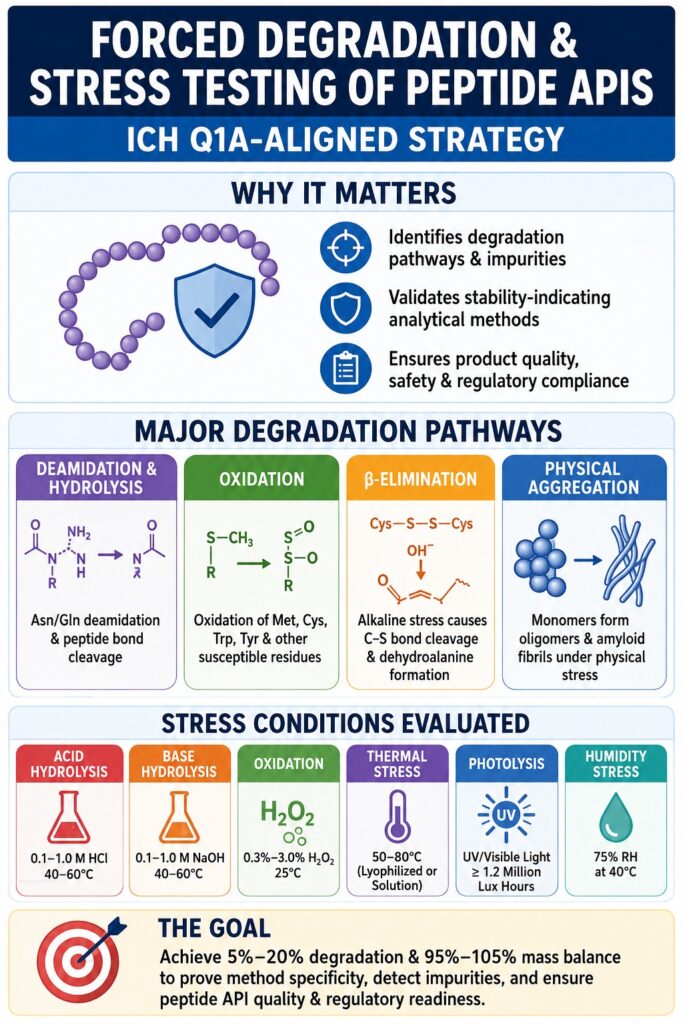
The primary chemical degradation pathways affecting peptide APIs include deamidation, oxidation, hydrolysis, and β-elimination. Each pathway is influenced by the amino acid sequence and environmental conditions. Comprehensive characterization of these degradation mechanisms during forced degradation studies is essential for predicting shelf-life performance and designing robust formulations.
Deamidation and Hydrolysis Mechanisms
Deamidation occurs when the side-chain amide group of asparagine (Asn) or glutamine (Gln) undergoes hydrolysis, resulting in the formation of a carboxyl group. Under acidic conditions (pH < 3), direct hydrolysis predominates, converting Asn directly into aspartic acid (Asp). Under basic conditions (pH > 6), an intramolecular cyclization reaction occurs in which the peptide backbone nitrogen attacks the side-chain carbonyl group, producing a cyclic succinimide intermediate. Hydrolysis of this intermediate proceeds non-selectively and yields a mixture of Asp and iso-aspartic acid (iso-Asp). The incorporation of iso-Asp disrupts peptide backbone conformation, significantly reducing biological activity and potentially increasing immunogenicity.
Hydrolysis refers to the non-enzymatic cleavage of the peptide backbone. This process is accelerated under extreme pH conditions and is particularly common in peptide sequences containing aspartate residues, such as Asp-Pro (D-P) and Asp-Gly (D-G) motifs, where cyclic imide intermediates facilitate rapid chain cleavage. The outcome is the formation of truncated peptide fragments and related impurities.
Oxidative Degradation and Site Susceptibility
Oxidative degradation represents a significant threat during peptide storage and handling. Sulfur-containing amino acids, including methionine and cysteine, as well as aromatic residues such as tryptophan, tyrosine, and histidine, are particularly susceptible to oxidation. Methionine (Met) readily oxidizes to methionine sulfoxide (+16 Da) and may subsequently undergo further oxidation to methionine sulfone (+32 Da) through chemical and photochemical pathways. Oxidation of cysteine (Cys) can result in disulfide bond scrambling, generating covalent aggregates or inactive structural isomers.
In addition, metal-catalyzed oxidation (MCO), promoted by redox-active transition metals such as Fe²⁺ and Cu²⁺ in the presence of trace hydrogen peroxide, induces site-specific oxidative damage. MCO frequently targets residues involved in metal-binding regions, particularly histidine and methionine, leading to localized structural alterations and peptide bond cleavage. A notable example is the site-specific cleavage observed in parathyroid hormone between Met8 and His9.
Beta-Elimination under Alkaline Stress
β-Elimination is a degradation pathway that occurs under alkaline conditions when hydroxide ions abstract the acidic α-proton from a cystine residue involved in a disulfide bond. This deprotonation event initiates C-S bond cleavage, producing a reactive dehydroalanine intermediate along with a persulfide group. Dehydroalanine is inherently unstable and may undergo subsequent hydrolysis, resulting in peptide chain cleavage that generates a C-terminal pyruvoyl group and an N-terminal amide. Alternatively, dehydroalanine may react through electrophilic addition with nearby cysteine thiols to form stable thioether cross-links known as lanthionine linkages. These reactions promote non-reducible covalent aggregation.
Developing complex biologic therapeutics or peptide conjugates? Ensure your molecules maintain structural integrity under extreme conditions by reviewing the frameworks for Forced Degradation Studies for Biologics.
Physical Aggregation and Biophysical Instability
Physical aggregation in peptide APIs describes the self-association of monomeric peptide chains into either disordered amorphous precipitates or highly ordered cross-β-sheet amyloid fibrils under physical stress conditions. These biophysical transformations are driven by factors such as mechanical shear, temperature fluctuations, interfacial adsorption, and changes in net molecular charge.
Unlike chemical degradation pathways that involve the formation or cleavage of covalent bonds, physical instability alters the peptide’s non-covalent structural organization. Elevated temperatures, mechanical agitation, lyophilization, and adsorption to container interfaces can all act as triggers. In solution, peptides frequently self-associate through a nucleation-polymerization mechanism. Once a critical oligomeric nucleus forms, monomer addition proceeds rapidly, leading to the generation of rigid and highly structured amyloid fibrils containing intermolecular β-sheets. These fibrillar structures are stabilized by backbone hydrogen bonding, hydrophobic interactions, and π-π aromatic stacking.
Aggregation rates are strongly influenced by pH and net molecular charge, both of which affect electrostatic repulsion between peptide monomers. For instance, GLP-1 peptides exhibit altered aggregation kinetics near neutral pH due to the formation of off-pathway oligomeric species. Aggregation presents a significant safety concern because aggregated peptides can be highly immunogenic and may stimulate anti-drug antibody responses in patients.
Struggling with aggregation or degradant pathways unique to metabolic therapies? Discover our dedicated specialized analytical solutions for GLP-1 Peptide Impurity Characterization.
Experimental Protocol Design for Forced Degradation and Stress Testing
The design of forced degradation and stress testing protocols requires the systematic selection of hydrolytic, oxidative, photolytic, and thermal stressors tailored to the specific chemical sequence of the peptide under investigation. Experimental conditions must be carefully optimized to induce controlled degradation while preserving sufficient analyte integrity for meaningful characterization.
A scientifically robust study does not rely on a universal protocol. Instead, stress conditions should reflect the molecular characteristics of the peptide. Dry lyophilized peptides are commonly subjected to solid-state stress involving heat and moisture, whereas solution formulations are challenged across a broad pH range. The objective is typically to achieve 5% to 20% degradation. To establish this controlled degradation window, analysts conduct pilot studies using matrices of stress conditions that evaluate variables such as acid concentration (0.1 M to 1.0 M HCl), base concentration (0.1 M to 1.0 M NaOH), hydrogen peroxide concentration (0.3% to 3.0%), and temperature increments such as 50°C, 60°C, and 80°C.
Looking for a proven roadmap to optimize your stress matrices? Read our technical guide on How to Design Forced Degradation Studies to maximize method validation success.
| Stress Pathway | Reagent or Condition | Target Parameters | Sampling Intervals | Target Mechanisms |
|---|---|---|---|---|
| Acid Hydrolysis | 0.1 M to 1.0 M HCl | 40°C to 60°C | Days 1, 3, 5 | Acid-catalyzed deamidation, Asp-Pro cleavage |
| Base Hydrolysis | 0.1 M to 1.0 M NaOH | 40°C to 60°C | Days 1, 3, 5 | Succinimide deamidation, β-elimination |
| Oxidation | 0.3% to 3.0% H₂O₂ | 25°C (Room Temperature) | Hours 1, 4, 24 | Met, Cys, Trp, and Tyr side-chain oxidation |
| Thermal Stress | Lyophilized powder or solution | 50°C to 80°C | Days 1, 3, 5 | Denaturation, physical aggregation, hydrolysis |
| Photolysis | UV/Visible Light (ICH Q1B) | ≥ 1.2 million lux hours | Continuous exposure | Photodegradation of aromatic residues |
| Humidity | Controlled chamber | 75% RH at 40°C | Weeks 2, 4, 8 | Solid-state moisture uptake, aggregation |
Chromatographic Separation for Forced Degradation and Stress Testing Validation
Chromatographic separation during forced degradation and stress testing relies primarily on high-resolution reversed-phase ultra-performance liquid chromatography (RP-UPLC) to achieve baseline separation of the parent peptide from structurally related degradation products. Optimization of this method ensures that the analytical procedure is genuinely stability-indicating and capable of detecting low-level impurities.
The development of a stability-indicating method requires a systematic and scientifically rigorous approach. RP-UPLC serves as the primary analytical technique for evaluating peptide purity and impurity profiles. Since peptide degradants often differ by only a single charge, one oxygen atom, or a subtle stereochemical variation, both stationary-phase selection and mobile-phase composition require careful optimization. The use of charged-surface hybrid (CSH) C18 columns or wide-pore (300 Å) particle technologies helps minimize peak tailing caused by secondary interactions with basic amino acid residues. Mobile-phase optimization frequently involves ion-pairing reagents such as trifluoroacetic acid (TFA) or formic acid (FA), although FA is generally preferred when direct coupling to mass spectrometry is required. The analytical method must provide sufficient sensitivity to ensure that the Limit of Quantitation (LOQ) supports detection of impurities at or below the 0.10% regulatory threshold.
Developing stability-indicating validation programs for long-acting peptide therapies? Explore our optimized protocols for GLP-1 Peptide Stability Analytical Methods.
Mass Balance Verification and Method Validity
Mass balance verification is a critical analytical requirement that demonstrates that the combined quantities of the remaining API and all detected degradation products account for the original concentration of the material before stress testing. Achieving a mass balance within the accepted regulatory range of 95% to 105% confirms analytical validity and method specificity.
Mass balance is calculated using the following equation:
Mass Balance (%) = ((Assay of API + Sum of Degradation Products) × 100) / Initial API Assay
Achieving a mass balance within the 95% to 105% range provides quantitative evidence of mass conservation and confirms that no significant analytical gaps or unaccounted losses occurred during stress testing. A low mass balance (<95%) may indicate recovery issues arising from insoluble aggregate formation, volatilization of degradants, loss of non-chromophoric species that evade UV detection, or incomplete extraction. Conversely, a high mass balance (>105%) may indicate degradant co-elution or detector response non-linearity. To address such issues, analysts employ systematic troubleshooting approaches using orthogonal analytical techniques, including mass spectrometry and charged aerosol detection.
| Observed Issue | Probable Root Cause | Proposed Diagnostic/Technical Remedy |
|---|---|---|
| Low Mass Balance (<95%) | Physical precipitation of aggregates | Centrifuge the sample and analyze the pellet; introduce mild non-ionic surfactants into the diluent |
| Low Mass Balance (<95%) | Volatilization of small degradation fragments | Conduct stress testing in hermetically sealed vessels and evaluate headspace composition |
| Low Mass Balance (<95%) | Non-chromophoric fragments (loss of chromophore) | Utilize direct LC-MS or Charged Aerosol Detection (CAD) for absolute quantification |
| Low Mass Balance (<95%) | Incomplete extraction from the sample matrix | Optimize extraction solvent polarity, pH, or ionic strength |
| High Mass Balance (>105%) | Peak co-elution beneath the main peak | Apply peak-purity assessment using PDA/MS and modify stationary phase or gradient conditions |
| High Mass Balance (>105%) | Detector response non-linearity | Establish response factors for major degradants and verify calibration linearity |
Advanced Mass Spectrometry and Site-Specific Peptide Mapping
Advanced mass spectrometry, combined with high-resolution MS/MS peptide mapping, represents the gold standard for localizing degradation-induced modifications to specific amino acid residues. This level of structural characterization is essential for defining critical quality attributes and ensuring product consistency throughout development.
Traditional LC-UV methods can identify impurity peaks but cannot determine the precise location of degradation events or distinguish isobaric modifications. This limitation is overcome through online LC-MS/MS peptide mapping. The peptide is enzymatically digested using sequence-specific proteases such as trypsin or chymotrypsin. The resulting fragments are separated by UPLC and analyzed using electrospray ionization tandem mass spectrometry (ESI-MS/MS), which acquires both precursor ion information and collision-induced fragmentation spectra.
This fragmentation information enables precise localization of chemical modifications. For example, a 1 Da mass increase localized to a specific b-ion or y-ion confirms deamidation at a particular asparagine residue, whereas a 16 Da mass shift is indicative of methionine or tryptophan oxidation. To minimize sample preparation artifacts, developers increasingly replace overnight digestions conducted under basic conditions with rapid five-minute tryptic digestion protocols performed at controlled pH, thereby reducing method-induced oxidation and deamidation.
Need absolute structural certainty regarding your impurity profile? Discover how to map sequence mutations and subtle degradation variants using advanced Peptide Sequencing of GLP-1 Drugs.
Case Studies: Forced Degradation of GLP-1 Receptor Agonists
Case studies involving GLP-1 receptor agonists such as Liraglutide, Semaglutide, and Tirzepatide illustrate how forced degradation studies can identify sequence-specific vulnerabilities, including tryptophan oxidation and hydrolysis of labile peptide bonds. These investigations generate realistic impurity profiles that are essential for confirming active ingredient sameness and supporting ANDA or NDA submissions.
Glucagon-like peptide-1 (GLP-1) analogs contain highly conserved hydrophobic sequences that make them valuable model compounds for stability evaluation. For example, Liraglutide and Semaglutide each contain a single tryptophan (Trp) residue that is highly susceptible to photo-oxidative degradation, resulting in the formation of Trp(O), kynurenine, and formylkynurenine species. Under hydrolytic stress conditions, whether acidic or alkaline, labile peptide bonds within these analogs can undergo cleavage, producing truncated fragment impurities.
Additionally, thermal stress accelerates both chemical degradation processes and the physical conversion of these analogs into β-sheet-rich amyloid aggregates. Characterizing these pathways during early-stage development enables manufacturers to establish a direct relationship between forced degradation outcomes and lifecycle impurity control strategies, thereby ensuring that immunogenicity risks remain controlled throughout the product shelf life. Such structural and stability data are also critical for demonstrating sameness to the reference listed drug (RLD) in generic ANDA submissions.
Preparing a generic peptide filing for an FDA or Health Canada submission? Review our analytical approach to fulfilling rigorous regulatory requirements via a specialized Peptide Sameness Study for ANDA.
Conclusion: Operationalizing Forced Degradation and Stress Testing
Operationalizing forced degradation and stress testing within an ICH-aligned framework is fundamental to establishing the critical quality attributes and stability-indicating analytical methods required for peptide APIs. This systematic strategy generates the analytical and structural evidence necessary to support successful global regulatory submissions.
A scientifically defensible forced degradation program extends far beyond regulatory compliance. By establishing a quantitative relationship between parent drug depletion and degradant formation, developers can confirm that analytical methods are specific, reliable, and free from unrecognized component loss. This rigorous approach reduces development risk, safeguards patient safety, and ensures the long-term quality, consistency, and performance of therapeutic products.
ResolveMass Laboratories Inc. specializes in the design and execution of these high-precision analytical workflows, helping organizations achieve regulatory readiness and maintain product quality. Their advanced capabilities, including high-resolution mass spectrometry (HRMS), LC-MS/MS structural elucidation, and comprehensive mass balance validation, provide developers with the scientific documentation necessary to withstand regulatory scrutiny and accelerate development timelines.
Accelerate your molecule’s path to market with expert northern partners. Reach out to learn more about partnering with a premier CRO for GLP-1 Peptide Characterization
or streamline your outsourcing needs using regional leaders in Forced Degradation Testing in Pharma.
For detailed inquiries or to consult with a scientist regarding custom method development, stability validation, and mass balance resolution, contact ResolveMass Laboratories Inc. directly at https://resolvemass.ca/contact/.
FAQs on Peptide API Forced Degradation and Stress Testing
No, the International Council for Harmonisation (ICH) does not provide a single guideline dedicated exclusively to forced degradation studies. Instead, regulatory expectations are established through multiple guidance documents, including ICH Q1A(R2), ICH Q5C, and ICH Q6B. Together, these guidelines outline requirements for stability assessment, characterization of degradation products, and specification development. Pharmaceutical companies must integrate principles from all applicable guidelines to design scientifically sound stress-testing programs and validate stability-indicating analytical methods.
A degradation range of 5% to 20% is widely accepted because it provides a sufficient amount of degradation products for analytical evaluation without excessively damaging the active pharmaceutical ingredient. This controlled level allows scientists to assess method specificity, peak separation, and impurity detection capabilities. If degradation exceeds this range, secondary degradation reactions may occur, generating artifacts that are unlikely to appear during normal storage. Maintaining a moderate degradation level ensures meaningful and representative stability data.
Deamidation at Asn-Gly motifs can significantly alter the structural and functional properties of therapeutic peptides. During this reaction, asparagine is converted into aspartic acid and iso-aspartic acid, introducing charge variations and conformational changes within the molecule. These modifications can reduce receptor binding, decrease biological activity, and increase the likelihood of aggregation. Because the resulting variants often differ in charge, complementary analytical techniques such as ion exchange chromatography are frequently used alongside HPLC for accurate characterization.
A mass balance value below 95% usually indicates that a portion of the degraded material has not been adequately detected or quantified. Common causes include the formation of insoluble aggregates, evaporation of volatile degradation products, incomplete extraction from the sample matrix, or generation of compounds that lack UV absorbance. Investigators typically address these issues by optimizing extraction procedures, modifying diluent composition, using sealed stress-testing systems, and incorporating orthogonal analytical tools such as LC-MS or charged aerosol detection to improve recovery and quantitation.
Metal-catalyzed oxidation occurs when trace transition metals such as iron or copper facilitate the generation of highly reactive oxygen species that attack specific regions of a peptide. This process often affects amino acid residues located near metal-binding sites, leading to localized structural damage. In contrast, autoxidation involves direct reaction with molecular oxygen and generally occurs more slowly in peptide systems. Because metal-catalyzed oxidation is highly site-specific, it can produce degradation patterns that differ substantially from those generated through spontaneous oxidative pathways.
β-Elimination is a degradation mechanism that becomes increasingly important under alkaline stress conditions. The reaction begins when hydroxide ions remove a proton adjacent to a disulfide-linked cystine residue, initiating cleavage of the carbon-sulfur bond. This process generates reactive intermediates such as dehydroalanine, which can subsequently promote peptide chain fragmentation or the formation of irreversible lanthionine cross-links. As a result, β-elimination contributes significantly to covalent aggregation and structural instability in peptide therapeutics exposed to elevated pH environments.
Wide-pore stationary phases are specifically designed to accommodate the larger molecular dimensions of peptides and peptide-related impurities. Pore sizes around 300 Å allow efficient diffusion of peptide molecules into the stationary phase, resulting in improved interaction and separation efficiency. Smaller pore materials can restrict molecular access, causing peak broadening, reduced resolution, and increased tailing. Consequently, wide-pore chromatographic columns play a critical role in achieving reliable separation of structurally similar peptide degradants.
Yes, sample preparation conditions can unintentionally introduce deamidation artifacts if not properly controlled. Traditional digestion workflows often involve prolonged incubation at neutral or alkaline pH, creating an environment that promotes chemical modification of susceptible amino acid residues. To minimize artificial deamidation, modern analytical approaches utilize rapid digestion protocols, carefully controlled pH conditions, and reduced processing times. These precautions help ensure that observed modifications accurately reflect stress-induced degradation rather than sample preparation artifacts.
Reference:
- United States Pharmacopeia (USP). (2025, January). USP peptide standards and solutions [Flyer]. United States Pharmacopeia. https://www.usp.org/sites/default/files/usp/document/our-work/biologics/documents/USP_PeptideStandardsFlyer_Digital_V11.pdf
- Zapadka, K. L., Becher, F. J., Gomes dos Santos, A. L., & Jackson, S. E. (2017). Factors affecting the physical stability (aggregation) of peptide therapeutics. Interface Focus, 7(6), Article 20170030. https://doi.org/10.1098/rsfs.2017.0030
- Mawla, G. D., & Elshahed, M. S. (2025). Regulatory guidelines for the analysis of therapeutic peptides and proteins. AAPS Open, 11, Article 12. https://doi.org/10.1186/s41120-025-00112-8
- Blessy, M., Patel, R. D., Prajapati, P. N., & Agrawal, Y. K. (2014). Development of forced degradation and stability indicating studies of drugs—A review. Journal of Pharmaceutical Analysis, 4(3), 159–165. https://doi.org/10.1016/j.jpha.2013.09.003
- McCarthy, D., Han, Y., Carrick, K., Schmidt, D., Workman, W., Matejtschuk, P., Duru, C., & Atouf, F. (2023). Reference standards to support quality of synthetic peptide therapeutics. Pharmaceutical Research, 40(6), 1317–1328. https://doi.org/10.1007/s11095-023-03493-1
- Rosenberg, L. E., Downing, S., Durant, J. L., & Segal, S. (1962). Hydroxyprolinemia: A new inborn error of amino acid metabolism. The Journal of Clinical Investigation, 41(9), 1796–1805. https://doi.org/10.1172/JCI104632
- Akers, M. J., & DeFelippis, M. R. (2017). Peptides and proteins as parenteral drugs: A review of the stability, formulation, and analytical characterization challenges. AAPS PharmSciTech, 18(4), 1084–1098. https://doi.org/10.1208/s12249-016-0628-x
Get In Touch With Us
About The Author


