

Introduction:
Forced Degradation Testing for Biosimilars is an important analytical strategy for understanding how a biosimilar drug substance changes when exposed to deliberately intensified stress conditions. The information generated can help identify degradation pathways, characterize degradation products, assess the stability-indicating capability of analytical procedures, and strengthen the scientific justification for stability programs.
Biosimilars are complex biological products whose quality can be affected by chemical and physical changes such as oxidation, deamidation, aggregation, fragmentation, unfolding, and other molecular modifications. Consequently, stability assessment requires analytical approaches capable of detecting changes across multiple critical quality attributes (CQAs).
ICH Q1A(R2) states that stress testing can help identify likely degradation products, establish degradation pathways, understand intrinsic stability, and validate the stability-indicating power of analytical procedures. The guideline specifically discusses temperature, humidity where appropriate, oxidation, photolysis, and hydrolysis across a range of pH conditions.
For biotechnology-derived and biological products, ICH Q5C provides specific stability principles and emphasizes the importance of appropriate physicochemical, biochemical, and immunochemical methods for monitoring degradation and molecular changes.
For organizations developing or manufacturing biosimilar drug substances, a scientifically designed biosimilar forced degradation study therefore provides more than a list of stressed samples — it creates evidence supporting the understanding and control of product quality.
Summary:
- Forced Degradation Testing for Biosimilars evaluates how a biosimilar drug substance responds to deliberate chemical, physical, and environmental stress conditions.
- The primary purpose is to identify degradation pathways and degradation products, and to demonstrate that analytical methods can detect meaningful changes.
- ICH Q1A(R2) describes stress testing for drug substances using factors such as temperature, humidity, oxidation, photolysis, and hydrolysis.
- ICH Q5C is particularly relevant to biotechnology-derived and biological products, where stability assessment must consider product-specific molecular and biological characteristics.
- Stress testing supports stability-indicating method development, degradation-pathway understanding, comparability assessments, and regulatory CMC documentation.
- Typical analytical characterization may include HPLC/UPLC, LC-MS, peptide mapping, SEC, ion-exchange chromatography, CE, spectroscopy, GC-MS, and bioassays, depending on the molecule and its quality attributes.
- A scientifically justified stress-testing strategy is more valuable than simply applying identical stress conditions to every biosimilar.
- ResolveMass Laboratories Inc. supports pharmaceutical and biopharmaceutical programs with forced degradation and stress testing strategies designed around the molecule, degradation risks, and regulatory objectives.
1: What Is Forced Degradation Testing for Biosimilars?
Forced degradation testing deliberately exposes a biosimilar drug substance to stress conditions to accelerate or reveal degradation pathways that may occur during manufacturing, storage, handling, or transportation. The objective is not simply to make the product degrade as much as possible; the study should generate scientifically useful degradation that allows analytical methods to distinguish the intact product from relevant degradation species.
Common stress categories and their typical outcomes include:
| Stress Condition | Examples of Potential Degradation |
|---|---|
| Thermal stress | Aggregation, fragmentation, chemical degradation |
| Oxidative stress | Oxidation of susceptible amino acid residues |
| Acidic stress | Hydrolysis, deamidation, structural changes |
| Basic stress | Hydrolysis, deamidation, molecular modifications |
| Photolytic stress | Photo-oxidation and other light-induced changes |
| Humidity/moisture | Physical or chemical instability where relevant |
| Freeze-thaw | Aggregation or structural changes |
| Agitation | Particle formation or aggregation |
| Mechanical stress | Physical instability or aggregation |
The exact conditions should be scientifically justified according to the molecule’s characteristics and the study objectives, rather than treated as a universal recipe. Our team routinely designs these programs as part of our dedicated forced degradation studies for biosimilars service.
2: Why Is Forced Degradation Testing Important for Biosimilars?
Forced degradation is important because it shows how a biosimilar drug substance responds to different stress factors and whether analytical methods can reliably detect the resulting changes. This evidence underpins degradation-pathway understanding, method development, and comparability work.
For biosimilars, this information can contribute to:
- Understanding degradation pathways
- Identifying potential degradation products
- Developing stability-indicating analytical methods
- Supporting analytical method validation
- Understanding critical quality attributes
- Supporting comparability and characterization strategies
- Investigating unexpected impurities or variants
- Establishing appropriate stability-indicating test panels
- Supporting regulatory CMC documentation
- Providing scientific evidence for storage and handling considerations
ICH Q1A(R2) specifically notes that examining degradation products under stress conditions is useful for establishing degradation pathways and developing/validating suitable analytical procedures. For biological products, Q5C emphasizes that stability assessment should monitor relevant degradation changes using appropriate analytical techniques, including molecular-size changes, charge changes, oxidation, aggregation, and fragmentation.
3: ICH Q1A(R2) Requirements for Stress Testing
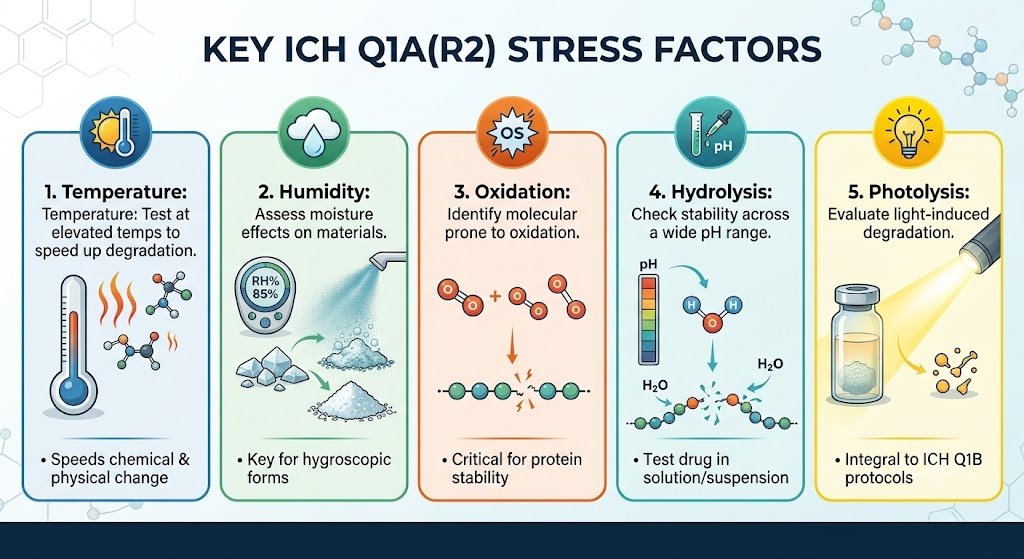
ICH Q1A(R2) recommends stress testing of drug substances to understand degradation pathways and evaluate the stability-indicating capability of analytical procedures. The guideline identifies five main stress factors.
1. Temperature
Temperature stress can accelerate chemical and physical degradation. For drug substances, Q1A(R2) describes stress testing at temperatures above accelerated-testing conditions, using increments such as 10°C where appropriate. For biosimilars, temperature studies should be designed carefully because excessive thermal stress can produce degradation mechanisms that may not be representative of realistic storage behavior.
2. Humidity
Humidity or elevated relative humidity can be relevant where moisture may affect the material. Relevance depends on:
- Product formulation
- Physical state
- Packaging
- Hygroscopicity
- Manufacturing process
- Intended storage conditions
3. Oxidation
Oxidative stress can reveal susceptible molecular sites. For protein-based biosimilars, oxidation may affect specific amino acid residues and potentially influence molecular structure, charge profile, biological activity, binding characteristics, and aggregation behavior.
4. Hydrolysis
Hydrolytic stress evaluates susceptibility to degradation across different pH conditions. Q1A(R2) specifically recommends evaluating susceptibility to hydrolysis across a wide pH range when the drug substance is in solution or suspension.
5. Photolysis
Photostability can reveal light-induced degradation. ICH Q1A(R2) identifies photostability testing as an integral part of stress testing and refers to ICH Q1B for standard photostability conditions. ResolveMass Laboratories offers dedicated forced degradation and photostability studies designed around Q1B-aligned light exposure protocols.
4: How Does ICH Q5C Apply to Biosimilar Drug Substances?
ICH Q5C provides stability-testing principles specifically for biotechnology-derived and biological products, making it highly relevant when designing stability strategies for biosimilar drug substances. Unlike many small molecules, biological products can undergo multiple types of molecular and physical changes, so a single chromatographic assay is often insufficient to establish a complete stability profile.
Q5C emphasizes appropriate physicochemical, biochemical, and immunochemical methods for characterization and monitoring of degradation, including:
- Deamidation
- Oxidation
- Sulfoxidation
- Aggregation
- Fragmentation
- Molecular-size changes
- Charge heterogeneity
- Other product-specific modifications
This is why a biosimilar forced-degradation program generally requires a multi-attribute analytical strategy rather than reliance on one assay.
5: ICH Q1A vs. ICH Q5C: Side-by-Side Comparison
Although Q1A and Q5C address stability from different perspectives, they work together in a scientifically appropriate biosimilar development strategy.
| Consideration | ICH Q1A(R2) | ICH Q5C |
|---|---|---|
| Primary scope | New drug substances/products | Biotechnology/biological products |
| Stress testing | Specifically discussed | Supports product-specific stability assessment |
| Temperature | Important stress factor | Important for biological products |
| Oxidation | Recommended | Highly relevant to proteins/biologics |
| Hydrolysis | Relevant where applicable | Consider according to product characteristics |
| Photostability | Refers to Q1B | Product-specific assessment |
| Degradation products | Identification and pathway understanding | Monitoring molecular degradation |
| Analytical approach | Stability-indicating methods | Multiple appropriate analytical methods |
| Product complexity | Generally applicable | Particularly relevant to complex biological molecules |
The appropriate regulatory strategy should always consider the molecule, product type, development stage, region, and applicable regulatory expectations, rather than assuming Q1A conditions can simply be transferred unchanged to a biological product.
6: Designing a Forced Degradation Study for Biosimilars
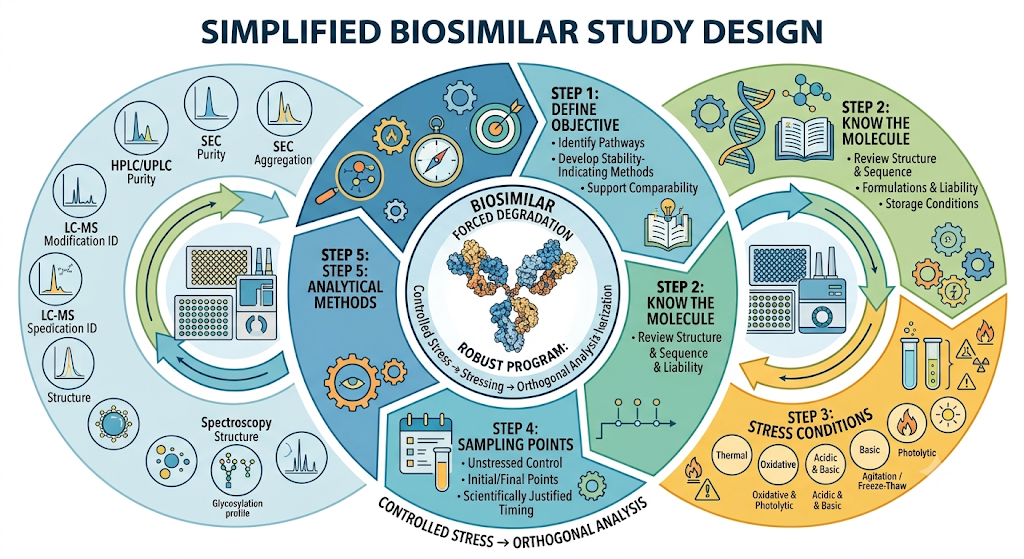
A robust program starts with risk-based study design, followed by controlled stressing and orthogonal analytical characterization. A typical workflow includes:
Step 1: Define the Study Objective — Determine whether the goal is to identify degradation pathways, develop stability-indicating methods, challenge an existing analytical method, investigate specific CQAs, support comparability, characterize degradation products, or generate regulatory CMC evidence.
Step 2: Understand the Molecule — Review protein structure, molecular size, amino acid sequence, formulation, known degradation liabilities, manufacturing process, storage conditions, container-closure system, and previous stability observations.
Step 3: Select Relevant Stress Conditions — A typical design evaluates thermal, oxidative, acidic, basic, photolytic, and agitation/freeze-thaw conditions, where applicable, sufficiently challenging to reveal meaningful degradation without unnecessarily destroying the sample.
Step 4: Establish Sampling Points — Sampling should compare an unstressed control, initial stressed sample, intermediate time points, and a final stressed sample, with number and timing scientifically justified.
Step 5: Apply Orthogonal Analytical Methods — Different techniques reveal different degradation types:
| Analytical Technique | Potential Information |
|---|---|
| HPLC/UPLC | Purity and related substances |
| SEC-HPLC | Aggregation and fragmentation |
| Ion-exchange chromatography | Charge variants |
| LC-MS | Molecular mass and modification characterization |
| Peptide mapping | Sequence and post-translational modifications |
| CE-SDS | Size variants |
| Spectroscopy | Structural changes |
| Bioassay | Biological activity |
| DLS | Particle/aggregation behavior |
| Glycan analysis | Glycosylation profile |
| GC-MS analysis | Volatile degradants, residual solvents, and small-molecule impurities |
Using complementary methods increases confidence that important degradation pathways are being detected.
7: What Degradation Pathways Should Be Investigated?
The degradation pathways investigated should be product-specific, but common protein-related pathways include oxidation, deamidation, aggregation, fragmentation, and charge or size alterations.
- Oxidation — Oxidative modifications can affect susceptible amino acid residues and potentially influence protein structure or function.
- Deamidation — Deamidation can alter molecular charge and potentially affect structural or functional characteristics.
- Aggregation — Particularly important for protein therapeutics because it may affect product quality and biological performance; SEC-based and complementary techniques help evaluate high-molecular-weight species.
- Fragmentation — Generates lower-molecular-weight species monitored through SEC, CE-SDS, LC-MS, or peptide mapping.
- Charge variants — Arise from chemical modifications such as deamidation; ion-exchange chromatography or capillary electrophoresis provides useful information.
8: How Analytical Methods Support Forced Degradation Studies
Forced degradation studies are only useful when analytical methods can distinguish the intact product from relevant degradation products and variants. A stability-indicating method should be capable of detecting meaningful changes under the selected stress conditions.
An effective analytical strategy may combine:
- Assay testing — evaluates remaining active/intact material
- Purity testing — monitors related species
- Size-based analysis — evaluates aggregates and fragments
- Charge-based analysis — monitors charge variants
- Mass spectrometry — characterizes molecular changes
- Peptide mapping — investigates site-specific modifications
- Biological assays — assesses functional consequences where appropriate
This orthogonal approach is especially important for biosimilars because degradation may occur at multiple molecular levels.
9: Forced Degradation Testing and Analytical Method Validation
Forced degradation data can help demonstrate that an analytical procedure is stability-indicating, but forced degradation itself does not automatically validate an analytical method. The study provides challenging samples containing different degradation species that are useful during analytical procedure development and validation.
The resulting evidence helps assess whether a method can:
- Separate degradation products from the main component
- Detect meaningful loss of the product
- Monitor relevant impurities or variants
- Demonstrate specificity
- Support appropriate analytical procedure validation
ICH Q1A(R2) explicitly connects stress-testing information with the development and validation of suitable stability-indicating analytical procedures.
10: Role of Forced Degradation in Biosimilar Comparability
Forced degradation can strengthen biosimilar comparability by showing whether the proposed analytical methods are capable of detecting relevant molecular changes between stressed and unstressed materials. Biosimilar development relies on extensive analytical characterization and comparison with the reference product.
A well-designed degradation study can help answer:
- Does the biosimilar show similar degradation pathways?
- Are new degradation products observed?
- Does the biosimilar generate different aggregate levels?
- Are charge variants affected differently?
- Does stress cause different structural modifications?
- Are analytical methods sufficiently discriminating?
Importantly, forced degradation should be considered a supporting analytical tool, not a standalone demonstration of biosimilarity.
11: What Does a Biosimilar Forced Degradation Testing Service Include?
A comprehensive service combines study design, controlled stressing, analytical testing, degradation characterization, data interpretation, and technical reporting.
| Service Stage | Typical Activities |
|---|---|
| Study planning | Define objectives and risk-based stress conditions |
| Sample preparation | Prepare controls and stressed samples |
| Stress exposure | Thermal, oxidative, pH, photolytic, and other relevant stresses |
| Analytical testing | Chromatographic, spectroscopic, and biochemical analysis |
| Degradation profiling | Compare stressed vs. control samples |
| Characterization | Investigate major degradation species |
| Data interpretation | Identify trends and potential pathways |
| Reporting | Summarize conditions, results, and conclusions |
For programs requiring advanced characterization, analytical platforms are selected according to the molecule and suspected degradation mechanism. This is the same structured approach we apply across our forced degradation and stress testing service line, including well-characterized small molecules such as our forced degradation study on dexamethasone, which illustrates how the same stress-testing principles apply across both biologic and small-molecule substrates.
12: Key Factors When Selecting a Forced Degradation Testing Laboratory
The best laboratory for biosimilar stress testing combines biological-product analytical expertise, suitable instrumentation, scientifically justified study design, and clear regulatory documentation.
Before outsourcing, sponsors should evaluate a laboratory’s:
- Experience with biological molecules
- Availability of orthogonal analytical techniques
- LC-MS and chromatographic capabilities
- Protein characterization expertise
- Method-development capabilities
- Sample-handling controls
- Data integrity practices
- Technical reporting quality
- Regulatory understanding
- Ability to customize study protocols
A laboratory should also be able to explain why a particular stress condition is being used, not merely provide a standard testing menu.
13: Common Challenges in Forced Degradation Testing for Biosimilars
| Challenge | Solution |
|---|---|
| Excessive degradation — over-stressing can create degradation products not representative of realistic pathways | Use scientifically justified conditions and monitor degradation progression |
| Insufficient degradation — very mild conditions may fail to challenge analytical methods | Optimize stress severity based on molecule-specific behavior |
| Single-method dependency — one analytical method may not detect every degradation mechanism | Use orthogonal analytical techniques |
| Complex degradation profiles — biological products may generate multiple overlapping variants | Combine chromatographic, mass-spectrometric, electrophoretic, and functional methods |
| Poor interpretation of degradation — reporting peak increases without understanding significance limits study value | Correlate analytical changes with molecular characteristics and potential degradation mechanisms |
14: Forced Degradation Testing for Biosimilars: Best-Practice Checklist
- Define the scientific objective
- Review molecular and product characteristics
- Identify potential degradation liabilities
- Select relevant stress conditions
- Include appropriate unstressed controls
- Define sampling time points
- Establish suitable analytical methods
- Use orthogonal techniques where necessary
- Monitor product-specific CQAs
- Characterize significant degradation products when appropriate
- Assess stability-indicating capability
- Document deviations and observations
- Interpret results using a scientific, risk-based approach
- Prepare clear technical documentation for CMC use
15: Why Choose ResolveMass Laboratories Inc. for Biosimilar Stress Testing?
ResolveMass Laboratories Inc. supports pharmaceutical and biopharmaceutical analytical programs by combining analytical testing capabilities with scientifically driven characterization strategies. For a biosimilar forced-degradation project, the analytical strategy is built around the product’s molecular characteristics and the questions the study needs to answer.
Our project-oriented approach helps sponsors:
- Select appropriate stress conditions
- Develop or optimize stability-indicating analytical methods
- Evaluate degradation profiles
- Investigate impurities and degradation products
- Apply complementary analytical techniques
- Generate interpretable technical data
- Support CMC and regulatory documentation
The goal is not simply to produce stressed samples; it is to generate decision-useful analytical evidence that improves understanding of the biosimilar drug substance. Explore our related capabilities in forced degradation studies for biosimilars, biosimilar forced degradation studies, and forced degradation and photostability studies.
Conclusion:
Forced Degradation Testing for Biosimilars provides a structured way to understand degradation pathways, challenge analytical procedures, and support stability-indicating method development for complex biological drug substances. ICH Q1A(R2) identifies temperature, humidity where appropriate, oxidation, photolysis, and hydrolysis as important stress-testing considerations for drug substances, while ICH Q5C addresses the specific stability challenges associated with biotechnology-derived and biological products.
For biosimilars, the most effective strategy is product-specific and typically combines multiple complementary analytical techniques. Properly designed Forced Degradation Testing for Biosimilars can provide valuable evidence for degradation-pathway understanding, analytical method development, stability assessment, and CMC documentation.
Frequently Asked Questions:
ICH Q1A(R2) recommends stress testing to help understand degradation pathways.
It identifies temperature, humidity where appropriate, oxidation, photolysis, and hydrolysis as relevant considerations.
Stress testing can help identify likely degradation products.
It can also support development and validation of stability-indicating analytical procedures.
For biosimilars, its principles should be applied alongside biological-product-specific considerations.
ICH Q5C provides stability-testing principles for biotechnology-derived and biological products.
It recognizes that biological molecules can undergo complex physical and chemical changes.
Relevant changes may include oxidation, deamidation, aggregation, fragmentation, and charge variation.
Q5C emphasizes using appropriate physicochemical, biochemical, and immunochemical methods.
This makes it particularly relevant when developing stability strategies for biosimilars.
Common degradation pathways include oxidation, deamidation, aggregation, and fragmentation.
Changes in molecular size and charge heterogeneity may also be investigated.
Protein structure and biological activity can be affected by these modifications.
Different stress conditions can reveal different degradation mechanisms.
Orthogonal analytical methods help provide a more complete degradation profile.
There is no universal degradation percentage applicable to every biosimilar.
The appropriate level depends on the molecule and the objective of the study.
Excessive stress can generate artificial degradation products that may not be meaningful.
Insufficient stress may fail to adequately challenge the analytical method.
Therefore, stress severity and exposure time should be scientifically justified.
Yes, forced degradation can provide supporting information for biosimilar analytical comparability.
It can challenge analytical methods to determine whether relevant molecular changes are detectable.
Comparisons may include aggregation, fragmentation, charge variants, and other degradation-related attributes.
The results can help identify potentially meaningful differences in degradation behavior.
However, forced degradation alone does not establish biosimilarity.
Yes, forced degradation can help reveal changes in relevant critical quality attributes (CQAs).
These may include purity, aggregation, fragmentation, charge heterogeneity, and molecular integrity.
For some products, biological activity may also be affected by degradation.
Monitoring CQAs under stress helps identify potential degradation-related risks.
The specific CQAs evaluated should be appropriate for the individual biosimilar.
Reference
- Davies JG, Gao D, Kim YJ, Harris R, Cash PW, Schofield TL, Zhang R, Qin Q. ICH Q5C stability testing of biotechnological/biological products. ICH quality guidelines: an implementation guide. 2017 Sep 27:345-73.https://onlinelibrary.wiley.com/doi/abs/10.1002/9781118971147.ch12
- Geigert J. The Art of Setting CQA Specifications for Biopharmaceuticals. InThe Challenge of CMC Regulatory Compliance for Biopharmaceuticals 2026 (pp. 511-558). Springer, Cham.https://link.springer.com/chapter/10.1007/978-3-032-25283-8_16
- Singh GJ, Hickey AJ. Regulatory Stipulations and Scientific Underpinnings for Inhaled Biologics for Local Action in the Respiratory Tract—Part II: A Characterization of Inhaled Biological Proteins†. BioChem. 2026 Mar 1;6(1):4.https://openurl.ebsco.com/contentitem/gcd:192658413?sid=ebsco:plink:crawler-gcd&id=ebsco:gcd:192658413&crl=c&jrnl=26736411
- Dyck YF, Rehm D, Joseph JF, Winkler K, Sandig V, Jabs W, Parr MK. Forced degradation testing as complementary tool for biosimilarity assessment. Bioengineering. 2019 Jul 21;6(3):62.https://www.mdpi.com/2306-5354/6/3/62
About the Author


