

Introduction
Preparing a Full Characterization Data Package for a GLP-1 Receptor Agonist ANDA is a critical regulatory milestone for demonstrating active pharmaceutical ingredient (API) sameness under Section 505(j) of the Federal Food, Drug, and Cosmetic (FD&C) Act. To meet Food and Drug Administration (FDA) expectations for complex generic synthetic peptides, applicants need to provide an integrated set of orthogonal analytical methodologies capable of confirming primary amino acid sequence identity, secondary and tertiary higher-order structural integrity, and comparative purity and immunogenicity profiles against the Reference Listed Drug (RLD).
Glucagon-like peptide-1 (GLP-1) receptor agonists—including semaglutide (31 amino acids), liraglutide (31 amino acids), and tirzepatide (39 amino acids)—are regulated as drug substances rather than biological proteins because they contain 40 or fewer amino acids. Moving from recombinant expression systems to chemical solid-phase peptide synthesis (SPPS) removes concerns associated with host-cell biological contaminants but creates a different impurity landscape involving synthetic peptide-related impurities. These may include deletion sequences, insertion variants, D-amino acid diastereomers, and defined degradation products. Obtaining generic approval therefore requires evidence that the synthetic drug product maintains the same primary, secondary, and tertiary structural characteristics as the RLD while demonstrating comparable or lower aggregate levels and maintaining rigorous control over peptide-related impurities.
Learn how our specialized team supports complex GLP-1 API and drug product characterization for ANDA submissions by visiting our GLP-1 Peptide Characterization CRO Services.
Share via:
Article Summary:
- Regulatory pathway: GLP-1 receptor agonists with ≤40 amino acids can follow the 505(j) ANDA pathway, requiring strong evidence of API sameness to the Reference Listed Drug (RLD).
- Structural characterization: Orthogonal methods such as LC-HRMS/MS, Edman degradation, peptide mapping, CD, and FTIR confirm primary sequence, modifications, and secondary structure.
- Higher-order structure (HOS): 1D/2D NMR, PCA, and Mahalanobis distance provide quantitative assessment of tertiary folding and structural similarity to multiple RLD lots.
- Impurity control: Peptide-related impurities ≥0.10% require identification; common impurities should remain ≤ RLD levels, while new impurities >0.5% may prevent an ANDA approach.
- Immunogenicity assessment: Novel impurities are evaluated for potential T-cell epitope formation and innate immune activation using HLA-DR, MHC-II, MAPPs, T-cell, PRR/TLR, and related assays.
- Multi-batch & stability comparison: Comparative testing should include multiple RLD and generic batches across shelf life, with SEC-MALS, AUC-SV, DLS, and flow imaging used to monitor aggregation and particles.
- Overall sameness package: A robust characterization matrix integrates sequence, modifications, counter-ions, secondary/HOS structure, impurities, immunogenicity, aggregation, and biological activity, supporting pharmaceutical equivalence and a scientifically defensible ANDA.
Regulatory Framework and Sameness Criteria for Generic Synthetic Peptides
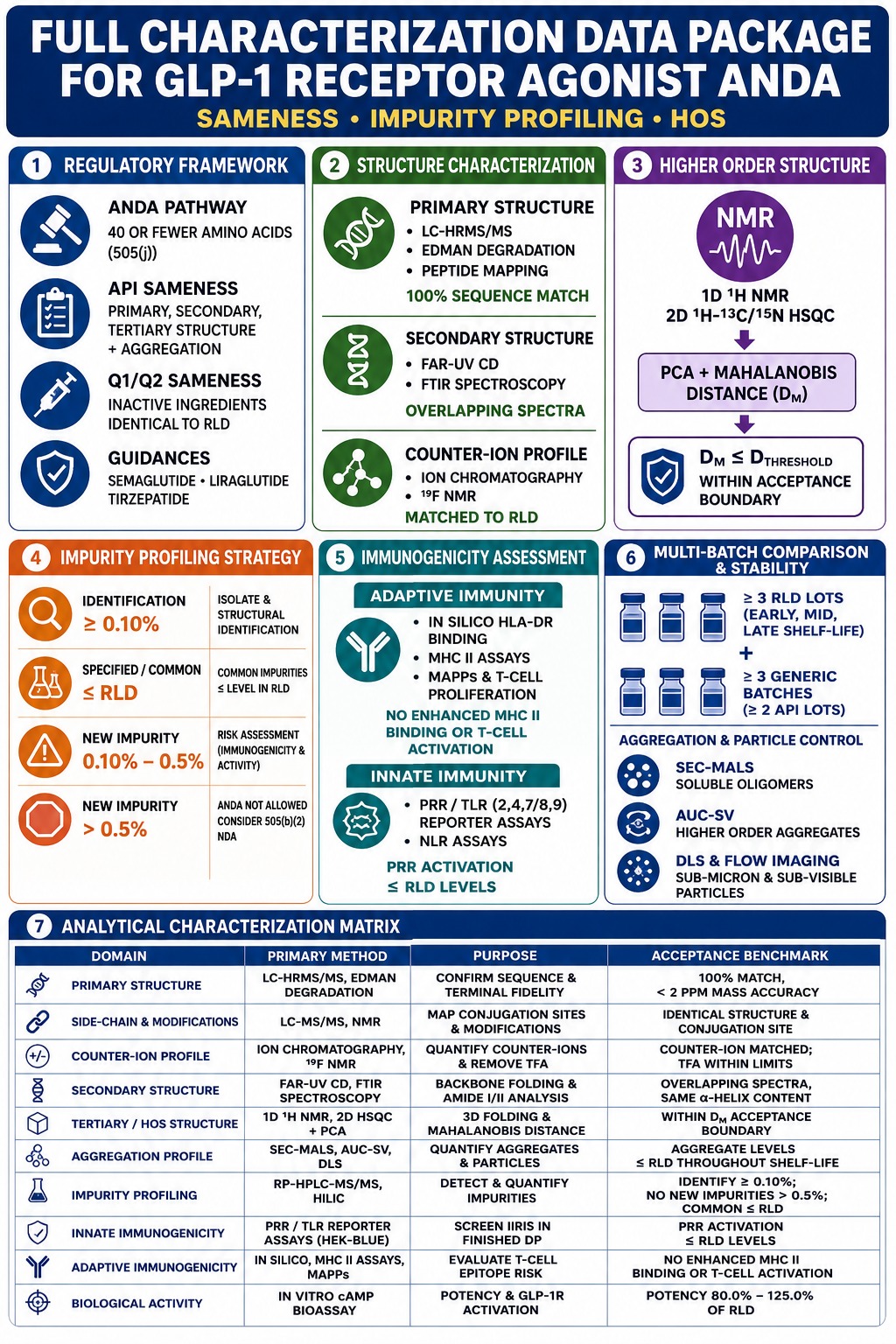
The regulatory pathway for generic synthetic GLP-1 receptor agonists requires applicants to establish active pharmaceutical ingredient sameness through comprehensive side-by-side physicochemical characterization and biological evaluation. This assessment is intended to demonstrate equivalent primary, secondary, and tertiary structures while confirming that aggregation levels are comparable to or lower than those observed in the Reference Listed Drug. Peptides containing 40 or fewer amino acids are eligible for the Abbreviated New Drug Application (ANDA) pathway under Section 505(j), whereas recombinant peptides have traditionally been addressed through the New Drug Application (NDA) pathway under Section 505(b)(2).
The FDA has further developed its regulatory expectations through revised draft Product-Specific Guidances (PSGs) for important peptide products, including semaglutide, liraglutide, and tirzepatide. These updated guidances reflect advances in analytical characterization and address areas such as structural characterization, innate immune response impurity (IIRI) testing, higher-order structure (HOS) evaluation, and biological activity assessment. Within this updated regulatory framework, generic applicants are expected to demonstrate API sameness through side-by-side comparative characterization studies involving multiple commercial RLD lots.
For pharmaceutical equivalence of generic GLP-1 injectable formulations, the generic drug product must be qualitatively (Q1) and quantitatively (Q2) identical to the RLD with respect to inactive ingredients. When Q1/Q2 sameness has been established for parenteral solution formulations, bioequivalence may generally be considered self-evident, allowing applicants to seek a waiver of in vivo bioequivalence studies. As a result, the primary regulatory emphasis shifts toward the scientific robustness of the characterization package. The package must provide convincing evidence that synthetic variations, counter-ion profiles, and trace-level impurities do not produce meaningful differences in the biological function or safety profile of the drug product.
Access our comprehensive guide on regulatory expectations for generic peptide submissions: Regulatory Requirements for GLP-1 Peptide Characterization.
Primary and Secondary Structure Characterization Protocols
Primary sequence identity and secondary structural conformation of a synthetic GLP-1 receptor agonist are established through a combination of orthogonal analytical techniques, including mass spectrometry, liquid chromatography, automated Edman degradation, Far-UV Circular Dichroism (CD), and Fourier-Transform Infrared (FTIR) spectroscopy. Together, these complementary methods provide evidence of the exact amino acid sequence, side-chain modifications, disulfide linkages, and backbone secondary structural characteristics.
Primary sequence confirmation begins with intact mass determination using Liquid Chromatography coupled with High-Resolution Mass Spectrometry (LC-HRMS), with Orbitrap or Time-of-Flight (Q-TOF) analyzers used to achieve mass accuracy within <2 ppm. To establish comprehensive sequence coverage and verify side-chain modifications—such as the hydrophobic C18 fatty diacid conjugated through a γ-Glu-2xOEG linker in semaglutide—the peptide is subjected to enzymatic digestion with trypsin or endoproteinase Glu-C, followed by LC-MS/MS peptide mapping. Collision-Induced Dissociation (CID) or Electron-Transfer Dissociation (ETD) produces complete b- and y-ion series, enabling confirmation of amino acid order and helping rule out sequence inversion.
Review our end-to-end analytical workflow for primary structure confirmation: GLP-1 Analog Peptide Sequencing Workflow.
Secondary structure characterization evaluates non-covalent backbone folding, particularly the α-helical domains that are important for GLP-1 receptor activation. Far-UV Circular Dichroism (CD) spectra acquired across the 190 nm to 260 nm range measure molar ellipticity (θ), providing information about the relative proportions of α-helix, β-sheet, and random coil conformations. FTIR spectroscopy provides complementary structural information by examining Amide I (1600–1700 cm⁻¹, C=O stretching) and Amide II (1500–1600 cm⁻¹, N-H bending and C-N stretching) vibrational bands. Comparison of second-derivative spectra between the generic product and RLD can be used to evaluate whether their hydrogen-bonding networks and secondary structural geometry are consistent.
Discover how circular dichroism spectroscopy is used to characterize peptide backbone folding: CD Spectroscopy for Peptide Secondary Structure Characterization.
Counter-ion quantification is another essential component of primary characterization. Solid-phase peptide synthesis uses trifluoroacetic acid (TFA) during peptide-resin cleavage and deprotection. Consequently, the final characterization package should demonstrate effective exchange of residual trifluoroacetate for approved pharmaceutical counter-ions, such as acetate or sodium. This assessment can be supported by validated Ion Chromatography (IC) or ¹⁹F NMR analytical procedures.
Higher Order Structure Evaluation via Advanced NMR and Multivariate Statistics
Higher Order Structure (HOS) sameness can be quantitatively assessed using 1D ¹H and 2D ¹H-¹³C/¹⁵N Nuclear Magnetic Resonance (NMR) spectroscopy in combination with Principal Component Analysis (PCA) and Mahalanobis distance (D_M) calculations. This non-invasive analytical strategy provides a means of evaluating tertiary structural folding while maintaining the final dosage form as the basis for assessment.
High-resolution 2D NMR techniques, including ¹H-¹³C Heteronuclear Single Quantum Coherence (HSQC), generate detailed conformational fingerprints at the atomic level. Because chemical shifts are highly responsive to changes in local electronic environments, 2D NMR spectra provide information concerning tertiary folding and spatial relationships between residues. For objective assessment of structural equivalence, spectral matrices can be divided into bins and evaluated using Principal Component Analysis (PCA). Mahalanobis distance (D_M) then provides a statistical measure of the distance between generic sample spectra and the multidimensional variability space established from multiple RLD batches. Generic samples that remain within the defined statistical acceptance boundary (D_M ≤ D_threshold) can be demonstrated to have tertiary conformations consistent with the reference product.
Learn more about higher-order structure evaluation using 2D NMR fingerprinting: 2D NMR for Peptide Characterization.
Direct NMR analysis of the drug product can introduce analytical complications associated with sample pH variability. Sample preparation is generally limited to the addition of a small volume of deuterium oxide (D₂O) for field locking so that the native formulation environment is retained as closely as possible. Nevertheless, small batch-to-batch pH differences (ΔpH < 0.1 units) between formulation lots can produce chemical shift perturbations in proton resonances associated with ionizable amino acid residues, including Histidine and Glutamic Acid. These changes arise from differences in residue protonation states rather than genuine alterations in tertiary conformation. If these pH-related effects are not addressed, they may artificially increase Mahalanobis distances and potentially result in incorrect HOS sameness failures.
For reliable HOS evaluation, the characterization strategy should therefore include precise pH alignment procedures or validated mathematical peak alignment algorithms. Small sample pH adjustments within ±0.02 units can reduce ionization-related resonance shifts without materially disturbing the non-covalent folding of the peptide. Demonstrating that observed spectral differences disappear or become reversible after pH alignment provides evidence that the underlying higher-order structure is consistent with the reference product.
Impurity Profiling and Threshold Strategy in a Full Characterization Data Package for a GLP-1 Receptor Agonist ANDA
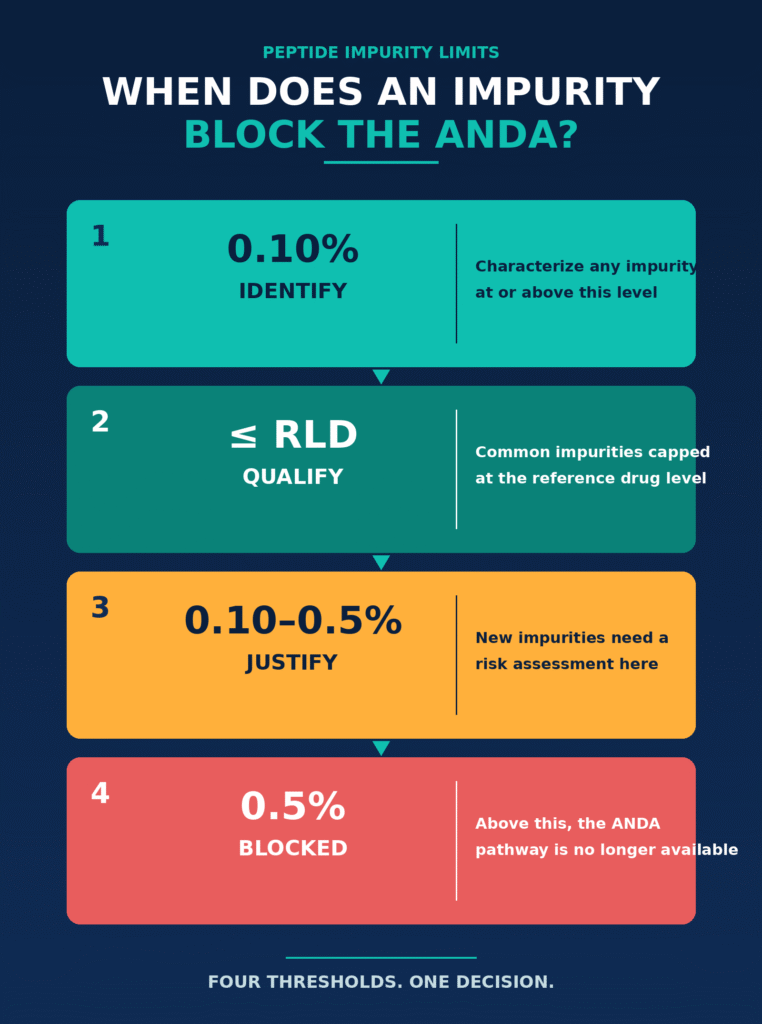
Impurity profiling within a Full Characterization Data Package for a GLP-1 Receptor Agonist ANDA combines ICH Q3A/Q3B baseline concepts with peptide-specific FDA expectations. These requirements call for structural identification of peptide-related impurities at or above 0.10% and restrict the presence of new impurities above 0.5%. Generic applicants must also demonstrate that peptide-related impurities common to the generic API and RLD are not present at concentrations exceeding those established for the RLD.
Synthetic GLP-1 manufacturing generates two broad categories of impurities: process-related impurities and peptide-related impurities. Process-related impurities may include residual organic solvents, such as dimethylformamide and dichloromethane; coupling reagents, such as HATU and PyBOP; cleavage scavengers; and trace heavy metals. These impurities are managed using applicable ICH Q3C and Q3D frameworks. Peptide-related impurities, in contrast, are structural variants that may arise during SPPS or subsequent storage. Examples include deletion sequences (n-1), insertion variants (n+1), D-amino acid diastereomers (epimers), deamidation products, oxidation species, and beta-amyloid/truncation products.
Read our in-depth analysis of identification strategies for peptide impurities: GLP-1 Peptide Impurity Characterization.
The regulatory strategy applies defined numerical boundaries to peptide-related impurities while complementing conventional small-molecule impurity controls:
- Identification Threshold (≥ 0.10%): Any peptide-related impurity detected at or above 0.10% of the drug substance should be isolated and structurally characterized using LC-MS/MS, nuclear magnetic resonance, or synthesis and comparison with authentic reference standards.
- Specified/Common Impurities (≤ RLD): Peptide-related impurities identified in both the generic API and the RLD may be considered qualified when the concentration in the generic product does not exceed the corresponding level observed in the Reference Listed Drug.
- New Impurity Justification Range (0.10%–0.5%): A new peptide-related impurity that is absent from the RLD or present at a higher concentration should undergo an appropriate risk assessment to determine whether it could increase immunogenicity potential or affect biological activity.
- New Impurity Ceiling (> 0.5%): A new peptide-related impurity present above 0.5% can prevent the generic candidate from following the ANDA pathway and may necessitate consideration of a 505(b)(2) NDA pathway.
Comparative Immunogenicity Assessment and Innate Immune Response Risk Mitigation
Comparative immunogenicity assessment for generic GLP-1 agonists is intended to address potential clinical safety risks associated with peptide-related impurities in the 0.10%–0.5% range. The assessment can include screening for novel T-cell epitopes and evaluation of finished drug formulations for Innate Immune Response Impurities (IIRIs) capable of activating host pattern recognition receptors. A comprehensive evaluation may integrate in silico HLA-DR binding algorithms, in vitro MHC binding assays, and cell-based Pattern Recognition Receptor (PRR) activation studies.
Immunogenicity is an important safety consideration for synthetic peptide impurities. Single amino acid deletions, insertions, or D-amino acid racemization can modify antigen processing and presentation and potentially create novel T-cell epitopes capable of interacting with Major Histocompatibility Complex (MHC) Class II molecules. Such interactions can stimulate CD4+ T-cells and promote anti-drug antibody (ADA) production, which may neutralize the therapeutic peptide or potentially cross-react with endogenous GLP-1. To evaluate this potential risk, a new impurity present between 0.10% and 0.5% can undergo in silico binding prediction against a globally representative panel of HLA-DR alleles. Impurities showing predicted binding potential may then be investigated using in vitro MHC Class II competitive binding assays, MHC-Associated Peptide Proteomics (MAPPs), and human peripheral blood mononuclear cell (PBMC) T-cell proliferation assays.
Innate Immune Response Impurities (IIRIs) comprise non-peptide contaminants—including endotoxins, peptidoglycans, flagellin, and residual host-cell components—that can activate innate immune signaling pathways. These impurities may function as immunological adjuvants by promoting dendritic cell maturation and strengthening adaptive immune responses against the primary peptide. The generic characterization package can evaluate the finished drug product through cell-based reporter assays expressing human PRRs, including Toll-Like Receptors (TLR2, TLR4, TLR7/8, TLR9) and NOD-like receptors (NLRs). Demonstrating that the generic formulation produces PRR activation levels comparable to or lower than those observed with the RLD provides evidence that innate immunogenicity risk is appropriately controlled.
Multi-Batch Comparative RLD Analytical Execution and Shelf-Life Stability
A robust ANDA submission requires comparative analytical assessment across an appropriately representative cohort of Reference Listed Drug lots and generic batches, with testing performed at release and during shelf-life stability studies. Standard regulatory practice involves evaluating at least three distinct commercial RLD batches together with three generic drug product batches manufactured using at least two independent active pharmaceutical ingredient synthesis lots.
To establish a meaningful equivalence baseline, RLD selection should account for the manufacturing variability that may occur throughout the innovator product’s shelf-life. The RLD cohort should ideally include batches close to release, batches representing mid-shelf-life, and batches approaching expiration. Side-by-side analytical testing should be performed using identical or appropriately harmonized instrumental conditions to reduce analytical drift and support scientifically valid statistical comparisons.
Review our methodologies for evaluating stability and degradation pathways in peptide therapeutics: GLP-1 Peptide Stability & Analytical Methods.
Maintaining physical-state integrity and controlling aggregation are critical stability considerations. Peptides in aqueous formulations can form soluble oligomers or insoluble fibrils as a result of hydrophobic interactions involving amphipathic helices. The characterization package therefore uses orthogonal size-exclusion and particle-characterization techniques to monitor aggregation and particulate formation:
- Size-Exclusion Chromatography with Multi-Angle Light Scattering (SEC-MALS): Provides quantitative characterization of soluble low-molecular-weight oligomers, including dimers and trimers, while reducing dependence on molecular shape or chromatographic retention behavior.
- Analytical Ultracentrifugation – Sedimentation Velocity (AUC-SV): Serves as a matrix-free reference technique for resolving and quantifying higher-order soluble aggregates while minimizing potential interference from formulation components.
- Dynamic Light Scattering (DLS) & Flow Imaging Microscopy: Provides information on sub-micron and sub-visible particulate matter (1–100 μm), helping verify that aggregate and particulate levels in generic formulations remain comparable to or lower than those of the RLD throughout shelf-life.
Examine orthogonal strategies for measuring low- and high-molecular-weight peptide aggregates: Peptide Aggregation Analysis.
Analytical Characterization Matrix for Generic Peptide Sameness
| Characterization Domain | Primary Analytical Methodology | Primary Purpose and Regulatory Focus | Acceptance Benchmark for Sameness |
|---|---|---|---|
| Primary Structure | LC-HRMS/MS (Orbitrap / Q-TOF), Edman Degradation | Confirm the exact amino acid sequence, peptide length, and terminal fidelity. | 100% sequence matching with < 2 ppm mass accuracy; fragmentation pattern matching the RLD. |
| Side-Chain & Modifications | LC-MS/MS (CID / ETD), NMR Spectroscopy | Map conjugation sites, such as the C18 fatty acid chain connected through the γ-Glu spacer. | Identical chemical structure and specific amino acid conjugation site as the RLD. |
| Counter-Ion Profile | Ion Chromatography (IC), ¹⁹F NMR Spectroscopy | Quantify salt counter-ions and verify removal of residual synthetic reagents, including TFA. | Counter-ion stoichiometry matched to the RLD; residual TFA maintained within strict safety limits. |
| Secondary Structure | Far-UV Circular Dichroism (CD), FTIR Spectroscopy | Determine backbone peptide ellipticity (θ) and characterize Amide I/II vibrations. | Overlapping spectral profiles with equivalent α-helical content percentages. |
| Tertiary / HOS Structure | 1D ¹H NMR, 2D ¹H-¹³C/¹⁵N HSQC NMR + PCA | Characterize atomic-level 3D folding and calculate Mahalanobis distance (D_M). | Generic spectra remain within the D_M statistical acceptance boundary established from RLD lots. |
| Aggregation Profile | SEC-MALS, AUC-SV, Dynamic Light Scattering (DLS) | Quantify soluble oligomers, sub-micron aggregates, and sub-visible particles. | Aggregate levels in the generic drug product are ≤ the levels observed in the RLD throughout shelf-life. |
| Impurity Profiling | RP-HPLC-MS/MS, Hydrophilic Interaction LC (HILIC) | Detect, identify, and quantify process-related and peptide-related impurities. | Identify all impurities ≥ 0.10%; no new impurities > 0.5%; common impurities ≤ RLD. |
| Innate Immunogenicity | PRR / TLR Reporter Cell Line Assays (HEK-Blue) | Screen the finished DP for Innate Immune Response Impurities (IIRIs). | PRR activation and pro-inflammatory signaling ≤ levels observed in RLD formulations. |
| Adaptive Immunogenicity | In silico HLA-DR binding, MHC II Competitive Assays, MAPPs | Evaluate potential T-cell epitope creation associated with new peptide impurities (0.10%–0.5%). | New impurities demonstrate no enhanced MHC Class II binding or T-cell activation relative to the RLD. |
| Biological Activity | In vitro Cell-Based Cyclic AMP (cAMP) Bioassay | Quantify potency and functional GLP-1 receptor activation kinetics. | Potency within 80.0%–125.0% of the RLD with comparable concentration-response curves. |
Conclusion
Successfully developing a Full Characterization Data Package for a GLP-1 Receptor Agonist ANDA requires a comprehensive scientific strategy that integrates high-resolution analytical chemistry with applicable regulatory expectations. Demonstrating active pharmaceutical ingredient sameness for complex synthetic peptides such as semaglutide, liraglutide, and tirzepatide requires substantially more than conventional quality control testing. It calls for a complete characterization framework that incorporates primary sequence confirmation, quantitative higher-order structural assessment using 2D NMR and Mahalanobis distance statistics, rigorous control of synthetic peptide impurities, and detailed immunogenicity risk evaluation.
By combining orthogonal analytical methodologies with side-by-side comparative testing across multiple RLD batches throughout shelf-life stability, generic applicants can build a scientifically robust case for pharmaceutical equivalence and therapeutic sameness. Addressing challenging analytical factors—including pH-induced chemical shift artifacts during HOS NMR assessment and synthetic racemization variants—helps ensure that generic peptide candidates demonstrate comparable safety and efficacy characteristics. As regulatory expectations surrounding complex peptides continue to develop, a scientifically defensible and comprehensive characterization package remains a central component of a successful ANDA strategy.
To learn more about advanced analytical testing methodologies, structural characterization packages, and regulatory consulting for generic GLP-1 ANDA submissions, connect with our technical experts via our Contact Page.
Frequently Asked Questions (FAQs)
A new peptide-related impurity above 0.5% raises additional concerns regarding product quality, safety, and potential immunogenicity that may not be adequately addressed through the abbreviated regulatory pathway. Such an impurity can prevent the product from meeting the criteria expected for a 505(j) ANDA. Depending on the circumstances, the sponsor may instead need to pursue a Section 505(b)(2) regulatory pathway.
Mahalanobis distance (D_M) is used as a statistical tool to determine how closely a generic peptide’s multidimensional NMR spectral profile corresponds to the variability observed among RLD lots. It considers relationships between multiple spectral variables rather than evaluating each chemical shift independently. This provides a quantitative approach for determining whether the tertiary structural characteristics of the generic product fall within the established RLD acceptance space.
Small differences in sample pH can change the chemical shifts of ionizable amino acid residues without producing an actual change in peptide conformation. When these shifts are incorporated into PCA and Mahalanobis distance calculations, they may appear as structural differences and lead to an incorrect HOS sameness failure. Careful pH alignment helps minimize these ionization-related effects while preserving the peptide’s native non-covalent structure.
A comprehensive comparative characterization strategy generally evaluates at least three commercial RLD batches together with at least three generic drug product batches. RLD samples should ideally represent different points across the product’s shelf-life, including batches close to release, during mid-shelf-life, and near expiration. The generic batches should be manufactured using at least two independent API synthesis lots to provide an appropriate assessment of manufacturing variability.
IIRI evaluation can involve cell-based reporter systems containing human Pattern Recognition Receptors (PRRs) that respond to specific classes of innate immune stimulants. Assays may include receptors such as Toll-Like Receptors (TLR2, TLR4, TLR7/8, TLR9) and NOD-like receptors, using systems such as HEK-Blue reporter cell lines. These studies help determine whether trace non-peptide contaminants trigger NF-κB-mediated inflammatory signaling at levels greater than those observed with the RLD.
Process-related impurities originate from manufacturing materials and processing steps, including organic solvents such as DMF, coupling reagents, cleavage reagents, scavengers, and trace metals. Peptide-related impurities, by comparison, are molecular variants of the target peptide that can arise during synthesis, purification, or storage. Examples include deletion sequences, insertion variants, epimers, deamidated species, oxidation products, and truncation or cleavage products.
For a generic GLP-1 injectable solution that is qualitatively (Q1) and quantitatively (Q2) identical to the RLD in its inactive ingredients, bioequivalence may be considered self-evident under the applicable regulatory framework. In such circumstances, an applicant may request a waiver of in vivo bioequivalence studies. The waiver is supported by demonstrating the required pharmaceutical equivalence and comprehensive API sameness through appropriate physicochemical and analytical characterization.
Withdrawal of the May 2021 synthetic peptide guidance reflects the FDA’s transition toward more current and product-specific regulatory expectations. Sponsors preparing GLP-1 ANDA submissions should therefore evaluate the applicable revised Product-Specific Guidances (PSGs) rather than relying solely on the withdrawn document. Current characterization strategies may need to address updated expectations for impurity assessment, immunogenicity risk, Higher Order Structure (HOS), quantitative NMR analysis, and biological activity.
Reference:
- U.S. Food and Drug Administration. (2022, November). Sameness evaluations in an ANDA—Active ingredients: Guidance for industry (Draft guidance). U.S. Department of Health and Human Services. https://www.fda.gov/media/163018/download
- U.S. Food and Drug Administration. (2022, November). Sameness evaluations in an ANDA—Active ingredients: Guidance for industry (Draft guidance). U.S. Department of Health and Human Services. https://www.fda.gov/media/163018/download
- U.S. Food and Drug Administration. (2026, July 28). FDA publishes revised draft product-specific guidances for certain generic peptide products. U.S. Department of Health and Human Services. https://www.fda.gov/drugs/drug-alerts-and-statements/fda-publishes-revised-draft-product-specific-guidances-certain-generic-peptide-products
- Rogers-Crovak, J. A., Delaney, E. J., & Detlefsen, D. J. (2024). Recommendation for clarifying FDA policy in evaluating “sameness” of higher order structure for generic peptide therapeutics. AAPS Journal, 27(1), 8. https://doi.org/10.1208/s12248-024-00994-8
- Pang, E. (2022, September 20). Assessing immunogenicity risk of peptides: The synthetic peptide guidance and PSGs [PowerPoint slides]. U.S. Food and Drug Administration. https://www.fda.gov/media/166571/download
Get In Touch With Us
About The Author


