Introduction to GCMS Analysis of Fatty Acids
GCMS analysis of fatty acids is the most reliable and accurate analytical method for identifying and quantifying fatty acid composition in diverse sample matrices. This advanced technique combines the separation power of gas chromatography with the detection capabilities of mass spectrometry to provide comprehensive lipid profiles with exceptional precision and sensitivity.
Fatty acids are fundamental building blocks of lipids that play crucial roles in human health, nutrition, food quality, and numerous industrial applications. Whether you’re analyzing omega-3 content in supplements, trans fats in food products, or biomarkers in clinical samples, GC-MS delivers the analytical rigor required for confident decision-making. At ResolveMass Laboratories Inc., we’ve processed thousands of fatty acid samples across pharmaceutical, food, clinical, and research sectors, developing specialized protocols that ensure accurate results every time.
Gas Chromatography-Mass Spectrometry (GC-MS) has become the cornerstone of lipid research, offering unmatched precision in identifying and quantifying GCMS analysis of fatty acids. In food science, where lipid composition directly influences nutrition, taste, and shelf life, GC-MS stands out as the gold standard. ResolveMass Laboratories Inc. specializes in advanced GC-MS analysis, providing accurate lipid profiling to meet industry and regulatory demands.
Summary
This comprehensive guide covers everything you need to know about GCMS analysis of fatty acids for precise lipid profiling:
- Industry Standards: Follows ISO, AOAC, and AOCS guidelines for regulatory compliance
- What is GC-MS Analysis: Gas chromatography-mass spectrometry is the gold standard technique for identifying and quantifying fatty acids in complex biological samples
- Sample Preparation Methods: Derivatization techniques including methylation and silylation are essential for volatile fatty acid detection
- Key Applications: Used across food testing, clinical diagnostics, pharmaceutical research, and environmental monitoring
- Technical Advantages: Provides superior sensitivity (ppb levels), accurate identification through mass spectral libraries, and simultaneous multi-component analysis
- Quality Assurance: Proper calibration, internal standards, and method validation ensure reliable, reproducible results
1: What is GC-MS and How Does It Work for Fatty Acid Analysis?
GC-MS (Gas Chromatography-Mass Spectrometry) is an analytical technique that separates chemical compounds based on their volatility and identifies them by their molecular mass. For fatty acid analysis, the process involves converting fatty acids into volatile derivatives, separating them through a chromatographic column, and detecting them using mass spectrometry.
The workflow consists of three primary stages:
- Sample Preparation and Derivatization: Fatty acids are extracted from the sample matrix and converted into methyl esters (FAMEs) or other volatile derivatives
- Gas Chromatographic Separation: Derivatized fatty acids are vaporized and separated based on their boiling points and interactions with the column stationary phase
- Mass Spectrometric Detection: Separated compounds are ionized, fragmented, and detected based on their mass-to-charge ratios, providing structural information for identification
This dual-detection approach makes GCMS analysis of fatty acids far superior to traditional methods, offering both qualitative identification through mass spectra matching and precise quantification through calibrated response factors.
2: Why Choose GC-MS for Fatty Acid Profiling?
GC-MS stands out as the preferred method for fatty acid analysis due to several compelling advantages:
Superior Analytical Performance
- High Sensitivity: Detects fatty acids at parts-per-billion (ppb) concentrations
- Excellent Resolution: Separates closely related fatty acid isomers including positional and geometric isomers
- Definitive Identification: Mass spectral libraries contain thousands of fatty acid references for confident compound identification
- Wide Dynamic Range: Quantifies both major and trace fatty acid components in a single analysis
Comprehensive Analytical Scope
GC-MS for fatty acid analysis can simultaneously measure:
- Saturated fatty acids (SFAs)
- Monounsaturated fatty acids (MUFAs)
- Polyunsaturated fatty acids (PUFAs)
- Trans fatty acids
- Odd-chain fatty acids
- Branched-chain fatty acids
- Cyclic fatty acids
Regulatory Acceptance
This method meets requirements established by:
- AOAC International (Association of Official Analytical Chemists)
- AOCS (American Oil Chemists’ Society)
- ISO (International Organization for Standardization)
- FDA and other regulatory agencies worldwide
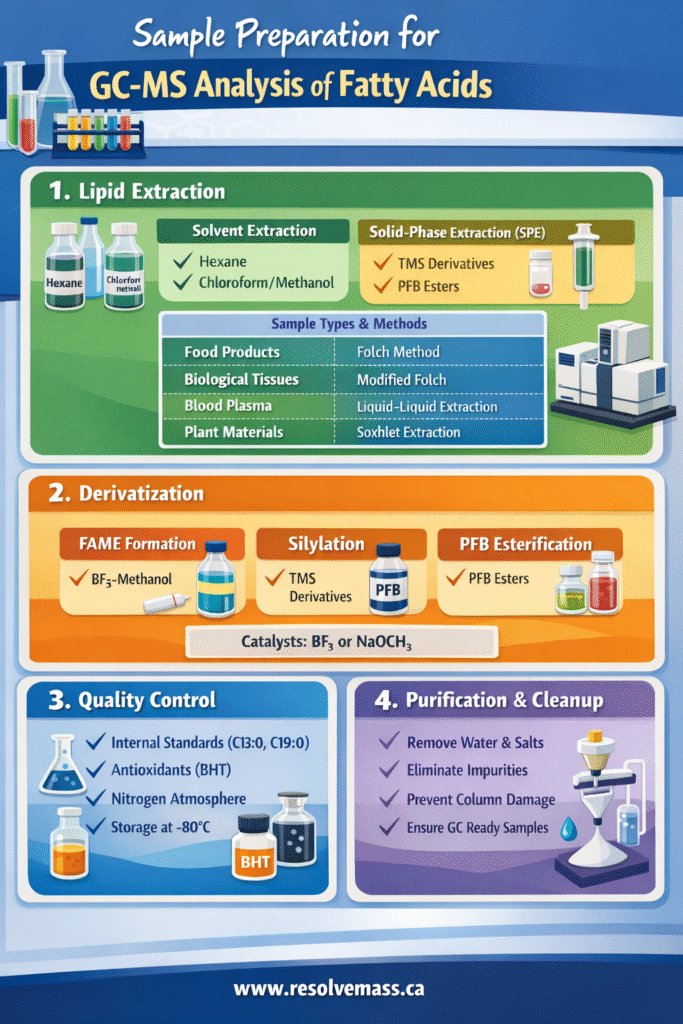
3: Sample Preparation for GCMS Analysis of Fatty Acids
Proper sample preparation is the foundation of accurate fatty acid analysis. The process typically involves three critical steps:
1. Lipid Extraction
- Solvent-Based Methods: Hexane or chloroform/methanol is commonly used.
- Solid-Phase Extraction (SPE): Removes impurities and enhances lipid recovery.
Fatty acids exist in various forms within sample matrices—free fatty acids, triglycerides, phospholipids, and cholesterol esters. Extraction methods depend on the sample type:
| Sample Type | Extraction Method | Common Solvents |
|---|---|---|
| Food Products | Folch Method, Bligh-Dyer | Chloroform/Methanol |
| Biological Tissues | Modified Folch | Chloroform/Methanol/Water |
| Blood Plasma | Liquid-Liquid Extraction | Hexane/Isopropanol |
| Plant Materials | Soxhlet Extraction | Hexane, Petroleum Ether |
2. Derivatization
Fatty acids must be converted to volatile derivatives for GC analysis. The most common derivatization approaches include:
- Methylation (FAME Formation): Converts fatty acids to fatty acid methyl esters using reagents like BF3-methanol, methanolic HCl, or sodium methoxide
- Silylation: Creates trimethylsilyl (TMS) derivatives for enhanced volatility
- Pentafluorobenzyl (PFB) Esterification: Used for enhanced sensitivity in negative ion chemical ionization
- Catalysts: Commonly used catalysts include boron trifluoride and sodium methoxide.
Our laboratory utilizes optimized derivatization protocols that ensure complete conversion while preventing degradation of unsaturated fatty acids and trans isomers.
3. Quality Control in Sample Preparation
- Addition of internal standards (C13:0, C19:0, or C23:0) before extraction for recovery assessment
- Use of antioxidants (BHT) to prevent oxidation during processing
- Nitrogen atmosphere handling for PUFA-rich samples
- Appropriate storage conditions (-80°C for long-term storage)
4. Purification
Purification removes residual water, salts, and non-lipid contaminants that can interfere with GC-MS performance. Effective cleanup helps:
- Reduce matrix effects
- Prevent column contamination and degradation
- Improve peak shape and signal stability
- Extend instrument lifespan
Drying agents and cleanup steps are routinely applied to ensure clean, GC-ready samples.
4: Importance of Fatty Acid Profiling
Fatty acids play a pivotal role in various fields, including nutrition, healthcare, and food safety. Accurate profiling is essential for:
- Nutritional Labeling: Ensuring transparency in reporting saturated, monounsaturated, and polyunsaturated fats.
- Quality Control: Maintaining product consistency and adhering to regulatory standards.
- Food Authenticity: Verifying origin and detecting adulteration.
- Health Research: Understanding the link between dietary fats and chronic diseases.
5: Fundamentals of GC-MS in Fatty Acid Analysis
GC-MS integrates two powerful analytical techniques:
1. Gas Chromatography (GC)
- Separation Process: Fatty acids are separated after derivatization into Fatty Acid Methyl Esters (FAMEs) for enhanced volatility.
- Column Dynamics: Capillary columns coated with non-polar stationary phases provide high resolution.
2. Mass Spectrometry (MS)
- Molecular Identification: Ionizes separated compounds and detects mass-to-charge (m/z) ratios.
- Spectral Libraries: Matches spectra against extensive databases for precise identification.
Advantages of Using GC-MS for Fatty Acid Analysis
- High Sensitivity: Detects trace levels of fatty acids.
- Specificity: Differentiates isomers and structurally similar compounds.
- Quantitative Accuracy: Provides precise concentration data.
- Robustness: Suitable for complex food matrices.
6: Applications of GC-MS in Food Science
1. Nutritional Analysis
Accurate profiling of omega-3, omega-6, and trans fats is essential for dietary guidelines.
- Case Study: A study on fish oils showed GC-MS could accurately quantify essential fatty acids [DOI:10.1016/j.foodchem.2022.134763].
2. Food Authenticity and Adulteration
Adulteration in edible oils is a global concern. GC-MS can identify unique fatty acid fingerprints to detect fraud.
- Example: Differentiating olive oil from cheaper vegetable oils [DOI:10.1021/jf102312y].
3. Lipid Oxidation and Shelf Life
Lipid oxidation produces aldehydes and ketones, affecting food quality and safety.
- Research Insight: GC-MS has been used to monitor lipid oxidation in dairy products [DOI:10.1111/ijfs.15789].
7: Innovations in GC-MS Technology
1. High-Resolution Mass Spectrometry (HRMS)
- Improves peak resolution, enabling better identification of co-eluting compounds.
2. Automated Sample Preparation
- Reduces human error and improves sample throughput.
3. Data Analysis with Machine Learning
- Predictive modeling and anomaly detection enhance data interpretation.
8: Comparison with Other Analytical Techniques
| Technique | Sensitivity | Specificity | Quantification | Best Use Case |
|---|---|---|---|---|
| GC-MS | High | High | Excellent | Complex lipid mixtures |
| HPLC | Moderate | Moderate | Good | Non-volatile lipids |
| NMR | Moderate | Low | Moderate | Structural elucidation |
| FTIR | Low | Low | Poor | Bulk analysis |
9: Challenges in GCMS analysis of fatty acids
1. Sample Complexity
Food matrices can be highly complex, requiring advanced purification techniques.
2. Derivatization Efficiency
Incomplete or inconsistent FAME formation can affect quantification accuracy.
3. Instrumentation Costs
High initial investment and maintenance costs can be a barrier for smaller labs.
10: ResolveMass Laboratories Inc. Expertise
At ResolveMass Laboratories Inc., we offer customized GC-MS analysis with a focus on:
- Precise Lipid Profiling: Covering saturated, unsaturated, and trans fats.
- Regulatory Compliance: Meeting FDA and EU standards.
- Advanced Data Reporting: Offering detailed analytics and insights.
11: Case Studies
Case Study 1: Nutritional Labeling in Infant Formula
- Objective: To verify omega-3 and omega-6 levels.
- Outcome: GC-MS provided accurate quantification, ensuring regulatory compliance.
Case Study 2: Detecting Adulteration in Olive Oil
- Objective: Identify cheaper oils mixed with olive oil.
- Outcome: GC-MS identified adulterants, preventing economic fraud.
Future Trends in GCMS analysis of fatty acids
- Green Analytical Chemistry: Eco-friendly solvents and energy-efficient instruments.
- Real-Time Monitoring: Portable GC-MS devices for on-site analysis.
- Integration with AI: Automated data interpretation and anomaly detection.
REFERENCES
- Petrović M, Kezić N, Bolanča V. Optimization of the GC method for routine analysis of the fatty acid profile in several food samples. Food Chemistry. 2010 Sep 1;122(1):285-91.
- Barnard H, Dooley AN, Faull KF. An introduction to archaeological lipid analysis by combined gas chromatography mass spectrometry (GC/MS). Theory and practice of archaeological residue analysis. 2007;2:42-60.
- Seppänen-Laakso T, Laakso I, Hiltunen R. Analysis of fatty acids by gas chromatography, and its relevance to research on health and nutrition. Analytica Chimica Acta. 2002 Aug 16;465(1-2):39-62.
- Gutnikov G. Fatty acid profiles of lipid samples. Journal of Chromatography B: Biomedical Sciences and Applications. 1995 Sep 15;671(1-2):71-89.
- Ackman RG. The gas chromatograph in practical analyses of common and uncommon fatty acids for the 21st century. Analytica Chimica Acta. 2002 Aug 16;465(1-2):175-92.
How Do You Derive an Acceptable Intake Limit for a Novel NDSRI with No Existing Toxicology Data?
Introduction: Deriving an NDSRI Acceptable Intake Limit for a novel nitrosamine drug substance-related impurity with…
What Is a ‘Reasonably Expected’ Nitrosamine Under FDA’s Guidance and How Does It Affect Your Risk Assessment?
Introduction: A “reasonably expected” nitrosamine is one that your chemistry, process, materials or storage make…
Regulatory Starting Materials for Synthetic Peptides: How to Justify Them Under ICH Q11
Introduction Justifying Regulatory Starting Materials for Synthetic Peptides under the International Council for Harmonisation (ICH)…

Amino Acid Derivatives and Building Blocks: How Raw Material Quality Shapes Impurities in GMP Peptides
Introduction Establishing rigorous quality attributes for Amino Acid Derivatives and Building Blocks is one of…

Neutralizing Antibody (NAb) Assays for Biosimilars: Assay Format, Cut Points and Comparative Interpretation
Introduction Neutralizing Antibody (NAb) Assays for Biosimilars evaluate the functional ability of anti-drug antibodies (ADAs)…

Case Study: PCL Subcutaneous Implant Development for 12-Month Hormonal Drug Delivery
Introduction: PCL Subcutaneous Implant Development is an emerging approach for designing long-acting hormonal drug delivery…