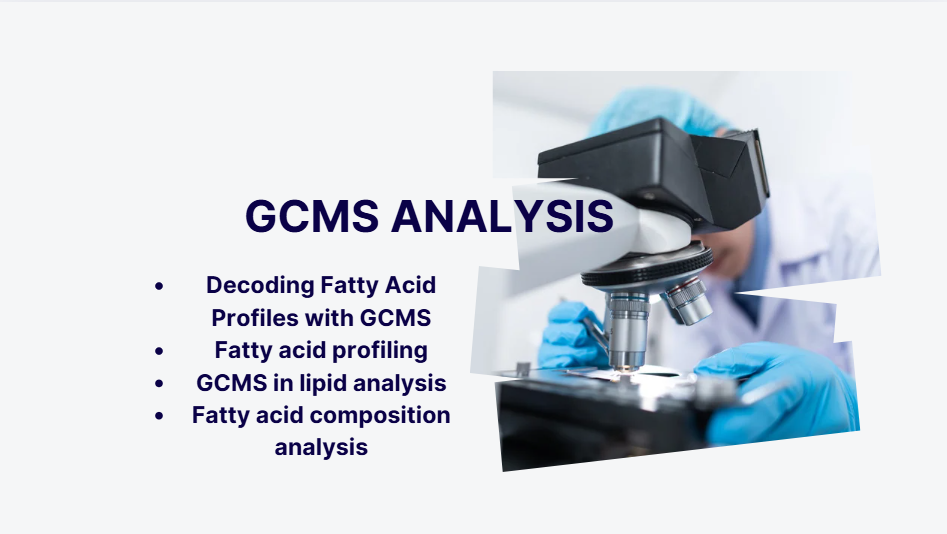
Fatty acids are crucial components of food, playing a significant role in nutrition, flavor, and overall food quality. GCMS analysis of fatty acids composition is essential for ensuring food safety, authenticity, and compliance with regulatory standards. Among the various analytical techniques available, Gas Chromatography-Mass Spectrometry (GC-MS) stands out as the gold standard for fatty acid research in food science due to its high sensitivity, specificity, and ability to provide detailed molecular insights.
In-Depth Video Guide: GC-MS Analysis of Fatty Acids in Food Science
Importance of Fatty Acid Analysis in Food Science
Fatty acid profiling is critical for:
- Nutritional labeling – Accurate identification of saturated, monounsaturated, and polyunsaturated fatty acids.
- Food authenticity and adulteration detection – Differentiating between plant and animal fats.
- Quality control – Ensuring compliance with industry and regulatory standards.
- Health research – Studying the impact of dietary fatty acids on human health.
- Shelf-life determination – Monitoring lipid oxidation and rancidity.
GCMS analysis of fatty acids : The Gold Standard for Fatty Acid Analysis
1. High Sensitivity and Specificity
GC-MS combines the separation capabilities of gas chromatography (GC) with the identification power of mass spectrometry (MS), enabling:
- Detection of fatty acids at trace levels.
- Differentiation between structurally similar compounds.
- High reproducibility and reliability in food analysis
2. Superior Separation Efficiency
The GC component efficiently separates fatty acid methyl esters (FAMEs), the common derivatives used for analysis. This is particularly useful in:
- Resolving complex lipid mixtures.
- Identifying fatty acids with varying chain lengths and degrees of unsaturation.
- Providing quantitative information on individual fatty acids.
3. Mass Spectrometry for Structural Elucidation
MS provides detailed fragmentation patterns, helping in:
- Identifying unknown fatty acids.
- Detecting lipid oxidation products.
- Differentiating between isomers
4. Applications in Food Science
Nutritional Analysis
GC-MS helps in accurate determination of essential fatty acids, such as:
- Omega-3 and Omega-6 fatty acids.
- Trans fats and their impact on health.
Adulteration and Food Authenticity
- Detecting vegetable oil adulteration in dairy and meat products.
- Identifying geographical origin of oils and fats.
- Differentiating synthetic and natural flavors.
Lipid Oxidation and Shelf-Life Assessment
- Monitoring formation of aldehydes and ketones.
- Studying oxidative stability of edible oils.
- Identifying rancidity markers.
GC-MS vs. Other Fatty Acid Analysis Techniques
| Technique | Sensitivity | Specificity | Quantification | Suitability for Food Science |
|---|---|---|---|---|
| GC-MS | High | High | Excellent | Gold standard |
| HPLC | Moderate | Moderate | Good | Limited for volatile fatty acids |
| FTIR | Low | Moderate | Poor | Used for bulk analysis |
| NMR | Moderate | Low | Moderate | Complex mixtures |
Future Trends in GCMS analysis of fatty acids Research
- Automated Sample Preparation – Reducing human error and improving throughput.
- High-Resolution GC-MS – Enhancing separation and detection capabilities.
- Integration with AI and Machine Learning – Improving data analysis and interpretation.
- Advancements in Derivatization Techniques – Enhancing fatty acid profiling accuracy
Conclusion
GC-MS remains the gold standard for fatty acid research in food science due to its unparalleled sensitivity, specificity, and ability to provide comprehensive lipid profiling. As advancements in technology continue, GC-MS will further enhance the precision and efficiency of fatty acid analysis, ensuring food quality, safety, and authenticity.
REFERNCES
- Al-Rubaye AF, Hameed IH, Kadhim MJ. A review: uses of gas chromatography-mass spectrometry (GC-MS) technique for analysis of bioactive natural compounds of some plants. International Journal of Toxicological and Pharmacological Research. 2017 Mar;9(1):81-5.
- Singh AK, Kumar P, Rajput VD, Mishra SK, Tiwari KN, Singh AK, Minkina T, Pandey AK. Phytochemicals, antioxidant, anti-inflammatory studies, and identification of bioactive compounds using GC–MS of ethanolic novel polyherbal extract. Applied Biochemistry and Biotechnology. 2023 Jul;195(7):4447-68.
- Loganathan T, Barathinivas A, Soorya C, Balamurugan S, Nagajothi TG, Jayakumararaj R. GCMS profile of bioactive secondary metabolites with therapeutic potential in the ethanolic leaf extracts of Azadirachta indica: A sacred traditional medicinal plant of india. Journal of Drug Delivery and Therapeutics. 2021 Jul 2;11(4-S):119-26.
How Do You Derive an Acceptable Intake Limit for a Novel NDSRI with No Existing Toxicology Data?
Introduction: Deriving an NDSRI Acceptable Intake Limit for a novel nitrosamine drug substance-related impurity with…
What Is a ‘Reasonably Expected’ Nitrosamine Under FDA’s Guidance and How Does It Affect Your Risk Assessment?
Introduction: A “reasonably expected” nitrosamine is one that your chemistry, process, materials or storage make…

Regulatory Starting Materials for Synthetic Peptides: How to Justify Them Under ICH Q11
Introduction Justifying Regulatory Starting Materials for Synthetic Peptides under the International Council for Harmonisation (ICH)…

Amino Acid Derivatives and Building Blocks: How Raw Material Quality Shapes Impurities in GMP Peptides
Introduction Establishing rigorous quality attributes for Amino Acid Derivatives and Building Blocks is one of…

Neutralizing Antibody (NAb) Assays for Biosimilars: Assay Format, Cut Points and Comparative Interpretation
Introduction Neutralizing Antibody (NAb) Assays for Biosimilars evaluate the functional ability of anti-drug antibodies (ADAs)…

Case Study: PCL Subcutaneous Implant Development for 12-Month Hormonal Drug Delivery
Introduction: PCL Subcutaneous Implant Development is an emerging approach for designing long-acting hormonal drug delivery…