

Introduction:
For sponsors planning an Abbreviated New Drug Application (ANDA) or Abbreviated New Drug Submission (ANDS), one of the first planning questions is almost always about scheduling: what is a realistic Generic Drug Development Timeline at a CDMO? Generic drug development is a complex, multi-stage process that requires scientific expertise, regulatory compliance, and efficient project management, and the honest answer is that it depends heavily on dosage form complexity, the reference listed drug, and how well a CDMO for generic drug development can run formulation, analytical, and stability work in parallel rather than in strict sequence. Many sponsors today also weigh outsourcing generic drug development to a Canada-based partner against building capability in-house, since a CDMO for generic drug development in Canada offers dual regulatory familiarity that a domestic-only lab may not.
This article breaks down what actually drives each phase of the timeline, where delays typically occur, and how experienced analytical partners like ResolveMass Laboratories help keep generic drug programs on schedule.
Summary:
- The Generic Drug Development Timeline at a CDMO typically ranges from 18 to 48 months, from feasibility assessment through ANDA/ANDS submission.
- Simple oral solid dosage generics move fastest (roughly 12–18 months); complex generics — injectables, long-acting depot formulations, peptides, ophthalmic products — routinely take 24–48 months.
- Development runs through distinct phases: feasibility assessment, reverse engineering of the reference product, formulation development, analytical method development/validation, process development and scale-up, stability studies, bioequivalence studies, and ANDA/ANDS dossier preparation.
- Stability and bioequivalence studies are usually the longest, least compressible phases, since they follow fixed regulatory timepoints.
- Early, thorough analytical characterization of the reference listed drug (RLD) — using techniques like LC-MS/MS, HRMS, and ICP-MS — reduces redevelopment cycles later in the program.
- Choosing between a CDMO and a CRO, and selecting a partner experienced in your specific dosage form (peptides, long-acting injectables, ophthalmics), has a bigger impact on timeline predictability than lab size alone.
- Working with a scientifically integrated partner such as ResolveMass Laboratories — with in-house mass spectrometry, nitrosamine testing, and cross-border US/Canada regulatory support — helps avoid the rework that most commonly extends timelines.
1: Why Does Generic Drug Development Take So Long?
Generic drug development takes longer than many sponsors expect because it involves far more than reproducing an innovator product — every formulation component, manufacturing process, analytical method, impurity profile, and stability characteristic must be scientifically justified and shown to be pharmaceutically equivalent and bioequivalent to the reference listed drug (RLD).
Unlike innovator drug development, generic programs rely heavily on:
- Reverse engineering of the reference product
- Formulation optimization against the RLD’s critical quality attributes
- Analytical characterization and method validation
- Process development and manufacturing scale-up
- Bioequivalence demonstration
- Regulatory documentation in CTD format
Each of these activities contributes directly to the overall Generic Drug Development Timeline at a CDMO, and running them as isolated, sequential handoffs — rather than as a coordinated program — is one of the most common reasons timelines stretch beyond initial estimates.
2: What Is the Typical Generic Drug Development Timeline at a CDMO?
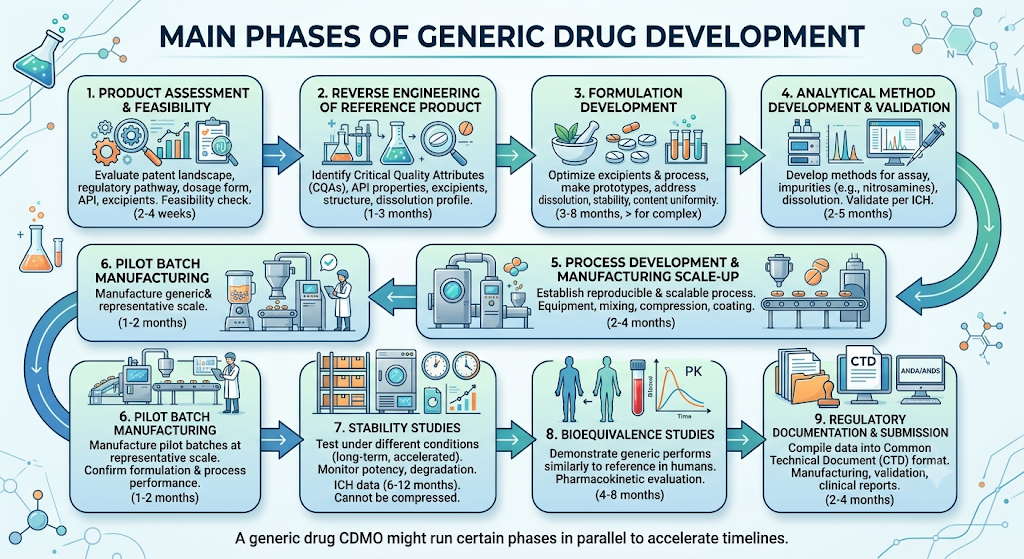
A typical Generic Drug Development Timeline at a CDMO runs 18 to 48 months in total, built from a series of phases that each have their own duration range, as shown below.
| Development Phase | Typical Duration |
|---|---|
| Product assessment & feasibility | 2–4 weeks |
| Reverse engineering of the RLD | 1–3 months |
| Formulation development | 3–8 months |
| Analytical method development & validation | 2–5 months |
| Process development & scale-up | 2–4 months |
| Pilot batch manufacturing | 1–2 months |
| Stability studies | 6–12 months |
| Bioequivalence study | 4–8 months |
| ANDA/ANDS dossier preparation | 2–4 months |
| Regulatory review after submission | Variable, agency-dependent |
Dosage form complexity also shifts the overall range considerably:
| Dosage Form Type | Typical Overall Timeline | Key Timeline Drivers |
|---|---|---|
| Oral solid (tablets, capsules) | 12–18 months | Dissolution method matching, bioequivalence scheduling |
| Oral liquids, suspensions | 14–20 months | Preservative efficacy, physical stability |
| Topical/semisolid (creams, gels) | 18–24 months | In vitro release testing (IVRT), microstructure comparability |
| Parenteral (injectables, sterile) | 20–30 months | Sterility assurance, extractables/leachables, particulate matter |
| Ophthalmic products | 20–30 months | Extractables/leachables, sterility, container closure integrity |
| Long-acting/depot (e.g., PLGA microspheres, leuprolide) | 24–42 months | Burst release characterization, in vitro-in vivo correlation |
| Peptide generics | 24–42 months | Peptide mapping, impurity profiling, technology transfer complexity |
| Complex generics (nasal sprays, transdermals, inhalation) | 24–36 months | Device-formulation interaction, comparative aerosol/particle studies |
3: What Are the Main Phases of Generic Drug Development?
Generic drug development at a CDMO moves through a defined sequence of phases, and the CDMO’s ability to run several of them in parallel — rather than strictly one after another — is often what separates a program on the faster end of the range from one on the slower end.
1. Product Assessment and Feasibility
This phase typically takes 2–4 weeks. Scientists evaluate the patent landscape, regulatory pathway, dosage form complexity, API availability, excipient selection, and manufacturing feasibility before committing further resources. A comprehensive feasibility assessment prevents investment in technically challenging or commercially unviable projects.
2. Reverse Engineering of the Reference Product
This phase generally runs 1–3 months. Reverse engineering identifies the critical quality attributes (CQAs) of the innovator product using techniques such as LC-MS/MS, LC-HRMS, GC-MS, ICP-MS, FTIR, DSC, TGA, SEM, particle size analysis, dissolution profiling, and XRPD. The goal is to characterize API properties, excipient composition, particle morphology, crystal form, impurity profile, dissolution behavior, and manufacturing clues — comprehensive characterization here significantly reduces formulation redevelopment time downstream.
3. Formulation Development
Formulation development generally consumes the largest portion of the Generic Drug Development Timeline at a CDMO, running 3–8 months. Scientists optimize excipient selection, manufacturing process, dissolution profile, tablet hardness, disintegration, content uniformity, moisture sensitivity, and stability, typically manufacturing multiple prototype formulations before identifying the optimal one. For complex dosage forms — extended-release tablets, liposomes, PLGA microspheres, injectable suspensions, ophthalmic formulations, and inhalation products — this phase can extend by several additional months.
4. Analytical Method Development and Validation
Running largely in parallel with formulation work, this phase typically takes 2–5 months. Methods are developed for assay, related substances, dissolution, residual solvents, elemental impurities, nitrosamines, extractables & leachables (where applicable), and stability-indicating assays, validated per ICH Q2(R2) for accuracy, precision, specificity, linearity, robustness, and detection/quantitation limits. Rigorous nitrosamine testing for CDMO programs completed at this stage — rather than after stability studies begin — is one of the most effective ways to avoid a mid-program restart.
5. Process Development and Manufacturing Scale-Up
This phase typically takes 2–4 months and establishes a reproducible, scalable manufacturing process through equipment selection, mixing and granulation optimization, compression studies, coating optimization, sterile process development where applicable, and cleaning validation planning.
6. Pilot Batch Manufacturing
Pilot batches, usually completed in 1–2 months, confirm that the optimized formulation and process perform consistently at a representative scale before larger stability and bioequivalence batches are committed.
7. Stability Studies
Stability studies (6–12 months, sometimes longer) are one of the least compressible phases, since ICH-compliant data points are collected at fixed timepoints — 0, 3, 6, 9, 12, 18, and 24 months for long-term conditions, plus accelerated and intermediate conditions. Parameters monitored include potency, dissolution, degradation products, moisture, appearance, and microbial quality. A program cannot submit long-term stability data before the committed timepoint exists, which is why locking in formulation and analytical methods early is so important — later changes force stability studies to restart.
8. Bioequivalence Studies
Bioequivalence (BE) studies, typically 4–8 months, demonstrate that the generic performs similarly to the reference product in humans, through fasting studies, fed studies, multiple-dose studies, pharmacokinetic evaluations, or in vitro bioequivalence approaches where permitted. Poor formulation performance during BE studies can delay the entire program, since it often triggers a return to formulation development.
9. Regulatory Documentation and ANDA/ANDS Submission
The final 2–4 months involve compiling data into Common Technical Document (CTD) Module 3 format, including administrative information, manufacturing process details, validation reports, stability reports, analytical methods, bioequivalence data, and risk assessments for ANDA (FDA) or ANDS (Health Canada) submission. Well-organized, regulatory-support-ready documentation for both the US and Canada reduces the likelihood of information requests during review.
4: What Factors Most Commonly Delay Generic Drug Development Timelines?
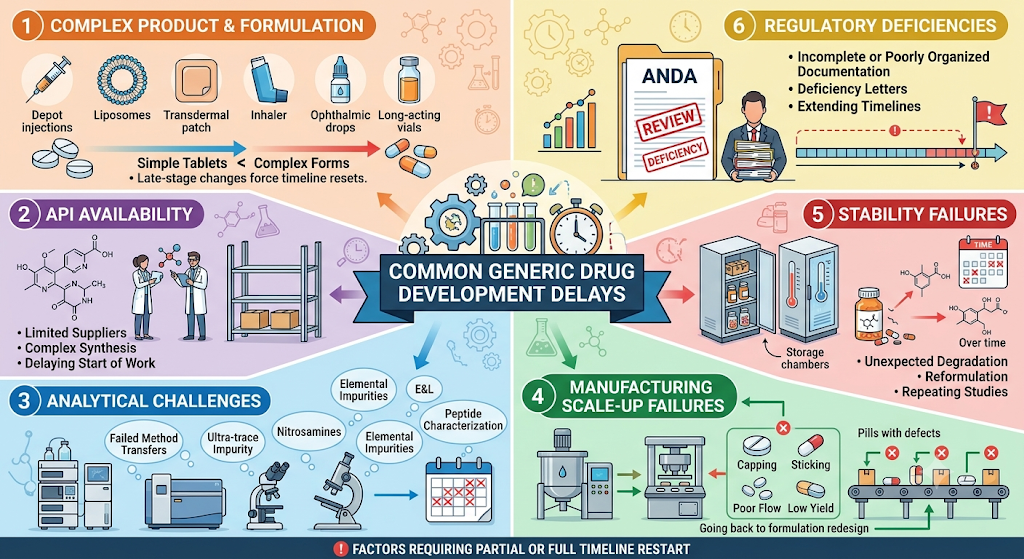
The most common causes of delay are late-stage formulation changes, failed method transfers, unresolved analytical challenges, manufacturing scale-up failures, stability failures, and incomplete regulatory documentation — each of which can force a partial or full restart of the stability or analytical timeline.
- Product complexity — simple immediate-release tablets develop faster than depot injections, liposomes, transdermal patches, inhalers, ophthalmic products, and long-acting injectables.
- API availability — limited API suppliers or complex synthesis routes can delay development before formulation work even begins.
- Analytical challenges — products requiring ultra-trace impurity analysis or complex characterization, such as nitrosamine analysis, elemental impurities, extractables & leachables, or peptide characterization, often need additional method development time.
- Manufacturing challenges — scale-up failures such as poor flow, segregation, capping, sticking, or low yield can require formulation redesign.
- Stability failures — unexpected degradation may require reformulation and repeat stability studies from time zero.
- Regulatory deficiencies — incomplete or poorly organized documentation can lead to deficiency letters, extending approval timelines well beyond the development phase itself.
5: CDMO or CRO — Which Should You Choose for a Generic Program?
The choice between a CDMO and a CRO affects timeline mainly through how many handoffs your program requires — fewer organizational handoffs generally means fewer opportunities for delay. Sponsors evaluating CDMO vs. CRO for generic drug development should weigh whether they need manufacturing capability alongside analytical and development work, or analytical/regulatory expertise layered onto an existing manufacturing relationship.
For ANDA-specific programs, this decision is often framed as generic drug development CRO support for ANDA versus building the capability internally — a comparison covered in more detail in CRO vs. in-house ANDA development. Sponsors weighing this decision may also find it useful to review guidance on how to choose the right CRO or CDMO for an ANDA submission, and how a well-structured CRO-CDMO partnership for ANDA programs can combine both capabilities without adding extra timeline risk.
6: Complex Generics: Long-Acting Injectables, Peptides, and Ophthalmics
Complex generics take longer than conventional oral solids primarily because their bioequivalence and characterization requirements are more scientifically demanding, not simply because manufacturing is harder.
Long-acting injectables — such as depot formulations built on leuprolide-type technology — require specialized development support. Sponsors often need a CDMO for long-acting injectable formulation development and a defined CMC strategy for complex generic injectables from the earliest feasibility stage. For leuprolide-specific programs, selecting the right partner is its own decision point, covered in choosing a CRO for leuprolide depot development and leuprolide depot CDMO selection criteria.
Peptide generics carry their own timeline considerations. Sponsors typically look for dedicated peptide CDMO services or evaluate what makes for the best peptide CDMO for their specific molecule. As with small-molecule generics, sponsors weigh peptide CDMO vs. CRO support, and — separately — peptide CDMO vs. CMO distinctions when manufacturing capability is also required. For US-market programs, working with a peptide CDMO based in the United States can simplify regulatory alignment, and many sponsors choose to outsource peptide manufacturing to a CDMO rather than build internal capability. A smooth peptide technology transfer process between originating and receiving labs is one of the more overlooked timeline factors in peptide programs, and specialized peptide CDMO services — covering peptide mapping, impurity profiling, and characterization — help keep analytical work from becoming the bottleneck.
Ophthalmic generics carry their own extractables/leachables and sterility burden, which is why sponsors often seek out CDMO services for generic ophthalmic drug products with specific experience in container closure and sterility assurance testing, rather than a generalist lab.
7: How Can a CDMO Accelerate Generic Drug Development?
An experienced CDMO shortens generic drug development timelines primarily by getting formulation and analytical methods right the first time, avoiding the restarts that consume the most schedule time — not simply by adding more staff to a rushed program.
Strategies that experienced CDMOs use include:
- Early risk assessments before scale-up
- Advanced analytical characterization of the RLD upfront
- Quality by Design (QbD) formulation approaches
- Running parallel development activities rather than sequential handoffs
- Robust, dedicated project management
- Experienced regulatory teams familiar with both FDA and Health Canada expectations
- GMP-compliant, in-house analytical laboratories (reducing subcontracting delays)
- Efficient technology transfer processes
- Generating submission-ready documentation throughout development, rather than compiling it all at the end
Why Scientific Expertise Matters
Successful generic drug development requires collaboration across pharmaceutical formulation, analytical chemistry, mass spectrometry, stability testing, GMP laboratory operations, regulatory affairs, process development, technology transfer, and quality systems. Integrated expertise across these disciplines — rather than fragmented across multiple vendors — reduces technical risk, improves data quality, and supports efficient ANDA/ANDS submissions.
8: Why Partner with ResolveMass Laboratories Inc.?
ResolveMass Laboratories Inc. supports pharmaceutical companies with high-quality analytical and development services that strengthen generic drug development programs across both the US and Canada, drawing on capability as a pharmaceutical CDMO serving the US and Canada and as a CDMO for generic projects based in Canada.
Our capabilities include:
- Reverse engineering of reference products
- Advanced LC-MS/MS and HRMS characterization
- Analytical method development and validation
- Extractables & leachables studies
- Nitrosamine testing and risk assessment
- Impurity profiling
- Stability testing support
- CTD-ready analytical documentation
- Regulatory-compliant scientific reporting for FDA and Health Canada submissions
Our experienced scientific team works closely with clients to generate reliable analytical data that supports formulation development, regulatory submissions, and successful commercialization — helping sponsors move through the Generic Drug Development Timeline at a CDMO with fewer surprises along the way.
Conclusion:
The Generic Drug Development Timeline at a CDMO typically spans 18 to 48 months, depending on formulation complexity, analytical requirements, manufacturing readiness, stability studies, and regulatory strategy. Although generic development follows a well-defined pathway, challenges such as formulation optimization, bioequivalence performance, and regulatory documentation quality can extend project timelines considerably. Selecting an experienced development partner with expertise in advanced analytical characterization, robust method development, and cross-border regulatory-ready documentation helps minimize technical risk and improve development efficiency, allowing sponsors to navigate the Generic Drug Development Timeline at a CDMO more predictably and bring high-quality generic medicines to patients sooner.
Frequently Asked Questions:
The timeline for generic drug development at a CDMO typically ranges from 18 to 48 months, depending on factors such as dosage form complexity, formulation challenges, analytical testing requirements, bioequivalence studies, stability testing, and regulatory review. Simple immediate-release oral tablets usually require less time, while sterile injectables, ophthalmics, inhalation products, and long-acting injectables often take considerably longer due to additional development and validation requirements. Proper project planning and collaboration with an experienced CDMO can help streamline the process and reduce avoidable delays.
Several factors influence development timelines, including the complexity of the dosage form, availability and quality of the API, formulation optimization, analytical method development, manufacturing scale-up, stability studies, and bioequivalence requirements. Regulatory expectations, supply chain issues, and unexpected formulation or manufacturing challenges can also extend project duration. Early risk assessments and comprehensive product characterization help minimize these delays and improve overall development efficiency.
Stability studies demonstrate that a generic drug maintains its identity, strength, quality, purity, and performance throughout its intended shelf life. These studies evaluate the product under accelerated, intermediate, and long-term storage conditions while monitoring critical quality attributes such as potency, dissolution, impurity levels, moisture content, and physical appearance. Stability data are a mandatory component of ANDA submissions and help establish appropriate storage conditions and product expiration dates.
Reverse engineering allows scientists to thoroughly characterize the reference listed drug (RLD), including its formulation composition, critical quality attributes, particle characteristics, impurity profile, dissolution behavior, and manufacturing-related properties. By understanding these attributes early, development teams can design formulations that closely match the innovator product, reducing trial-and-error experimentation and increasing the likelihood of successful bioequivalence studies. This scientific approach often shortens overall development timelines.
Yes. An experienced CDMO can significantly reduce development timelines by providing integrated services such as formulation development, advanced analytical characterization, process optimization, stability testing, regulatory documentation, and manufacturing support under one organization. Efficient project management, experienced scientific teams, and proactive risk mitigation also help minimize costly delays and improve the chances of first-cycle regulatory success.
Complex generics such as liposomes, inhalation products, transdermal patches, ophthalmic formulations, long-acting injectables, and drug-device combination products require extensive characterization, specialized analytical testing, additional formulation optimization, and often more demanding bioequivalence studies. These products also face higher regulatory scrutiny, making their development timelines significantly longer than those for conventional immediate-release oral dosage forms.
Reference
- PARASRAMPURIA S, SERTKAYA A, LORD A, BERGER C. Cost of generic drug development and approval final.https://aspe.hhs.gov/sites/default/files/documents/66e13df52a6d314ba4e10c8e55b68b4b/cost-of-generic-drugs-erg.pdf
- Hotha KK. Fast-to-Clinic, Fast-to-Market in Biotech Innovation: Optimizing Chemistry Manufacturing & Controls (CMC) Excellence for Clinical and Commercial Success. Advances in Chemical Engineering and Science. 2024;14(3):155-71.https://drhothas.com/wp-content/uploads/2024/09/Fast-to-Clinic-Fast-to-Market-in-Biotech-Innovation-Optimizing-Chemistry-Manufacturing-Controls-CMC-Excellence-for-Clinical-and-Commercial-Success.pdf
- Huang J, Ali S. A CDMO Perspective on Developing Biological Modalities from Discovery to Commercialization. Compliant, Consistent, Convenient..:28.https://research.rug.nl/files/495105256/AmericanPharmaceuticalRevew_apr_nov_dec_2022.pdf#page=31
- Darji P. Benefits of Working With a Specialized Peptide CDMO for Generic and Innovative Drugs.https://resolvemass.ca/specialized-peptide-cdmo-services/
- Bieri C. CDMO Industry Thrives Amid Consolidation The underlying drivers for these developments and what they mean for the pharma industry.https://www.pharmamanufacturing.com/sector/contract-manufacturing/article/11309693/cdmo-industry-thrives-amid-consolidation
About the Author


