

Introduction: Why Generic Injectable Co-Development Is Critical for Depot Injectables
Generic Injectable Co-Development is no longer just an option—it is essential for developing complex depot injectables successfully. As these products become more advanced, traditional development methods are proving less effective and more expensive.
Depot injectables are very different from standard generics. They rely on long-acting release systems, complex polymers, sterile processes, and sometimes device integration. These factors increase both technical difficulty and development risk. Companies working alone often face delays, higher costs, or failed outcomes.
Explore specialized support for your next project:Learn how a CDMO can accelerate generic drug development in the US and Canada
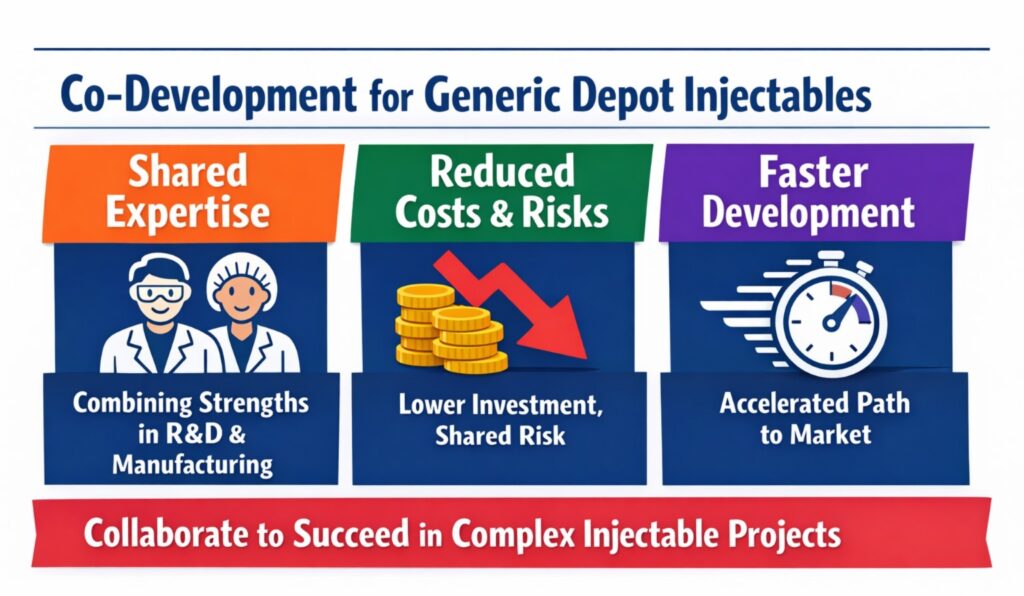
Co-development allows organizations to combine their strengths in formulation, manufacturing, and regulatory strategy. This shared approach speeds up development and spreads financial and technical risks. It also lets companies focus on what they do best instead of building everything from scratch.
Another benefit is innovation. When different experts collaborate, they bring new ideas and better solutions. This leads to stronger product design and improved problem-solving throughout the project. In a competitive market, this can make a significant difference.
Share via:
Why Traditional Development Models Fail for Depot Injectables
Traditional development models often struggle because depot injectables require expertise across many areas. Most companies do not have all the necessary capabilities in-house.
Some common challenges include:
- Complex drug release behavior and bioequivalence requirements
- Strict sterile manufacturing and containment needs
- Scale-up variability in systems like microspheres or liposomes
- High costs for clinical or pharmacokinetic (PK) studies
These challenges increase both time and cost. Companies working alone may face repeated trial-and-error cycles, leading to delays and inefficiencies.
Optimize your development strategy:Understand the differences between CDMO vs CRO for generic drug development
Research and industry experience show that collaborative models improve success rates. By sharing knowledge and infrastructure, companies can solve problems more effectively. This makes Generic Injectable Co-Development a more reliable and scalable solution.
Core Co-Development Models in Generic Depot Injectables
1. Risk-Sharing Joint Development Model in Generic Injectable Co-Development
This model spreads financial and technical risks between partners from early stages to commercialization. It is especially useful for complex and high-cost projects.
Key characteristics:
- Shared investment in research and clinical studies
- Joint ownership of intellectual property or defined market rights
- Milestone-based funding approach
This model works well for high-value products like oncology or CNS therapies. It also supports faster execution in competitive opportunities.
By sharing risks, companies improve decision-making and reduce financial pressure. It also allows smaller companies to participate in large projects.
Access local expertise for complex projects:Find a CDMO for generic projects in Canada
2. CDMO-Led Generic Injectable Co-Development Model
In this approach, a CDMO handles formulation and manufacturing, while the sponsor focuses on regulatory and commercial activities.
Key features:
- Access to advanced technologies like PLGA and microspheres
- Integrated analytical and manufacturing support
- Faster scale-up due to existing infrastructure
This model reduces the need for heavy investment and speeds up development. It is ideal for companies without in-house manufacturing capabilities.
Partner with a full-service provider:Explore comprehensive pharmaceutical CDMO services in the US and Canada
3. Licensing + Technology Transfer Hybrid Model
This model combines early licensing with co-development for later stages.
Structure:
- The innovator provides the formulation or platform
- The partner develops it for market readiness
- Responsibilities for validation and regulatory work are shared
This approach removes early research risks and allows companies to focus on final development steps. It also helps in faster market entry.
4. Regional Co-Development & Commercialization Partnerships
This model divides responsibilities across regions.
Typical structure:
- One partner manages development and main regulatory filing
- Others handle local approvals and commercialization
Local partners understand regional regulations better and improve market access. This makes global expansion more efficient.
Critical Success Factors in Generic Injectable Co-Development
Early Technical Alignment
Early agreement on formulation and analytical strategies is essential. Without it, inconsistencies may arise later.
Key considerations:
- Q1/Q2 sameness and Q3 equivalence
- IVIVC strategies
- Device compatibility
Strong alignment reduces rework and improves efficiency.
Ensure technical precision from the start:Learn about analytical development for generic drugs in Canada
Regulatory Strategy Integration
A unified regulatory plan should be established early.
Key actions:
- Align ANDA and hybrid pathways
- Define bioequivalence strategy
- Standardize CMC documentation
This improves approval success and reduces delays.
Navigate complex filing requirements:Get regulatory support for generic drugs from a US and Canada CDMO
Manufacturing & Scale-Up Readiness
Scale-up is often the most challenging stage.
Key risks:
- Batch inconsistency
- Sterility issues
- Process variability
Early planning and expert involvement can reduce these risks.
| Development Stage | Primary Risk | Ideal Responsible Partner |
|---|---|---|
| Formulation | Release kinetics variability | CDMO / R&D partner |
| Analytical | Method reproducibility | Joint responsibility |
| Scale-up | Process inconsistency | Manufacturing partner |
| Regulatory | Filing deficiencies | Sponsor / regulatory lead |
Intellectual Property (IP) and Data Ownership
Clear IP agreements are necessary.
Key considerations:
- Define existing and new IP
- Set data-sharing rules
- Clarify commercialization rights
This ensures smooth collaboration and avoids conflicts.
Risk Management in Co-Development Models
Effective risk management is essential in Generic Injectable Co-Development.
Key strategies:
- Joint decision-making committees
- Milestone-based reviews
- Transparent data sharing
These steps improve accountability and help address issues early.
Emerging Trends in Generic Injectable Co-Development
Integration of Digital & AI Tools
Technology is improving development processes.
Applications:
- Predictive modeling
- Process simulations
- Data-driven documentation
These tools reduce errors and improve efficiency.
Platform-Based Development
Reusable platforms like PLGA systems are becoming popular.
Benefits:
- Faster development
- Standardized methods
- Better scalability
Leverage specialized peptide platforms:Discover the best peptide CDMO for complex formulations
Increased Collaboration Across Ecosystems
Modern projects involve multiple partners.
Examples:
- Academia + CDMO + pharma
- Integrated supply chains
This improves innovation and resource use.
Strategic Advantages of Generic Injectable Co-Development
The biggest advantage is faster and lower-risk development.
Key benefits:
- Shared costs
- Access to expertise
- Better regulatory outcomes
- Faster market entry
This approach helps companies achieve results that are difficult alone.
Streamline your path to market:Outsource generic drug development to expert teams in Canada
Conclusion
Generic Injectable Co-Development is the most effective way to develop complex depot injectables in today’s market. The increasing complexity of these products makes collaboration essential.
By combining expertise, infrastructure, and resources, companies can overcome technical and regulatory challenges more efficiently. Structured co-development models help reduce risks and improve outcomes.
Specialized analytical insights for peptides:Review our peptide characterization case study of Semaglutide
Organizations that adopt these strategies achieve faster approvals and stronger market positions. For companies entering this space, choosing the right co-development model is critical for long-term success.
👉 Contact us to explore co-development opportunities.
FAQs: Generic Injectable Co-Development
One of the main difficulties is keeping all partners aligned on formulation design, testing methods, and regulatory plans. Even small gaps in alignment can lead to delays or repeated work. Because depot injectables are complex, early coordination is very important. Strong communication helps teams avoid costly mistakes later.
Risk is usually divided through shared funding, clear roles, and milestone-based progress tracking. Each partner takes responsibility based on their expertise and capabilities. This balanced structure reduces pressure on any single organization. It also improves accountability and keeps the project moving efficiently.
CDMOs play a key role because they bring advanced technical knowledge and ready-to-use manufacturing facilities. Their experience with complex formulations helps avoid common development issues. This support allows companies to move faster without building their own infrastructure. It also lowers overall development risk.
Intellectual property is handled through detailed agreements that clearly define ownership and usage rights. These agreements also cover how data is shared and how products are commercialized. Clear terms reduce the chances of disputes between partners. This helps maintain a smooth and long-term collaboration.
Co-development allows multiple teams to work at the same time on different parts of the project. This reduces delays and avoids repeating the same work. Shared expertise also speeds up problem-solving and decision-making. As a result, products can reach the market more quickly.
Analytical development ensures that the product meets quality and performance standards. It is essential for proving equivalence with the reference product. Poor alignment in testing methods can delay approvals. Strong coordination in this area improves overall project success.
Manufacturing tasks are assigned based on each partner’s strengths and available infrastructure. Often, a CDMO handles production because of its specialized facilities. Other partners may focus on development or commercialization. This clear division improves efficiency and product quality.
Reference:
- Ibeanu, N., Egbu, R., Onyekuru, L., Javaheri, H., Khaw, P. T., Williams, G. R., Brocchini, S., & Awwad, S. (2020). Injectables and depots to prolong drug action of proteins and peptides. Pharmaceutics, 12(10), 999. https://doi.org/10.3390/pharmaceutics12100999
- U.S. Food and Drug Administration. (2023). Mechanistic modeling of complex injectable drug products: Considerations for model-informed drug development. https://www.fda.gov/media/166586/download
- Gutierro Aduriz, I., & Gómez Ochoa, M. T. (2011). Methods for the preparation of injectable depot compositions (WO Patent No. WO2011151356A2). World Intellectual Property Organization. https://patents.google.com/patent/WO2011151356A2/en
- U.S. Food and Drug Administration. (2023). Complex injectable drug products: Bioequivalence recommendations for generic development. https://www.fda.gov/media/166584/download
Get In Touch With Us
About The Author


