

Introduction
Executing a successful Generic Metered Dose Inhaler (MDI) ANDA Development program requires a comprehensive weight-of-evidence regulatory framework that demonstrates formulation sameness, comparable device delivery dynamics, and bioequivalence through in vitro, pharmacokinetic, and clinical endpoints. Locally acting inhalation aerosols create complex bioequivalence challenges because pulmonary deposition is influenced by the dynamic interaction among the formulation, canister metering valve, and actuator nozzle.
The development of orally inhaled and nasal drug products (OINDPs) is considered one of the most technically demanding areas of generic pharmaceutical manufacturing because these products are classified as drug-device combination products under 21 CFR 3.2(e). In contrast to systemically acting solid oral dosage forms, for which bioequivalence is primarily established using plasma drug concentrations, locally acting pressurized MDIs introduce unique biopharmaceutic challenges. Regional lung deposition and local tissue availability are strongly influenced by the dynamic interactions among the formulation components, including propellant, co-solvent, and surfactant, the internal canister valve hardware, and the patient-actuated mouthpiece orifice. ResolveMass Laboratories Inc. assesses these multiple interdependent factors through integrated analytical frameworks designed to meet United States Food and Drug Administration (US FDA) product-specific guidances (PSGs) and applicable compendial standards.
Discover how expert CDMO partnerships can streamline complex generic drug development across the US and Canada. 🔗 Explore CDMO Acceleration for Generic Drug Development
Share via:
Quick Summary:
- Generic MDI ANDA development requires a weight-of-evidence strategy combining formulation sameness, device performance, in vitro testing, and in vivo bioequivalence.
- Regulatory compliance involves FDA PSGs, 21 CFR Part 4, CGMP, and appropriate drug-device design controls to demonstrate therapeutic equivalence to the Reference Listed Drug (RLD).
- Q1/Q2 formulation sameness requires careful control of APIs, HFA propellants, co-solvents, surfactants, particle size, and formulation stability for consistent aerosol performance.
- In vitro characterization evaluates SAC/DDU, APSD, MMAD, GSD, FPD/FPF, spray pattern, plume geometry, and priming/repriming across the product lifecycle.
- Population Bioequivalence (PBE) assesses both mean performance and variability between test and reference products, with manufacturing consistency being critical for success.
- In vivo BE studies combine systemic PK parameters (Cmax, AUC) with PD or clinical endpoints such as FEV1 when needed to demonstrate comparable pulmonary delivery and therapeutic response.
- A successful ANDA submission integrates reverse engineering, formulation/device optimization, automated testing, analytical characterization, and PK/PD evidence into one coherent package to support efficient FDA approval.
Regulatory Framework for Generic Metered Dose Inhaler (MDI) ANDA Development
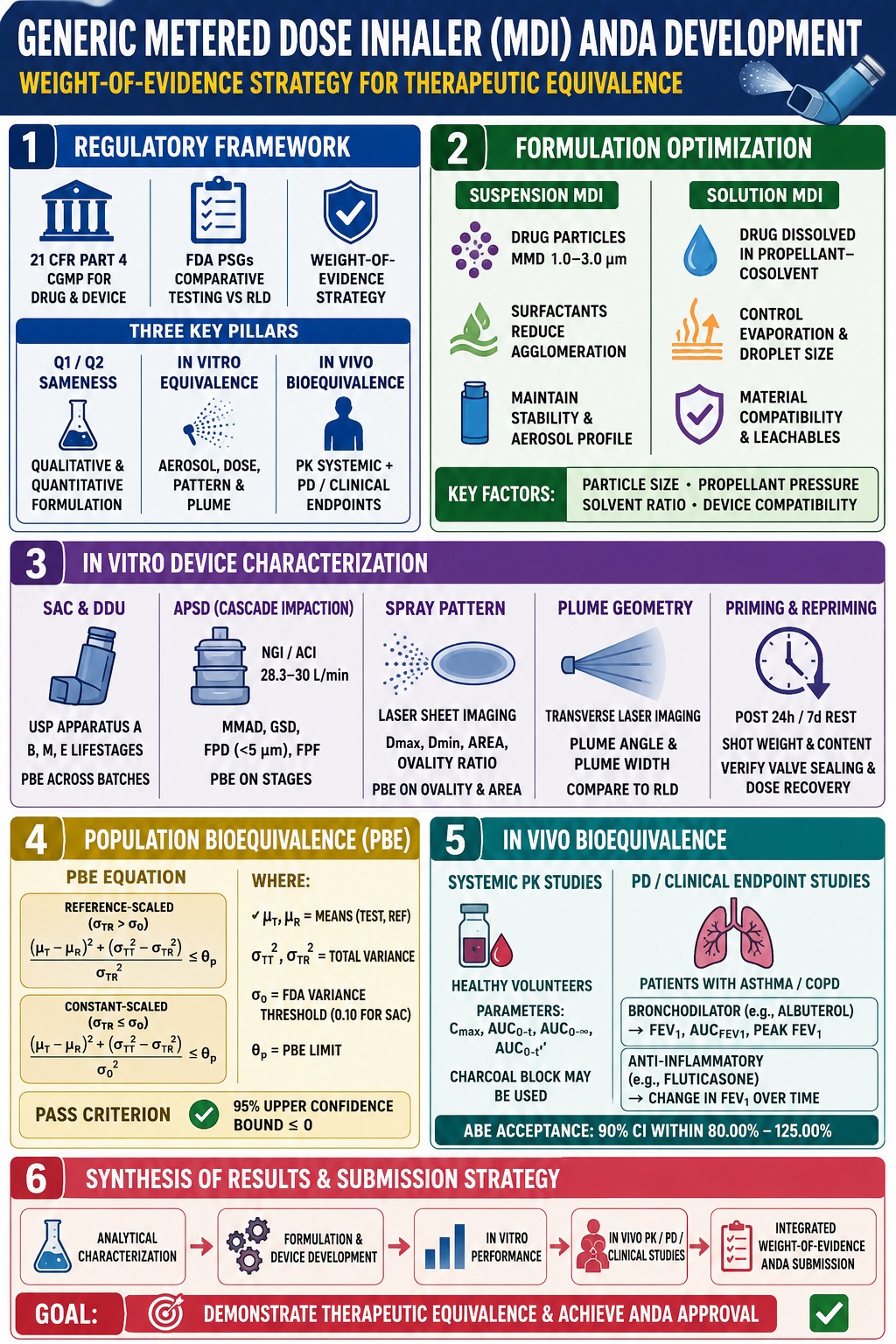
The regulatory framework for generic metered-dose inhalers follows a multi-tiered weight-of-evidence strategy that combines Q1/Q2 formulation sameness, comparative in vitro performance testing, systemic pharmacokinetic (PK) studies, and local delivery pharmacodynamic (PD) or clinical endpoint trials. This integrated approach is intended to establish therapeutic equivalence for generic drug-device combination products regulated under 21 CFR part 4 without requiring complete safety and clinical efficacy programs equivalent to those conducted for new products.
Under 21 CFR part 4, MDIs must comply with current good manufacturing practice (CGMP) requirements applicable to both drug products and medical devices. Device design controls under 21 CFR 820.30 require generic sponsors to verify the performance of device constituent parts and demonstrate that changes in actuator geometry, valve metering volume, or orifice diameter do not modify aerosolization physics or create unexpected clinical variability.
Learn more about navigating US and Canadian CDMO compliance standards for complex generic drug approvals.🔗 Read US and Canada Regulatory Support Guidelines
The US FDA Product-Specific Guidance (PSG) framework for MDIs, including guidances applicable to products such as Albuterol Sulfate and Fluticasone Propionate, establishes a comprehensive comparative testing strategy against the Reference Listed Drug (RLD). To meet ANDA approval expectations, generic applicants must demonstrate equivalence across three fundamental areas:
- Qualitative (Q1) and Quantitative (Q2) Formulation Sameness: Confirming that the active ingredients and inactive components are identical and present within appropriate quantitative tolerances to reproduce the physical characteristics of the RLD.
- In Vitro Performance Equivalence: Characterizing aerodynamic particle size distribution (APSD), single actuation content (SAC), spray pattern, and plume geometry throughout the container life to demonstrate comparable aerosol performance.
- In Vivo Bioequivalence: Conducting systemic pharmacokinetic (PK) studies to evaluate systemic absorption and safety, together with pharmacodynamic (PD) or clinical endpoint (CE) studies where required to establish comparable pulmonary delivery and therapeutic response.
| BE Assessment Pillar | Evaluation Focus | Primary Parameters / Analytical Metrics | Regulatory Objective |
|---|---|---|---|
| In Vitro Characterization | Physical aerosol mechanics & delivery | SAC (DDU), APSD (NGI/ACI), Spray Pattern, Plume Geometry, Shot Weight | Establish physical & aerodynamic comparability across lifestages under Population Bioequivalence (PBE) |
| In Vivo Systemic PK | Plasma exposure & systemic safety | Cmax, AUC0-t, AUC0-∞, early time-point exposure (AUC0-t’) | Confirm equivalent rate/extent of systemic absorption and safety profile |
| In Vivo Local Delivery (PD / CE) | Therapeutic site-of-action efficacy | FEV1 bronchodilation, airway hyper-responsiveness challenge, or clinical symptom scores | Validate equivalent local therapeutic efficacy at pulmonary receptor sites |
Evaluating partner models for your generic drug pipeline? Understand the core differences between CRO and CDMO models.🔗 Compare CDMO vs. CRO for Generic Drug Development
Reverse Engineering and Formulation Optimization in Generic Metered Dose Inhaler (MDI) ANDA Development
Formulation optimization for generic MDIs requires achieving qualitative (Q1) and quantitative (Q2) sameness for active pharmaceutical ingredients, hydrofluoroalkane (HFA) propellants, co-solvents, and surfactants while reproducing the physical behavior of the reference listed drug. Precise management of drug particle size, propellant vapor pressure, and solvent ratios is essential for minimizing physical instability and reproducing the aerosol atomization profile of the RLD.
Development of stable MDI formulations requires careful differentiation between suspension and solution systems. In suspension MDIs, such as those containing Albuterol Sulfate, the drug substance is maintained as micronized solid particles suspended within hydrofluoroalkane propellants, including HFA-134a or HFA-227ea. Maintaining an appropriate active particle size distribution before filling is critical. Primary drug crystals generally require a Mass Median Diameter (MMD) between 1.0 µm and 3.0 µm to support the intended pulmonary deposition following plume evaporation. In addition, surfactants such as oleic acid and sorbitan trioleate, along with co-solvents such as ethanol, must be carefully optimized to reduce particle agglomeration, crystal growth through Ostwald ripening, and deposition of drug substance on the canister wall.
Explore specialized contract development capabilities tailored for generic ophthalmic and complex dosage formats.🔗 View CDMO Services for Generic Drug Products
For solution MDIs, in which the active drug is completely dissolved within a propellant-cosolvent matrix, flash evaporation of the volatile propellant plays a major role in determining the final aerosol droplet size. Accurate control of the propellant-to-cosolvent ratio influences evaporation rate, droplet velocity, and retro-mouthpiece impact force. Material compatibility studies are also necessary to verify that non-reactive elastomers and gasket materials incorporated into the metering valve do not release leachable compounds into the formulation during the intended storage shelf-life.
In Vitro Device Characterization Protocols
In vitro device characterization for generic MDIs examines aerosol mechanics, dose delivery consistency, and aerodynamic particle size profiles under standardized USP and FDA product-specific guidance requirements. The use of automated mechanical actuation reduces operator-related variability and enables consistent evaluation of device performance throughout different container life stages.
Compendial testing under USP provides standardized procedures for evaluating aerosol performance. To reduce operator bias and establish reproducible actuation conditions, automated force-driven or velocity-driven mechanical actuators are used. Automated actuation parameters, including stroke force, rise time, hold time, and velocity, are carefully validated to reproduce relevant human actuation mechanics while reducing variability between individual tests.
Learn how full-service pharmaceutical CDMO partnerships support rigorous in vitro characterization and clinical testing.🔗 Browse Pharmaceutical CDMO Services in the US and Canada
Single Actuation Content and Delivered Dose Uniformity
Single Actuation Content (SAC) testing determines the precise mass of active drug substance delivered from an individual actuation at the beginning, middle, and end container lifestages. When assessed using Population Bioequivalence (PBE) statistical methodology, SAC testing determines whether dose delivery remains consistent over the complete lifespan of the product.
FDA product-specific guidances require a minimum of 10 units per batch to be evaluated across three defined container lifestages: Beginning (B), Middle (M), and End (E). Delivered Dose Uniformity (DDU) assessment determines whether factors such as propellant loss, valve clogging, or formulation segregation can result in underdosing or overdosing during the product’s container life. Samples are collected using USP Apparatus A collection tubes and analyzed using validated high-performance liquid chromatography (HPLC) or LC-MS/MS analytical methods.
Aerodynamic Particle Size Distribution via Cascade Impaction
Aerodynamic Particle Size Distribution (APSD) testing using multi-stage cascade impactors determines the size distribution of aerosolized particles and provides an estimate of their potential regional pulmonary deposition. The Next Generation Impactor (NGI) or Andersen Cascade Impactor (ACI) can be used to generate critical aerodynamic parameters, including Mass Median Aerodynamic Diameter (MMAD) and Fine Particle Dose (FPD), which are used to assess in vitro equivalence.
Multi-stage cascade impactors fractionate aerosolized particles according to their aerodynamic diameter under controlled airflow conditions, typically 28.3 L/min or 30 L/min for MDIs. Aerosolized particles pass through calibrated nozzles and impact collection cups at different stages. Larger particles possessing greater inertia are retained on the upper stages, whereas smaller respirable particles continue through the impactor and are collected on the lower stages.
Key metrics obtained from cascade impaction include:
- Mass Median Aerodynamic Diameter (MMAD): The aerodynamic diameter at which 50% of the aerosolized mass consists of particles larger than the median and 50% consists of particles smaller than the median.
- Geometric Standard Deviation (GSD): A statistical measure of aerosol polydispersity calculated from the distribution of drug mass across the impactor stages.
- Fine Particle Dose (FPD): The cumulative drug mass associated with particles smaller than 5.0 µm, representing the respirable fraction that can penetrate into the deeper tracheobronchial and alveolar regions.
- Fine Particle Fraction (FPF): The percentage of the emitted dose represented by particles <5.0 µm.
Examine analytical characterization techniques used for complex, highly sensitive drug delivery molecules and formulations.🔗 Read Peptide Analytical Characterization Services
Spray Pattern and Plume Geometry Analysis
Spray pattern and plume geometry analyses characterize the spatial expansion, cross-sectional ovality, and cone angle of the emitted aerosol plume using non-destructive laser-sheet visualization techniques. These assessments help establish whether the generic actuator orifice and metering valve generate plume dynamics comparable to those of the reference product, which can influence throat deposition and aerosol velocity.
Spray Pattern assessment determines the cross-sectional geometry of the aerosol plume at a specified distance, such as 2.5 cm or 3.0 cm from the actuator orifice. Evaluated parameters include maximum diameter (Dmax), minimum diameter (Dmin), area, and ovality ratio (Dmax/Dmin). Plume Geometry assessment evaluates the side profile of the plume and determines plume angle and plume width as a function of distance. These physical characteristics provide information regarding the atomization efficiency of the valve orifice and can directly affect deposition within the throat.
| Characterization Test | Primary Instrumentation / Method | Evaluated Lifestages / Parameters | Statistical & Regulatory Criteria |
|---|---|---|---|
| Single Actuation Content (SAC) | USP Apparatus A / HPLC | Beginning (B), Middle (M), End (E) lifestages | Evaluated via Population Bioequivalence (PBE) across batches |
| Aerodynamic Particle Size (APSD) | Next Generation Impactor (NGI) at 28.3–30 L/min | B and E lifestages; MMAD, GSD, FPD (<5 µm), FPF | Stage-by-stage mass deposition & PBE analysis on specific impactor stages |
| Spray Pattern | Non-imaging high-speed laser sheet | Cross-sectional Dmax, Dmin, Area, Ovality ratio | Quantitative image analysis & PBE on ovality and area |
| Plume Geometry | High-speed transverse laser imaging | Side-view Plume Angle and Plume Width | Descriptive comparability to RLD across container life |
| Priming & Repriming | DDU collection after static storage | Shot weight & content post 24h/7d resting intervals | Verification of valve sealing & dose recovery after non-use |
Review real analytical data demonstrating structural characterization and comparative equivalence testing.🔗 Explore Generic Peptide Analytical Characterization Case Study
Applying Population Bioequivalence to Generic Metered Dose Inhaler (MDI) ANDA Development
Population Bioequivalence (PBE) is the statistical approach used by the US FDA for evaluating comparative in vitro performance data by considering both differences in mean performance and total variability between test and reference batches. Through linearized reference-scaled or constant-scaled statistical criteria, PBE determines whether the generic MDI demonstrates comparable central tendency and device-to-device variability relative to the RLD.
Traditional Average Bioequivalence (ABE), which assesses mean ratios using an 80.00%–125.00% confidence interval, does not adequately address the variability associated with in vitro inhalation performance because device-to-device and batch-to-batch variation can be substantial. FDA product-specific guidances therefore require PBE in relevant circumstances to establish that the Test (T) product is non-inferior to the Reference (R) product with respect to both central tendency and total variability.
The PBE criterion evaluates the standardized population distance between the test and reference formulations against a regulatory limit (θp). Depending on the total variance of the reference product (σTR²), PBE applies either reference-scaled or constant-scaled criteria:
(μT − μR)2 + (σT2 − σTR2)/ σTR2 ≤ θp for σTR > σ0 (Reference-Scaled)
(μT − μR)2 + (σTT2 − σTR2)/ σ02 ≤ θp for σTR ≤ σ0 (Constant-Scaled)
Where:
- μT and μR represent the mean values obtained for the test and reference products, respectively.
- σTT² and σTR² represent the total variance, including combined inter-batch and intra-batch variability, for the test and reference products.
- σ0 represents the regulatory variance threshold specified by the FDA, typically 0.10 for SAC.
- θp represents the regulatory PBE limit derived from the standard tolerance limit.
For a product to satisfy the PBE criterion, the 95% upper confidence bound of the linearized PBE equation must be less than or equal to zero. This requirement places considerable emphasis on controlling manufacturing variability. Consequently, substantial variability within generic manufacturing batches can negatively affect the PBE calculation even when the mean performance values closely match those of the RLD.
Learn key selection criteria for choosing an analytical CDMO capable of scaling production while meeting strict statistical thresholds.🔗 How to Choose a Peptide CDMO in the US
In Vivo Bioequivalence Study Design: PK and Clinical Endpoints
Demonstrating in vivo bioequivalence for generic MDIs requires a dual strategy that combines highly sensitive systemic pharmacokinetic (PK) studies with local delivery pharmacodynamic (PD) or clinical endpoint studies. Systemic PK studies characterize systemic exposure and safety and may provide information regarding total lung exposure, whereas PD and clinical endpoint studies assess therapeutic performance at the intended site of action in appropriate patient populations.
Establishing in vivo bioequivalence for locally acting MDIs involves significant methodological challenges because the therapeutic effect occurs locally throughout the pulmonary tree, whereas plasma drug concentrations reflect downstream systemic absorption and clearance.
Pharmacokinetic Bioequivalence Studies
Pharmacokinetic (PK) bioequivalence studies quantify systemic drug exposure using parameters such as Cmax and AUC in healthy volunteers. An oral charcoal block co-administration protocol may be used to differentiate pulmonary absorption from gastrointestinal intake. These studies can provide a sensitive measure of pulmonary absorption and help establish comparable systemic exposure and safety profiles.
For inhaled formulations, systemic plasma drug concentrations can originate from two primary absorption pathways: pulmonary absorption, which can occur rapidly across alveolar membranes, and gastrointestinal (GI) absorption of the swallowed fraction. To distinguish pulmonary absorption from GI absorption, PK studies may incorporate an oral charcoal block co-administration protocol. Activated charcoal binds the swallowed drug substance within the GI tract, thereby reducing its gastrointestinal absorption and allowing measured plasma concentrations to more specifically reflect pulmonary deposition and absorption. PK bioequivalence generally involves standard ABE assessment of peak plasma concentration (Cmax) and total exposure (AUC0-t, AUC0-∞), with the relevant confidence interval assessed against the 80.00%–125.00% range. In addition, early time-point exposure parameters, such as AUC0-t’, may be examined to determine whether the initial absorption rate is comparable.
See how advanced analytical protocols characterize complex therapeutic APIs such as GLP-1 peptides down to picogram levels.🔗 Discover GLP-1 Peptide Analytical Characterization
Pharmacodynamic and Clinical Endpoint Studies
Pharmacodynamic (PD) and clinical endpoint studies establish local delivery bioequivalence by evaluating clinically meaningful response parameters, including Forced Expiratory Volume in 1 second (FEV1), in patients with asthma or COPD. These randomized, double-blind clinical trials are designed to demonstrate that the generic MDI provides therapeutic efficacy comparable to the reference listed drug at the relevant airway receptor sites.
For MDIs for which PK assessment alone cannot adequately establish equivalence in local pulmonary delivery, FDA PSGs may require comparative clinical endpoint (CE) or PD studies.
- Bronchodilator Formulations (e.g., Albuterol): These formulations may be evaluated through PD studies measuring Forced Expiratory Volume in 1 second (FEV1). Such studies can use randomized, double-blind, crossover designs in patients with mild-to-moderate asthma to evaluate equivalent bronchodilation onset, baseline-adjusted FEV1 Area Under the Curve (AUCFEV1), and peak FEV1 response.
- Anti-inflammatory Formulations (e.g., Fluticasone Propionate): These formulations may require clinical endpoint studies in appropriate asthmatic patient populations. Primary endpoints can include the mean change from baseline in morning pre-dose FEV1 over a multi-week treatment period, supporting an assessment of whether the generic product provides therapeutic performance comparable to and non-inferior to the RLD.
Read a detailed case study on analytical characterization and equivalence testing for complex therapies like Semaglutide.🔗 View Semaglutide Peptide Characterization Case Study
Synthesis of Results and Submission Strategy for Generic Metered Dose Inhaler (MDI) ANDA Development
A successful submission strategy integrates analytical characterization, formulation development, in vitro performance testing, and in vivo bioequivalence findings into a coherent weight-of-evidence package for ANDA review. Coordinating automated benchtop testing with robust quality-by-design (QbD) principles can reduce regulatory refusal-to-receive risks and support a more efficient path toward market clearance.
The development of complex generic MDI combination products requires coordinated integration of analytical characterization, formulation development, device assessment, and clinical trial design. Establishing automated actuation protocols at an early stage of in vitro characterization helps laboratory teams minimize manual handling variability and supports consistent translation of laboratory findings into regulatory submissions. Advanced analytical platforms, including high-throughput NGI cascade impaction, automated spray pattern imaging, and picogram-level LC-MS/MS bioanalysis, can further reduce generic development and submission risks while supporting efficient progression toward commercialization.
Learn how outsourcing complex pharmaceutical scale-up and commercial production can streamline your time-to-market.🔗 Explore Peptide API Scale-Up & Manufacturing
Conclusion
Successful Generic Metered Dose Inhaler (MDI) ANDA Development depends on a rigorous and integrated weight-of-evidence strategy that connects formulation sameness, in vitro performance, and in vivo bioequivalence into a unified development framework.
Successfully progressing a complex drug-device combination product through the ANDA pathway requires precise control and execution across every stage of the development lifecycle. From reverse-engineering propellant-actuator dynamics to demonstrating equivalence according to USP and FDA product-specific guidances, sponsors must carefully manage analytical, formulation, device, and manufacturing variability. As regulatory expectations for orally inhaled and nasal drug products continue to evolve, the use of advanced analytical methodologies and structured weight-of-evidence strategies remains fundamental to supporting timely ANDA approval and successful market entry.
For technical consultation, analytical characterization, and regulatory strategy inquiries regarding complex inhalation products, visit the ResolveMass Contact Page.
Frequently Asked Questions (FAQs)
Population Bioequivalence (PBE) is used for relevant in vitro MDI performance assessments because it considers both differences in mean performance and variability between test and reference products. This includes inter-batch and intra-batch variability that may affect aerosol performance. Unlike Average Bioequivalence (ABE), PBE provides a broader assessment of whether the Test product has comparable overall performance and variability to the Reference Listed Drug (RLD).
USP establishes standardized compendial methods and apparatuses for evaluating important inhalation product characteristics, including Delivered Dose Uniformity (DDU) and Aerodynamic Particle Size Distribution (APSD). These procedures provide consistent testing conditions for assessing aerosol performance. The resulting data can support product quality evaluation and regulatory comparability for generic MDIs.
An oral charcoal block protocol is used to reduce systemic absorption of the swallowed portion of an inhaled drug during pharmacokinetic studies. Activated charcoal binds drug substance present in the gastrointestinal tract, limiting its absorption into systemic circulation. This allows plasma drug concentrations to more specifically reflect drug absorbed through the lungs.
Cascade impactor testing using the Next Generation Impactor (NGI) generates several important aerodynamic parameters for characterizing aerosol performance. These include Mass Median Aerodynamic Diameter (MMAD), Geometric Standard Deviation (GSD), Fine Particle Dose (FPD <5 µm), and Fine Particle Fraction (FPF). Together, these measurements describe the particle-size distribution and respirable fraction of the emitted aerosol.
Automated actuators provide controlled and repeatable conditions for aerosol dose emission by precisely regulating parameters such as force, velocity, stroke length, and hold time. By standardizing the actuation process, they minimize variability associated with manual operation. This improves reproducibility when conducting SAC, DDU, and APSD assessments across multiple samples and lifestages.
Q1 (qualitative) sameness establishes that the generic formulation contains the same active and inactive ingredients as the Reference Listed Drug (RLD). Q2 (quantitative) sameness addresses the quantities or concentrations of those components within the formulation. Demonstrating Q1/Q2 sameness helps minimize formulation-related differences that could influence physicochemical properties, aerosol behavior, and regulatory comparability.
Spray Pattern characterization examines the cross-sectional profile of the emitted aerosol and can include maximum diameter (Dmax), minimum diameter (Dmin), plume area, and ovality ratio (Dmax/Dmin). Plume Geometry analysis evaluates the aerosol from a side view to determine parameters such as plume angle and plume width. These measurements help characterize actuator performance and aerosol dispersion behavior.
MDIs are drug-device combination products, so their development and manufacturing must address applicable requirements for both drug and device components. 21 CFR part 4 establishes CGMP requirements for combination products, while 21 CFR 820.30 addresses design controls for medical devices. Together, these requirements support verification that device components function appropriately with the formulation and maintain consistent aerosol performance.
Testing Single Actuation Content (SAC) at different container lifestages determines whether the inhaler delivers a consistent dose throughout its intended use period. Beginning (B), Middle (M), and End (E) evaluations can identify changes associated with propellant loss, valve performance, formulation segregation, or other factors. This helps demonstrate that dose delivery remains consistent from the beginning through the end of container life.
Reference:
- U.S. Food and Drug Administration. (2017). FYs 2013–2017 regulatory science report: Locally-acting orally inhaled and nasal drug products. U.S. Food and Drug Administration
- Lee, S. L., Saluja, B., García-Arieta, A., Santos, G. M. L., Li, Y., Lu, S., Hou, S., Rebello, J., Vaidya, A., Gogtay, J., Purandare, S., & Lyapustina, S. (2015). Regulatory considerations for approval of generic inhalation drug products in the US, EU, Brazil, China, and India. AAPS Journal, 17(5), 1285–1304. https://doi.org/10.1208/s12248-015-9787-8
- U.S. Food and Drug Administration. (2018). Metered dose inhaler (MDI) and dry powder inhaler (DPI) products—Quality considerations: Guidance for industry (Draft guidance). U.S. Department of Health and Human Services. https://www.fda.gov/media/70851/download
- U.S. Food and Drug Administration. (n.d.). Product-specific guidances for generic drug development. U.S.
- U.S. Food and Drug Administration. (2024). Fiscal Year 2024 Generic Drug Science and Research Initiatives Public Workshop: Session 2—Predictive tools for generic product development and assessment [Workshop transcript]. U.S. Department of Health and Human Services. FDA document
- Lu, D., Lee, S. L., Lionberger, R. A., Choi, S., Adams, W., Caramenico, H. N., Chowdhury, B. A., Conner, D. P., Katial, R., Limb, S., Peters, J. R., Yu, L., & Seymour, B. I. (2015). International guidelines for bioequivalence of locally acting orally inhaled drug products: Similarities and differences. AAPS Journal, 17(3), 546–557. https://doi.org/10.1208/s12248-015-9733-9
- U.S. Food and Drug Administration. (2026, March 3). FDA approves first generic of Flovent HFA for treatment of asthma. U.S. Department of Health and Human Services. FDA webpage
Get In Touch With Us
About The Author


