

Introduction
Executing Generic Ophthalmic Suspension ANDA Development requires a comprehensive technical strategy that integrates qualitative and quantitative formulation sameness (Q1/Q2), structural and physicochemical comparability (Q3), robust aseptic process engineering, and validated container closure system integration. Generic Ophthalmic Suspension ANDA Development involves complex biopharmaceutic and manufacturing considerations because of its multiphasic composition, non-Newtonian rheological behavior, and direct administration to sensitive anterior segment ocular tissues. Within the United States Food and Drug Administration (FDA) regulatory framework, including updated Product-Specific Guidances (PSGs) and the revised draft guidance on Quality Considerations for Topical Ophthalmic Drug Products, demonstrating generic equivalence requires a rigorous totality-of-evidence approach. Generic drug developers must carefully balance formulation deformulation accuracy with advanced sterile manufacturing controls to meet stringent safety, quality, and bioequivalence requirements.
Ophthalmic suspensions are specifically designed to prolong ocular surface residence time and deliver hydrophobic active pharmaceutical ingredients (APIs) to local target tissues and sites, including the cornea, aqueous humor, and ciliary body. Establishing therapeutic equivalence without depending on expensive and statistically variable clinical endpoint trials depends substantially on qualifying for an in vitro bioequivalence pathway. This case study presents an extensive technical assessment of the scientific, analytical, and regulatory principles necessary to navigate Generic Ophthalmic Suspension ANDA Development, beginning with pre-formulation deformulation and progressing through the final stages of Abbreviated New Drug Application (ANDA) approval.
Learn more about generic drug development and testing with CDMO Services for Generic Ophthalmic Drug Products.
Share via:
Quick Summary:
- Q1/Q2 sameness: Match the RLD’s inactive ingredients and keep excipient concentrations within ±5% using detailed deformulation and reverse-engineering studies.
- Q3 microstructural equivalence: Compare particle size, rheology, crystal form, zeta potential, pH, osmolality, surface tension, and redispersibility to establish physical similarity.
- Discriminatory IVRT: Use specialized systems such as USP Apparatus 4 or Vertical Diffusion Cells to compare drug-release behavior, with f₂ ≥ 50 supporting release-profile similarity.
- Dual-stream aseptic manufacturing: Combine a 0.22 µm sterile-filtered vehicle with separately sterilized micronized API under controlled Grade A aseptic conditions, followed by high-shear homogenization.
- Container closure qualification: Demonstrate extractables/leachables safety, container-closure integrity, drop-size uniformity, and preservative effectiveness throughout the product lifecycle.
- Regulatory bioequivalence strategy: Prioritize the in vitro waiver pathway when Q1/Q2, Q3, and IVRT requirements are met; otherwise, aqueous humor PK or clinical endpoint studies may be required.
- Integrated development approach: Early FDA engagement, rigorous analytical characterization, robust sterile processing, and qualified packaging can reduce development risk and cost while accelerating ANDA approval and supporting safe generic ophthalmic therapy.
Establishing Q1/Q2 Sameness and Reverse Engineering Strategy in Generic Ophthalmic Suspension ANDA Development
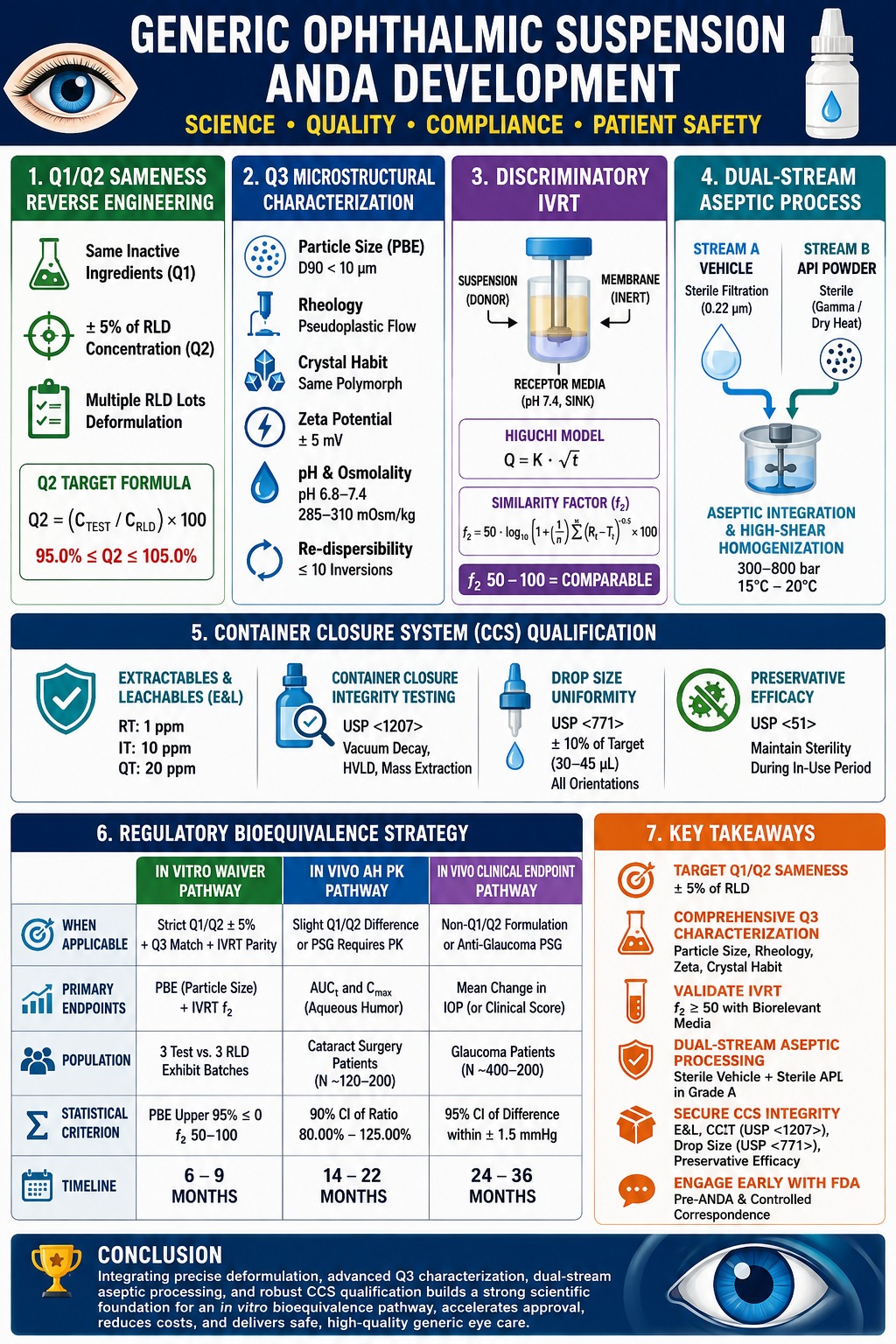
Establishing Q1/Q2 sameness during Generic Ophthalmic Suspension ANDA Development requires identification of the same inactive ingredients and alignment of their concentrations within a strict ± 5% relative target tolerance of the Reference Listed Drug (RLD). Qualitative sameness (Q1) establishes that the generic test product contains inactive ingredients that are identical to those used in the RLD, whereas quantitative sameness (Q2) requires the concentration of every inactive ingredient to remain within the 95.0%–105.0% target range relative to the RLD vehicle.
Deformulation, also referred to as chemical reverse engineering, of multiple RLD exhibit batches is essential for characterizing the vehicle composition, evaluating lot-to-lot variability, and defining appropriate target formulation specifications. Excipients incorporated into topical ophthalmic suspensions perform essential functional roles that can directly influence physical stability, ocular tolerability, and local bioavailability. Even relatively small differences in polymeric suspending agents, including carbomers, hydroxypropyl methylcellulose, or microcrystalline cellulose, or in surfactant concentrations, such as polysorbate 80 or tyloxapol, can substantially influence vehicle viscosity, API saturation solubility, particle growth kinetics, and corneal permeability.
The quantitative sameness relationship for each excipient is defined as:
Q2 Target Formula (%):
Q2 Target (%) = (CTest / CRLD) × 100
where 95.0% ≤ Q2 Target ≤ 105.0%
| Excipient Class | Representative Examples | Primary Function in Ophthalmic Suspensions | Deformulation & Quantitation Analytical Technique |
|---|---|---|---|
| Suspending / Viscosity Agents | Carbomer Interpolymer Type A, HPMC, Carboxymethylcellulose | Prevents particle sedimentation, provides shear-thinning rheology, and prolongs precorneal residence time | Size Exclusion Chromatography (SEC-MALLS), Nuclear Magnetic Resonance (^1H-NMR), Viscometry |
| Surfactants / Wetting Agents | Polysorbate 80, Tyloxapol, Pluronic F-68 | Reduces solid-liquid interfacial tension, facilitates crystal dispersion, and stabilizes particle size | Reverse-Phase High-Performance Liquid Chromatography (RP-HPLC-CAD/ELSD), LC-MS/MS |
| Tonicity Adjusters | Sodium chloride, Potassium chloride, Glycerin, Mannitol | Maintains isotonicity (280–320 mOsm/kg) to minimize lacrimal irritation | Osmometry (Freezing Point Depression), Ion Chromatography (IC) |
| Buffering Agents | Sodium phosphate, Boric acid, Sodium citrate | Maintains target pH (6.5–7.8) to support chemical stability and ocular comfort | Potentiometric Titration, Ion Chromatography (IC) |
| Preservatives | Benzalkonium chloride (BAC), Polyquaternium-1, Purite | Maintains multidose package sterility throughout patient use | Gradient RP-HPLC-UV/Vis, Capillary Electrophoresis (CE) |
| Chelating / Stabilizing Agents | Edetate disodium (EDTA) | Supports preservative efficacy and sequesters trace metal ions | Inductively Coupled Plasma Mass Spectrometry (ICP-MS), Complexometric Titration |
Analytical deformulation procedures require orthogonal method validation to ensure reliable identification and quantitation of formulation components. Polymeric excipients, such as carbomers, may need to be isolated using selective precipitation, dialysis, or gel permeation chromatography to evaluate molecular weight distributions and cross-linking densities. Quantitative assessment of ionic species depends on validated ion chromatography, while non-ionic surfactants can be quantified using liquid chromatography coupled with Charged Aerosol Detection (CAD) or Evaporative Light Scattering Detection (ELSD). Establishing accurate Q1/Q2 sameness minimizes formulation-related differences in local tissue irritation and ocular retention, thereby providing a compliant foundation for subsequent physical equivalence evaluations.
Streamline your filing process with One-Stop CDMO Analytical Services for ANDA.
Microstructural Comparability and Q3 Characterization in Generic Ophthalmic Suspension ANDA Development
Microstructural (Q3) characterization in Generic Ophthalmic Suspension ANDA Development determines whether the test product demonstrates comparable physical state, spatial arrangement, and rheological flow characteristics to the RLD under both storage conditions and dynamic stress. Demonstrating Q3 equivalence establishes that, despite differences in raw material suppliers and manufacturing processes, the test and reference products maintain comparable physical arrangements of matter.
For Generic Ophthalmic Suspension ANDA Development, comparative Q3 characterization requires assessment of three separate exhibit batches of the generic product against three recent commercial lots of the RLD.
Particle size distribution (PSD) represents a critical quality attribute (CQA) for ophthalmic suspensions. Sedimented particles should readily re-disperse following manual shaking, while suspended API crystals should not exceed 20 µm to minimize ocular irritation, foreign body sensation, and excessive lacrimal tearing. Laser diffraction and automated image analysis are used to characterize particle metrics (D10, D50, D90, and SPAN). The SPAN parameter represents the breadth of the particle size distribution:
SPAN = (D90 − D10) / D50
The FDA requires Population Bioequivalence (PBE) statistical analysis of D50 and SPAN metrics using a 95% upper confidence bound to evaluate particle size distribution sameness. The PBE linearized statistical criterion can be represented as:
PBE Metric = [(μT − μR)2 + (σT2 − σR2)] / σR2 ≤ θp
Rheological characterization is similarly essential. Ophthalmic suspensions are expected to demonstrate pseudoplastic (shear-thinning) flow behavior. Under storage conditions, where the shear rate is near zero, elevated viscosity helps limit particle aggregation and sedimentation. During eye blinking, where shear rates can exceed 10,000 s−1, viscosity should decrease rapidly enough to promote uniform drug distribution over the corneal surface without producing excessive visual blurring. Rotational and oscillatory rheometry can be used to determine low-shear zero-shear viscosity, yield stress (the minimum force required to initiate flow), thixotropic hysteresis (the recovery rate following shear), and viscoelastic moduli (G’ storage modulus and G” loss modulus) across dynamic temperature sweeps from 25°C for storage to approximately 34°C representing the precorneal temperature.
| Q3 Quality Parameter | Regulatory Acceptance Criteria | Primary Analytical Instrumentation | Clinical & Physicochemical Impact |
|---|---|---|---|
| Particle Size Distribution | PBE (95% upper confidence bound ≤ 0) on D50 and SPAN; D90 < 10 µm | Laser Diffraction, Dynamic Light Scattering (DLS), Morphologi 4 | Influences ocular dissolution rate, corneal penetration, and avoidance of reflex lacrimation |
| Rheological Flow & Yield Stress | Overlapping pseudoplastic flow curves; yield stress within ± 10% of RLD | Rotational Rheometer (Cone-and-Plate), Oscillatory Shear Rheometer | Determines physical suspension shelf life, redispersibility, drop formation, and corneal spreading |
| Crystal Habit & Polymorphism | Identical crystal polymorphism; consistent morphology | X-Ray Powder Diffraction (XRPD), Differential Scanning Calorimetry (DSC), Raman Imaging | Influences thermodynamic drug solubility, physical stability, and crystal growth (Ostwald ripening) |
| Zeta Potential | Equivalent surface charge profile (± 5 mV) | Electrophoretic Light Scattering (Zetasizer) | Helps predict colloidal stability, electrostatic repulsive forces, and flocculation state |
| pH and Buffer Capacity | pH within 6.8–7.4; buffer capacity matched within ± 5% | Potentiometric pH Meter, Automated Micro-Titration System | Influences corneal comfort, local tissue tolerability, and baseline ocular drug stability |
| Osmolality | Target isotonicity (285–310 mOsm/kg) | Freezing Point Depression Osmometer | Helps prevent corneal epithelial cell damage, dry eye irritation, and tearing response |
| Surface Tension | Equivalent interfacial tension (28–35 mN/m) | Du Noüy Ring / Pendant Drop Tensiometer | Controls drop detachment volume, tear film spreading, and pre-corneal film stability |
| Re-dispersibility | Complete re-dispersion within ≤ 10 manual inversion cycles | Automated Mechanical Shaking / Inversion Tester + Optical Turbidimetric Evaluation | Supports uniform dose delivery throughout the product life cycle |
Solid-state crystal form evaluation using X-Ray Powder Diffraction (XRPD) and Differential Scanning Calorimetry (DSC) confirms whether API micronization and manufacturing processes have caused polymorphic transitions or amorphization. Maintaining the same polymorphic form is important because metastable polymorphs can exhibit different solubility kinetics, potentially promoting unpredictable crystal growth through Ostwald ripening and resulting in changes in bioequivalence over time.
Biorelevant Performance and Discriminatory In Vitro Release Testing (IVRT)
Discriminatory In Vitro Release Testing (IVRT) functions as a performance-based surrogate for microstructural sameness by continuously evaluating drug release kinetics under biorelevant sink conditions. Whereas Q3 characterization focuses on static physical properties, IVRT evaluates the dynamic movement of active drug molecules from the suspension matrix into an aqueous receptor phase.
Developing a discriminatory IVRT method for complex generic ophthalmic suspensions requires specialized diffusion equipment and carefully controlled experimental conditions. Conventional USP dissolution apparatuses, including USP 1 or 2, may not provide the sensitivity needed for small-volume ocular suspensions containing poorly soluble drugs. Preferred configurations include Vertical Diffusion Cells (VDCs / Franz Cells) or USP Apparatus 4 (Flow-Through Cell System) equipped with specialized semisolid/suspension adapters.
Within an optimized IVRT study design, the selected synthetic membrane, such as polyethersulfone [PES], cellulose acetate, or polytetrafluoroethylene [PTFE], should function only as an inert mechanical barrier separating the suspension sample from the receptor medium. The membrane should not become a rate-limiting barrier to API diffusion. The receptor medium, typically phosphate-buffered saline (PBS) at pH 7.4 and supplemented with solubilizing agents such as isopropyl alcohol or surfactants to preserve sink conditions, should support drug transport while maintaining formulation integrity.
The active drug release rate (K) is obtained by plotting cumulative drug released per unit area (Q, µg/cm²) against the square root of time (√t), based on the classical Higuchi diffusion model:
Q = K × √t
Comparative IVRT profiles for the test generic product and RLD are generated using three independent manufacturing lots. Drug concentrations in receptor samples collected at predetermined intervals, such as 15, 30, 45, 60, 90, 120, 180, and 240 minutes, are measured using validated ultra-high-performance liquid chromatography coupled with tandem mass spectrometry (UHPLC-MS/MS) or UV-Vis spectroscopy.
Statistical assessment is performed using the mathematical similarity factor (f2):
f2 = 50 × log10 [((1 + (1/n) Σt=1n (Rt − Tt)2))−0.5 × 100]
An f2 value ranging from 50 to 100 indicates comparable release profiles and supports the conclusion that formulation processing has maintained the functional release characteristics of the innovator product.
Explore advanced analytical characterization approaches with GLP-1 Peptide Analytical Characterization.
Dual-Stream Aseptic Processing and Sterile Fill Engineering
Dual-stream aseptic processing addresses the physical challenge associated with non-filterable suspended API particles by integrating a sterile-filtered aqueous vehicle with terminal-sterilized micronized active powder under Grade A compounding conditions. Suspended drug particles commonly range from 0.5 µm to 10 µm in diameter; therefore, passing these particles through a 0.22 µm filter would remove the active ingredient and potentially change the particle size distribution.
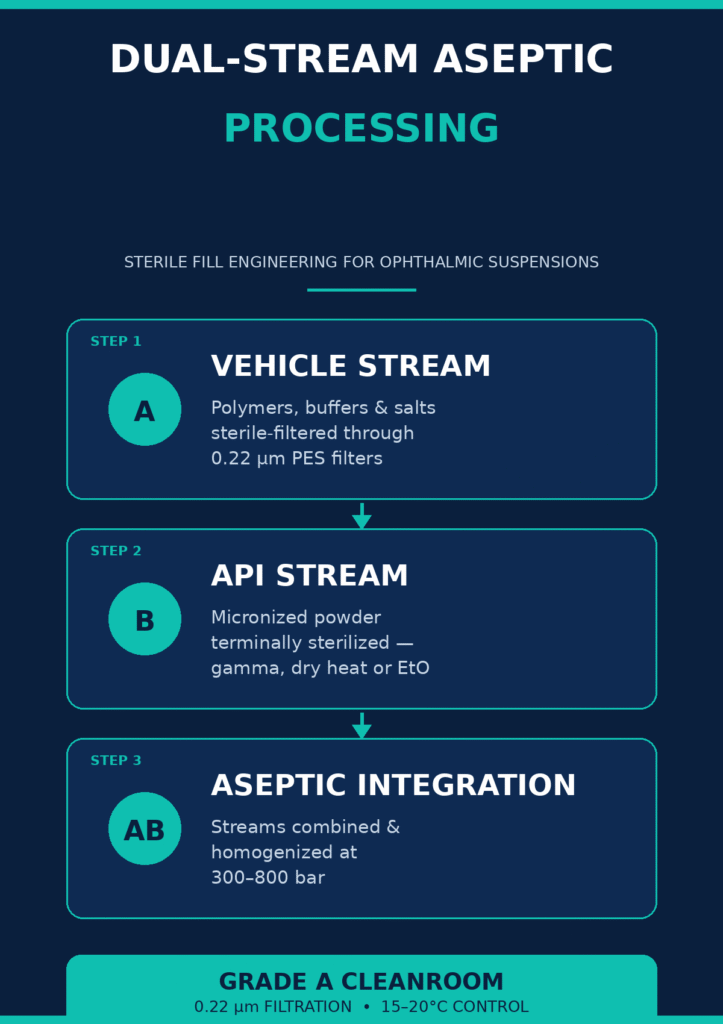
Process engineering is based on a segregated dual-stream compounding architecture:
- Vehicle Stream A (Sterile Filtration): Polymers, including carbomers, salts, buffers, tonicity agents, and preservatives, are dissolved in Water for Injection (WFI), adjusted to the required pH, thermally processed, and passed through redundant 0.22 µm polyethersulfone (PES) sterilizing-grade filters into a pre-sterilized compounding vessel positioned within a Grade A (ISO 5) cleanroom environment.
- API Stream B (Sterile Powder Processing): Micronized API powder undergoes terminal sterilization using validated techniques such as gamma radiation, dry heat sterilization, ethylene oxide treatment, or aseptic crystallization under sterile conditions. The sterilization process must be carefully optimized to avoid chemical degradation, impurity formation, or changes in crystal habit.
- Aseptic Integration & High-Shear Dispersion: The two streams are combined within a high-shear aseptic compounding suite. Sterile API powder is introduced into the sterile aqueous vehicle under controlled agitation. The resulting mixture then passes through a validated inline microfluidizer or high-pressure aseptic homogenizer operating at pressures of 300 to 800 bar to break down agglomerates, improve particle distribution uniformity, and establish stable viscosity profiles.
Process controls must limit thermal exposure generated during high-shear homogenization. Heat produced during milling can modify polymer hydration, disturb suspension yield stress, or promote API dissolution followed by uncontrolled re-crystallization during cooling. Maintaining precise temperature boundaries of 15°C–20°C during aseptic mixing helps minimize Ostwald ripening and preserve physical stability throughout the batch life cycle.
Need to scale your active pharmaceutical ingredients? Check out Peptide API Scale-Up
and Peptide CDMO Scale-Up Services.
Container Closure System (CCS) Qualification and Quality Considerations
Container Closure System (CCS) qualification for generic ophthalmic suspensions is essential for maintaining sterility over the product’s intended shelf life, controlling toxicological risks associated with extractables and leachables, and ensuring consistent drop volume delivery across different package orientations. In response to global regulatory recalls and safety alerts, the FDA’s revised draft guidance on Quality Considerations for Topical Ophthalmic Drug Products emphasizes microbiological safety, package integrity, and physical dispensing performance.
Ophthalmic products are commonly packaged in low-density polyethylene (LDPE) or high-density polyethylene (HDPE) squeeze bottles fitted with controlled-drop tip nozzles and high-density polypropylene caps. Because LDPE is semi-permeable, these packaging systems can be vulnerable to solvent loss, atmospheric oxidation, and chemical leaching originating from inks, labels, or resin additives.
Extractables and Leachables (E&L) testing programs include controlled extraction studies using solvents with different polarity characteristics, followed by analysis using GC-MS, LC-MS/MS, and ICP-MS. Safety assessment is guided by established regulatory thresholds:
- Reporting Threshold (RT): 1 ppm (0.0001% w/w)
- Identification Threshold (IT): 10 ppm (0.0010% w/w)
- Quantification Threshold (QT): 20 ppm (0.0020% w/w)
Leachables testing performed on long-term stability batches stored under 25°C/60% RH and 40°C/75% RH conditions helps demonstrate that potential leachates remain substantially below applicable toxicological safety limits.
Container Closure Integrity Testing (CCIT) should be performed in accordance with USP <1207> guidelines. Deterministic approaches, including Vacuum Decay Leak Detection, High-Voltage Leak Detection (HVLD), and Mass Extraction, are used in place of traditional dye ingress methods. CCIT provides evidence that packaging seal integrity remains intact under environmental stress and shipping-related vibration.
Dispensing performance requirements under USP <771> include evaluation of drop size uniformity. Standard drop volumes should remain consistent within ± 10% of the target, typically 30–45 µL, across different bottle orientations, including upright, inverted 45°, and fully inverted 90°, as well as different fill levels, including a full bottle and approximately 10% remaining volume. Variability in drop size can change the amount of API administered per dose, potentially resulting in sub-therapeutic dosing or increased systemic toxicity.
For multidose packaging systems, preservative efficacy must remain adequate throughout the labeled in-use period. Antimicrobial Preservative Effectiveness Testing (APET) according to USP <51> confirms that preservatives such as Benzalkonium Chloride (BAC) continue to provide antimicrobial activity despite possible absorption into the inner walls of LDPE containers. When a preservative-free multidose bottle system is selected, internal one-way mechanical valves and micro-porous filtration membranes must be appropriately qualified to minimize microbial ingress during patient use.
Regulatory Bioequivalence Strategy: In Vitro Waiver vs. In Vivo Endpoints
Obtaining regulatory approval for generic ophthalmic suspensions depends on either qualifying for an in vitro bioequivalence waiver through Q1/Q2 and Q3 equivalence with IVRT parity or conducting in vivo aqueous humor pharmacokinetic or clinical endpoint studies when required by product-specific guidance. The appropriate regulatory BE pathway is determined primarily by the product-specific guidance (PSG) published by the FDA.
For generic sponsors, the preferred strategy is generally the In Vitro Bioequivalence Waiver Pathway. When a generic suspension demonstrates Q1/Q2 formulation sameness, Q3 microstructural equivalence, and comparable IVRT release profiles, the FDA may waive the need for certain in vivo studies. This approach can avoid patient recruitment delays, reduce development costs, and minimize statistical variability associated with clinical studies.
When Q1/Q2 sameness cannot be achieved or when a PSG specifically requires in vivo confirmation, generic applicants may need to select between an Aqueous Humor (AH) PK study and a Clinical Endpoint study.
Aqueous Humor PK studies provide an objective and quantifiable assessment of local drug exposure. Because repeated ocular sampling from the same human subject is medically impractical, AH PK trials generally use a single-dose, sparse-sampling parallel design involving patients scheduled for elective cataract surgery. Patients receive a single drop of either the test generic or reference product at a specified pre-operative time point, followed by aspiration of a single aqueous humor sample (50–100 µL) during anterior chamber entry. Population-level pharmacokinetic modeling, using bootstrap or parametric approaches, is then used to calculate the area under the concentration-time curve (AUCt) and peak concentration (Cmax). Bioequivalence is established when the 90% confidence intervals for the AUCt and Cmax ratios fall entirely within 80.00%–125.00%:
0.8000 ≤ AUCt,Test / AUCt,Reference ≤ 1.2500 and 0.8000 ≤ Cmax,Test / Cmax,Reference ≤ 1.2500
For anti-glaucoma suspensions, such as Brinzolamide, product-specific guidances may require a comparative clinical endpoint study assessing intraocular pressure (IOP) reduction when the in vitro pathway cannot be satisfied. These studies may require large patient cohorts (N > 400) distributed across multiple treatment arms to establish non-inferiority within a clinically justified equivalence margin:
|ΔIOPTest − ΔIOPReference| ≤ 1.5 mmHg
| Development Criteria | In Vitro Waiver Pathway | In Vivo Aqueous Humor (AH) PK Pathway | In Vivo Clinical Endpoint Pathway |
|---|---|---|---|
| Regulatory Requirement | Strict Q1/Q2 sameness (± 5%) + Q3 match + IVRT parity | Recommended when Q1/Q2 differs slightly or PSG mandates local PK | Prescribed for non-Q1/Q2 formulations or specific anti-glaucoma PSGs |
| Primary Endpoints | Physicochemical parameters, PBE on particle size, f2 release kinetics | AUCt and Cmax of drug concentrations in aspirated aqueous humor | Mean change in clinical score (e.g., IOP reduction, inflammatory flare score) |
| Study Population | Laboratory benchtop exhibit batches (3 Test vs. 3 RLD lots) | Patients undergoing scheduled cataract surgery (N approximately 120–200) | Patients with open-angle glaucoma or ocular hypertension (N approximately 400–600) |
| Statistical Criterion | PBE upper 95% bound ≤ 0; f2 similarity factor 50–100 | 90% Confidence Interval of geometric mean ratio within 80.00%–125.00% | Two-sided 95% CI of mean treatment difference within fixed margin (± 1.5 mmHg) |
| Development Timeline | 6 to 9 months | 14 to 22 months | 24 to 36 months |
| Technical Risk Profile | Low-to-moderate; governed by deformulation and process controls | Moderate-to-high; governed by clinical surgical recruitment and assay sensitivity | High; governed by large sample sizes and inter-patient variability |
Discover strategic tips on How to Choose a Peptide CDMO in the US.
Key Takeaways for Generic Ophthalmic Suspension ANDA Development
Successful Generic Ophthalmic Suspension ANDA Development requires a coordinated execution plan that integrates precise deformulation, advanced Q3 analytical characterization, sterile fill process control, and regulatory alignment.
- Target Strict Q1/Q2 Sameness: Formulate inactive ingredients within a ± 5% range of RLD targets to support qualification for an in vitro bioequivalence waiver and potentially avoid clinical endpoint trials.
- Perform Comprehensive Q3 Characterization: Establish structural and microstructural sameness using Population Bioequivalence (PBE) assessment for particle size (D50 and SPAN), together with pseudoplastic flow dynamics, yield stress, crystal habit, and zeta potential profiles.
- Validate Discriminatory IVRT: Use specialized diffusion apparatuses, including USP 4 or VDC, with non-rate-limiting membranes and biorelevant media to demonstrate comparable release rates (f2 ≥ 50).
- Implement Dual-Stream Aseptic Processing: Integrate 0.22 µm sterile-filtered aqueous vehicles with separately sterilized micronized API powders in Grade A cleanroom environments while applying controlled high-shear homogenization.
- Secure Container Closure Integrity: Maintain compliance with revised FDA topical quality guidance by evaluating Extractables and Leachables (E&L) safety limits, container seal integrity according to USP <1207>, and drop size uniformity across bottle orientations in accordance with USP <771>.
- Engage Pre-ANDA Regulatory Pathways: Use FDA Controlled Correspondence and Pre-ANDA meeting requests to align the deformulation strategy, alternative BE approaches, and testing protocols before ANDA submission.
Read real-world testing insights in our Peptide Characterization Case Study of Semaglutide.
Conclusion
Successfully navigating Generic Ophthalmic Suspension ANDA Development requires a unified technical strategy that connects reverse engineering, Q3 physical characterization, dual-stream sterile manufacturing, and rigorous container closure qualification. Generic Ophthalmic Suspension ANDA Development requires comprehensive scientific evidence demonstrating Q1/Q2 formulation sameness, Q3 microstructural equivalence, reliable sterile fill execution, and regulatory compliance. By systematically integrating chemical deformulation accuracy, Population Bioequivalence particle size analysis, pseudoplastic rheological profiling, validated dual-stream aseptic processing, and compliant container closure qualification, generic drug developers can build a strong scientific basis for an in vitro bioequivalence pathway. Aligning technical execution with evolving FDA quality expectations can accelerate regulatory approval, reduce development costs, and support earlier access to high-quality generic topical ophthalmic therapies.
For expert analytical development, deformulation, and testing services for complex generic drug products, contact the specialized team at ResolveMass Laboratories Inc.: https://resolvemass.ca/contact/.
Frequently Asked Questions (FAQs)
Micronized API particles commonly have dimensions larger than the 0.22 µm pore size used for sterilizing-grade filtration. Attempting to filter the suspension can therefore retain drug particles on the membrane, potentially cause filter blockage, and alter the intended formulation. For this reason, specialized sterilization and aseptic compounding approaches are required for suspensions containing non-filterable APIs.
Population Bioequivalence (PBE) provides a statistical framework for comparing particle size characteristics between test and reference products while considering both differences in means and variability. For ophthalmic suspensions, parameters such as D50 and SPAN can be evaluated across representative test and RLD batches. The resulting PBE assessment helps determine whether the particle size distribution of the generic product is sufficiently comparable to that of the reference product.
In Vitro Release Testing (IVRT) for complex ophthalmic suspensions can use Vertical Diffusion Cells (VDCs / Franz Cells) or USP Apparatus 4 with an appropriately selected synthetic membrane. Samples are collected from the receptor phase at predefined intervals and analyzed using a validated analytical method. The resulting release profiles can then be assessed using mathematical models and the f2 similarity factor to compare test and reference products.
Extractables and Leachables (E&L) assessments use analytical thresholds to determine when detected compounds require reporting, identification, and quantification. The values described for the ophthalmic bottle system are 1 ppm for the Reporting Threshold (RT), 10 ppm for the Identification Threshold (IT), and 20 ppm for the Quantification Threshold (QT). Compounds identified as potential leachables must be evaluated appropriately to determine their potential impact on product quality and ocular safety.
An Aqueous Humor (AH) pharmacokinetic study may become necessary when formulation sameness or Q3 equivalence cannot adequately support an in vitro bioequivalence approach, or when the applicable Product-Specific Guidance (PSG) calls for local pharmacokinetic assessment. The study measures drug concentrations directly in aqueous humor obtained from appropriately selected surgical patients. These data provide an assessment of local ocular exposure that can support comparative bioequivalence evaluation.
USP <771> addresses quality and performance considerations relevant to ophthalmic preparations and their delivery characteristics. Depending on the product and applicable requirements, evaluation may include attributes such as sterility, particulate matter, pH, osmolality, viscosity, particle size, re-dispersibility, and dispensing performance. Drop volume uniformity is particularly important because variations in delivered volume can affect the amount of API administered to the patient.
Shear-thinning, or pseudoplastic, behavior allows an ophthalmic suspension to remain relatively viscous when undisturbed, helping minimize particle settling and supporting longer ocular residence. When the formulation experiences high shear during administration and blinking, its viscosity decreases, allowing the formulation to spread more readily across the ocular surface. This balance between viscosity at rest and reduced viscosity under shear can support both physical stability and appropriate ocular delivery.
USP <1207> provides a framework for evaluating container closure integrity using appropriate deterministic and probabilistic methods. For ophthalmic packaging systems, techniques such as Vacuum Decay Leak Detection, High-Voltage Leak Detection (HVLD), and Mass Extraction can be considered based on package design and study objectives. Proper CCIT demonstrates that the container closure system can maintain its required integrity throughout storage, transportation, and intended use.
Generic sponsors can communicate with the FDA before ANDA submission through mechanisms such as Controlled Correspondence and Pre-ANDA meetings, particularly when the product presents complex formulation or bioequivalence considerations. These interactions can help clarify the proposed Q1/Q2 and Q3 strategy, analytical methods, IVRT design, and potential alternative BE approaches. Early regulatory dialogue can improve alignment with FDA expectations and help identify potential deficiencies before the ANDA is submitted.
Reference:
- Demonstrating ophthalmic bioequivalence: A comprehensive PKPD study framework under FDA and EMA guidance with MIDD as an enabling tool. (2026). ResearchGate. https://www.researchgate.net/publication/403160895_Demonstrating_ophthalmic_bioequivalence_A_comprehensive_PKPD_Study_Framework_under_FDA_and_EMA_guidance_with_MIDD_as_an_enabling_tool
- Arafat, B. T., & others. (2016). Clinical pharmacokinetic and in vitro studies to support bioequivalence of ophthalmic drug products. ResearchGate. https://www.researchgate.net/publication/303292896_Clinical_Pharmacokinetic_and_In_Vitro_Studies_to_Support_Bioequivalence_of_Ophthalmic_Drug_Products
- U.S. Food and Drug Administration. (n.d.). Product-specific guidance for nitroglycerin ointment, 2% (NDA 050065). https://www.accessdata.fda.gov/drugsatfda_docs/psg/PSG_050065.pdf
- U.S. Food and Drug Administration. (2023). Draft guidance for industry: Ophthalmic drug products (excluding ophthalmic ointments)—quality considerations. U.S. Department of Health and Human Services. https://www.fda.gov/media/173389/download
- U.S. Food and Drug Administration. (2016). Draft guidance for industry: Waiver of in vivo bioavailability and bioequivalence studies for immediate-release solid oral dosage forms based on a biopharmaceutics classification system. U.S. Department of Health and Human Services. https://www.fda.gov/media/105890/download
- U.S. Food and Drug Administration. (2016). Product-specific guidance for rimexolone ophthalmic suspension. U.S. Department of Health and Human Services. https://www.accessdata.fda.gov/drugsatfda_docs/psg/Rimexolone_ophthalmic%20suspension_RLD%20020474_RV06-16.pdf
Get In Touch With Us
About The Author


