


Glass transition temperature (Tg) testing is a critical analytical technique used across various industries, including polymers, pharmaceuticals, electronics, and advanced materials. Tg testing provides essential information about the thermal properties of amorphous materials, influencing their stability, performance, and suitability for specific applications. In the United States, where technological advancement and industrial innovation are paramount, cutting-edge methods for glass transition temperature testing have gained prominence.
This article delves into the significance of Tg testing, advanced techniques available, and how ResolveMass Laboratories Inc. leverages these methods to support clients across industries.
Article Highlights
- Glass transition temperature (Tg) testing is essential for evaluating the thermal behavior, stability, and performance of amorphous materials across multiple industries.
- The article explains the fundamentals of Tg, its importance, and how sample preparation and thermal history influence accurate results.
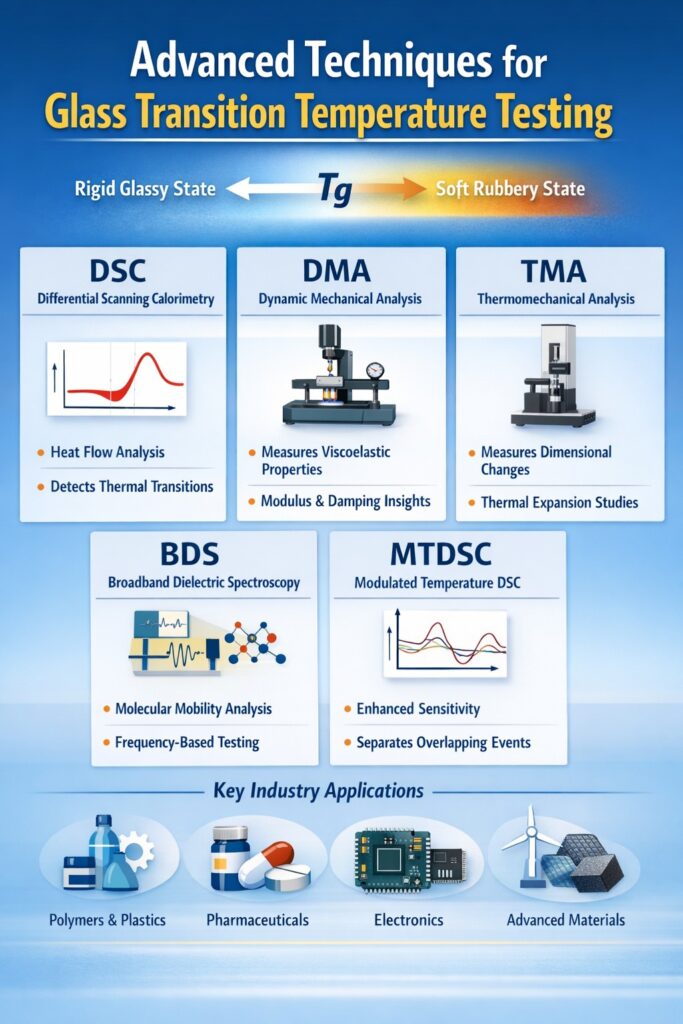
- Advanced Tg testing techniques such as DSC, DMA, TMA, BDS, and MTDSC are explored, along with their key applications and advantages.
- The integration of complementary thermal methods, automation, and digital data analysis enhances precision and efficiency in modern Tg testing laboratories.
- Industry applications, future technology trends, and the expertise of ResolveMass Laboratories Inc. highlight the evolving role of Tg testing in material innovation.
Understanding Glass Transition Temperature (Tg)
The glass transition temperature (Tg) is the temperature range at which an amorphous material transitions from a hard, glassy state to a softer, rubbery state. Unlike melting points, Tg is not a sharp transition but a temperature range influenced by the material’s composition and structure.
Why Tg Testing Matters:
Material Stability: Identifies the operational temperature range of materials.
Performance Insights: Ensures material integrity under various thermal conditions.
Formulation Development: Helps optimize polymers, pharmaceuticals, and composites.
Regulatory Compliance: Many industries mandate Tg analysis for safety and quality assurance.
Role of Sample Preparation in Accurate Tg Measurement
Proper sample preparation plays a decisive role in obtaining reliable and reproducible glass transition temperature results. Variations in sample thickness, moisture content, thermal history, and physical form can significantly influence Tg values. Inconsistent preparation may lead to broadened transitions, shifted temperature ranges, or misleading interpretations, especially when analyzing amorphous or semi-crystalline materials. Standardizing preparation protocols ensures that Tg measurements truly reflect material behavior rather than experimental artifacts.
In U.S.-based laboratories, stringent preparation guidelines are commonly followed to maintain analytical accuracy. Conditioning samples under controlled humidity, removing residual solvents, and ensuring uniform geometry are critical steps prior to testing. For polymers and pharmaceuticals, pre-annealing is often employed to erase prior thermal history. These preparatory measures enhance method repeatability and allow meaningful comparison across batches, formulations, and research studies.
Advanced Techniques for Glass Transition Temperature Testing
The United States leads the charge in adopting sophisticated methodologies for Tg testing. These advanced techniques deliver precision, reliability, and comprehensive material analysis.
Impact of Thermal History on Glass Transition Temperature Results
Thermal history refers to the sequence of heating, cooling, and storage conditions a material experiences prior to Tg testing. These factors can strongly affect molecular mobility and structural relaxation, leading to variations in the observed glass transition temperature. Rapid cooling, for example, can trap materials in a non-equilibrium state, resulting in a higher apparent Tg during analysis. Conversely, slow cooling may allow molecular rearrangement that lowers Tg values.
Understanding and controlling thermal history is particularly important in research and industrial quality control environments. U.S. laboratories often document and standardize thermal conditioning steps to minimize variability. By carefully managing heating rates and equilibration times, analysts can isolate intrinsic material properties from processing-induced effects. This practice ensures that Tg data is both scientifically meaningful and industrially actionable.
1. Differential Scanning Calorimetry (DSC)
DSC is one of the most widely used techniques for Tg determination. It measures the heat flow associated with transitions in a material as a function of temperature or time.
Applications:
Polymer research for thermal stability analysis.
Pharmaceutical development for excipient compatibility studies.
Advantages:
High sensitivity to detect even minor transitions.
Simultaneous analysis of multiple thermal events (e.g., melting and crystallization).
Cross-reference: Differential scanning calorimetry provides unmatched precision in Tg testing, as described by Ingle et al. (2020) DOI: 10.1016/j.polymertesting.2020.106748.
2. Dynamic Mechanical Analysis (DMA)
DMA measures the mechanical properties of a material as a function of temperature, time, and frequency, providing insights into viscoelastic behavior.
Applications:
Characterizing Tg in composite materials.
Testing adhesives and coatings under dynamic stress.
Advantages:
High accuracy in Tg determination.
Offers insights into the modulus and damping properties of materials.
3. Thermomechanical Analysis (TMA)
TMA measures dimensional changes in a material as a function of temperature, providing complementary insights to DSC and DMA.
Applications:
Testing dimensional stability of polymers and composites.
Analysis of thermal expansion coefficients.
Advantages:
Non-destructive testing.
Applicable for materials with low Tg.
4. Broadband Dielectric Spectroscopy (BDS)
BDS is an advanced technique used to study the dielectric properties of materials across a wide temperature range, offering unique insights into molecular mobility.
Applications:
Studying relaxation processes in polymers.
Tg determination in complex molecular systems.
Advantages:
Exceptional precision in Tg and secondary transition analysis.
Effective for materials with low thermal contrast.
5. Modulated Temperature Differential Scanning Calorimetry (MTDSC)
MTDSC is an enhancement of DSC, introducing a modulation in temperature to separate overlapping thermal events.
Applications:
Analysis of multi-phase materials.
Tg determination in polymer blends and pharmaceuticals.
Advantages:
Resolves overlapping thermal transitions.
Enhanced sensitivity for weak transitions.
Integration of Tg Testing with Complementary Thermal Techniques
While Tg testing provides valuable insight on its own, integrating it with complementary thermal analysis techniques enhances overall material characterization. Combining Tg measurements with thermogravimetric analysis (TGA), for example, allows simultaneous evaluation of thermal stability and decomposition behavior. This integrated approach helps identify temperature limits where both physical transitions and chemical degradation may occur.
In advanced U.S. research laboratories, multi-technique strategies are increasingly used to accelerate material development. Correlating Tg data with crystallinity, mass loss, or heat capacity changes enables a deeper understanding of structure-property relationships. Such integrated testing frameworks are especially valuable for high-performance polymers, electronic materials, and pharmaceutical formulations requiring precise thermal control.
Automation and Digital Data Analysis in Tg Testing Laboratories
Automation has significantly transformed glass transition temperature testing by improving consistency, throughput, and data integrity. Modern thermal analyzers equipped with automated sample loaders and programmable methods reduce operator-dependent variability. Automated calibration routines further enhance measurement accuracy while minimizing downtime, making Tg testing more efficient for high-volume industrial laboratories.
Equally important is the role of advanced data analysis software in interpreting Tg results. Digital tools enable precise baseline correction, derivative analysis, and comparative trend evaluation across multiple samples. In the United States, laboratories increasingly rely on data analytics to support regulatory documentation, product validation, and long-term material performance monitoring. This digital integration strengthens decision-making and accelerates innovation cycles.
Industries Benefiting from Tg Testing in the United States
1. Polymers and Plastics
Tg testing is essential for understanding the thermal behavior of polymers and plastics used in industries such as automotive, aerospace, and packaging.
Key Insights:
Determines operational temperature ranges for polymeric material.
Aids in designing materials with specific flexibility or rigidity.
2. Pharmaceuticals
Tg testing in pharmaceuticals ensures the stability and efficacy of drugs, particularly in amorphous solid dispersions.
Key Insights:
Ensures drug stability during storage and transportation.
Helps in selecting appropriate excipients for formulations.
Example: DSC and MTDSC techniques are commonly used to study drug-polymer interactions, as highlighted by Mahieu et al. (2019) DOI: 10.1016/j.xphs.2019.03.027.
3. Electronics and Semiconductors
Thermal analysis, including Tg testing, is crucial for materials used in electronics, where stability under varying temperatures is critical.
Key Insights:
Determines thermal stability of dielectric materials.
Ensures performance reliability of circuit components.
4. Advanced Materials and Composites
Tg testing aids in designing high-performance composites for aerospace, defense, and renewable energy sectors.
Key Insights:
Identifies thermal limits for structural applications.
Assists in optimizing material compositions for extreme environments.
5. Food and Packaging Industries
Thermal analysis, including Tg testing, ensures the integrity of packaging materials and stability of processed foods.
Key Insights:
Ensures the stability of polymers used in food packaging.
Optimizes processing conditions for food safety.
ResolveMass Laboratories Inc.: Your Trusted Partner in Tg Testing
At ResolveMass Laboratories Inc., we utilize state-of-the-art techniques to deliver precise and reliable Tg testing services tailored to your industry’s needs.
Future Trends in Glass Transition Temperature Testing Technologies
Emerging trends in Tg testing focus on increasing sensitivity, reducing sample size, and enhancing real-time analysis capabilities. Miniaturized thermal analysis instruments are gaining attention for applications where sample availability is limited, such as biomedical materials and specialty polymers. These advancements allow precise Tg determination with minimal material consumption while maintaining analytical reliability.
Another significant trend is the integration of artificial intelligence and machine learning in thermal data interpretation. Predictive modeling tools are being developed to estimate Tg based on compositional and structural parameters, reducing experimental trial-and-error. In the United States, such innovations are expected to redefine material testing workflows, supporting faster development cycles and more sustainable research practices.
Why Choose Us?
Expertise: Deep experience in advanced thermal analysis.
Cutting-Edge Equipment: Access to DSC, DMA, TMA, and other advanced methodologies.
Tailored Solutions: Custom testing protocols to meet industry-specific requirements.
Regulatory Compliance: Adherence to global standards for thermal analysis.
Conclusion
Glass transition temperature testing remains a cornerstone of material characterization across a wide range of industries in the United States. As materials become more complex and performance demands more stringent, accurate Tg analysis plays a vital role in ensuring reliability, safety, and functionality. Advanced techniques such as DSC, DMA, TMA, BDS, and MTDSC provide detailed insights into molecular behavior, enabling researchers and manufacturers to make informed decisions throughout the product lifecycle.
With continued advancements in automation, data analytics, and integrated testing approaches, Tg testing is evolving beyond routine analysis into a strategic tool for innovation. Laboratories that adopt rigorous preparation protocols, leverage complementary techniques, and stay aligned with emerging trends are better positioned to meet future challenges. As industries push the boundaries of material science, glass transition temperature testing will remain essential in driving quality, compliance, and technological progress.
Reference
- Tomaszewska, J., Sterzyński, T., Woźniak-Braszak, A., & Banaszak, M. (2021). Review of recent developments of glass transition in PVC nanocomposites. Polymers, 13(24), 4336. https://doi.org/10.3390/polym13244336
- Červinka, C., & Fulem, M. (2021). Structure and glass transition temperature of amorphous dispersions of model pharmaceuticals with nucleobases from molecular dynamics. Pharmaceutics, 13(8), 1253. https://doi.org/10.3390/pharmaceutics13081253

Case Study: Immunogenicity Risk Assessment of a New Impurity in a Generic Peptide ANDA
Introduction: Immunogenicity Risk Assessment of Peptide Impurities is a key part of pharmaceutical development whenever…

Is Peptide Synthesis the Same as Protein Manufacturing?
Introduction: Peptide Synthesis vs Protein Manufacturing is an important distinction in pharmaceutical development, biotechnology, and…

Is It Better to Use One Integrated CDMO or Multiple Specialized Vendors?
Introduction Selecting between an integrated contract development and manufacturing organization (CDMO) and multiple specialized vendors…

Afucosylation, Sialylation, and High Mannose: What Glycan Profiling Analysis for Biosimilar Characterization Reveals About Efficacy and Safety
Introduction Glycan profiling analysis for biosimilar characterization provides valuable insights into how critical N-glycoforms, particularly…

Same Sequence, Different Shape: Why Higher Order Structure Analysis for Biosimilar Characterization Can’t Be Skipped
Introduction Higher Order Structure Analysis for Biosimilar Characterization is essential because proteins with identical primary…

Clinical Trial Material Manufacturing at a CDMO: Phase I and II Supply Planning
Introduction: Clinical Trial Material Manufacturing for Phase I and II is a critical part of…

