

Introduction
GLP-1 Peptide Impurity Characterization is a critical part of modern pharmaceutical analysis, especially for peptide-based therapies. It focuses on identifying, separating, and understanding small differences between peptide variants that may appear during drug development. These differences are often very subtle, which makes the process technically demanding.
In GLP-1 analogs such as liraglutide and semaglutide, impurity profiling is not only a regulatory requirement but also a key factor in ensuring drug safety and effectiveness. Even small levels of impurities can impact biological activity, stability, and overall therapeutic performance. Because of this, accurate impurity analysis is essential.
Explore our specialized solutions: CRO for GLP-1 Peptide Characterization
Compared to small molecule drugs, GLP-1 peptides show more complex impurity patterns. These impurities can arise from synthesis steps, formulation conditions, or degradation over time. This complexity requires advanced analytical tools and well-planned strategies.
This article explains the most effective analytical approaches used in GLP-1 Peptide Impurity Characterization. It covers key challenges, modern techniques, and regulatory expectations in a clear and practical way.
Share via:
🔍 Quick Summary
- GLP-1 Peptide Impurity Characterization relies heavily on orthogonal analytical techniques, primarily RP-HPLC and LC–MS/MS, to resolve structurally similar peptide variants.
- Process-related impurities (e.g., truncations, deletions, oxidation) and degradation products (e.g., deamidation, aggregation) require high-resolution mass spectrometry (HRMS) for structural confirmation.
- Forced degradation studies are critical to map impurity pathways under stress conditions (pH, temperature, oxidation).
- Low-level impurities (≤0.1%), including D-amino acid isomers, demand ultra-sensitive LC-HRMS methods.
- Method development strategies must integrate QbD principles, ensuring robustness, reproducibility, and regulatory compliance.
- Hyphenated techniques (LC-MS, LC-HRMS) are the gold standard for GLP-1 Peptide Impurity Characterization due to their specificity and sensitivity.
- Regulatory expectations (ICH Q3A/B, Q6B) require comprehensive impurity identification, qualification, and quantification.
GLP-1 Peptide Impurity Characterization: What Analytical Challenges Must Be Solved?
The main challenge is to accurately separate and identify very similar impurities, such as isomers, truncations, and modified peptides, even when present at extremely low levels.
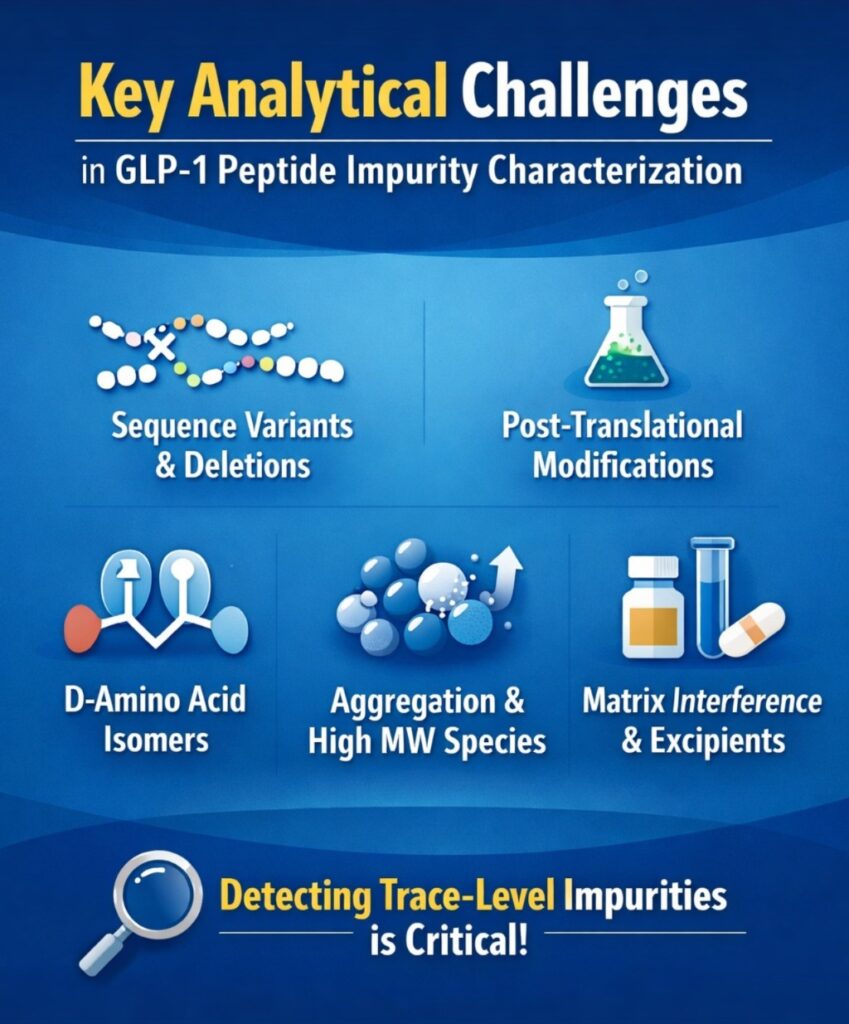
Key Analytical Challenges
- Sequence-related impurities (deletions, insertions, misincorporations)
- Post-synthetic modifications (oxidation, deamidation)
- Isomerization (D-amino acids), which is difficult to separate
- Aggregation and high-molecular-weight species formation
- Matrix interference from formulation excipients
These challenges become more difficult because impurities often have structures very close to the target peptide. As a result, standard methods may not be sufficient, and high-resolution, sensitive techniques are required for proper identification.
Research shows that even impurities present at 0.1% must be detected and characterized. This strict requirement drives the use of advanced analytical systems and optimized workflows in GLP-1 Peptide Impurity Characterization.
Learn more about identifying sequence variants: Peptide Sequencing of GLP-1 Drugs
Core Analytical Techniques for GLP-1 Peptide Impurity Characterization
1. RP-HPLC: First-Line Separation Tool in GLP-1 Peptide Impurity Characterization
RP-HPLC is mainly used for separating impurities based on hydrophobic properties, but it does not provide structural details.
- Commonly used for routine impurity profiling
- Effective for separating truncated and oxidized peptides
- Typically combined with UV detection
Although RP-HPLC is widely used, it may not fully resolve closely related impurities. Co-elution can occur, which limits its ability to identify compounds accurately. Therefore, it is often combined with advanced techniques.
Optimizing columns, gradients, and mobile phases can improve separation. However, structural confirmation requires additional tools such as mass spectrometry.
Master your testing protocols: Peptide Sameness Testing Methods
2. LC–MS/MS: Gold Standard for GLP-1 Peptide Impurity Characterization
LC–MS/MS provides detailed structural information along with accurate molecular weight analysis.
- Identifies sequence variants
- Detects chemical and post-translational modifications
- Generates mass-to-charge (m/z) data
- Supports peptide mapping
This technique plays a key role in confirming impurity identity after chromatographic separation. It provides both qualitative and quantitative insights, making it highly valuable.
LC–MS/MS is widely applied in GLP-1 research to study degradation pathways and complex impurity profiles. It is considered essential in any advanced analytical workflow.
See how we use Mass Spec for GLP-1: LC-MS Characterization of GLP-1 Peptides
3. High-Resolution Mass Spectrometry (HRMS)
HRMS enables precise detection of low-level and structurally similar impurities.
- Detects D-amino acid isomers
- Resolves very small mass differences
- Confirms exact molecular structures
HRMS is especially useful for trace-level impurities that cannot be identified using conventional methods. Its high accuracy allows clear differentiation between closely related compounds.
This technique strengthens confidence in impurity identification and is crucial for ensuring drug safety and quality.
Deep dive into analytical characterization: Analytical Characterization of GLP-1 Peptide Drugs
4. Orthogonal Techniques in GLP-1 Peptide Impurity Characterization
Answer: Orthogonal techniques provide additional insights that may not be captured by LC-MS alone.
| Technique | Application |
|---|---|
| CE (Capillary Electrophoresis) | Charge variants |
| SEC (Size Exclusion Chromatography) | Aggregates |
| Peptide Mapping | Sequence confirmation |
Using multiple analytical approaches ensures a more complete impurity profile. Each method highlights different impurity characteristics, improving overall understanding.
These techniques are particularly important when dealing with complex formulations or strict regulatory requirements.
Access comprehensive services: Peptide Characterization Service
GLP-1 Peptide Impurity Characterization: Forced Degradation & Stability Studies
Forced degradation studies help identify how impurities form under stress conditions.
Common Stress Conditions
- pH variation
- Temperature changes
- Oxidative stress
- Light exposure
These studies simulate real-world conditions and help predict how the drug behaves over time. They also support the development of stable formulations.
Outcomes of Forced Degradation
- Identification of degradation pathways
- Development of stability-indicating methods
- Support for regulatory submissions
Understanding degradation is essential for maintaining product quality and ensuring long-term stability.
Discover our degradation study protocols: Forced Degradation Studies
Impurity Classification in GLP-1 Peptide Drugs
Impurities are grouped based on their origin and formation mechanism.
| Impurity Type | Examples | Analytical Approach |
|---|---|---|
| Process-related | Truncated sequences, deletions | RP-HPLC, LC-MS |
| Degradation products | Oxidation, deamidation | LC-HRMS |
| Isomeric impurities | D-amino acids | HRMS, chiral methods |
| Formulation-related | Excipient interactions | LC-MS, stress studies |
Each impurity type requires a specific analytical approach. Understanding their source helps in controlling and minimizing them effectively.
Interactions between excipients and peptides can sometimes create unexpected impurities. This highlights the importance of formulation studies in GLP-1 Peptide Impurity Characterization.
Ensure your ANDA compliance: Peptide Sameness Study for ANDA
Method Development Strategies for GLP-1 Peptide Impurity Characterization
Method development should follow QbD principles to ensure consistent and reliable results.
Key Considerations
- Column selection (C18 vs. phenyl)
- Mobile phase optimization
- Gradient design for better separation
- MS parameter tuning
A structured approach improves method robustness and reduces variability. It also ensures reproducibility across different laboratories.
QbD-based strategies provide better control over analytical parameters, leading to more accurate impurity profiling.
Optimize your lab results: Analytical Method Development and Validation Service
GLP-1 Peptide Impurity Characterization: Regulatory Expectations
Regulatory agencies require full identification and control of impurities above defined limits.
Key Guidelines
- ICH Q3A/Q3B – Impurity thresholds
- ICH Q6B – Biotech product specifications
Regulatory Focus Areas
- Identification of impurities ≥0.1%
- Toxicological assessment
- Stability-indicating method development
Meeting regulatory standards is essential for product approval. Poor impurity characterization can delay submissions or require additional studies.
Stay ahead of the curve: FDA Peptide Sameness Study Requirements
Emerging Trends in GLP-1 Peptide Impurity Characterization
New technologies are improving speed, sensitivity, and accuracy in impurity analysis.
Key Innovations
- LC-HRMS with AI-based data analysis
- Multi-dimensional chromatography
- Automated peptide mapping
These advancements allow faster data processing and better impurity detection. They also improve confidence in analytical results.
Modern platforms are moving toward real-time monitoring, enabling quicker decisions during drug development.
Conclusion
GLP-1 Peptide Impurity Characterization is a complex but essential process in peptide drug development. It requires a combination of chromatographic and mass spectrometric techniques to ensure accurate impurity detection and identification.
From initial RP-HPLC separation to detailed LC-MS/MS and HRMS analysis, each step contributes to a complete impurity profile. This layered strategy ensures both detection and structural confirmation.
As GLP-1 therapies continue to grow, strong analytical strategies will remain critical for maintaining quality, meeting regulatory requirements, and ensuring patient safety. Companies that adopt integrated and QbD-based approaches will be better prepared for future challenges.
📩 Contact Experts
For advanced analytical support in GLP-1 peptide characterization:
FAQs on GLP-1 Peptide Impurity Characterization
GLP-1 analogs often contain impurities such as truncated peptides, oxidized forms, and deamidated variants. Isomeric changes can also occur during synthesis or storage. These impurities may affect the drug’s performance. Careful monitoring is required to maintain quality.
Low-level impurities are detected using highly sensitive tools like LC-HRMS. These systems can identify even trace amounts below 0.1%. Accurate detection ensures safety and consistency. This is a critical step in GLP-1 Peptide Impurity Characterization.
HPLC is useful for separating impurities but cannot fully identify them. It does not provide enough structural information. For complete analysis, it must be paired with mass spectrometry. This combination gives more reliable and detailed results.
Excipients can interact with peptides and create unexpected impurities. These interactions may happen during formulation or storage. Such changes can affect stability and safety. That is why compatibility studies are important.
Regulatory guidelines usually require identification of impurities at or above 0.1%. These impurities must be studied for safety and impact. Proper documentation is also needed for approval. This ensures compliance with global standards.
Orthogonal techniques provide different types of analytical information. Each method focuses on a specific property of the impurity. Together, they give a more complete picture. This improves confidence in GLP-1 Peptide Impurity Characterization.
Reference:
- Müller, T. D., Finan, B., Bloom, S. R., D’Alessio, D., Drucker, D. J., Flatt, P. R., Fritsche, A., Gribble, F., Grill, H. J., Habener, J. F., Holst, J. J., Langhans, W., Meier, J. J., Nauck, M. A., Perez-Tilve, D., Pocai, A., Reimann, F., Sandoval, D. A., Schwartz, T. W., … Tschöp, M. H. (2019). Glucagon-like peptide 1 (GLP-1). Molecular Metabolism, 30, 72–130. https://doi.org/10.1016/j.molmet.2019.09.010
- Manandhar, B., & Ahn, J.-M. (2015). Glucagon-like peptide-1 (GLP-1) analogs: Recent advances, new possibilities, and therapeutic implications. Journal of Medicinal Chemistry, 58(3), 1020–1037. https://doi.org/10.1021/jm500810s
- Jiang, N., Su, D., Chen, D., Huang, S., Tang, C., Jing, L., Yang, C., Zhou, Z., Yan, Z., & Han, J. (2024). Discovery of a novel glucagon-like peptide-1 (GLP-1) analogue from bullfrog and investigation of its potential for designing GLP-1-based multiagonists. Journal of Medicinal Chemistry, 67(1), 180–198. https://doi.org/10.1021/acs.jmedchem.3c01049
Get In Touch With Us
About The Author


