

Introduction
Global contract development and manufacturing organization (CDMO) capacity is under severe pressure because the unprecedented multi-ton demand for semaglutide and tirzepatide has driven a fundamental transition from low-volume clinical synthesis to high-throughput, industrial-scale API production. Traditional contract manufacturing facilities are often not structurally equipped to manage the specialized, resource-intensive, and technically complex chemical processes required to scale up GLP-1 Peptide Manufacturing to satisfy rapidly expanding global therapeutic demand.
The global market for glucagon-like peptide-1 (GLP-1) receptor agonists and co-agonists is undergoing unprecedented growth, primarily because of their demonstrated clinical efficacy in glycemic control and substantial weight-loss benefits. The global GLP-1 receptor agonist market is estimated to expand from USD 74.4 billion in 2026 to USD 232.8 billion by 2033, representing a compound annual growth rate (CAGR) of 17.7%. At the same time, sales of obesity medicines are projected to reach between USD 105 billion and USD 200 billion by 2027 and beyond. This rapid therapeutic expansion is being further accelerated by the loss of exclusivity for semaglutide in major markets, including India, China, Brazil, Turkey, and Canada. As a result, a growing number of generic and biosimilar developers are seeking reliable contract manufacturing partnerships.
Looking to evaluate development frameworks for off-patent biologics? Learn how to partner with a CDMO for generic projects in Canada to streamline your commercial scale-up strategy.
The resulting industrial pressure is not driven solely by the increase in production volume but also by the structural complexity of these molecules. Historically, therapeutic peptides were manufactured at kilogram scale to serve comparatively small patient populations. In contrast, modern GLP-1 therapies require chronic administration to millions of patients, shifting annual demand toward hundreds of kilograms and even metric-ton quantities. Because these molecules contain complex amino acid backbones, lipid side-chain conjugations, and stringent regulatory purity requirements, their manufacture places substantial pressure on every stage of the contract manufacturing value chain. This includes upstream raw material sourcing and synthesis, downstream purification, high-resolution analytical characterization, and aseptic fill-finish operations.
Share via:
Article Summary:
- GLP-1 therapies are driving unprecedented manufacturing demand. The rapid adoption of semaglutide and tirzepatide for diabetes and obesity treatment has significantly increased the need for large-scale peptide production, placing substantial pressure on global CDMO infrastructure.
- Manufacturing these peptides is technically demanding. Their long amino acid chains, non-standard amino acids, and complex lipid conjugation steps reduce synthesis efficiency, increase impurity risks, and make large-scale production more challenging.
- Semaglutide and tirzepatide require different production strategies. Semaglutide is manufactured using a hybrid recombinant and chemical process, whereas tirzepatide depends entirely on advanced chemical synthesis due to its more complex molecular structure.
- Regulatory expectations for generic GLP-1 products are extremely rigorous. Developers must prove active ingredient sameness, tightly control impurity levels, and perform comprehensive structural characterization using advanced analytical technologies such as LC-MS and high-resolution mass spectrometry.
- Fill-finish operations have become a major supply chain bottleneck. Limited sterile manufacturing capacity, growing reliance on injection pens, and shortages of packaging components continue to restrict the availability of finished GLP-1 products worldwide.
- Innovation is essential to expand manufacturing capacity. Emerging technologies such as continuous-flow peptide synthesis, green chemistry, recombinant production platforms, and improved oral peptide formulations are expected to enhance scalability and reduce production constraints.
- Future competitiveness will depend on advanced manufacturing capabilities. As patents expire and more generic manufacturers enter the market, CDMOs that invest in automation, efficient synthesis technologies, and robust analytical quality systems will be better positioned to meet increasing global demand.
Why Chemical Complexity Limits GLP-1 Peptide Manufacturing Scalability
The scalability of semaglutide and tirzepatide manufacturing is restricted by their long amino acid sequences, the presence of non-canonical amino acids, and the need for highly precise, site-specific fatty acid acylation. These structural complexities significantly increase the likelihood of peptide chain aggregation and reduced coupling efficiency during large-scale manufacturing campaigns.
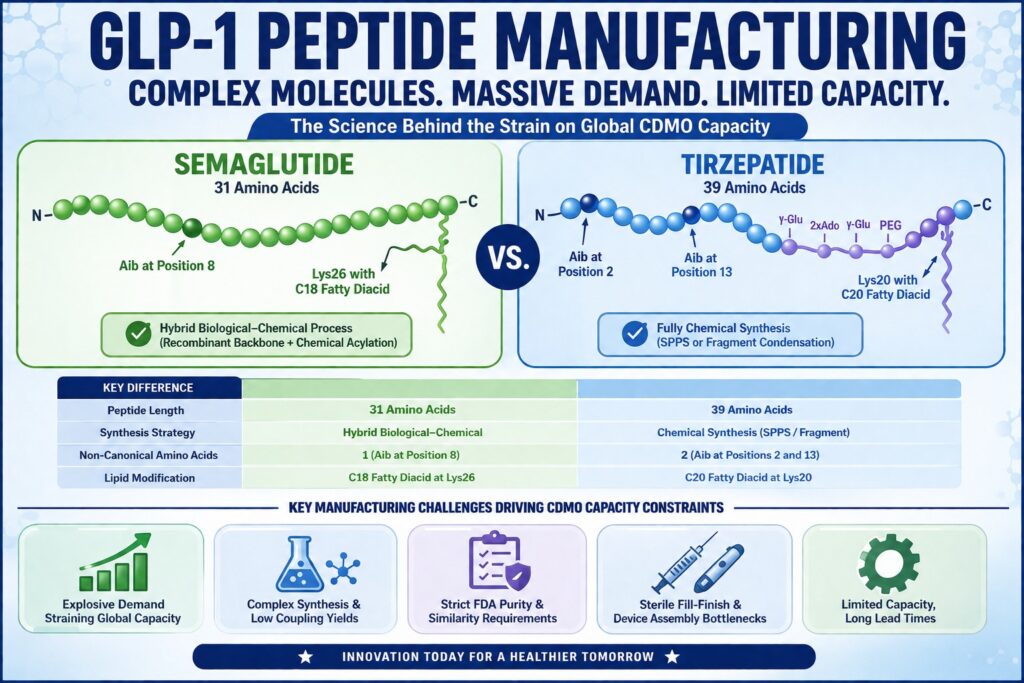
A major factor contributing to the current capacity constraint is the fundamental difference in the synthesis strategies used for semaglutide and tirzepatide. Semaglutide is a 31-amino-acid peptide with 94% sequence homology to native human GLP-1. Its structure includes a substitution of alanine with α-aminoisobutyric acid (Aib) at position 8 to prevent dipeptidyl-peptidase-4 (DPP-4) enzymatic degradation, a substitution of lysine for arginine at position 34, and a C18 fatty diacid side chain conjugated to Lys26 through a hydrophilic spacer. The production of this peptide backbone involves a hybrid biological-chemical process in which a peptide precursor is recombinantly expressed in yeast and subsequently chemically modified through acylation to introduce the lipid side chain.
Tirzepatide, by comparison, is a more structurally complex 39-amino-acid linear peptide that functions as a dual GIP and GLP-1 receptor agonist. It contains two non-canonical Aib residues at positions 2 and 13, has an amidated C-terminus, and contains a C20 fatty diacid, eicosanedioic acid, attached to the Lys20 residue through hydrophilic linkers, including γ-Glu-2xAdo, gamma glutamate, and PEG linkers. Since non-canonical amino acids are extremely difficult to incorporate consistently into biological expression systems, tirzepatide requires pure chemical synthesis. This can be achieved through linear SPPS or fragment-based synthesis, in which four distinct peptide fragments are synthesized separately and subsequently conjugated in solution.
Discover specialized manufacturing platforms by partnering with an experienced peptide drug development CDMO equipped to handle multi-step synthesis and acylation.
| Parameter | Semaglutide | Tirzepatide |
|---|---|---|
| Peptide Length | 31 amino acids | 39 amino acids |
| Receptor Profile | Selective GLP-1 receptor agonist | Dual GIP & GLP-1 receptor agonist |
| Non-Canonical Amino Acids | α-aminoisobutyric acid (Aib) at position 8 | Aib at positions 2 and 13 |
| Lipid Modification | C18 fatty diacid side chain at Lys26 | C20 fatty diacid side chain at Lys20 |
| Synthesis Pathway | Hybrid biological-chemical (recombinant backbone in yeast + chemical acylation) | Chemical synthesis (linear SPPS or fragment condensation) |
| Molecular Formula | C187H291N45O59 | C225H348N48O68 [cite: 12] |
| Molecular Weight (Mw) | 4113.5 Da | 4813.45 Da |
| Primary Route of Delivery | Subcutaneous injection or daily oral | Subcutaneous injection |
How Structural Differences Impact Upstream Synthesis Choices
The molecular structure of semaglutide enables a hybrid biological-chemical manufacturing strategy that combines recombinant yeast expression with subsequent chemical acylation. Tirzepatide, however, must be manufactured entirely through chemical synthesis because it contains multiple non-canonical amino acids. Recombinant expression platforms are structurally incapable of consistently and reliably incorporating non-canonical amino acids such as α-aminoisobutyric acid (Aib). Therefore, pure chemical solid-phase peptide synthesis (SPPS) or fragment condensation represents the only viable manufacturing pathway for tirzepatide.
During solid-phase peptide synthesis (SPPS), the overall yield decreases exponentially as the number of coupling cycles increases, according to the following relationship:
Overall Yield = (Per-Cycle Yield)ᴺ
In this equation, N represents the number of amino acid residues. For long-chain peptides such as tirzepatide (N = 39), even relatively small reductions in coupling efficiency can result in substantial product loss and increased concentrations of deletion impurities. The problem becomes particularly pronounced at sterically hindered residues, including Aib, valine, and isoleucine. To overcome these steric challenges, CDMOs must implement carefully optimized chemical protocols, including the following:
Alternative Coupling Reagents: Standard carbodiimide-based reagents, such as DIC/HOBt, are often replaced with highly active uronium or phosphonium salts, including HATU, HBTU, or PyBOP. These reagents improve coupling kinetics and can enhance the efficiency of difficult amino acid incorporations.
Temperature Control: Coupling reactions are typically conducted at elevated temperatures, commonly between 50 and 60°C, to disrupt secondary structures and reduce peptide chain aggregation on the solid support. This helps improve reagent access to the growing peptide chain and promotes more efficient coupling.
Suppressing Racemization: Elevated temperatures can increase the risk of racemization in sensitive residues such as histidine and cysteine. To minimize this risk, sterically hindered, non-nucleophilic bases such as diisopropylethylamine (DIPEA) are used in combination with racemization-suppressing additives, including ethyl cyanohydroxyiminoacetate (Oxyma) or 1-hydroxybenzotriazole (HOBt).
Side-Chain Lipidation: The conjugation of the hydrophobic fatty acid side chain, specifically the C18 chain in semaglutide or the C20 chain in tirzepatide, to the lysine residue is particularly challenging because fatty acids have limited solubility in the polar solvents commonly used during SPPS. This step may require reaction temperatures of approximately 40°C, extended coupling times, and real-time colorimetric monitoring, such as the Kaiser test, to confirm complete acylation before the synthesis proceeds to the next stage.
Capping Cycles: Peptide chains that remain unreacted after a coupling step are systematically deactivated using a capping solution containing 10% acetic anhydride and 1% DIPEA in DMF. This prevents these incomplete sequences from participating in subsequent chain elongation cycles and produces shorter, truncated sequences that are considerably easier to separate during downstream purification.
Comparing operational models for complex synthesis? Review our detailed comparison on peptide CDMO vs CRO to choose the right partner for your commercial pipeline.
The Core Materials and Solvent Bottlenecks in Large-Scale Peptide Assembly
Upstream peptide assembly is significantly constrained by shortages of protected amino acids, specialized solid-phase resins, and the enormous volumes of solvents required for production. These challenges are further intensified by increasingly stringent global environmental regulations governing hazardous chemicals such as dimethylformamide (DMF). Traditional manufacturing facilities also encounter substantial equipment limitations because highly corrosive cleavage acids, including trifluoroacetic acid (TFA), require specialized and expensive corrosion-resistant alloys rather than conventional stainless steel.
Linear SPPS requires substantial quantities of raw materials, while solvent consumption remains a continuous source of material expense and environmental burden. During a typical manufacturing campaign, solvents are essential at nearly every stage of the process, including dissolving protected amino acids, facilitating reagent transfer, and washing away excess reagents and reaction byproducts between successive coupling cycles. Dimethylformamide (DMF) remains the primary workhorse solvent used in peptide coupling; however, its industrial application has encountered significant regulatory challenges. In December 2023, the European Commission restricted the industrial use of two of the most widely used SPPS solvents, DMF and N-Methyl-2-pyrrolidone (NMP), because of their documented reproductive toxicity.
The tightening of chemical regulations is increasing operating costs and shifting the commercial viability of chemical synthesis toward greener alternatives. As a result, CDMOs are increasingly required to invest in solvent recovery systems and develop local raw material infrastructure. These physical and regulatory limitations affecting essential raw materials represent a major contributor to global peptide manufacturing capacity shortages.
Planning to externalize your synthesis requirements? Read about how to efficiently outsource peptide manufacturing to CDMO teams to safeguard supply chain continuity.
| Material / Equipment Class | Function in SPPS | Scale-Up Bottleneck & Facility Impact |
|---|---|---|
| DMF and NMP Solvents | Primary coupling and washing solvents. | Subject to strict European Commission environmental restrictions because of reproductive toxicity, requiring costly solvent recovery systems or process redesign. |
| Trifluoroacetic Acid (TFA) | Cleaves the completed peptide from the solid resin support. | A highly corrosive acid that can rapidly degrade standard stainless-steel vessels, requiring expensive corrosion-resistant alloys, such as Hastelloy, which may cost approximately five times more and involve long equipment lead times. |
| Solid-Phase Resins | Insoluble polymer beads that serve as the physical support for peptide assembly. | Demand has exceeded available supply in some markets, prompting CDMOs to restart or expand local resin manufacturing facilities, including operations such as PolyPeptide in Europe, to maintain supply continuity. |
| Specialized Linkers and Fatty Acids | Used to conjugate the C18/C20 fatty acid side chains required to achieve a long half-life. | Highly customized chemical inputs that depend on fragile, single-source global supply chains, creating substantial geopolitical and delivery risks. |
| Protected Amino Acids | Essential starting materials for sequential peptide assembly. | More than 40% of key starting materials used for US-approved drugs are sourced from China, creating significant logistical and geopolitical vulnerabilities within the supply chain. |
Downstream Purification and the Chromatography Throughput Crisis
Downstream purification represents one of the most significant bottlenecks in commercial peptide manufacturing because traditional preparative reversed-phase high-performance liquid chromatography (RP-HPLC) is a slow, linear, batch-mode process that consumes unsustainable quantities of hazardous solvents. This linear production model does not scale efficiently to multi-ton campaigns, resulting in severe backlogs in chromatographic column throughput and the downstream bulk lyophilization capacity required to process purified peptide fractions.
Preparative reversed-phase chromatography remains one of the most resource-intensive stages in synthetic peptide manufacturing. Peptides are generally eluted using a shallow linear gradient of water and acetonitrile (ACN), with 0.1% trifluoroacetic acid (TFA) added as an ion-pairing reagent to improve chromatographic resolution. Although this system provides the high resolution necessary to separate closely related peptide impurities, it functions as a batch process and can generally process only one injection run at a time.
Purifying peptides at the metric-ton scale requires enormous quantities of high-purity acetonitrile and water. This generates substantial volumes of solvent waste that must be recovered, treated, or disposed of, resulting in considerable operational and environmental costs. After HPLC separation, the purified fractions must be rapidly isolated through lyophilization, or freeze-drying. Because GLP-1 peptides can gradually degrade while remaining in aqueous solution, the freezing and drying stages must be carefully conducted under vacuum using controlled cycles. Consequently, insufficient bulk freeze-drying cabinet capacity has become a major physical limitation for many contract manufacturing facilities.
For specialized analytical support during scale-up, evaluate dedicated peptide analytical characterization services to optimize downstream yield and purity profiles.
Innovative Purification Strategies to Overcome Solvent Consumption
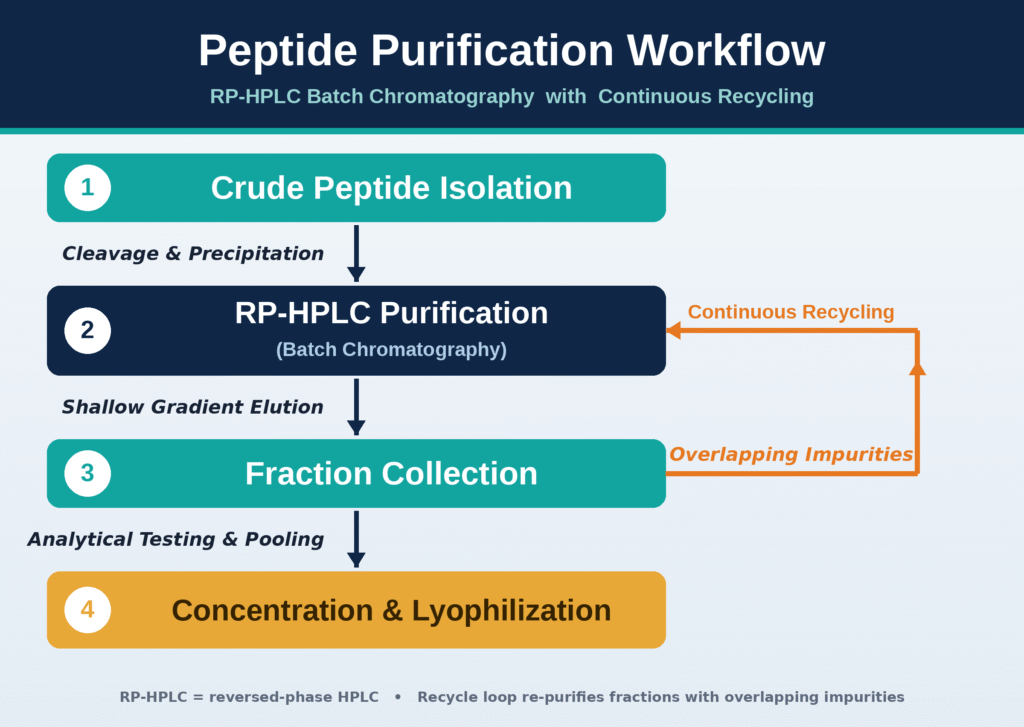
To reduce solvent consumption and improve process yields, CDMOs are increasingly implementing continuous twin-column chromatography, greener eluent systems, and alternative “catch-and-release” purification platforms. Technologies such as Multicolumn Countercurrent Solvent Gradient Purification (MCSGP) and Peptide Easy Clean (PEC) are increasingly being used as alternatives to conventional batch RP-HPLC by enabling continuous separation and parallel purification workflows.
The implementation of Multicolumn Countercurrent Solvent Gradient Purification (MCSGP) represents a significant advancement in downstream peptide processing. MCSGP operates as a continuous twin-column system that automatically recycles overlapping impure fractions. This enables manufacturers to maximize product recovery while maintaining the required purity levels. When combined with green solvent systems, such as ethanol/acetic acid or dimethyl carbonate/acetic acid, MCSGP can help compensate for the lower separation efficiencies that may be associated with sustainable eluents. For example, studies have demonstrated that MCSGP can produce equivalent purity profiles for tirzepatide using green solvents, achieving an 88.1% yield at 89.0% purity while increasing column productivity to 6.3 g/L resin/h.
An alternative strategy is the Peptide Easy Clean (PEC) “catch-and-release” platform. This approach uses a specialized chemical linker that is selectively coupled to the N-terminus of the full-length target peptide while the peptide remains attached to the resin. Following cleavage, the crude peptide mixture is loaded onto agarose beads, where the linker-modified target peptide is selectively immobilized through oxime ligation. Repeated washing steps then remove unreacted, capped, and truncated peptide fragments.
Because PEC is compatible with organic solvents, it facilitates the processing of aggregation-prone peptides and supports parallel, batch-free purification workflows. However, PEC does not remove point deletions, deamidated species, or stereoisomers. Therefore, a final high-performance chromatographic polishing step remains necessary to achieve the clinical specifications required for the finished peptide product.
Looking to contract full-spectrum development operations? Explore top-tier peptide CDMO services tailored for scalable continuous purification.
Meeting Strict FDA Guidance on Generic GLP-1 Peptide Manufacturing
Generic manufacturers must demonstrate complete active ingredient sameness and maintain exceptionally clean impurity profiles under the FDA’s guidance for highly purified synthetic peptides. This guidance limits new impurities to 0.5% and requires detailed characterization of any impurity present above 0.10%. This stringent regulatory expectation requires CDMOs to implement highly advanced liquid chromatography-mass spectrometry (LC-MS) workflows capable of distinguishing closely related sequence variants and stereoisomers.
Under the FDA’s May 2021 guidance for Abbreviated New Drug Applications (ANDAs) involving synthetic peptides that reference drugs of recombinant DNA (rDNA) origin, generic developers must establish “active ingredient sameness” through comprehensive physicochemical characterization and biological evaluation. This requirement directly applies to semaglutide because the FDA permits ANDAs for synthetic versions of the drug that reference the innovator’s recombinant product.
The regulatory requirements are highly demanding:
- The applicant must evaluate and characterize every peptide-related impurity present in the generic drug substance.
- For any impurity already present in the reference listed drug (RLD), the concentration in the generic product must be equal to or lower than the level present in the RLD.
- For any new peptide-related impurity that is not present in the RLD, the applicant must identify and characterize the impurity if it is present at ≥ 0.10%.
- Any new impurity must remain below the 0.5% threshold, and its presence must be justified to demonstrate that it does not adversely affect safety, efficacy, or immunogenicity. This includes evaluating the potential for impurities to act as adjuvants that trigger innate immune responses, including innate immune response modulating impurities (IIRMIs).
- If any new synthetic impurity exceeds 0.5%, the application falls outside the scope of an ANDA and must proceed through the more costly and time-consuming 505(b)(2) regulatory pathway, which requires clinical trial data.
Need to establish market compliance for non-proprietary therapeutics? Secure robust regulatory support for generic drugs US and Canada CDMO to navigate ANDA filings smoothly.
To support generic developers in demonstrating equivalence and structural integrity, specialized analytical platforms, such as those operated by ResolveMass Laboratories Inc., provide high-resolution mass spectrometry (HRMS) characterization, peptide mapping, sequencing, and comprehensive peptide sameness studies to confirm molecular composition and identify degradation pathways. The complex impurity profiles of GLP-1 agonists may include structural modifications that differ from the parent molecule by only a single oxidation, deletion, deamidation, or stereochemical inversion. Resolving these highly similar species is not possible using standard small-molecule analytical methods because peptides undergo adsorption-desorption mechanisms in reversed-phase systems. Consequently, peptide chromatography is highly sensitive to factors such as gradient slope, column temperature, and stationary phase chemistry.
To address these analytical challenges, advanced high-resolution mass spectrometry (HRMS) platforms, including Orbitrap and Quadrupole Time-of-Flight (Q-TOF) instruments, are coupled with Ultra-High Performance Liquid Chromatography (UHPLC) and specialized column chemistries. To minimize peak tailing, irreproducible peak areas, and sample loss, modern analytical systems eliminate or deactivate stainless-steel components throughout the LC flow path by using bio-inert materials. In addition, orthogonal separation modes, including Hydrophilic Interaction Liquid Chromatography (HILIC) and Size Exclusion Chromatography (SEC), are used alongside reversed-phase LC to separate polar impurities, aggregates, and covalent dimers that may not be adequately resolved by conventional RP-HPLC methods.
To see real-world application of these regulatory workflows, review this generic peptide drug analytical characterization case study detailing structural identity testing.
| Chromatography / Analytical Mode | Target Analytical Species | Mobile & Stationary Phase Conditions | Primary Role in GLP-1 Quality Control |
|---|---|---|---|
| Reversed-Phase HPLC/UHPLC | Resolves the majority of related substances and synthesis impurities according to overall molecular hydrophobicity. | Chemically modified, bio-inert silica columns, such as hybrid charged C18 columns, with a water/acetonitrile gradient containing TFA or formic acid (FA) as an ion-pairing component. | Primary quantitative method for purity testing, lot release, and routine stability monitoring. |
| Hydrophilic Interaction Chromatography (HILIC) | Differentiates highly polar and hydrophilic impurities, truncated fragments, and unreacted spacers. | High-purity zwitterionic stationary phases, such as Poroshell HILIC-Z, with ammonium formate buffer at pH 3 and an acetonitrile gradient. | Provides a powerful orthogonal separation mode to reversed-phase HPLC by resolving polar species that may co-elute or show limited retention on C18 columns. |
| Size Exclusion Chromatography (SEC) | Detects high-molecular-weight products (HMWPs), including covalent and non-covalent peptide aggregates and dimers. | Aqueous mobile phases and specialized peptide pore-size columns, typically 100–160 Å, using high-performance surface (HPS) technology to minimize metal adsorption. | Critical for aggregation testing and for evaluating conformational stability throughout the shelf-life of the formulated product. |
| Liquid Chromatography-MS/MS (Q-TOF & Orbitrap) | Identifies low-level impurities, sequence variants, and the precise locations of chemical modifications. | Bio-compatible UHPLC coupled directly to high-resolution accurate-mass (HRAM) mass spectrometers using MS/MS gas-phase fragmentation through collision-induced dissociation. | Identifies sequence variations, detects isobaric impurities, and performs bottom-up peptide mapping to localize modifications to specific residues. |
Downstream Aseptic Fill-Finish and Device Assembly Capacity Crises
Sterile fill-finish operations and device assembly represent major physical bottlenecks within the GLP-1 supply chain because high-speed aseptic syringe-filling lines are operating at near-saturated capacity. In addition, the increasing use of single-use pen devices significantly increases the overall packaging burden. This physical capacity constraint is further intensified by the multi-year lead times required to construct and qualify sterile manufacturing facilities, as well as severe global shortages of precision-molded pen components.
The physical logistics associated with delivering GLP-1 therapies to patients are particularly complex. Because these molecules are peptides, they are fragile and susceptible to rapid enzymatic degradation within the digestive tract. As a result, many GLP-1 therapies require subcutaneous injection to bypass the gastrointestinal tract. Subcutaneous administration, however, requires absolute product sterility, which is achieved through automated aseptic processing under Grade A (ISO Class 5) laminar airflow conditions.
In 2025, the global capacity utilization rate for high-speed sterile syringe and cartridge filling lines suitable for GLP-1 drugs reached an unprecedented 94%. This left virtually no additional capacity for routine maintenance, unexpected equipment failures, or unplanned downtime across global manufacturing networks. Approximately 45% of all commercial GLP-1 fill-finish volume is currently outsourced to CDMOs, demonstrating the extent to which the biopharmaceutical industry depends on contract manufacturing partners to meet rapidly increasing demand.
The physical bottleneck is further intensified by the transition toward single-use autoinjector pens. Under a standard weekly dosing schedule, a patient uses four separate autoinjector devices each month. Compared with standard multidose vials, this format effectively quadruples the physical manufacturing and packaging burden:
Total Manufacturing Units = 4 × (Glass Cartridges + Rubber Stoppers + Precision Springs + Needle Assemblies)
A shortage or delay involving even one component, such as the plastic housing, precision spring, internal plunger, or outer carton, can halt the entire assembly process and make the bulk peptide API undistributable. This capacity gap represents a long-term challenge because commissioning a new sterile formulation line generally requires 18 to 24 months because of extended equipment lead times. Constructing a new sterile manufacturing facility can require approximately 3 to 5 years from groundbreaking through regulatory validation.
This physical bottleneck became even more pronounced following Novo Holdings’ 16.5 billion acquisition of contract manufacturing giant Catalent, which closed in December 2024. Under the terms of the transaction, Novo Nordisk acquired Catalent’s three major sterile fill-finish facilities, located in Bloomington, Indiana; Brussels, Belgium; and Anagni, Italy, for 11 billion upfront. The acquisition was intended to expand internal Wegovy filling capacity from 2026 onward.
By removing three of the largest independent sterile fill-finish facilities from the open market, the transaction substantially reduced the capacity available to competing pharmaceutical companies. As a result, generic and next-generation GLP-1 developers have been forced to compete aggressively to secure available filling capacity with the remaining independent CDMOs.
Partnering with North American manufacturing networks can mitigate international supply risks. Learn how a premier peptide CDMO in United States provides integrated fill-finish and API services.
Advanced Engineering Solutions for Next-Generation GLP-1 Peptide Manufacturing
The future of GLP-1 production is being reshaped by rapid advances in continuous-flow synthesis, enzymatic peptide ligation, and oral solid-dosage formulations that can reduce reliance on traditional sterile injectable products. These advanced engineering platforms are designed to reduce toxic solvent waste, increase manufacturing throughput, and lessen the industry’s dependence on complex physical autoinjector pen systems.
A major clinical and commercial driver in this next-generation manufacturing landscape is the development of oral solid dosage forms. A significant milestone occurred in January 2026 with the US launch of the oral Wegovy pill, the first oral GLP-1 product specifically approved for obesity. Within eight weeks of its launch, oral Wegovy accounted for approximately one-third of new-to-brand prescriptions in the US. Nearly two-thirds of these prescriptions were issued to patients who had not previously used GLP-1 therapies. This rapid uptake suggests that oral administration may significantly expand the market by attracting patients who are hesitant about needles and individuals who face challenges accessing cold-chain distribution.
However, oral peptide delivery introduces distinct chemical and manufacturing challenges. Peptides generally exhibit very low oral bioavailability because they are rapidly degraded by gastric acid and proteolytic enzymes. Co-formulation with absorption enhancers such as SNAC can help the drug withstand the gastric environment, but overall bioavailability remains extremely low. Consequently, oral administration requires a substantially greater quantity of peptide API per dose than subcutaneous injection.
For contract manufacturers, this means that a widespread transition toward oral GLP-1 formulations could substantially increase the required volume of API and place additional pressure on already constrained upstream peptide synthesis capacity.
To meet this increased volume requirement, drug developers are pursuing two major strategies:
Non-Peptide Small Molecules: Companies are actively developing non-peptide, small-molecule GLP-1 receptor agonists, including Eli Lilly’s orforglipron. Because small molecules can be produced using conventional chemical manufacturing processes, their production can be scaled across the existing global small-molecule CDMO network. This approach can bypass peptide-specific SPPS, chromatography, and sterile autoinjector bottlenecks.
Recombinant Optimization: Researchers are developing cell-free expression systems and engineered biological strains designed to approach the cost efficiency of chemical synthesis. Through the optimization of biological expression platforms, manufacturers aim to produce long and structurally complex peptides containing non-canonical amino acids through recombinant methods. This could reduce dependence on toxic solvents and highly intensive chemical synthesis processes.
Need to fast-track your molecule’s path to market? Discover how a specialized CDMO accelerate generic drug development US and Canada can streamline regulatory pathways.
Conclusion
Resolving the global capacity constraints associated with GLP-1 Peptide Manufacturing will require the rapid adoption of highly efficient linear synthesis, continuous chromatography, and green chemistry platforms. Scaling these structurally complex, high-volume molecules requires contract manufacturers to optimize every stage of the manufacturing value chain while maintaining the stringent analytical and purity standards established by global regulatory authorities.
As patent expiries for blockbuster molecules take effect across global markets, the contract manufacturing landscape is expected to move beyond a duopoly and transition toward a highly competitive and deeply segmented market. To remain competitive, CDMOs must invest in advanced automation, continuous chromatography, and green chemistry technologies to address the dual pressures of increasingly stringent environmental regulations and rapidly rising multi-ton demand. High-resolution analytical validation will remain a critical component of this scale-up process because generic developers must demonstrate absolute structural identity to obtain regulatory approval.
Whether you require analytical testing or full commercial production, choosing the best peptide CDMO is critical to navigating capacity bottlenecks and securing market leadership.
For specialized analytical verification, high-resolution mass spectrometry, and peptide sameness studies to support regulatory compliance, contract manufacturing organizations and drug developers can partner with the expert team at ResolveMass Laboratories Inc. by visiting ResolveMass Contact Us.
Frequently Asked Questions
Semaglutide is a 31-amino-acid peptide that contains one non-canonical Aib residue at position 8 and a C18 fatty diacid side chain conjugated to Lys26. Tirzepatide is a longer 39-amino-acid peptide that functions as a dual GIP and GLP-1 receptor agonist. It contains two non-canonical Aib residues at positions 2 and 13 and a C20 fatty diacid side chain attached to Lys20 through hydrophilic linkers.
Tirzepatide cannot be produced reliably through conventional recombinant expression because its sequence contains two non-canonical amino acids, specifically Aib residues at positions 2 and 13. Standard cellular translation machinery in biological hosts such as yeast and bacteria is not designed to consistently incorporate these amino acids into a growing peptide chain. Therefore, tirzepatide requires chemical manufacturing approaches, including linear SPPS or fragment condensation.
The principal raw material constraints include limited availability of high-purity protected amino acids, solid-phase resins, specialized linkers, and fatty acids required for lipidation. These materials often depend on complex and geographically concentrated supply chains. Such dependence increases exposure to transportation disruptions, geopolitical instability, and regional production shortages. The sourcing of key starting materials from China further increases supply chain vulnerability for manufacturers.
The European Commission restricted the industrial use of dimethylformamide (DMF) and N-Methyl-2-pyrrolidone (NMP) in December 2023 because both solvents have documented reproductive toxicity concerns. These regulatory changes have increased the operational complexity and cost of peptide manufacturing. CDMOs must now consider safer solvent alternatives, process redesign, or advanced solvent-recovery systems. These requirements can significantly affect the economic feasibility of large-scale SPPS operations.
Continuous twin-column Multicolumn Countercurrent Solvent Gradient Purification (MCSGP) improves purification efficiency by continuously processing material and recycling overlapping impure fractions. This approach can increase product recovery, column productivity, and overall process efficiency compared with conventional batch HPLC. MCSGP can also support the use of greener solvent systems, including ethanol or dimethyl carbonate. As a result, manufacturers can reduce solvent consumption while maintaining the required peptide purity.
The FDA requires generic developers to demonstrate active ingredient sameness between a synthetic peptide and the reference listed drug (RLD) through extensive physicochemical and biological characterization. Developers must evaluate peptide-related impurities and ensure that impurities already present in the RLD are not present at higher levels in the generic product. New synthetic impurities present at or above 0.10% must be identified and characterized, while new impurities must remain below the 0.5% threshold. Their potential effects on safety, efficacy, and immunogenicity must also be appropriately evaluated.
Single-dose autoinjector pens require a separate device for each weekly administration, substantially increasing the number of cartridges, stoppers, needle assemblies, and other components required for treatment. Compared with multidose vial systems, this creates a significantly greater manufacturing, assembly, and packaging burden. The availability of precision-molded device components is also limited, creating additional supply chain pressure. At the same time, high-speed sterile filling lines are operating at extremely high utilization levels, leaving little capacity for expansion or unexpected downtime.
The acquisition of Catalent by Novo Holdings in late 2024 significantly affected the availability of independent sterile fill-finish capacity. As part of the transaction, three major Catalent facilities in Bloomington, Indiana; Brussels, Belgium; and Anagni, Italy, were acquired by Novo Nordisk for 11 billion. Removing these major facilities from the open contract manufacturing market reduced the amount of capacity available to other pharmaceutical companies. Consequently, generic and emerging GLP-1 developers face increased competition when attempting to secure clinical and commercial sterile filling services.
Oral GLP-1 formulations generally require greater quantities of peptide API because peptides have poor oral bioavailability. They can be rapidly degraded by gastric acid and digestive enzymes and may also exhibit limited absorption across the intestinal tract. As a result, substantially more peptide may be required to achieve exposure comparable to that obtained through subcutaneous administration. A broad shift toward oral GLP-1 products could therefore place additional pressure on upstream peptide synthesis and bulk API manufacturing capacity.
Reference:
- U.S. Food and Drug Administration. (2022, November). Sameness evaluations in an ANDA—Active ingredients: Guidance for industry (Draft guidance). https://www.fda.gov/media/163018/download
- U.S. Food and Drug Administration. (2024). Biosimilar User Fee Act (BsUFA) III regulatory science pilot program annual report: Develop acceptance parameters and standards for the innate immune response modulating impurities (IIRMI) assays in the biosimilar space. https://www.fda.gov/media/187436/download
- Balasubramaniam, A. (2026). Ramifications of delivery devices on GLP-1 drug shortages. The Pharmacist, 6(1), 1. https://doi.org/10.18231/j.pharmacist.99373.1783315539
Get In Touch With Us
About The Author


