

Introduction:
GLP-1 Peptide Mapping Regulatory Requirements are central to demonstrating biosimilarity and structural integrity in generic drug development. Regulatory authorities expect detailed analytical characterization to ensure that generic GLP-1 peptides match the reference listed drug (RLD) in sequence, structure, and impurity profile. Advanced approaches such as peptide mapping of GLP-1 peptides and LC-MS characterization of GLP-1 peptides are widely adopted to meet these expectations.
Peptide mapping is not just a supportive tool—it is a regulatory necessity that validates molecular identity and ensures patient safety. With increasing scrutiny, leveraging analytical characterization of GLP-1 peptide drugs and GLP-1 peptide characterization regulatory requirements becomes essential early in development.
Share via:
Summary:
- Regulatory agencies require comprehensive peptide mapping to confirm structural identity and comparability of GLP-1 generics.
- GLP-1 Peptide Mapping Regulatory Requirements focus on identity, purity, sequence integrity, and impurity profiling.
- High-resolution techniques like LC-MS/MS and HRMS peptide mapping GLP-1 are the gold standard.
- Compliance with ICH Q6B, ICH Q2(R1), and FDA/EMA guidelines is critical.
- Method validation, reproducibility, and data integrity are essential for approval.
- Early-stage characterization reduces risk using GLP-1 peptide stability analytical methods.
1: What Do Regulatory Agencies Expect from Peptide Mapping?
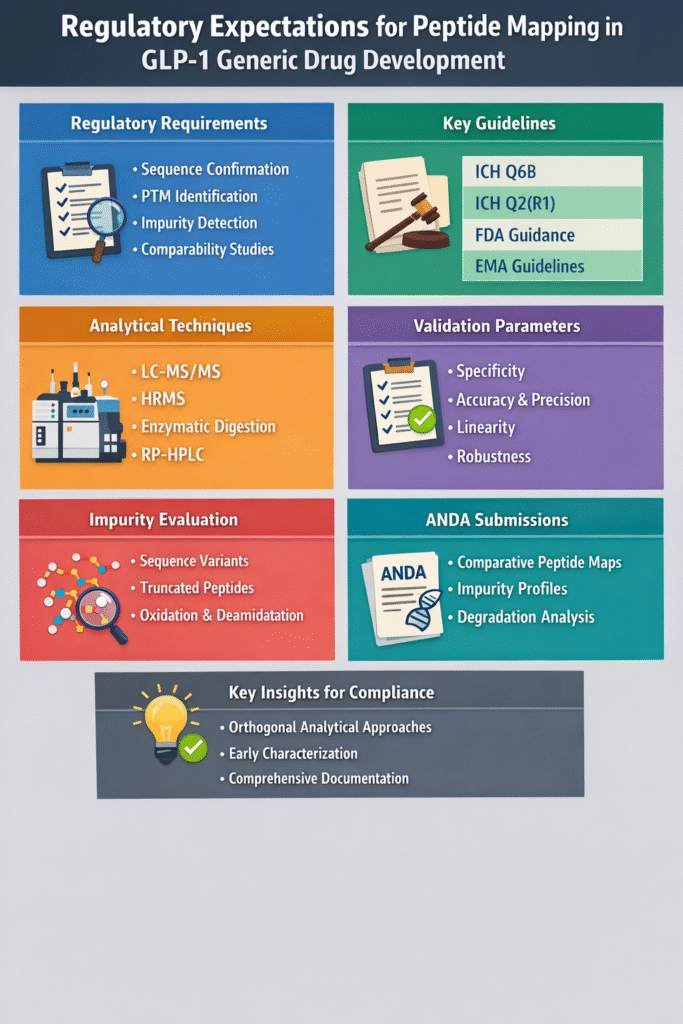
Regulators expect peptide mapping to confirm structure and detect impurities. This is typically achieved using peptide sequencing of GLP-1 peptide and GLP-1 sequence variant analysis.
Key Expectations:
- Sequence Confirmation:
Verification of the complete amino acid sequence to ensure structural identity with the reference product.
Sequence Confirmation using peptide sequencing of GLP-1 drugs - Post-Translational Modifications (PTMs):
Identification of modifications such as oxidation, deamidation, and other chemical changes that may impact stability or activity.
PTM Identification supported by GLP-1 peptide sequencing analytical technique - Impurity Detection:
Identification and quantification of sequence variants, truncated peptides, and degradation products.
Impurity Detection via GLP-1 peptide impurity characterization - Comparability Studies:
Direct comparison of peptide maps between the generic and the reference listed drug (RLD) to demonstrate equivalence.
Comparability Studies using GLP-1 peptide mapping vs intact mass
Why It Matters:
- Ensures Therapeutic Equivalence:
Confirms that the generic GLP-1 peptide performs the same biological function as the innovator drug. - Minimizes Immunogenicity Risks:
Detects structural variations that could trigger unwanted immune responses in patients. - Supports Regulatory Approval:
Provides critical analytical evidence required for IND and ANDA submissions, reducing the risk of delays or rejection.
2: Which Regulatory Guidelines Govern Peptide Mapping?
Peptide mapping must comply with globally accepted regulatory guidelines that define analytical, quality, and comparability expectations for GLP-1 peptide drugs. These frameworks ensure that peptide characterization is scientifically robust and acceptable for regulatory submissions.
Peptide mapping must align with global expectations supported by regulatory requirements for GLP-1 peptide characterization and GLP-1 peptide characterization regulatory requirements.
Key Regulatory Frameworks:
| Guideline | Purpose |
|---|---|
| ICH Q6B | Defines specifications and acceptance criteria for biotechnological/biological products |
| ICH Q2(R1) | Establishes requirements for analytical method validation |
| ICH Q5E | Provides guidance on comparability of biotechnological products |
| FDA Guidance | Outlines requirements for ANDA submissions of peptide-based drugs |
| EMA Guidelines | Covers biosimilar and peptide drug development expectations |
Regulatory Insight:
Regulatory authorities expect the use of orthogonal analytical approaches—this means peptide mapping alone is not sufficient. It should be complemented with additional techniques such as:
- Intact Mass Analysis for molecular weight confirmation
- Chromatographic Methods (HPLC) for purity assessment
- Bioanalytical Assays for functional evaluation
This multi-technique strategy enhances confidence in structural characterization and ensures compliance with GLP-1 Peptide Mapping Regulatory Requirements.
This is further supported by workflows like GLP-1 analog peptide sequencing workflow.
3: What Analytical Techniques Are Required?
Regulators require high-resolution, sensitive, and reproducible analytical techniques to ensure accurate peptide mapping of GLP-1 drugs. These methods must reliably identify sequence, detect impurities, and characterize structural modifications in line with GLP-1 Peptide Mapping Regulatory Requirements.
Commonly Accepted Techniques:
- LC-MS/MS (Liquid Chromatography–Tandem Mass Spectrometry)→ LC-MS characterization of GLP-1 peptides:
The gold standard for peptide mapping, enabling detailed sequence analysis and precise identification of modifications. - High-Resolution Mass Spectrometry (HRMS)→ HRMS peptide mapping GLP-1:
Provides accurate mass measurements for confirming molecular composition and detecting subtle structural differences. - Enzymatic Digestion (Trypsin, Glu-C)→ GLP-1 enzymatic digestion mapping:
Breaks down the peptide into smaller fragments, allowing site-specific analysis and improved sequence coverage. - Reverse-Phase HPLC:
Separates peptide fragments based on hydrophobicity, supporting purity assessment and peak resolution prior to MS detection.
To overcome analytical complexity, challenges are addressed through GLP-1 peptide sequencing challenges and de novo GLP-1 peptide sequencing accuracy.
Key Capabilities Required by Regulators:
- High Sensitivity for Low-Level Impurities:
Detection of trace impurities and sequence variants that may impact safety or efficacy. - Accurate Mass Measurement:
Ensures precise identification of peptide fragments and confirmation of molecular weight. - Site-Specific Modification Detection:
Enables localization of post-translational modifications such as oxidation or deamidation within the peptide sequence.
4: How Should Peptide Mapping Methods Be Validated?
Peptide mapping methods must be thoroughly validated to demonstrate they are fit for their intended regulatory purpose, ensuring reliable, reproducible, and accurate characterization of GLP-1 peptides in compliance with GLP-1 Peptide Mapping Regulatory Requirements.
Validation aligns with regulatory expectations and is strengthened by:
- Analytical characterization of GLP-1 peptide drugs
- CRO support via CRO for GLP-1 peptide characterization
Critical Validation Parameters:
- Specificity:
The method must clearly distinguish the target GLP-1 peptide from impurities, degradation products, and closely related variants. - Accuracy:
Ensures correct identification of amino acid sequences and modifications, typically verified using reference standards or spiked samples. - Precision:
Demonstrates reproducibility across multiple runs, analysts, instruments, and days (intra- and inter-day variability). - Linearity:
Confirms that the analytical response is directly proportional to peptide concentration over a defined range. - Robustness:
Evaluates method reliability under small variations in conditions such as pH, temperature, mobile phase composition, and digestion parameters.
Regulatory Expectation:
Validation must strictly comply with ICH Q2(R1) guidelines and include comprehensive, well-documented evidence. Regulatory agencies expect:
- Full data integrity and traceability
- Clearly defined acceptance criteria for each parameter
- Detailed validation protocols and reports
- Demonstration of method suitability for intended use
Companies often outsource GLP-1 peptide sequencing services to ensure compliance and reproducibility.
A well-validated peptide mapping method not only ensures compliance but also strengthens the overall analytical package, significantly improving the chances of successful IND and ANDA approvals.
5: What Role Does Peptide Mapping Play in ANDA Submissions?
Peptide mapping plays a critical role in ANDA submissions by demonstrating structural equivalence with the reference listed drug (RLD). It provides the analytical evidence required to prove that the generic GLP-1 peptide matches the innovator product in identity, purity, and quality—core to GLP-1 Peptide Mapping Regulatory Requirements.
This is achieved using:
Key Contributions:
- Confirms Structural Sameness:
Verifies that the amino acid sequence and molecular structure of the generic peptide are identical to the reference product. - Supports Bioequivalence Claims:
While pharmacokinetic studies are essential, peptide mapping strengthens the overall case by confirming molecular-level similarity. - Identifies Critical Quality Attributes (CQAs):
Helps define and monitor attributes such as sequence integrity, impurity levels, and post-translational modifications that impact product quality and performance.
Required Data for ANDA Submissions:
- Comparative Peptide Maps:
Side-by-side analysis of generic and reference products to demonstrate high similarity in fragmentation patterns and sequence coverage. - Impurity Profiles:
Detailed identification and quantification of impurities, including sequence variants and degradation products. - Degradation Pathway Analysis:
Evaluation of how the peptide degrades under stress conditions, ensuring comparable stability profiles between generic and reference products.
Regulatory agencies rely heavily on this data to assess analytical similarity and risk, making peptide mapping a cornerstone of successful ANDA approvals for GLP-1 generics.
6: How Are Impurities and Variants Evaluated?
Regulators require comprehensive identification, quantification, and risk assessment of impurities and sequence variants to ensure the safety and quality of GLP-1 peptide drugs. This is a critical component of GLP-1 Peptide Mapping Regulatory Requirements, as even minor variations can impact efficacy or immunogenicity.
Types of Impurities:
- Sequence Variants:
Amino acid substitutions or misincorporations that alter the primary structure. - Truncated Peptides:
Shortened sequences resulting from incomplete synthesis or degradation. - Oxidized or Deamidated Forms:
Chemical modifications (e.g., methionine oxidation, asparagine deamidation) that may affect stability and biological activity.
Evaluation Strategy:
- Identification:
Performed using MS/MS fragmentation, which provides detailed structural information and enables precise localization of modifications within the peptide sequence. - Quantification:
Determined by measuring the relative abundance of each impurity compared to the main peptide, often using extracted ion chromatograms. - Toxicological Assessment:
Each impurity is evaluated for potential safety risks, including immunogenicity and toxicity, based on regulatory thresholds and scientific justification.
Advanced impurity profiling uses:
Key Insight
Regulatory agencies expect that even trace-level impurities are fully characterized and scientifically justified. Failure to adequately assess and report these impurities is a common reason for regulatory delays or rejection.
A robust impurity evaluation strategy not only ensures compliance but also strengthens the overall quality profile of the GLP-1 generic product, supporting smoother regulatory approval pathways.
7: Are Common Regulatory Deficiencies?
Regulatory deficiencies in peptide mapping arise when studies are incomplete, poorly validated, or lack sufficient analytical depth, leading to delays or rejection of GLP-1 generic submissions under GLP-1 Peptide Mapping Regulatory Requirements.
Common failures often stem from poor analytical depth. These can be avoided by leveraging:
- GLP-1 peptide sequencing CRO services
- Standardized workflows like GLP-1 analog peptide sequencing workflow
Frequent Issues:
- Inadequate Sequence Coverage:
Failure to achieve high (>95%) sequence coverage raises concerns about undetected modifications or variants. - Lack of Method Validation:
Absence of proper validation (as per ICH Q2(R1)) undermines data reliability and regulatory acceptance. - Missing Impurity Characterization:
عدم identification and quantification of impurities, including trace-level variants, is a major red flag. - Poor Data Reproducibility:
Inconsistent results across runs, instruments, or analysts reduce confidence in the analytical method. - Insufficient Comparability Data:
Lack of robust side-by-side comparison with the reference product weakens claims of equivalence.
How to Avoid These Deficiencies:
- Start Characterization Early:
Early-stage peptide mapping helps identify risks before regulatory submission. - Use Validated and Standardized Methods:
Implement robust, regulatory-compliant analytical workflows. - Maintain Comprehensive Documentation:
Ensure all experimental procedures, validation data, and results are well-documented and audit-ready.
Addressing these common gaps proactively strengthens the analytical package, enhances regulatory confidence, and significantly improves the chances of successful IND and ANDA approvals.
8: Why Early Peptide Mapping Is Critical in GLP-1 Development
Early peptide mapping is essential because it identifies structural risks and analytical gaps before they escalate into regulatory hurdles, ensuring smoother development aligned with GLP-1 Peptide Mapping Regulatory Requirements.
Early mapping reduces risk and improves outcomes using:
Benefits of Early Peptide Mapping:
- Reduces IND and ANDA Rejection Risks:
Early detection of sequence deviations, impurities, and stability issues minimizes the chances of regulatory delays or deficiencies. - Enables Robust Process Development:
Provides critical insights into how manufacturing conditions impact peptide structure, allowing optimization of synthesis and purification processes. - Improves Product Consistency:
Ensures batch-to-batch reproducibility by identifying variability early and controlling critical quality attributes (CQAs).
Strategic Advantage
Companies that invest in peptide mapping at the early stages of development gain a significant competitive edge:
- Stronger regulatory confidence and data integrity
- Faster and smoother regulatory approvals
- Reduced need for rework and repeat studies
- Lower overall development costs
9: Best Practices for Meeting Regulatory Expectations
To align with GLP-1 Peptide Mapping Regulatory Requirements, companies should follow these best practices:
Recommended Approach:
- Use high-resolution LC-MS/MS platforms
- Ensure >95% sequence coverage
- Perform forced degradation studies
- Apply orthogonal analytical techniques
- Maintain audit-ready documentation
Workflow Overview:
- Sample preparation
- Enzymatic digestion
- LC-MS/MS analysis
- Data processing and interpretation
- Validation and reporting
For full-service support, companies partner with CRO for GLP-1 peptide characterization.
Conclusion:
GLP-1 Peptide Mapping Regulatory Requirements are a cornerstone of successful generic drug development. By integrating advanced analytical techniques, validated workflows, and expert support such as outsource GLP-1 peptide sequencing services, companies can ensure compliance, accelerate approvals, and deliver high-quality peptide therapeutics.
Organizations that prioritize early characterization, robust analytical methods, and regulatory compliance are far more likely to achieve successful IND and ANDA approvals. Peptide mapping is no longer optional—it is a critical regulatory expectation that defines the success of GLP-1 generic programs.
Frequently Asked Questions:
GLP-1 Peptide Mapping Regulatory Requirements refer to the analytical and validation standards set by regulatory agencies to confirm the identity, purity, and structural integrity of GLP-1 peptide drugs. These requirements ensure that generic products match the reference drug in sequence and quality. They also include impurity profiling and comparability studies. Compliance is essential for IND and ANDA approvals.
Peptide mapping is critical because it verifies the amino acid sequence and detects structural modifications or impurities. This ensures biosimilarity between the generic and reference product. It also helps identify risks related to immunogenicity and stability. Regulatory agencies rely on this data to assess product safety and efficacy.
Peptide mapping must comply with guidelines such as ICH Q6B, ICH Q2(R1), and ICH Q5E, along with FDA and EMA recommendations. These frameworks define requirements for analytical validation, product specifications, and comparability studies. They ensure that peptide characterization is scientifically sound and reproducible. Following these guidelines is mandatory for regulatory submissions.
Common techniques include LC-MS/MS, high-resolution mass spectrometry (HRMS), enzymatic digestion, and reverse-phase HPLC. LC-MS/MS is considered the gold standard due to its sensitivity and accuracy. These methods enable detailed sequence analysis and impurity detection. Often, multiple techniques are combined for comprehensive characterization.
Peptide mapping is validated based on parameters like specificity, accuracy, precision, linearity, and robustness. Validation must follow ICH Q2(R1) guidelines and include documented evidence. Regulatory agencies expect full data integrity, reproducibility, and defined acceptance criteria. Proper validation ensures the method is reliable for its intended purpose.
Peptide mapping demonstrates structural equivalence between the generic and reference listed drug. It supports bioequivalence by confirming molecular similarity. The data helps identify critical quality attributes and impurity profiles. This makes it a key requirement for successful ANDA approval.
Impurities are identified using MS/MS fragmentation, which provides detailed structural information. They are quantified based on their relative abundance compared to the main peptide. Common impurities include sequence variants, truncated peptides, and oxidized forms. Each impurity must be evaluated for safety and regulatory acceptance.
Reference
- Alhiary R, Kesselheim AS, Gabriele S, Beall RF, Tu SS, Feldman WB. Patents and regulatory exclusivities on GLP-1 receptor agonists. Jama. 2023 Aug 15;330(7):650-7.https://jamanetwork.com/journals/jama/article-abstract/2808050
- Madny MA, Murthy A. From Venom‐to‐Vial‐to‐Pill: The Translational Journey of GLP‐1 Peptides and the Evolving Landscape of Biopharmaceutics Modeling. Journal of peptide science. 2026;32(4):e70092.https://onlinelibrary.wiley.com/doi/abs/10.1002/psc.70092
- De Groot AS, Mattei A, Gabriel B, Calderini J, Roberts BJ, Lelias S, McAllister M, Boyle C, Martin W, Richard G. Immunogenicity of generic peptide impurities: current orthogonal approaches. Pharmaceutical research. 2025 May;42(5):805-18.https://link.springer.com/article/10.1007/s11095-025-03843-1
- Wen J, Razick A, How‐Volkman C, Bernstein E, Nadora D, Truong A, Razick D, Akhtar M, Karabala M, Frezza E. An exploratory analysis of glucagon‐like peptide‐1 (GLP‐1) agonists and biosimilars: A literature review. Diabetes, Obesity and Metabolism. 2025 Mar;27(3):1113-22.https://dom-pubs.onlinelibrary.wiley.com/doi/abs/10.1111/dom.16110
About the Author


